
Many people have asked me the same question over the past several years: How do we wake people up to what is happening in this country and throughout the Western world?
I recently discussed the question during a telephone call with my friend Paul in British Columbia. The more we talked, the more convinced I became that waking people up is no longer a realistic objective. You cannot force someone to recognize a danger they are emotionally committed to denying, particularly when acknowledging it would require them to reconsider their politics, their institutions, their friendships and perhaps their understanding of themselves.
Trying to awaken such a person can become remarkably similar to trying to convince a drug addict to seek help. Families can plead, reason, present evidence, describe the damage and warn about what will happen next, but the addict must eventually recognize his own rock bottom. Some people recognize it before losing everything. Others continue until their health, family, employment and dignity have been destroyed, while a few never recognize it at all.
Political denial works in much the same way.
People can watch their standard of living deteriorate while insisting the economy is strong. They can lose confidence in the justice system while repeating that our institutions remain beyond question. They can see government spending, taxation, censorship, social division and bureaucratic control expanding around them, yet attack anyone who points out where the road may lead.
The evidence is often sitting directly in front of them, but accepting it would be uncomfortable. Denial allows them to remain respectable within the approved social order, while acknowledging the danger might require courage, independence and the possibility of being disliked.
For many people, remaining comfortable today is more important than preventing a catastrophe tomorrow.
Yuri Bezmenov, the Soviet propagandist who defected to the West, described what happens when a population has been ideologically demoralized. He warned that exposure to truthful information would eventually stop being enough because a demoralized person could lose the ability, or perhaps the willingness, to evaluate evidence honestly.
Documents, photographs, testimony and firsthand evidence could be placed in front of such a person, yet the person would continue refusing to believe what was happening. Bezmenov said that even taking someone to the Soviet Union and showing them the reality of a concentration camp might not be enough. Recognition would arrive only when the system delivered a sufficiently painful personal blow.
His warning is often paraphrased by saying that a demoralized person would continue denying reality even while being loaded into a boxcar. Whether or not those were his exact words, the meaning remains unmistakable: many people will defend an abusive system until the door closes behind them.
Bezmenov also warned about the fate of activists, intellectuals and political idealists who help revolutionary systems acquire power. They imagine that their loyalty will earn them influence in the society that follows. In reality, once they have served their purpose, they may become a liability.
The people who enthusiastically denounced their neighbours, demanded greater control, excused government abuses and attacked anyone resisting the transformation can eventually discover that the new system has no permanent use for them. Their value existed only while they were helping it consolidate power.
Once that power has been secured, their idealism becomes dangerous because they begin expecting the promised paradise. When they realize they were manipulated, they become angry. They complain that the revolution was betrayed, that the wrong people are in charge or that the system was never supposed to operate this way.
The government they empowered will have little interest in listening to their sense of betrayal. Disillusioned former supporters can become more threatening than long-standing opponents because they understand the movement’s language, methods and internal contradictions. Bezmenov warned that yesterday’s useful supporters could be imprisoned, exiled or eliminated after becoming expendable.
They believed they were building the future, only to discover that they had helped build their own irrelevance.
There is a historical truth people remain strangely unwilling to confront: The greatest mass murders in human history have always been the governments of the very people they murdered.
The victims were rarely strangers to the state. They were citizens, neighbours, workers, farmers, families and political opponents who had been disarmed, dehumanized, isolated or declared inconvenient by their own institutions.
Despite that history, millions of people continue to believe their government would never knowingly deceive them, abuse its authority or sacrifice ordinary citizens to protect political power. Even after COVID-19, as more information emerges about government secrecy, coercion, censorship, institutional conflicts and the suppression of legitimate questions, many people still cling to the belief that serious government misconduct could never happen here.
They may admit that governments have lied throughout history while insisting their government would never lie now. They acknowledge that other populations were manipulated, while imagining themselves too intelligent to be manipulated. They understand that previous generations surrendered freedom through fear, propaganda and social pressure, yet remain convinced that their own obedience was informed, virtuous and entirely voluntary.
History does not justify such confidence.
Governments are made up of human beings, and human beings remain vulnerable to ambition, cowardice, greed, ideology, self-preservation and the desire to avoid accountability. Giving those people more power does not make them more trustworthy. It increases the damage they can cause before the public finally decides to stop believing them.
A few years ago, someone asked me what the greatest lesson of COVID-19 had been for me. My answer had very little to do with masks, vaccines or public-health policy. It concerned human nature.
Before COVID-19, I believed history had taught us enough to recognize how ordinary people become participants in authoritarian systems. I thought I knew which people would have resisted the Nazis and which people would have quietly fallen into line.
COVID-19 forced me to reconsider almost every assumption I had made.
Many of the people I once imagined would have resisted authoritarianism proved remarkably willing to obey, condemn their neighbours, demand punishment for dissent and excuse the suspension of basic rights whenever authority told them it was necessary. And they had the absolute benefit of history!
Perhaps the most disturbing part was watching millions of people believe an anchorman on television, a man who had no idea they even existed, over their own flesh-and-blood relatives. People dismissed parents, children, siblings and lifelong friends because the person reading from a teleprompter carried the approval of government and large institutions. I heard these stories repeatedly, and I experienced them firsthand.
Some of the people who behaved this way were my friends. Some were fellow soldiers with whom I had served, people who had sworn an oath and whom I had assumed understood the danger of unquestioned power.
I do not say that lightly.
Military service teaches us to obey lawful orders, but it should also teach us that responsibility cannot be surrendered to authority. History is filled with people who defended their actions by claiming they had merely followed orders, trusted their leaders or believed the experts of their time.
At the same time, people I had never expected to resist stood their ground with extraordinary courage. They accepted ridicule, professional consequences, damaged relationships and social exclusion rather than surrender their judgment or participate in something they believed was wrong.
The experience was deeply unsettling because people do not reveal their true relationship with authority when resistance is theoretical and safely confined to a history book. They reveal it when obedience is rewarded, dissent is punished and the personal cost of saying no becomes real.
COVID-19 showed me that many people who confidently believe they would have resisted the authoritarian movements of the past would probably have complied, rationalized and cooperated. It also showed me that some of the quietest and least celebrated people among us would have held their ground.
The people I believed would have resisted the Nazis often proved that they would have fallen into line, while some of the people I had underestimated showed that they possessed the courage to stand alone.
That realization changed the way I looked at friends, colleagues, institutions and even people with whom I had served.
The title of this article comes from something my wife, Joanna, experienced as a young girl in Communist Poland.
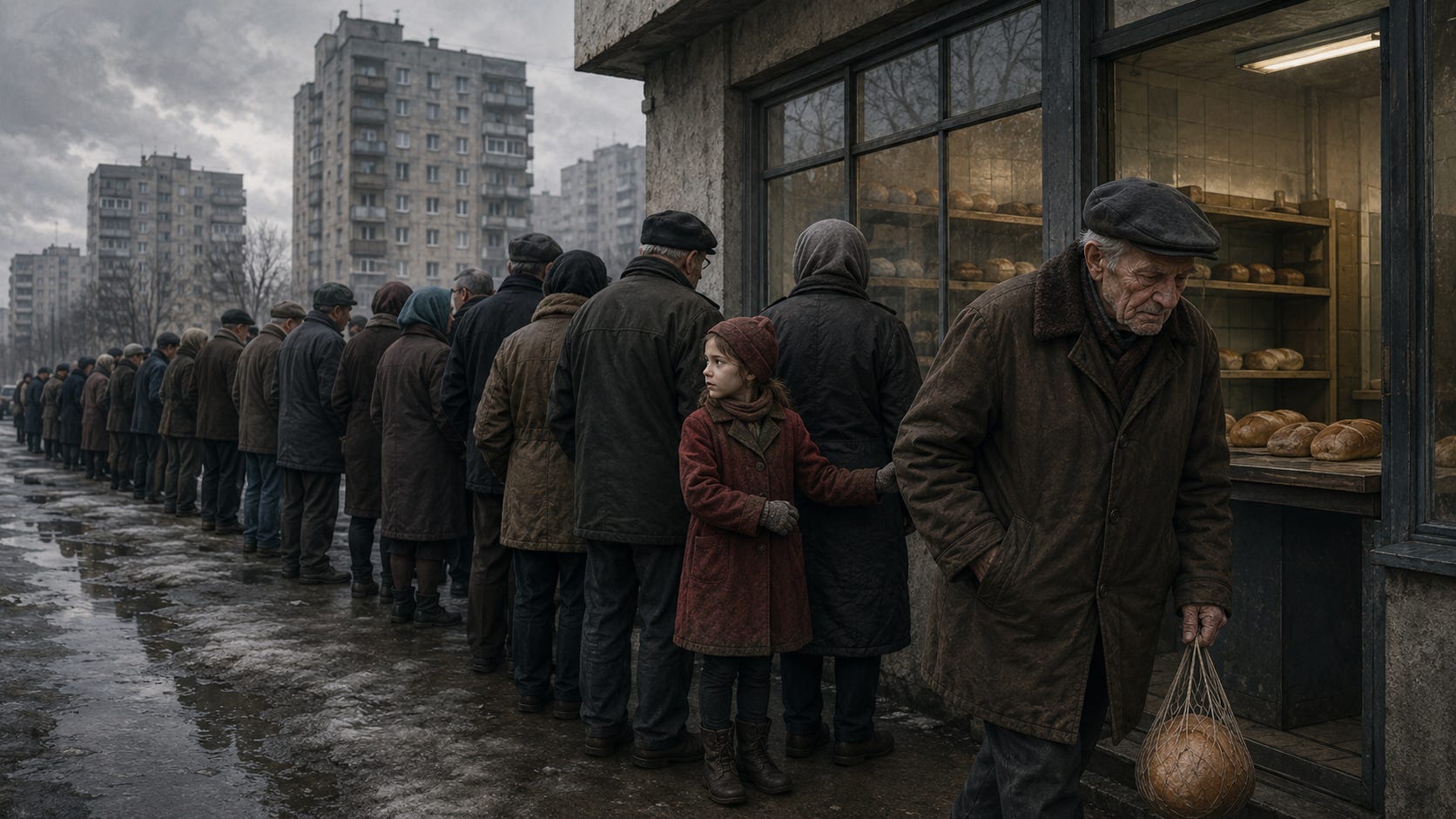
Her grandfather would stand in line outside a store, sometimes for hours, waiting for a new shipment. At some point, Joanna would be sent to relieve him so that he could go home, eat something and rest. She would hold his place until he returned.
What makes the story difficult for people raised in relative prosperity to understand is that those waiting often did not know what the store had received. Nobody was lining up because a particular advertised product had gone on sale. They were lining up because something had arrived, and whatever it was might be scarce enough to justify sacrificing most of the day for the opportunity to buy it.
Perhaps the shipment contained food. Perhaps it contained household supplies, clothing or some other basic item people could not reliably obtain. The specific product was almost beside the point. Scarcity had trained everyone to join the line first and ask questions later.
Imagine surrendering an entire day because a truck arrived at a store, sending a child to hold your place while you went home to eat, and still having no certainty that anything would remain when your turn finally came.
Most Canadians cannot imagine living that way because our abundance has convinced us that abundance is natural. Grocery stores remain full, electricity usually works, fuel is normally available and necessities can still be purchased with relatively little effort. Even when prices rise, most people assume the shelves will remain stocked and the systems around them will continue functioning.
Prosperity has allowed people to treat warnings about government incompetence, economic decline and ideological control as abstract political disagreements. They can dismiss concerns because dinner is still on the table, entertainment is still streaming and a package ordered online will probably arrive tomorrow.
History shows that none of those conveniences is guaranteed.
Political deterioration rarely announces itself with a dramatic declaration that freedom has ended. It advances through smaller concessions that individually appear survivable.
People accept new taxes because each increase is presented as modest. They tolerate new restrictions because each one is described as temporary or necessary. They watch governments assume emergency powers and trust that those powers will be surrendered voluntarily. They accept censorship because the first people silenced hold unpopular opinions. They ignore political prosecutions because they dislike the accused.
Every compromise becomes the precedent for the next one.
During this process, the public continues adjusting its expectations downward. Food becomes more expensive, housing moves further beyond reach, public services become less reliable and personal independence becomes more difficult, yet the population adapts. People work longer, borrow more, own less and postpone important parts of life while governments congratulate themselves for managing the decline.
The bread lines do not appear at the beginning. They appear after years of warnings were mocked, elections were treated as entertainment, dissenters were smeared and citizens decided that paying attention was someone else’s responsibility.
By the time shortages become severe enough to awaken the comfortable, the institutions capable of correcting the problem may already have been weakened, politicized or captured.
I no longer believe our responsibility is to spend every waking hour trying to persuade people who are determined not to listen.
We should continue speaking truthfully, documenting what is happening, building alternatives, preparing our families and supporting those willing to defend their communities. We should remain available to people who ask sincere questions, particularly those beginning to recognize the contradictions around them.
Endless arguments with people who treat denial as a moral virtue accomplish very little. Some will only reconsider their beliefs when their savings disappear, their employment becomes insecure, their children lose opportunities or the grocery shelves no longer contain what their family needs.
Their political awakening may not begin with a book, a speech, a court decision or a carefully researched article. It may begin in a line outside a store, waiting for a shipment nobody can identify.
When that day comes, I do not want to hear anyone ask why nobody tried to stop it.
People did try.
They spoke publicly while others remained silent. They protested while others mocked them. They lost jobs, reputations, friendships, bank accounts and opportunities because they refused to pretend that everything was normal. They warned about expanding government power, collapsing accountability, economic recklessness and the erosion of civil liberties.
Many of the people who will eventually ask why nobody acted were not merely inattentive. Some actively stood in the way. They ridiculed those sounding the alarm, repeated government talking points, demanded punishment for dissenters and treated obedience as evidence of superior character.
When the consequences finally reach them, they may sincerely believe nobody warned them because admitting otherwise would require acknowledging their own role.
I will have very little patience for that performance.
Nobody can honestly claim there were no warnings. The warnings were everywhere. The problem was that too many people refused to listen because listening would have disturbed their comfort.
Eventually, discomfort will arrive without asking their permission.
Perhaps the awakening will begin when the mortgage cannot be renewed, when the power bill becomes impossible to pay or when a parent discovers that a full-time job no longer provides enough food for the family. Perhaps it will begin when government controls once directed at political enemies are turned against yesterday’s supporters.
For some, it will begin only when the bread lines start.
By then, the question will no longer be how to wake people up. The question will be whether enough awake people prepared in time to rebuild what everyone else allowed to be destroyed.
My book, The People’s Emergency Act: Freedom Convoy 2022, is a firsthand account of what I witnessed and helped organize in Ottawa, including the courage of ordinary Canadians who stood their ground when government power was turned against them. Buy it here!
My second book, The People’s Emergency Plan: A Civilian Guide to Structured Emergency Planning, provides individuals and families with a practical framework for identifying risks, establishing priorities and preparing a written emergency plan before a crisis arrives. Find it here!
One book documents what happened when Canadians were forced to confront government overreach. The other helps people prepare for whatever may come next.
Comments
Nothing yet. Say the first thing.
Sign in to join the conversation.