
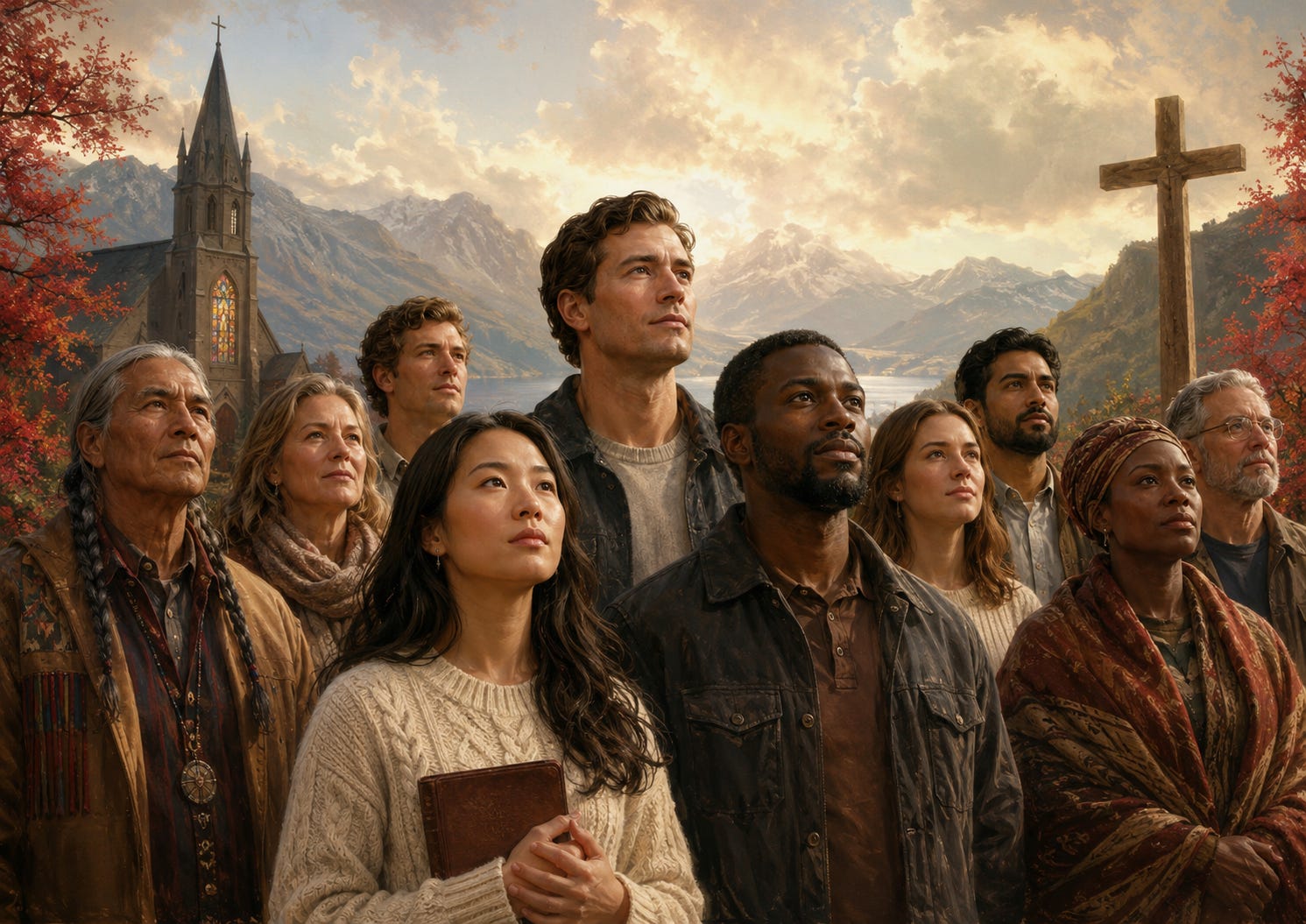
This week, I had a conversation with Derek Sloan in which the subject of Christian nationalism came up. Later, I found myself discussing many of the same ideas with Eddie Cornell and Andrew McGillivray. Derek also told me about a book written by our friend David Haskell called Christ or Collapse, a title that captures the seriousness of the cultural choice now facing Western countries.
The phrase “Christian nationalism” immediately makes some people uncomfortable, partly because nationalism has been deliberately associated with racial politics. Mention national identity, cultural preservation or the defence of Western heritage, and someone will inevitably introduce the term “white nationalism.” Once race has been inserted into the discussion, every other consideration becomes secondary. Faith, history, culture, family, morality and civic responsibility are pushed aside while the conversation becomes an argument about skin colour.
This framing is both dishonest and self-defeating.
A movement built around whiteness can only divide people according to ancestry. It tells Christians of different ethnic backgrounds that, regardless of what they believe or how deeply they share the same values, they can never truly belong. It replaces a potentially broad brotherhood with an exclusive racial club and then seems surprised when the movement becomes smaller, weaker and easier to dismiss.
Christian nationalism, properly understood, offers the opposite approach. It creates unity around faith, morality, culture and a shared responsibility to preserve the civilization we have inherited. Christianity does not belong to one race, one country or one ethnic group. A Christian from Africa, Asia, Europe, Latin America or the Middle East can share the same faith, moral commitments and understanding of human dignity. They may speak different languages, eat different foods and come from very different family histories, but their beliefs can still unite them more powerfully than race divides them.
A person does not need to share my ancestry to share my principles. He does not need to look like me to stand beside me in defence of family, faith, freedom, responsibility and the dignity of the individual. If we agree that our society is worth preserving, and if we are prepared to accept the duties that come with belonging to it, then we already have more in common than a racial nationalist could ever recognize.
Andrew’s participation in our conversation was particularly valuable because he is an atheist. He was not defending Christianity because he personally believes in God, nor was he attempting to promote his own religious identity. He was looking at the practical consequences of organizing a society around Christian values rather than racial identity.
Andrew agreed that Christian nationalism is far more inclusive than white nationalism. It preserves human dignity because it judges people according to their character, conduct, values and commitments rather than the colour of their skin. It also creates the possibility of a much larger and more durable cultural movement. Obsessing over whiteness immediately excludes millions of people who may already agree on the importance of strong families, personal responsibility, freedom of conscience, respect for tradition, public order and the protection of children.
A fixation on racial purity does not preserve a civilization. It gradually destroys the coalition required to defend one.
Andrew also agreed that the most successful countries in the modern Western world were built upon moral foundations heavily shaped by Christianity. Even atheists remain direct beneficiaries of this inheritance. Canadians enjoy a society in which the individual is understood to possess inherent dignity, where the vulnerable are deserving of compassion, where power is expected to be restrained, where forgiveness is considered a virtue and where government is not supposed to be the ultimate source of moral truth.
Many Canadians now treat these ideas as though they appeared naturally, perhaps emerging from the soil alongside maple trees and universal health care. They assume these values are simply the default condition of an advanced society and will continue indefinitely, even after the religious and cultural foundations beneath them have been removed.
History offers little support for such confidence.
The moral equality of human beings was not universally accepted throughout history. Neither were the ideas that rulers should be restrained, the weak should be protected, charity should be encouraged, conscience should be respected and every individual possesses value beyond his economic usefulness or political power. These principles were strengthened and embedded in Western culture through centuries of Christian thought, practice, conflict and reform.
Christians have often failed to live up to those principles. Churches, governments and individuals have all acted hypocritically, cruelly or corruptly while claiming Christian authority. Human beings possess a remarkable ability to corrupt almost any institution they control, including religious ones. Yet hypocrisy does not disprove the value of the principle being violated. A corrupt judge does not prove that justice is worthless, just as a dishonest pastor does not prove that Christian morality contributed nothing to our civilization.
The more important question concerns what happens when the moral framework itself is abandoned.
A society cannot remove the foundations of its moral order while assuming the structure above will remain standing forever. People may continue using words such as dignity, equality, compassion, rights and justice, but those words gradually become political slogans rather than principles grounded in something higher than government preference. When there is no higher moral authority, the state eventually becomes the institution that defines what is good, who deserves protection and which rights remain convenient.
Those decisions rarely end well.
Christian nationalism, as I understand it, does not require forced conversion, government-controlled churches or religious tests for citizenship. It does not require the removal of civil rights from atheists, Muslims, Jews, Hindus or anyone else. Nor does it mean that clergy should control Parliament or that every provision of modern law should be taken directly from Scripture.
The purpose is to preserve a culture shaped by Christian morality and to acknowledge honestly where many of our most important principles came from. A country should be permitted to honour its history, defend its moral inheritance and expect newcomers to respect the culture they have chosen to join. Welcoming people from other nations does not require Canadians to erase their own identity before anyone arrives.
Real inclusion also requires something more substantial than placing different racial groups in the same geographic area and calling the result diversity. A stable country needs shared values, mutual obligations and a common understanding of what citizenship requires. Without those things, multiculturalism can easily become a collection of competing communities living beside one another while demanding recognition, resources and political influence from the same government.
Christian brotherhood offers a better foundation because it crosses ethnic boundaries without pretending those differences do not exist. It allows people to preserve their family traditions while joining a larger moral community. It provides a shared language of duty, sacrifice, forgiveness, service and responsibility. Most importantly, it reminds us that every human being possesses dignity because human worth does not depend upon race, wealth, intelligence, status or political usefulness.
White nationalism cannot make the same promise. Its entire structure depends upon exclusion. Even among white people, it eventually becomes consumed by arguments over who qualifies, whose ancestry is acceptable and which European heritage deserves priority. A movement that begins by dividing humanity according to race will eventually divide its own supporters according to increasingly narrow definitions of belonging.
Christianity begins from a different premise. Human beings possess value because they were created by God, and Christians are instructed to treat one another as brothers and sisters in faith. The Church has existed among countless nations and ethnic groups, often adapting to local cultures while preserving its central beliefs. Christianity therefore provides a framework capable of uniting people without requiring them to share a bloodline.
Critics will still insist that Christian nationalism is merely white nationalism carrying a Bible. In some cases, people may indeed use Christian language to disguise racial hostility, and Christians should be the first to reject that manipulation. Allowing racists to define Christian nationalism, however, would be as foolish as allowing corrupt politicians to define democracy.
Christians should not surrender their faith, history or cultural inheritance because someone else has attached an accusation to the word “nationalism.” Nor should they permit their concern for their country to be reduced to an obsession with race. The stronger and more defensible position is a nationalism based upon shared moral commitments, cultural continuity, service to one another and respect for human dignity.
The future of Canada will not be secured by convincing white people to become more preoccupied with being white. It will be secured by bringing Canadians of every ethnicity together around principles worth defending. Christianity provides such a foundation because it asks more of people than racial loyalty. It demands responsibility, sacrifice, forgiveness, courage, charity, restraint and service.
An atheist can benefit from those values without accepting the theology behind them. Andrew understands this, which is why his agreement carried particular weight in our conversation. He does not need to become a Christian to recognize that Canada’s Christian inheritance has benefited him, just as it has benefited millions of people who rarely enter a church.
The real choice is not between a white Christian Canada and a diverse secular Canada. The more important choice is between a country united by a durable moral framework and one divided into racial, ideological and political factions competing for control.
Christian nationalism can become a brotherhood of faith, values and shared national responsibility, open to people of every ethnicity who are prepared to respect and preserve the culture they have inherited or chosen to join. It can defend our history without worshipping ancestry, welcome newcomers without erasing our identity and preserve human dignity without reducing anyone to the colour of his skin.
A civilization cannot survive by being embarrassed about its foundations. Canada will either recover the confidence to defend the values that made it successful, or it will continue enjoying the fading benefits of an inheritance it no longer understands.
David Haskell’s title presents the question bluntly: Christ or Collapse.
We should at least have the courage to discuss the choice honestly.
A Note About My Book
In The People’s Emergency Act: Freedom Convoy 2022, I wrote about what happens when government power, public fear and institutional pressure collide with individual conscience. The book documents the Convoy from the perspective of someone who was there and examines the values of courage, faith, freedom and personal responsibility that brought ordinary Canadians together.
Comments
Nothing yet. Say the first thing.
Sign in to join the conversation.