
Authors’ Note: this is the latest in an occasional series that profiles the cases of citizens who were treated as “second class” by local public officials. These are ordinary people who received uncalled for treatment from The Local Establishment. In their stories, readers will find essential insight into local civics that no classroom instruction can deliver. For the other posts in this series, see the Links section.
This post challenges that theory. We further argue that public officials too often substitute their personal moral convictions for the legal foundations they operate under. Good governance depends on officials recognizing this critical difference.
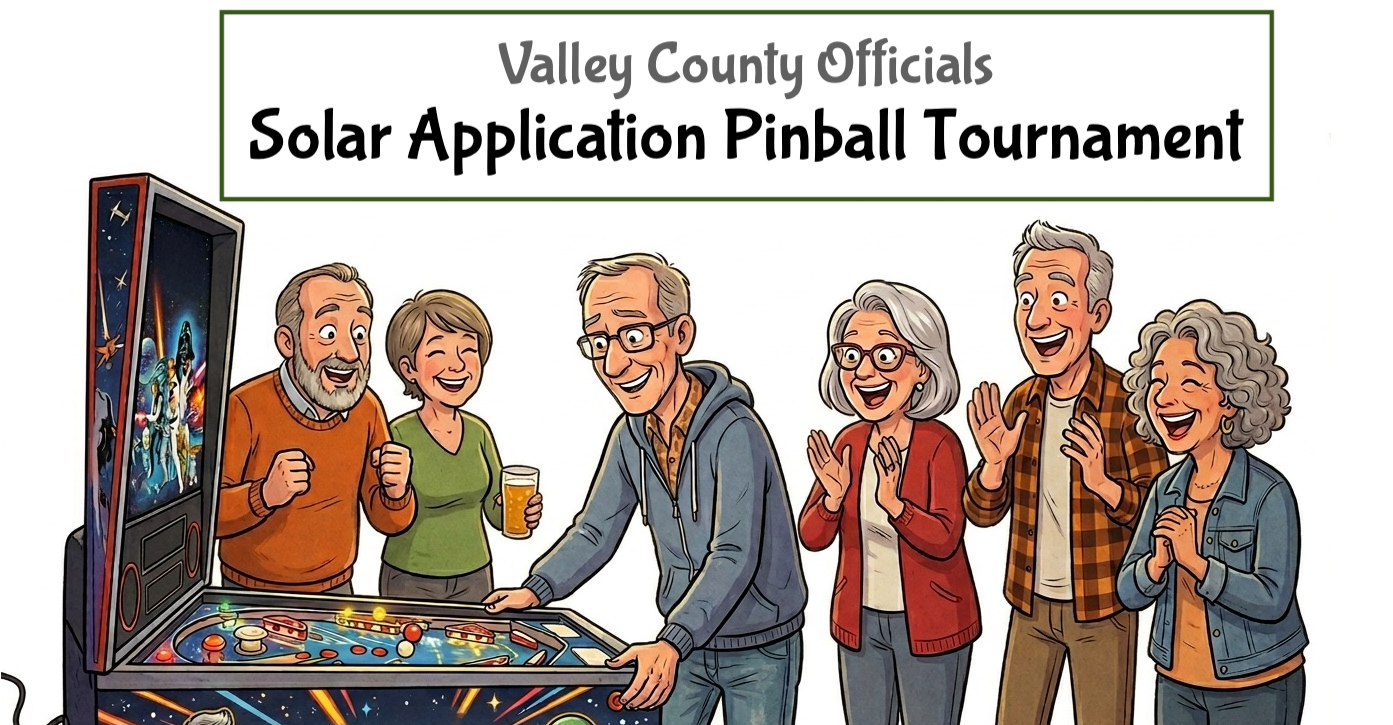
Valley County officials have been playing pinball with real people. In this story, a couple building their retirement home is the ball and the county’s weird solar energy code are the pins. To keep their ball in play, county officials kept flipping the couple back up into the system to bounce around some more. Last week, the county narrowly voted to end the game, leaving the couple to nurse their bruises.
When players give a pinball machine an unfair shove, the machine penalizes them with a TILT. But The Establishment plays a mean pinball. The county’s unchecked, unfair advantage dragged this couple’s ordeal out for six months. Too many public officials either don’t know the rules, don’t choose to play by them or make them up as they go along,
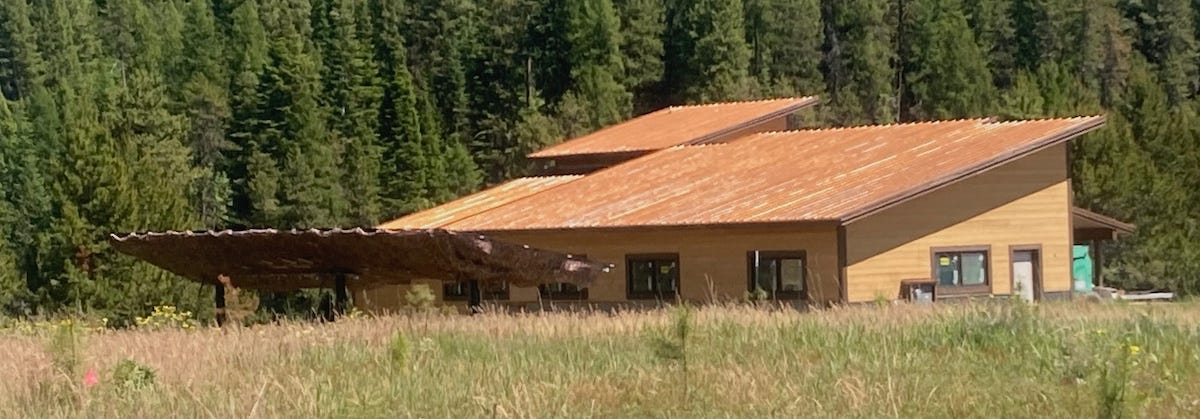
• In 2025, the couple hired a solar installer from east Idaho. The project was of a standard residential variety. In counties serious about encouraging solar power, these are covered by a building permit. So the installer made a logical but erroneous assumption that Valley’s laws are typical. Having gotten the prerequisite approval from Idaho Power, he applied for the building permit. He then was told that a Conditional Use Permit (CUP) is required for any detached solar array over 8 sq. ft. How ludicrous is that limit? An 8 sq. ft. array won’t run a laptop computer.
• A CUP requires a public hearing and approval by Valley County P&Z. In other words, an applicant for a piddly little residential solar installation goes through the same basic process as a subdivision. The installer tried to begin the process but was told the earliest slot on the P&Z agenda would be after the 1st of 2026. This, the couple said, presented them with a dilemma. They would lose a tax credit if the installation wasn’t completed by the end of the 2025 tax year. So they elected to risk completing the installation before being granted the CUP permit.
In standard land use law, building without the required permits is a code violation. The couple never disputed that they were guilty of an infraction. The heart of this is, how does the law deal with such matters? Simply put, people who get caught building without proper permitting are circled back through the process like everybody else. Their “punishment” is the risk they took if the permit is denied. People who get a permit before building don’t face any risk. In other words, permitting is an incentive program (do it right or risk having to do it over), not a punitive one (i.e. fines).
This process went wildly off track because from the start, some key officials got their personal moral code and their land use code all tangled up. In January, the VCP&Z reviewed the matter. A winter wasp had found its way into the P&Z chair’s shorts. He delivered a series of stinging moral rebukes to the installer. Reading the transcript, it’s easy to imagine the chair poking his finger into the installer’s chest. Then, the chair made an irresponsible suggestion that has no grounding in county policy:
“...we could consider (denying) the current application and then have the homeowner come back in with a plan after doing their due diligence and speaking with the neighbors.”
Uh, if it’s required to consult with neighbors before applying for a CUP permit, staff would have turned back the application. The chair had already made it quite clear that, in his opinion, the installer and his clients were outlaws and needed to be taught a lesson. That’s what we mean by substituting personal moral code with process code. He wanted a punitive action that the commission has no authority to carry out.
Fwwaaap!, and up goes the couple’s pinball for another round of ricochet.
In round #2, the chair finally got around to articulating more clearly what was really bugging him. He said, “...easier to beg for forgiveness than ask for permission is an often stated concept here. And I think it’s very appropriate here, and that is that we really shouldn’t be approving this after it’s installed.”
It’s a catchy myth not backed up by any proof that we could find. Projects that retroactively go through the permitting process are typically approved only because they complied with the code as originally built, not because the code was bent or rewritten to accommodate them. If this couple’s story proves anything, it is that building a project without a permit is no advantage! The chair’s punitive anger and the narrow margin by which this project barely escaped denial portrays, in living color, the danger of treating folk fallacy as fact.
Know anybody who would appreciate an emporium of local prosaic truths?
By the end of the P&Z deliberations three months later, the solar project was found to comply with code. Even county staff and the neighbors couldn’t come up with a better plan. But the chair would not let go of his pique and he convinced another member to vote with him. The final tally was 3-2, narrowly approving the permit.
The neighbors appealed to the county commission and Fwwaaap!, the couple’s pinball got sent up for a third batt-around.
Six months, two commissions, four meetings and a lawyered-up neighborhood fracas over this?
It took another three months for the couple to finally get their permit. Surprisingly, a normally sure-footed commissioner came down with forgiveness/permission fever. Another commissioner caught it too. But the county commission chair (in contrast to the P&Z chair) had a clear-eyed grasp of what the permitting process involves and the tests that are to be applied. Happily, her arguments won the day and the permit was approved 2-1. We would love to get a draft from the dissenting commissioner as to how she would write a denial statement based on her forgiveness/permission argument that would stand up to a court appeal.
Nobody in county government—officials or staff—voiced any discomfort with how derelict their solar code is. It gives officials tremendous leeway to define “impact” any way they feel like without penalty. In their defense, the commission and P&Z did seem to have some sense of definition set by precedent. But, as we pointed out, approval teetered precariously on one person’s institutional memory. That’s government by fate, not by consistency.
Does Valley County really believe that playing Pinball Wizard with individual homebuilders is the way to promote alternative energy? If solar installations become all the rage, does the P&Z want to review EVERY ONE of them? Do they want to ref the scrums that are guaranteed to escalate once it gets out that neighbors have the power to design newcomers’ houses for them? The most compelling reason to rewrite this code is what happened to this couple and, worse, what nearly happened to them.
Just. Sayin’.
Would you like to a)tell us how wonderful we are b)tell us to crawl back where we came from? Write us a private email! Send your bribe observations to: tomigrote@substack.com. We promise we won't out your trash talk to your church congregation.
🟧 We looked at Blaine County (Sun Valley, Ketchum) solar code. We expected to find a list of rules and regs so persnickety that it would go too far the other way. Instead, we found a collection of clear, reasonable specifics, like setbacks, height, etc., very similar to rules governing standard home construction. If Valley County’s ordinance were similar, and with the CUP requirement dumped, we wouldn’t be writing up this couple’s circus solar permit story today.
🟧 A disturbing double standard. This is what we meant when we said in the post that the rules are not bent or rewritten, but are often ignored for convenience. In the very same April meeting in which he voted against the couple’s project, the P&Z chair and another commissioner voted in favor of a second property owner who asked forgiveness, not permission for a solar installation. The only difference between the two projects that we could see, is that one got the neighbors riled up and the other one didn’t. So is forgiveness/permission a moral failing only if there’s controversy, but totally acceptable otherwise?
🟧 Speaking in code. The Valley County code for detached solar arrays contains language unlike any we could find in other counties. It says: Impact to neighbors will be a determining factor. The term “impact” is not defined, which means what constitutes an impact is entirely subjective. The term “a determining factor” is also wobbly. If the neighbors don’t like your solar array for whatever reason, can a board deny a solar installation that it can’t kill by another reason? The absence of any clarity renders a Play-Doh ordinance that can be shaped into anything, depending on what mood the governing body’s majority is in. If it isn’t changed, the ignorant will be the only people who will be adding solar to their homes. Nobody with any sense would do it if they knew what was coming at them through the CUP process.
🟧 Good thing three P&Z commissioners is a crowd. Fortunately for the couple and the principle of fairness, a bare majority of the commission voted to approve the application. Those commissioners’ remarks were a stark contrast to their chair’s. They exhibited the same literacy of the process and the law that later, the county commission chair showed at the appeal level. Our compliments to them. There appears to be a consistent philosophical 3-2 split on the county P&Z. The fact that a commission chair is in a consistent minority when there’s a split is very unusual.
🟧 Why not hit people who build without permits with a heavy fine? Legacy land use experience holds that there are too many reasons and extenuating circumstances to permitting to make fines practical, fair and consistently applied. So the law has evolved to embrace the “cure” remedy. The draconian approach would be: no permit > tear it down and get one. But that runs afoul of the American legal standard that the punishment should fit the crime. The number one reason permits are not applied for is ignorance. The ultimate goal of permitting is not to judge and punish the motivations or legal illiteracy of violators, but to guarantee code compliant construction. Fines do nothing to advance that objective.
🟧 Worth repeating? When a P&Z land use judgement is appealed to the county commission, they don’t review the findings of the lower body like an appellate judge does. Instead the applicant has to start all over again as if the P&Z approval never happened. For a subdivision, there might be some logic to a ground-up review. But a little residential solar array?
🟧 The legal definition of harm differs from the everyday colloquial one. That is why the “forgiveness/permission” myth is such an easy sell but falls flat in court arguments. Courts evaluate actual harm, meaning an action must result in an injury to another that is measurable, not subjective. Enumeration to the harmed is calculated on that basis. Permit violations are one-offs. So a fine will not prevent a repeat offense. Serial violators face a different and harsher set of penalties. The conclusion honed by time is that the risk of building first (permit denial and expensive retro-build) is sufficient deterrence. And if a violator’s project is approved without penalty, the only actual harm has been subjective, not concrete. The civic goal of permitting has been achieved. Instead of “forgiveness/permission,” think no harm, no foul.
🟧 Nukes? no problem. According to Valley County code, neighbors can determine the fate of a solar installation. But no such language exists for the sections on wind turbines, hydro projects, even nuclear power generation (yes, VC really has code for that)! Anybody who lives next door to a proposed wind farm or mini-nuke is SOL.
🟧 The couple’s decision to roll the dice for a tax credit is none of the public’s business. Again, that is because motive is not a factor in the permitting process. Nor is a couple’s judgment of their financial options.
🟧 Send it up the flagpole...by the time they got before the county commission, the neighbors’ arguments had gotten so wacky, they even suggested that their subdivision CC&Rs should apply to the couple even through the property in question was not in the subdivision.
Links to the Second Class Citizen Series
About us: Tom and Tomi Grote owned/published The Star-News for 40 years (1983-2022). We sold the paper and are now retired on an acreage near Lake Fork with two horses and a Basset Hound named Gidget.
No posts
Comments
Nothing yet. Say the first thing.
Sign in to join the conversation.