
Since our last post, the Valley County commission, the Cascade Medical Center board and McCity council have revealed starkly different interpretations of what respect for their public means to them. But before we get to that, here’s a brief, soup kitchen sermon for background:
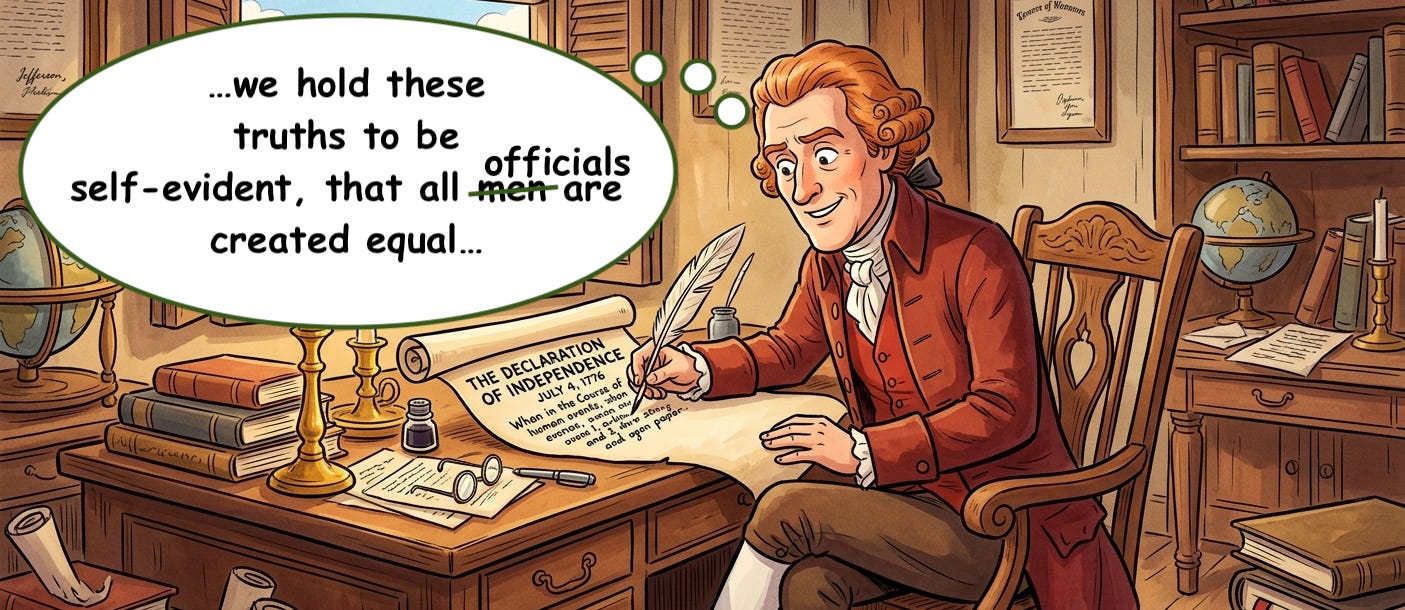
America is the first country successfully founded purely on ideals, rather than on ethnicity. The first of those ideals is a free exchange of viewpoints. The thinking is that a culture accustomed to speaking freely is highly resistant to subjugation by intimidation. Put more bluntly, the Return On Investment (ROI) of persuasion is far superior because firing real bullets into each other is expensive and dead people are not free people. The second idea is that all men are created equal. Since the revolution, the definition of “men” has thankfully (and painfully) evolved to all humans from the original white, male property owners.
Living up to these ideals is still an American work in progress, including the founding concepts of free expression and equal opportunity. These later were embodied in two much drier terms: open meetings and public records. When regular citizens must beg for information about something they care about, they are subordinate to privileged public officials. If public officials shut the door to deliberate in private, citizens are denied access to the exchange of ideas that is so critical to their ability to evaluate those decisions and hold officials accountable.
With that in mind, please evaluate the following:
• The Valley County Commission recently moved to post the information that they receive before their meetings (called “packets”) online. Anybody who has tried to follow their YouTube videos knows this frustration. Without being able to see the reports the board members discuss, the citizen has absolutely no idea what specifics the commishes are talking about. Equally exasperating is having to prepare a public comment without all the ingredients to the recipe. It makes flying blind a coping mechanism. What was truly distinctive about the commissions’ reaction to our request was their wholehearted enthusiasm. It was such a refreshingly sharp contrast to...
• The Cascade Medical Center board, who was asked to post packets months ago. Unlike the county commissioners, the CMC board reacted strongly against accommodating the public—so much so that they recently sat through a 45 minute presentation by their attorney on public records. This no doubt was a reaction to a little hoodwink we pulled on them last month. After declining our request that they post the packets to their website, we filed a public records request. Then we posted the packet publicly on our Substack to show the board that their obstinance had no purpose other than to inconvenience interested members of their public. The chair asked the lawyer incredulously, “they can do that?” “Yes,” was his answer. Obviously, that wasn’t the response the board wanted to hear, so they moved on to the next agenda item. Nobody suggested any future discussion of posting the packets, so the matter appears to be closed. CMC’s concept of the American ideal of “all men are created equal” is inescapable. Taxpaying citizens are equal to each other, but inferior to board members. Of course, they grant elevated status to citizens who just want to tell them what a good job they’re doing.
• The McCity Council put a different wrinkle on the “equality for me and not for thee” quip. The other day, they conducted a one-sentence public hearing. The topic was spending $347,000 on what their staff had been told much earlier was a practically worthless sliver of real estate. We submitted a public comment objecting to the decision (published in our last post, see Afterthoughts/Links sections). We complained that the purchase was rushed and that all discussion of it unnecessarily took place behind closed doors. Worse, the public has never been given the substance of those private conversations nor the counter arguments to the points we raised. The official reason given for accepting the appraisal was because competent appraisers are hard to find. We aren’t kidding:
“I feel like we’ve done the best that we could with trying to narrow down the valuation of that property to what’s reasonable. I think our legal counsel who worked on that had a hard time even getting an appraiser who was willing to take that on if I’m not mistaken. So given the discussion that we’ve already had about this, I don’t think there’s a whole lot to say about it.” —McMayor
Thanks for reading Letters to the Valley County Electorate! This post is public so feel free to share it.
All of the “discussion we’ve already had about this” was out of public earshot. McCouncil’s interpretation of the words “all men are created equal” is, “we know what we are doing and the public doesn’t.” This is a consistent theme with McCouncil. In their minds, they were elected and that automatically elevates their judgment above all others, so that they don’t have to justify or explain it in public.
McMayor called an outrageous and capricious property valuation “reasonable.” That reminds us of an old joke familiar to the sales profession:
A customer points to a shiny sports car and asks the salesman “how much?” Salesman: “Two hundred thousand dollars.” The customer nearly faints, “What????” Salesman: “I do have this other model. It’s only one hundred thousand.” The customer says, “that’s much more reasonable,” and buys it. On the drive home, his wife asks, “weren’t you planning to spend about thirty thousand?” He replies, “yes, but I got a much better deal. I saved us a hundred thousand dollars.”
This comparison also points to another recurring inequality theme in our posts. CMC and McCity just brought back up a common bias in the minds of public officials. Members of the public—no matter how credible—are never equal in their eyes to the stature of paid staff. This Presumption of Openness ethic we talk so much about is not a legal question. The county commission’s enthusiastic embrace of the principle proves that. Rather, adoption is a matter of policy, and attitude. Here’s a thought experiment:
What would have happened if CMC’s staff had recommended posting board meeting packets instead of John Q. Citizen? What would have happened if it had been McCity’s staff who had recommended pursuing any one of several options open to them to solve the property title problem, instead of John Q. Citizen? In both cases, the questions themselves are exactly the same. But isn’t it always striking how automatically boards defer to the hired hands...and how dismissive they always are to the few from the public who have the courage to step forward?
Arguments that come from citizens shouldn’t get any special weight either. That defeats our equality argument. We’ll settle for equal weight. We’ll settle for respect over ‘who do you think you are’ skunk spray. The public record is clear about what happens to input from the peanut gallery. It mostly goes unacknowledged or is dismissed. Public comments are thought of as a bulletin board for the lunatic fringe instead of the worthy ideas of equals.
As we said, the American ideal that all men, er, human beings are created equal is still very much a work in progress, even at the local level. Just. Sayin.’
The McCall Memorial Hospital District board of trustees.
For the first time in an eternity, MMHD members asked perceptive and penetrating questions about the 2027 St. Luke’s McCall funding request. The district demurred SLM’s first request to fund another phase of subsidized housing for the hospital conglomerate because of an advancing attorney general inquiry into the legality of the expenditure. So, Luke’s officials dove into the grab bag and fished out replacing a CAT scanner to substitute. They tried to sell it using the tried-and-true technique of “how bad do you want to let this equipment get before you trust us to buy a new one”?
But some board members saw that coming and questioned why taxpayers should fund replacing what the SLM CEO said was their “number one diagnostic tool” for which they charge handsomely ($1600-$2800 per scan, $300 more than in Boise—price source: St. Luke’s MyChart estimator). Usage was “skyrocketing” the CEO said. Even taking into account discounted insurance reimbursement rates, McCall’s much wealthier than average clientele delivers higher profit margin per scan, so downtime is especially costly to SLM, as are all the cross services and referrals that go with the scans.
Furthermore, if the housing subsidy hadn’t been scotched, nobody would be talking about funding this item, and Luke’s would just replace it on its normal retirement schedule. That schedule will likely accelerate because, in October, the federal government is going to pump $186 million per year into Idaho rural hospitals for the next five years. It’s called the Rural Hospital Transformation Program (RHTP). A CAT scanner might qualify for the funding and even if it doesn’t, there will be enough cash for other stuff to free up Luke’s “capital improvement budget” substantially.
So, the fact is that Luke’s was prepared to replace the scanner on its own before the housing project presented an opportunity for them to hang it on taxpayers. That takes out any argument that the district is responsible for major equipment replacement. And the RHTP infusion substantially takes out the budget squeeze defense. St. Luke’s McCall is not hurting for anything and nothing in the district’s agreement says it has to fund anything. Board members are to be commended for their critical thinking. The only precedent their persistence risks setting is prudent stewardship on behalf of the taxpayer.
Scroll down for the Afterthoughts after this commercial break:
Don’t be shy! Write us a private email! Send your bribe observations to: tomigrote@substack.com. We promise we won't out your trash talk to your church congregation.
🟧 Anybody who missed our full evaluation of McCity’s real estate prowess can follow the Link to it below. The short version is that converting a little, obscure strip of land between Mile High Marina and Brown Park into a swimming area has been on the drawing board for decades—ever since a dock building business moved its operations to dry land. Apparently, the McParks department had run out of things to spend its sumptuous local option tax money on, so suddenly, this project became its highest priority. The city has been encroaching on it also for decades and even built a walkway and railings on it. After what appears to be the most cursory “investigation” of some ownership anomalies, the parks staff took the word of some low-level bureaucrat in the Idaho Department of Lands that appeasing the land and buying it was the only option. Hilarity ensued and if you want the rest of the story, you have to follow the link.
🟧 McCity dabbles in the real estate business: use keywords: “McCall Property Buyer”
🟧 The May, 2026 CMC meeting packet
About us: Tom and Tomi Grote owned/published The Star-News for 40 years (1983-2022). We sold the paper and are now retired on an acreage near Lake Fork with two horses and a Basset Hound named Gidget.
No posts
Comments
Nothing yet. Say the first thing.
Sign in to join the conversation.