
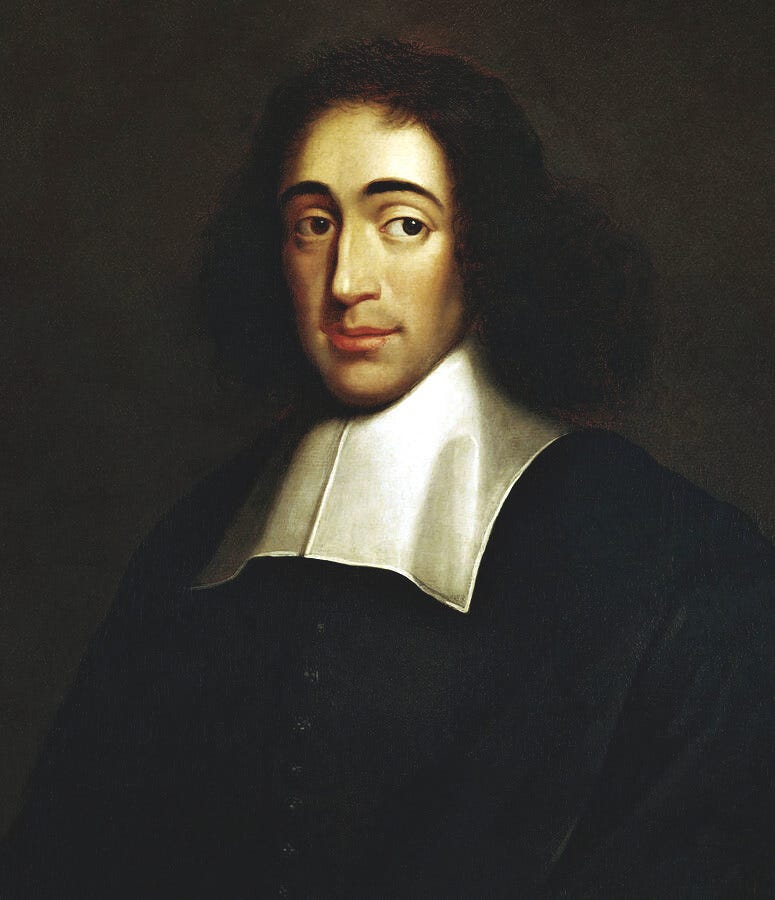
Back in October, we finished reading Montaigne’s Essays. I took a little break given other reading I had going on which didn’t feel right for the newsletter but now we’re back, and we will be reading Baruch de Spinoza’s masterpiece, The Ethics.
Before I get into schedule of readings and why I chose this book, a quick heads up: if you want to keep getting my newsletter but prefer not to follow the Book Club read-along click here and toggle off ‘Book Club’. You will still get my regular essays and other updates.

I’ve read bits and pieces of The Ethics over the past year, but I wanted to go through it systematically. Reading it together with you will help us grapple with the more difficult parts of the text. The juice will be worth the squeeze.
The schedule of chapters (for now) is as follows:
March 13 - Introduction: George Eliot’s Spinoza
March 20 - Part I: Of God
March 27 - Part II: On the Nature and Origin of the Mind
April 3 - Part III: On the Origin and Nature of the Emotions
April 10 - Part IV: On the Servitude of Man and on the Power of the Passions
April 17 - Part V: On the Power of the Intellect, or, On Human Liberty
Spinoza has always been a polarizing character. During his lifetime, he managed to be excommunicated from the Jewish community he grew up in, accused of heresy, atheism, and somehow also being drunk on God. It was only about a century after his death that his ideas started to spread beyond his inner circle.
In The Ethics he sets out to prove the interconnectedness of all things in the universe and to derive a philosophy for how to live a good life out of that knowledge. It’s both metaphysics and ethics in one comprehensive system.
The German philosopher Hegel said that “one is either a Spinozist or not a philosopher” and Nietzche was apparently enchanted by his discovery of Spinoza’s writing. Goethe remarked that "every philosopher has two philosophies: their own and Spinoza's.”
Albert Einstein was once asked if he believed in God to which he replied “I believe in Spinoza’s God, who reveals himself in the lawful harmony of the world, not in a God who concerns himself with the fate and the doings of mankind.” Einstein even penned a somewhat mediocre poem for Spinoza, while Jorge Luis Borges wrote two far better ones. He clearly touched many great thinkers but why?
He is often lumped with his Descartes and Leibniz as the 17th century philosophers known as Rationalists, whose ideas are pitted against British philosophers from around the same time period—John Locke, George Berkeley, and David Hume—collectively known as Empiricists. Rationalists believed knowledge comes from reason, intuition, and innate ideas alone, independent of sensory experiences. They emphasized deduction from first principles. Descartes’ cogito ergo sum, ‘I think therefore I am.’ Empiricists, on the other hand, argued that knowledge derives from sensory experience and reflection, rejecting innate ideas in favor of a tabula rasa, a blank slate, with the mind built through induction and observation.
But I think even this flattens Spinoza a bit, and what he meant for future generations. He was the only one of either camp of philosophers to be labelled an atheist. He managed to anger both the Jewish and Christian communities of 17th century Netherlands, and Leibniz pretended he never had any connection, affiliation, or had even met Spinoza, which ample evidence suggests otherwise. So what was so dangerous about his ideas and why have they stood the test of time and influenced so many?
In Bertrand Russell’s History of Western Philosophy, he writes:
Spinoza is the noblest and most lovable of the great philosophers. Intellectually, some others have surpassed him, but ethically he is supreme. As a natural consequence, he was considered, during his lifetime and for a century after his death, a man of appalling wickedness.
Spinoza was a radical. He proposed ideas that people during his time were not willing to hear. To the religiously devout, his ideas sounded like heresy. To believers in free will, it sounded too mechanistic. To individualists, his ideas sound too mystical. The truth, as we’ll come to see, is more complicated.
Above all, Spinoza was a man of integrity which is why I think he became so beloved posthumously. He walked the walk as few philosophers have. He declined an offer of professorship so that he could keep his mind clear from the pressures of academia and any risk of censorship. He lived a humble life as a lens grinder by day and philosopher by night, ate the same simple meal everyday, never married, never lost his temper in public, and walked away from both familial wealth and the comfort of the Jewish community he was raised in, all in the name of living philosophically and contributing to the grand human project.
The Ethics are considered a more difficult read but we will work through it, section by section. For this read along, I’m using the George Eliot translation. If you’re not familiar with Eliot, she was a 19th Century English writer and author of Middlemarch, Silas Marner, The Mill on the Floss, and Daniel Deronda. She was also the first person to translate Spinoza into English and his philosophy influenced her to such a degree she infused it into her novels. So hers is the version I am choosing but if you have or prefer another one, feel free to do so.
I may reference the Beth Lord companion guide to Spinoza’s Ethics, as well as Steven Nadler’s Spinoza’s Ethics: An Introduction, and where I do I will make sure to be clear about that. I believe in reading primary texts first before companion guides, but I’m not above asking for help when needed.
Spinoza will seem much more comprehensive, systematic, and confident than Montaigne. His Ethics sought to find that link between the interconnectedness of all things and to fuse it with a guide to living well. Let us see what we can learn from this Dutch philosopher ourselves.
I am incredibly excited to kick this off together. See you next week.
Comments
Nothing yet. Say the first thing.
Sign in to join the conversation.