
Thank you for supporting irreverent, psychologically sharp well-being work. Every note you send and every new reader you introduce makes the weekly grind worth it. And I will reward you for recruiting fellow independent thinkers interested in helping humanity:
3 referrals → 1 free month
5 referrals → 3 free months
10 referrals → 6 free months
My childhood had its share of sharp edges [LINK], but poverty was not one of them. I never had to sleep in a car, ration toilet paper, or calculate whether asking for lunch money would make things worse at home. So memory could only take me so far. To understand the many ways childhood can go sideways, I had to step outside my own life and listen to other people. I spent hours reading Reddit threads where adults described the strange, humiliating logistics of growing up insufficiently.
A cheerleader whose teammates cleaned a toilet with her toothbrush, abandoned her miles from a competition, and drove her into a bathroom stall for lunch.
Emergency testicular surgery as a high school freshman turned into a rumor that he lost his manhood. His mother over-explained the reason for a few missed school days when she called in. A teacher who got the details told an entire class. He came back to find the whole school convinced he’d lost a testicle. He had not. The jokes ran for a very long time.
A boy beaten, robbed, and stuffed upside down into a trash can until a janitor found him hours later.
A girl told a teacher, in confidence, how cruel the popular girls we’re being and asked her specifically not to confront them. The teacher did anyway. The girls stormed her math class screaming and threatening to beat her up after school. She had to be escorted to the principal’s office and leave through a back gate. Same year, at a “friend’s” sleepover, girls covered her in shaving cream, then a seventh-grader poured her own urine on her. The host later showed up at her house with flowers to apologize.
A girl whose ponytail was cut off from behind and who still cannot wear her hair up without tremoring, paranoid that someone lurks behind her with scissors…everywhere.
I suspect you’re thinking what I’m thinking, I wish I could have been there to shield them, to take the pain for them.
The stories grew more complicated the longer I read. A child was hospitalized after a beating by a boy who showed up the next week to play Nintendo because his own family could not afford one. An 11-year-old fought back against a much older refugee classmate, then learned after the boy’s death that he had watched his family murdered during a war. A terrified student brought an unloaded gun to school after months of death threats and was led away in handcuffs. In these stories, the victim and the villain often occupied the same frightened body. These are underage children dealing with plots used in barely believable R-Rated films.
Some of these children grew up without money. Others lived in homes that would have looked perfectly respectable on a census form. What they lacked was harder to capture, something in the vein of safety, dignity, trustworthy adults, protection from humiliation, somewhere to sit at lunch without locking the door.
Household income (or socioeconomic status) matters enormously. It can predict what is in the refrigerator and whether the lights stay on. Entire categories of childhood suffering still slip through it untouched.
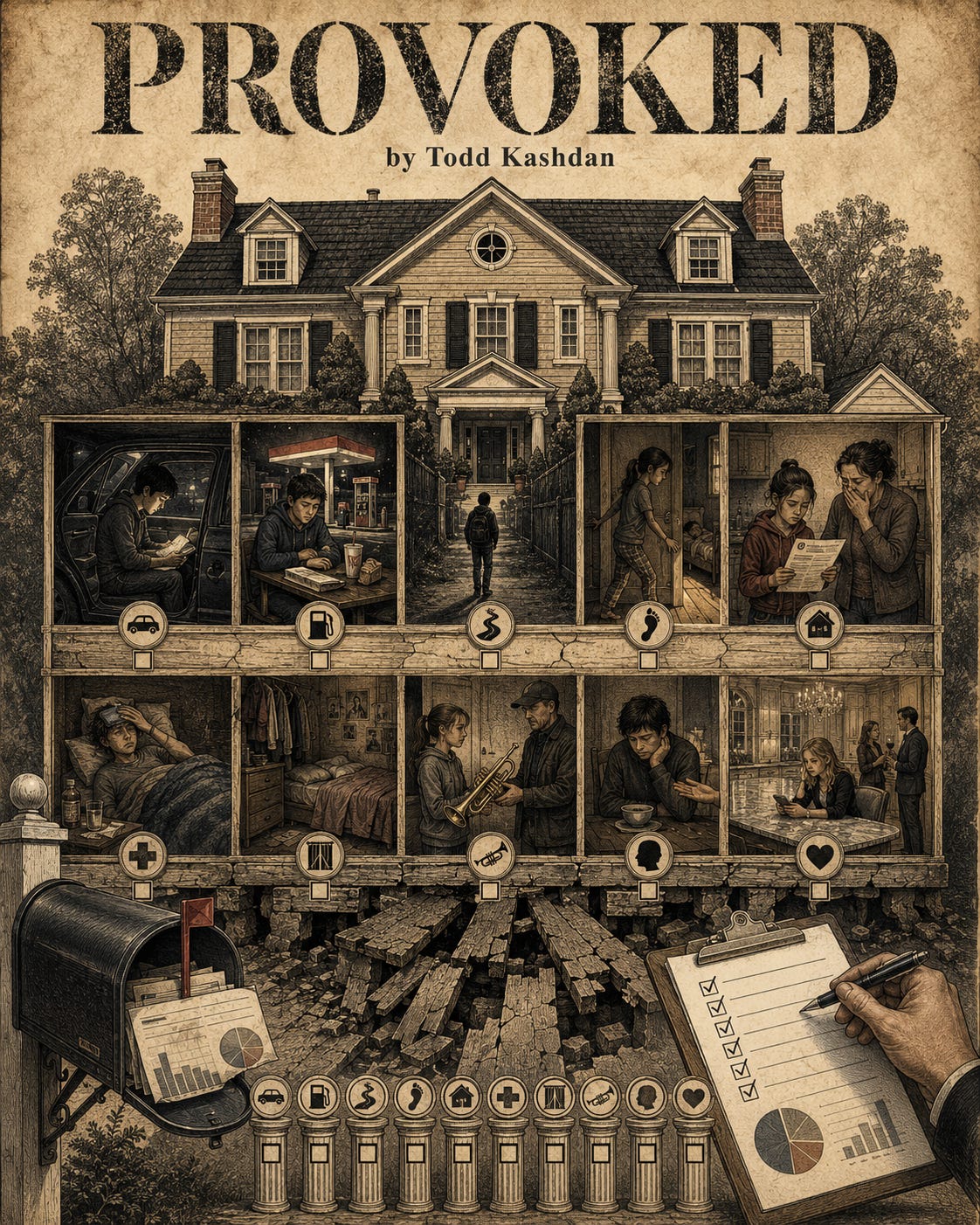
So let’s try a different test. Ten questions, drawn from remarkable science that deserves far more attention. In about thirty seconds, your answers will reveal whether you received the minimum viable conditions of childhood, or were forced to become an adult far too early.
Now describe the other end of the spectrum.
The reflex answer is fantastic. A golden childhood. Bikes dropped on lawns at dusk. Pancakes on Sunday. A 529 college fund humming away, collecting interest to almost pay for those six figure annual tuition costs.
You mean well but you’re at the wrong end of the ruler.
The opposite of a shitty childhood is adequate, beginning with a safe route home from school or wherever else you traveled to. Four researchers built an assessment to measure that floor. Before you the test below, know this, roughly half of American teenagers live below the minimum floor line.
For decades, researchers decided whether a child was deprived by inspecting the household from the curb. Family income. Parents’ education. Eligibility for free lunch.
Urie Bronfenbrenner, one of the 20th century’s most influential developmental psychologists, spent his career arguing that children cannot be understood apart from the worlds surrounding them: families, schools, neighborhoods, institutions, and the larger culture pressing down on all of it. In 1979, he warned researchers about relying on what he called social addresses.
Two teenagers can have identical family incomes and inhabit different psychological spaces. One has a bedroom of their own, where nobody enters unannounced while they’re changing, with a grandmother upstairs, a reliable bus, and an adult who asks for the day’s highs and lows. The other has none of these. These are not equivalent lifestyles.
The proxies are not especially impressive. Teenagers rarely know what their parents earn. Free-lunch enrollment is a strange peephole into a family’s finances. We have been sorting children by variables many of them cannot report and if they could, it would fail to capture what morning through evening feels like.
Bad measures survive because they are convenient and already being used in district databases. Nobody loses their job for using the same mediocre strategies as their predecessors.
Income can tell you how much money exists in the house. It cannot tell you whether anyone inside allowed for a satisfactory childhood.
Comments
Nothing yet. Say the first thing.
Sign in to join the conversation.