
Thank you so much for being a subscriber. And you wonderful paid members fund this version of psychology that does not pander, and are the reason Provoked exists. Invite friends/colleagues and earn rewards when they subscribe:
3 referrals → 1 free month
5 referrals → 3 free months
10 referrals → 6 free months
I’ve been thinking about how I want the trolls (LINK) liars (LINK) and abusers (LINK) in my life to be punished, but not in the traditional way…
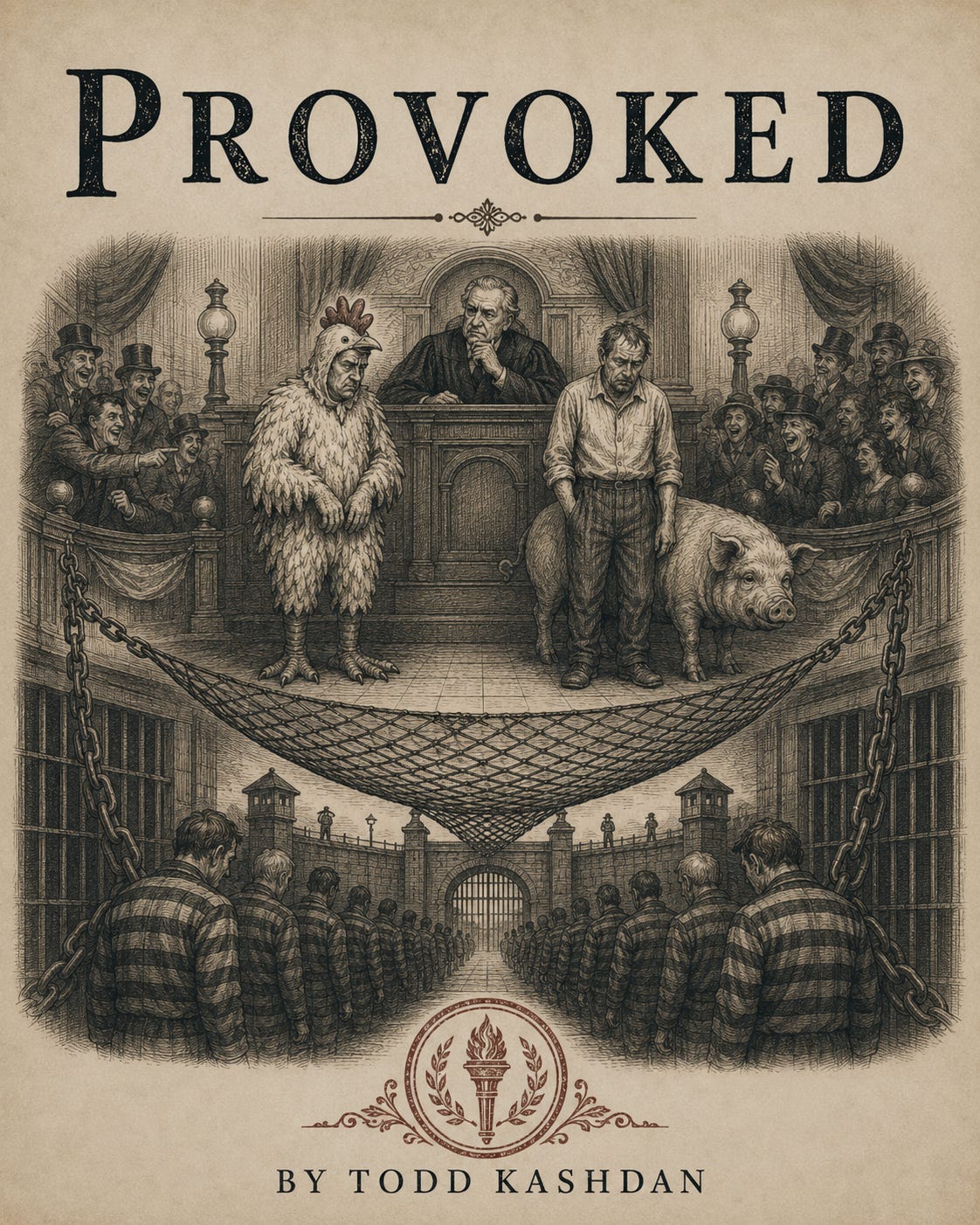
In 2002, a man in Painesville, Ohio stood on a public street beside a 350-pound sow, holding a sign that read This is not a police officer. He had nearly run a cop down with his car and shouted PIG out the window with spittle dripping down his chin and oversized big gulp. Judge Michael Cicconetti offered him a choice of 30 days in jail, or two hours with a livestock pig. He took the pig. For two hours he stood on a busy corner while drivers slowed to point and laugh.
Cicconetti spent 25 years on that bench and seemed to have a constant flow of material (far different than the lame Kevin Hart roast on Netflix).
He sent a woman who dumped 35 kittens in the woods in wintertime to spend a night alone in those same woods.
He made a cab fare skipper walk 30 miles, the distance she had ridden before bolting. (Do you feel the schadenfreude yet??!!)
Three men caught soliciting sex were forced to stand around in chicken suits.
He sentenced a man who stole a Salvation Army kettle to spend 24 hours homeless
By the time he retired in September 2019, he was nicknamed Judge Chick, with plenty of copycats across the country (link).
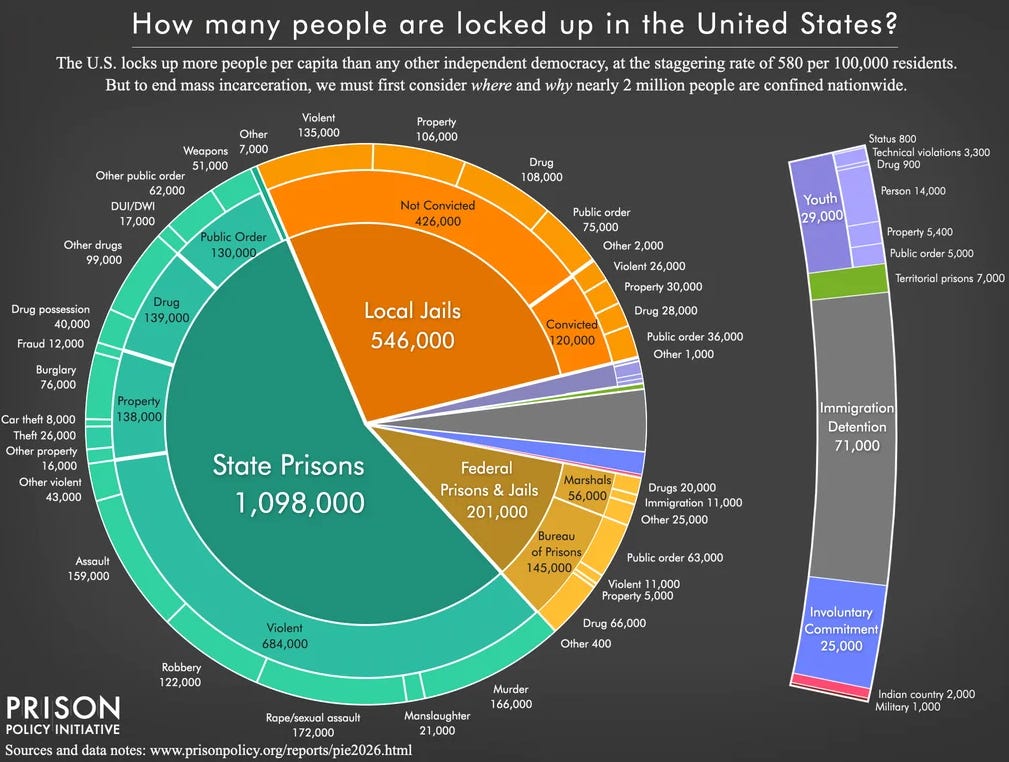
Set the chicken suit against the numbers and you can see why we cheer. Roughly 1.9 million people are locked up on any given day in the USA (where our country really sucks compared to say, Japan), in a country with about 4% of the world’s population and close to a fifth of its prisoners, at a cost of $182 billion a year (yes, billion). In comparison, a judge who hands a mail thief a sign instead of a cell becomes the epitome of imagination + pragmatism.
There is now data on how much we love imaginative punishments. Across 13(!) studies, Timothy Kundro and colleagues found that observers hate the usual trade-off where harsh sentences seem to deter crime but also seem cruel, whereas proportionate sentences seem fair but toothless (LINK). Creative punishments dissolve the tension. They appear to teach through experience rather than raw severity, so they read as effective and humane at once. Transgressors preferred them too. When the researchers ran an AI analysis of more than 17,000 social media reactions to creative sentences for criminal/immoral activity, the delight was intense.
Cicconetti’s stated philosophy was to make the punishment fit the crime. That is overused phrase is nearly word for word with inhumane acts and humane alternatives, depending on the politics of the speaker. In the 1980s, states rolled out intensive supervision probation, an intermediate sanction pitched as something between a cell and a slap on the wrist, meant to fit the punishment to the crime and save money doing it. The RAND Corporation ran a randomized experiment across 14 sites in nine states to see if it worked (LINK). It did not reduce new arrests. It put more people in jail. Closer supervision meant more drug tests and more rule-breaking caught, and the humane alternative to the status quo produced MORE incarceration.
We should discuss unintended asshole consequences. Invent a punishment that feels gentle and clever, and you will not save it for the people bound for prison. You will spend it on the people who were going home. A prosecutor who might have dropped a petty case now has a humane-adjacent option, so the case does not get dropped. The net grows wider, and once someone is inside it, a single slip drops them into a cell. A technical violation is breaking a rule of supervision rather than committing a crime: a failed drug test, a fee you could not pay, a county line crossed without a form. Miss one meeting because your shift ran long, and you can be sent to a cell, having harmed no one.
Probation has no bars and no razor wire, so nobody considers it incarceration. They should. Roughly 3.7 million American adults are on probation or parole, nearly twice the number behind bars (LINK). These are the alternatives. They did not replace the cage.
Creative punishment is the newest version with one advantage the old alternatives lacked. It is fun to watch. A man in a chicken suit is content that can earn money to social media posters. The 17,000 delighted reactions in Kundro’s data recruit fans. Every viral clip of a judge dispensing poetic justice makes the public a little more chill with the idea that the state should be creatively involved in more lives, for smaller and smaller things. That pleasurable emotion is what allows the net to widen.
Now look at who is holding the gavel. Creative sentencing is judicial discretion with the guardrails pulled off. Sentencing guidelines exist because unbounded discretion produced wildly different punishments for the same act, and reliably harsher ones for some defendants than others. When the judge is a charming ex-Eagle Scout, two teenagers who defaced a nativity scene lead a donkey through town under a sign reading “Sorry for the jackass offense” (Cute, right?)
When the judge is a bully, you get Shawn Gementera, ordered to stand outside a San Francisco post office in a sandwich board reading “I stole mail. This is my punishment,” a sentence a federal appeals court examined and let stand (seriously, read the case - HERE). The legal power is identical. The creativity is identical. What has transformed is the emotional tone.
None of this makes creative punishment a mistake. A creative sentence that replaces a prison term is a gift. But, But! Give the sentence to someone who would otherwise have walked out free and you have spared no one. You have widened the state’s reach which is how we get to terms such as the Prison Industrial Complex that financially supports small towns and leads to protests when there is a possible prison closing. Not because citizens care about human lives because they don’t want to lose paychecks that incentivize locking more and more people up, even if innocent.
Probation, studied carefully, works as a genuine alternative in some places and a net-widener in others, depending entirely on how it is used (LINK). The viral video doesn’t detail what would have happened to this person if the judge had done nothing clever?
Carry that question out of the courtroom, because you hand down creative punishments too, from a phone. Every time you share the clip of someone getting what they deserved, you become one more reason the next judge reaching for the chicken suit. So be skeptical of your own joy. For one month, when a clever sentence makes you want to share it, ask what the person would have gotten otherwise. A warning, a dropped case, or continued freedom. If the answer is freedom, you and the others did not experience the residuals of justice. You dragged someone back into the net who had already slipped it.
A Few Provocations
Laugh if you want. Just know that somewhere a person who was going home is standing next to a pig instead, because you shared the last news article or clip.
Todd B. Kashdan is the author of several books including The Upside of Your Dark Side (Penguin) and The Art of Insubordination: How to Dissent and Defy Effectively (Avery/Penguin) and Professor of Psychology and Founder of The Well-Being Laboratory at George Mason University.
No posts
Comments
Nothing yet. Say the first thing.
Sign in to join the conversation.