
The woman across from me and my girlfriend says she’s exhausted.
She’s an old friend, and we’re meeting her over lunch. Let me call her Annie (not her real name). Annie has been running an animal sanctuary in France for many years.
She’s 69, and apart from the occasional help of volunteers, does it all by herself. She’s in my country, Belgium, for a brief visit. In fact, all her visits are brief, because she can’t leave her 120 animals - horses, donkeys, goats, cats, dogs, chickens, and more - alone for long. Even during these few days away, a volunteer told her over the phone that a donkey needed to be euthanized after a freak accident. “Why,” Annie said with a sigh, “do these things continue to happen?”
Annie would like to move back to Belgium, where she’s originally from. She feels very lonely in the south of France, where few people understand her. She’s surrounded by locals who eat the animals she would save, hunters who shoot them, and vets who don’t get why she cares so much.
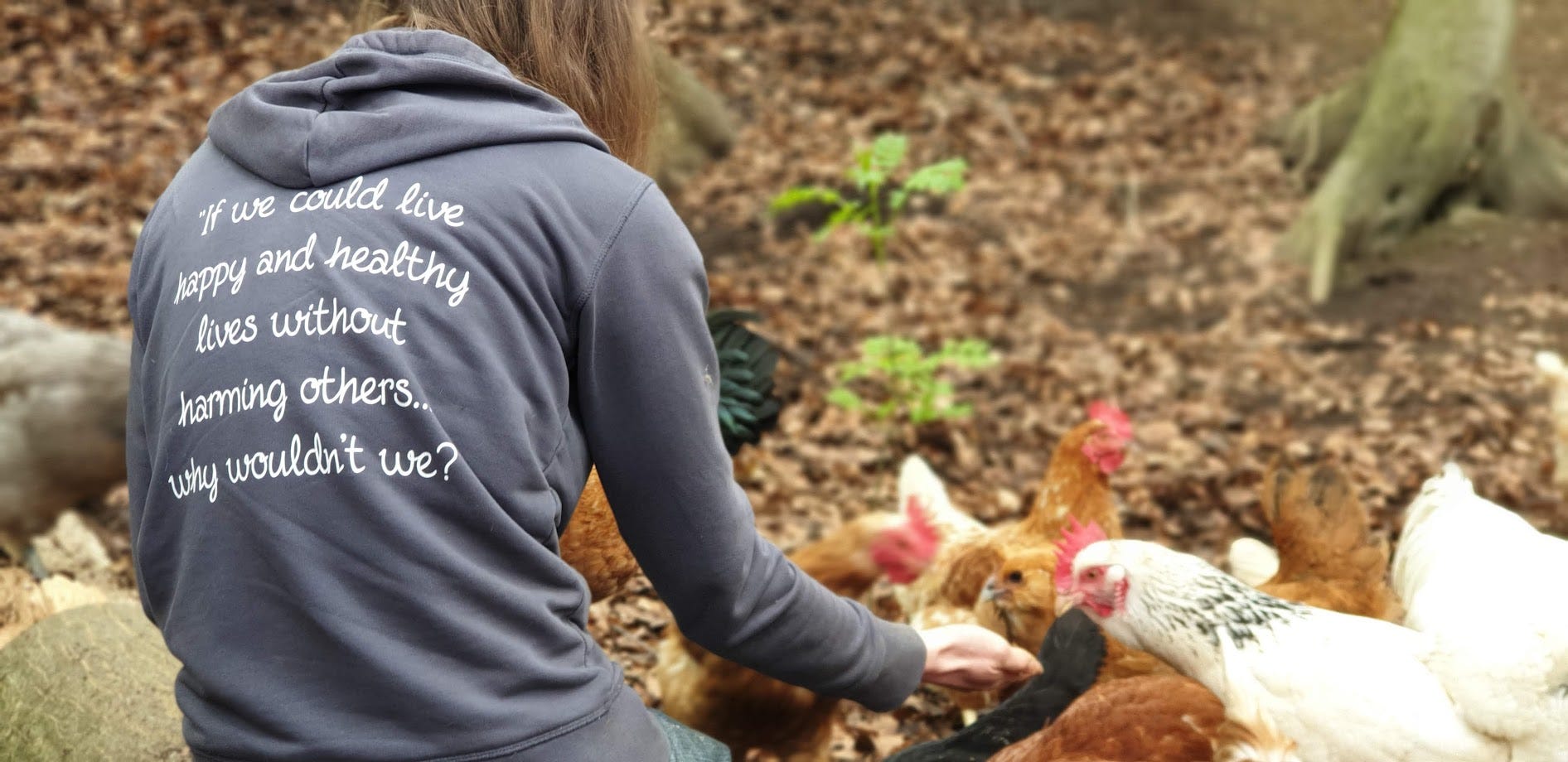
Annie spends all her time and money on her animals, whom she saved from abandonment, neglect, or slaughter. People know how to find her. They often emotionally blackmail her, saying that if she doesn’t take a particular animal, it will be euthanized or slaughtered. Annie has a very hard time saying no in these situations.
Sitting across from her, it’s hard not to feel that her life is no longer entirely her own. That something else is making the decisions.
We could call Annie a prisoner of compassion.* She’s less free than many people are because of how much she cares. Her compassion decides when she travels, how long she stays, how she spends her money, and how much rest she allows herself. While many caring people may feel like this to some extent, it may be worse for frontline animal helpers in animal sanctuaries or shelters.
We have our own sanctuary (Feathery Forest). It’s entirely my girlfriend Melanie’s project. She loves to do hands-on work with animals, while I’m more of a cerebral person who prefers the top-down work. Sanctuaries, and people who take care of individual animals, can only help a small number of animals directly. Costs are high, and animals require a lot of space. For that reason, among activists who focus on impact and effectiveness, sanctuaries sometimes have a difficult reputation: resources could be better spent to help larger numbers of animals.
I think there’s truth to this criticism, but sitting across Annie - and living at a sanctuary myself - I can hardly allow myself to think it. The thing is, I am so glad sanctuaries and shelters are there for the animals, who will remain the victims of human indifference and cruelty for as long as these traits exist in us.
The frontline helpers are the ones who get up close and personal with the misery and the surplus of animals. They incur costs. They experience the heartbreak of having to say no. They face physical and mental exhaustion. They see their animals die, one after another, at a pace that doesn’t even give them time to mourn. They absorb a part of the world’s cruelty so that others don’t have to see it directly. They are the ones, it seems, whom compassion is holding most tightly in its grip.
Looking at Annie, I was thinking about something that could help her. I’m guilty of increasing people like Annie’s burden: when I encounter an animal in need, I’ll find a shelter or sanctuary, or someone who’s got too many animals to take care of already. That’s because I don’t know myself what to do with the animal - certainly not if it’s in need of medical care. At the very least, I leave a donation.
I told Annie something I hope could bring some comfort: that a quick, painless death - euthanasia - is not the worst thing in the world. And that on a planet where there are more animals in need than there are people, resources, or space to care for them, tragic trade-offs are unavoidable. Refusing to accept that can mean pushing people like her past their limits.
When we said goodbye, Annie would soon return to her animals in France. Back to the same responsibilities and the same impossible choices.
I hope that she, and all other prisoners of compassion, don’t just appreciate what holds them hostage, but can also take pride in it. Even if compassion limits their freedom, it is also the reason so many animals are safe. Most of all, their work is an inspiration. In a world where animal exploitation is legal, subsidized and everywhere, they are the ones who remind us of all that humans can be.
* I came across this term in the writing of the Dutch author Charlotte Mutsaers
Comments
Nothing yet. Say the first thing.
Sign in to join the conversation.