
When we started building Tmind AI, we thought we were creating a simple therapy training tool.
Students would log in, talk to an AI client, receive feedback, and improve.
We had the technology. We had evaluation rubrics. We collaborated with professors to align with clinical training standards.
One year later, it’s clear:
what therapists actually need from training tools is not what we expected.
But before we get into that, it’s important to zoom out.
The conversation around mental health access often focuses on one thing:
we need MORE therapists.
That’s true, but it’s only part of the picture.
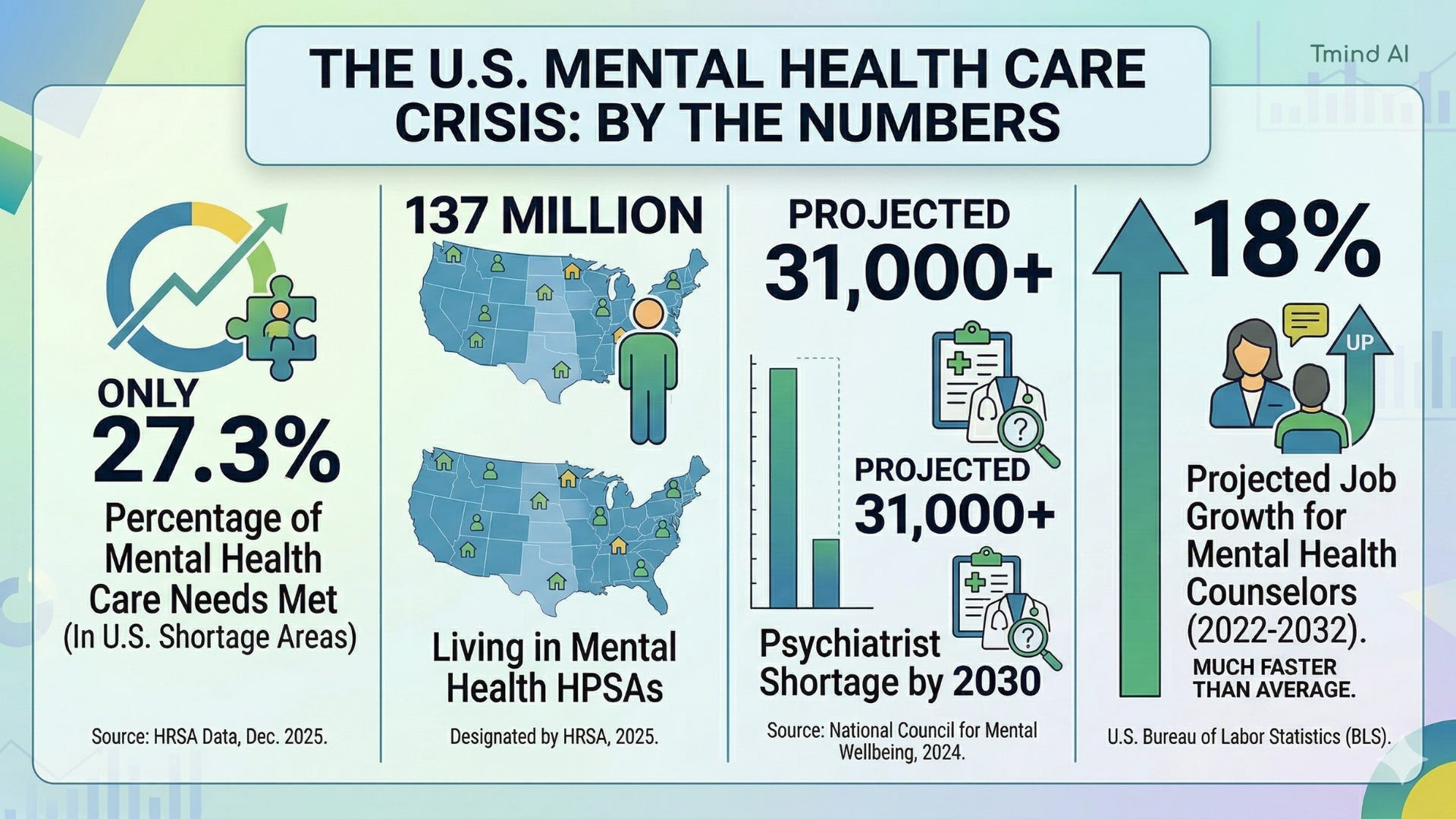
Only 27.3% of mental health needs in the U.S. are currently met1
Over 30,000 psychiatric positions remain unfilled2
137 million Americans live in mental health provider shortage areas3
The U.S. Bureau of Labor Statistics projects 18% growth in demand for mental health counselors through 20324
This points to a clear reality: demand is accelerating faster than supply.
But there’s a second bottleneck that gets less attention: The clinical training system itself is already at capacity. Even as programs try to enroll more students, training still depends on:
Limited role-play hours
Overextended supervisors
Practice environments that are difficult to scale
You can’t train significantly more therapists using systems that are already stretched thin. This isn’t about replacing what works.
It’s about asking:
What tools can expand training capacity without increasing faculty burden?
That’s the question that led us to build Tmind AI, and the lens through which we’ve interpreted everything we’ve learned.
We initially believed students needed more practice. They DO, but the deeper issue isn’t just skill development. It’s clinical confidence.
Professor at Salisbury University shared:
“I’ve seen a real boost in my students’ confidence. The vast majority felt proud and excited as they saw their skills improving.”
This wasn’t about scores or technical proficiency. It was about a shift:
From “I understand the theory”
To “I trust myself in the room with a client”
That shift is what determines readiness for real-world therapy.
And it only happens when practice feels real enough to carry emotional weight.
We originally positioned Tmind AI as an additional training resource. But the feedback from counselor education programs was consistent:
“We don’t need more tools. We need less burden.”
Faculty are balancing:
Teaching full course loads
Supervising practicum students
Managing accreditation requirements
Maintaining clinical responsibilities
The features that actually drove adoption weren’t the most advanced, they were the most practical:
Automated evaluation templates that generate feedback
Progress dashboards that reduce manual review time
Custom AI clients aligned with existing course materials
One of the most overlooked barriers in clinical training is emotional: the fear of failing in front of others.
In-class role-play is valuable, but it can also create pressure that limits learning.
We heard from a student at York University who practiced CBT techniques using Tmind AI. Before entering practicum, he said he finally felt: “like a therapist.”
Not because the AI replaced training, but because it created space to:
Try
Make mistakes
Reflect
Improve
Without being observed or judged.
This idea (private, repeatable practice) turned out to be one of the most impactful parts of the platform.
Not the AI sophistication. Not the scoring system.
Just the ability to learn without pressure.
One year in, the core question guiding our product has changed.
We used to ask: “How do we make the AI more realistic?”
Now we ask: “What does this student need to feel ready for their first real client?”
That shift changes everything.
It moves the focus from:
Technology → to education
Features → to outcomes
Simulation → to preparedness
And the answers are often simpler than expected:
Timely, actionable feedback
Practice scenarios aligned with coursework
Visibility for supervisors without requiring more time
The shortage of mental health providers is not just a pipeline issue.
It’s a training infrastructure problem.
If we want to prepare more therapists, without overwhelming educators, we need:
Scalable practice environments
More efficient feedback systems
Tools that extend, rather than replace, existing training models
This is bigger than any single platform. It’s a systems challenge that requires new approaches across the field.
We’re still early. One year is just the beginning. But one thing is clear: The future of therapist training isn’t just about better AI. It’s about better preparation.
If you’re a faculty member, supervisor, or student, we’d love to hear your perspective.
What’s working? What’s missing?
Because this isn’t a finished product. It’s an ongoing conversation. 💚
https://data.hrsa.gov/default/generatehpsaquarterlyreport
https://www.healingpsychiatryflorida.com/blogs/mental-health-provider-shortage-statistics-2026-report/
https://data.hrsa.gov/default/generatehpsaquarterlyreport
https://www.bls.gov/careeroutlook/2023/article/careers-in-mental-health-services.htm
Comments
Nothing yet. Say the first thing.
Sign in to join the conversation.