
One of the first things we learned while building TMind AI was that creating an AI that can hold a conversation is not the hardest part.
The harder question is whether that conversation actually helps someone become a better clinician.
A simulated client can sound natural and still teach the wrong lesson. A score can look precise without telling a student what they should do differently. A technically impressive platform can create more work for faculty rather than supporting the way they already teach.
Clinical education is not simply a technology problem.
It involves empathy, judgment, ethics, supervision, culture, professional identity, and the gradual process of learning how to sit with another person’s uncertainty. Those things cannot be understood from product development alone.
That is why we believe clinical training AI should be built with educators, clinicians, and researchers—not around them.
At TMind AI, this belief shapes both the platform we are building and the questions we ask along the way.
Real clients do not arrive as perfectly organized case studies.
They may not know exactly why they are seeking help. They may contradict themselves, avoid a difficult subject, change direction, become frustrated, or struggle to put an experience into words.
A useful simulated client should therefore do more than provide plausible answers. It should give learners an opportunity to notice emotional cues, tolerate uncertainty, recover from missed opportunities, and adapt their approach.
If every simulated client is articulate, cooperative, and easy to understand, students may become more comfortable with ideal conversations without becoming more prepared for real ones.
This is one reason the clinical backgrounds represented in the TMind AI advisory network matter.
Dr. Patricia Desrosiers brings experience in clinical social work supervision, child welfare, victim services, interpersonal violence, and interprofessional education. Dr. Dany Lamothe brings a psychiatric and integrative-care perspective from Stanford’s Department of Psychiatry and Behavioral Sciences. Dr. Rebecca Anthony and Dr. Rachel Buchanan bring expertise related to social work education, identity, social justice, adolescent mental health, wellness, and professional self-care.
Their fields remind us that a client cannot be reduced to a diagnosis, a script, or a clean set of symptoms.
Clinical simulation must leave room for context, identity, ambiguity, and the parts of a conversation that do not unfold as planned.
Practice matters. But practice by itself does not guarantee improvement.
As we discussed in our previous article, Why AI-Simulated Practice Needs Feedback, learners need more than repetition. They need help recognizing what happened in the conversation, what they did well, what they missed, and what they might try differently next time.
That feedback cannot simply say, “Good job.”
It should connect specific moments in a session to meaningful clinical skills, such as:
Empathy and reflective listening
Client-centered communication
Cultural humility
Professional ethics
Motivational Interviewing
CBT, DBT, ACT, or other therapeutic approaches
Assessment and clinical reasoning
Therapeutic collaboration
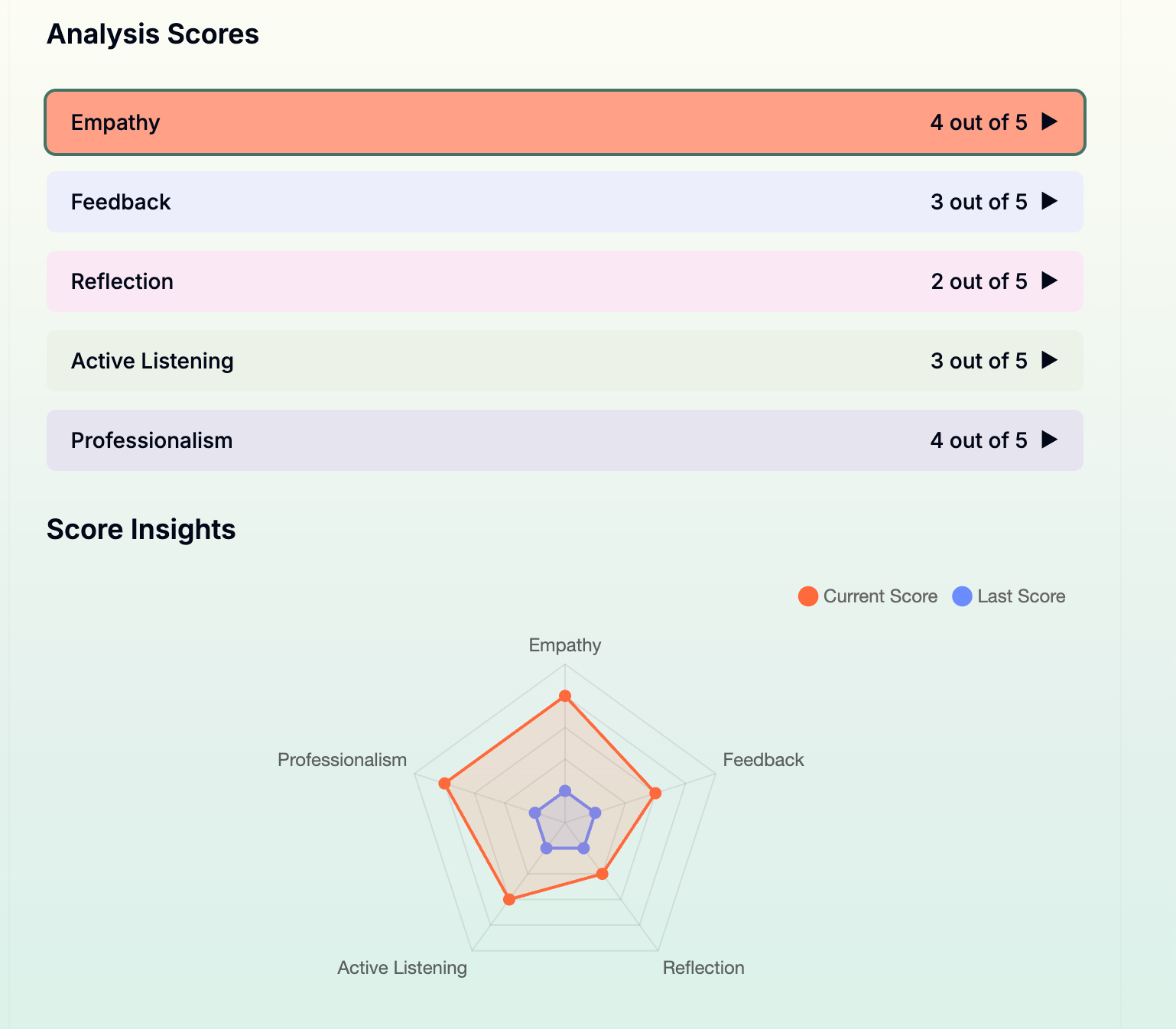
TMind AI allows educators to create evaluation templates aligned with the therapeutic frameworks and competency standards they already use. The platform currently supports customizable post-session feedback for approaches including CBT, DBT, ACT, Solution-Focused Brief Therapy, Motivational Interviewing, and family systems.
The research and evaluation expertise within our advisor network helps keep us honest about this principle.
Dr. Lia Nower, Associate Dean for Research at Rutgers School of Social Work, brings expertise in psychometric measurement and research methodology. Dr. Jeffrey Parsons brings experience in counselor education, program evaluation, accreditation, pedagogy, and instructional technology.
Their backgrounds point to a basic truth: an AI-generated score is not valuable merely because it is numerical.
Feedback should be understandable, relevant to the curriculum, and useful enough to support a real conversation between a learner and an educator.
Every program teaches differently.
An MSW course preparing students for practicum will not have the same objectives as a PMHNP psychotherapy course, a counseling skills lab, or a psychiatry residency program.
Faculty know what their students have been taught. They understand the purpose of an assignment, the developmental stage of the learner, and the context behind a student’s performance.
AI should not override that judgment.
Educators should be able to decide:
Which client scenarios students practice with
Which competencies are evaluated
How feedback is interpreted
Whether a session should be repeated
How transcripts are used in teaching or supervision
Where simulation fits within the broader curriculum
TMind AI supports customizable client profiles, evaluation templates, course-based practice, transcript review, faculty dashboards, cohort analytics, and institutional integration. Programs can also create shared libraries of approved cases and rubrics aligned with frameworks such as CSWE, CACREP, or their own internal standards.
Academic leadership and teaching experience are especially important here.
Dr. George Leibowitz, Dean and Distinguished Professor at Rutgers School of Social Work, brings the perspective of a social work educator, scholar, and academic leader. Dr. Amy Skeen, Professor of Practice and Associate Director of the MSW Program at Simmons University, brings more than 20 years of direct social work practice and nonprofit leadership to her work as an educator.
Their backgrounds reflect the reality that technology has to work within actual programs—with real faculty responsibilities, learning objectives, institutional constraints, and student needs.
The program should not have to reshape itself around the tool.
The tool should be flexible enough to support the program.
Clinical growth is difficult to capture in a dashboard.
A score may help identify a pattern, but it cannot fully explain why a student responded in a particular way, what they noticed in the moment, or what made them hesitate.
Two learners may receive a similar result for very different reasons.
One may have missed an emotional cue. Another may have recognized it but felt unsure how to respond. A third may have understood the client’s emotion but moved too quickly toward advice because silence felt uncomfortable.
Those are different learning needs.
That is why the purpose of feedback should not be to deliver a final verdict. It should give the learner and educator something more concrete to reflect on together.
TMind AI combines structured feedback with session transcripts so students can revisit the conversation rather than relying only on memory. Faculty and supervisors can review what was said, identify specific moments, and turn an evaluation into a more meaningful teaching conversation.
The social work and counseling educators in our advisor network bring valuable perspectives to this part of the work.
Dr. Amy Skeen’s experience connecting social work education with direct practice, Dr. Rebecca Anthony’s work in digital technologies and social work education, and Dr. Jeffrey Parsons’s expertise in counselor pedagogy and professional identity all reinforce the importance of learning as a reflective process—not simply a score to optimize.
We want students to understand how they practice, not merely whether an automated system marked their response as correct.
AI simulation can make practice more accessible.
Students can rehearse difficult conversations outside scheduled class time. They can repeat a scenario without placing a real client at risk. They can experiment, make mistakes, and review what happened afterward.
Faculty can gain greater visibility into communication patterns that might otherwise be difficult to observe.
But none of this replaces human supervision.
A supervisor helps a learner understand much more than technique. Supervision creates space to discuss uncertainty, ethics, culture, boundaries, emotional reactions, professional identity, and the realities of working inside complex systems.
Those responsibilities should not be delegated to an automated platform.
TMind AI is designed as a training environment—not as a replacement for faculty, clinical supervisors, standardized patients, field education, or professional judgment.
Its role is to make practice more available and feedback more actionable while keeping human educators at the center.
That boundary is particularly important in mental health education. The goal is not to make learning less human.
It is to give educators more ways to support the human development already at the heart of their work.
It would be easy to present an advisor network as a collection of recognizable titles and university names.
That is not what matters most to us.
What matters is the range of perspectives represented.
A dean may ask whether a platform fits the realities and responsibilities of an academic program.
A researcher may ask whether an evaluation is valid and whether the evidence supports the claim being made.
A clinical supervisor may ask whether a simulated interaction reflects the uncertainty of real practice.
A social work educator may ask whether identity, culture, ethics, and the realities of the communities students serve are being treated seriously.
A counselor educator may ask how the platform supports professional development, accreditation standards, and reflective learning.
A psychiatrist may ask where simulation is useful—and where its limits need to be made clear.
These questions do not make product development easier.
They make it more responsible.
The expertise represented across our advisory network helps us remember that TMind AI should not be judged by how convincingly it can imitate a client.
It should be judged by whether it helps learners become more prepared, thoughtful, and responsible when the client is real.
The future of clinical training technology should not be defined by what AI can generate on its own.
It should be defined by what students do better with it.
That means building realistic simulation without pretending that a simulated client is the same as a real person.
It means offering structured feedback without treating an AI score as unquestionable.
It means giving faculty useful tools without taking control away from them.
It means encouraging reflection rather than teaching students to chase a number.
And it means using technology to support supervision—not to replace the people who make supervision meaningful.
We are still learning.
Every pilot, faculty conversation, student experience, and research collaboration helps us see the work more clearly. That process is not separate from building TMind AI. It is the work.
We are building with educators because they understand what happens before, during, and after a student enters the room with a real client.
And because the quality of clinical education deserves more than technology built from the outside looking in.
TMind AI is being built with educators, not around them.
The current TMind AI advisory network includes:
George Leibowitz, MSW, Ph.D. Dean and Distinguished Professor, Rutgers School of Social Work
Lia Nower, JD, Ph.D. Associate Dean for Research, Rutgers School of Social Work
Patricia Desrosiers, Ph.D., LCSW Retired Professor and Department Chair, Western Kentucky University
Amy Skeen, DSW, MSW Professor of Practice and Associate Director of the MSW Program, Simmons University
Rebecca Anthony, Ph.D., MSW Associate Professor of Social Work, Salisbury University
Rachel Buchanan, Ph.D., MSW Associate Professor of Social Work, Salisbury University
Dany Lamothe, MD Clinical Assistant Professor, Psychiatry and Behavioral Sciences, Stanford University
Jeffrey Parsons, Ph.D. Professor of Counseling, Lindsey Wilson University
Titles and institutional affiliations are provided for identification. Advisor participation should not be interpreted as an endorsement by the advisors’ institutions unless separately stated.
Comments
Nothing yet. Say the first thing.
Sign in to join the conversation.