
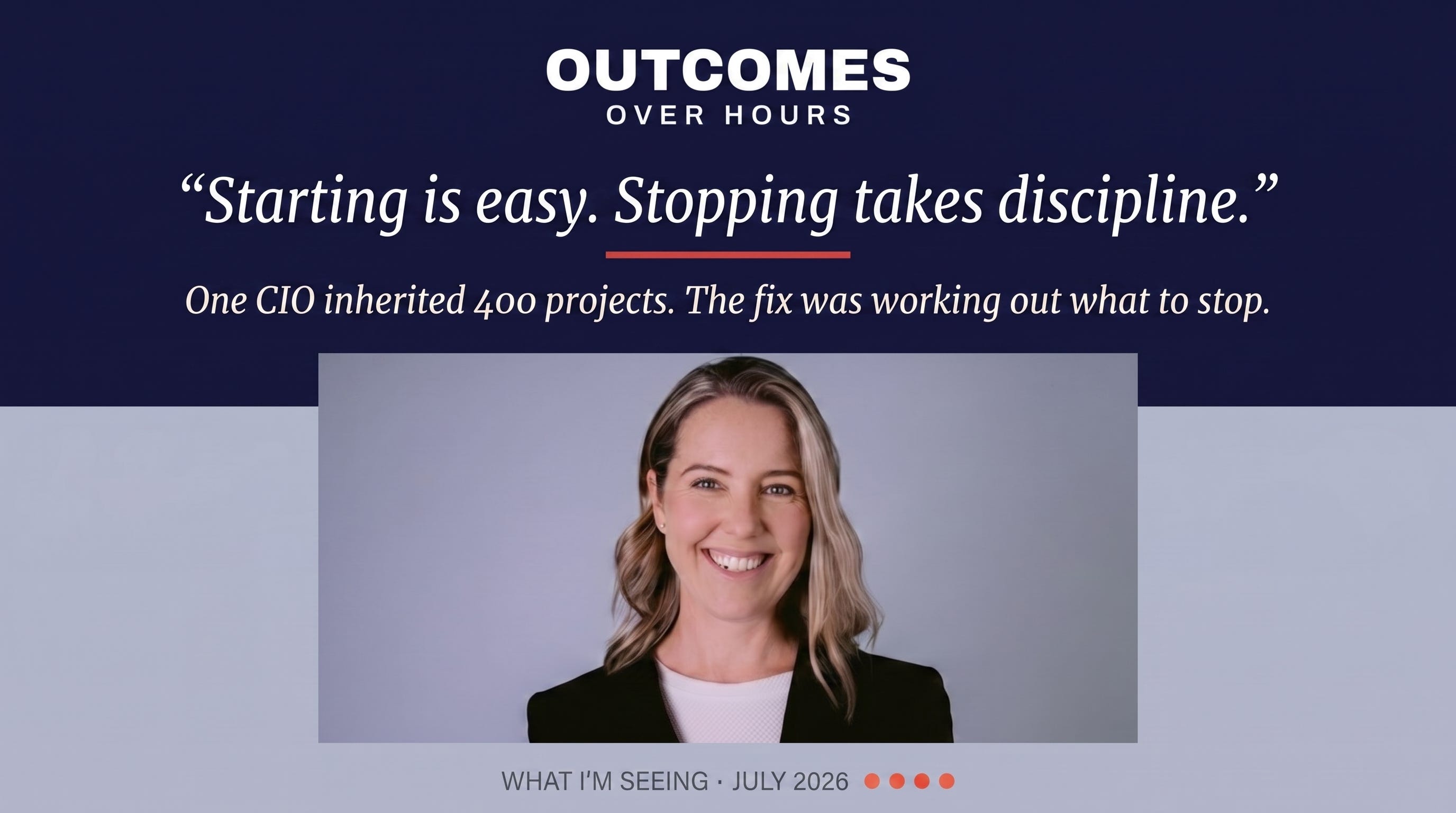
A CIO I’ve worked with for years moved into a new role at a large Australian organisation.
In his first few weeks, he counted the projects underway.
More than 400.
Not 400 ideas. More than 400 things someone was actively working on, meeting about, or building a business case for.
He worked out fast what that number was costing him.
The projects that mattered most were slipping. The high-visibility ones. The ones with real teams assigned and board-promised returns were late and over budget.
The teams were highly capable, but they were drowning in the whole system of everything else.
So he brought me in. We started with co-designing their department’s strategy on a page with his Leadership Team, so the broader team was clear on what actually mattered.
Then we did the part most LTs avoid … we worked out what to stop.
Here’s what was really going on under that 400+ number.
Senior people were sitting in rooms scoping work that hadn’t been approved. Building business cases. Aligning on outcomes for projects that might never make the cut.
New projects kicked off before the higher-priority ones were closed out and had delivered the returns promised to the Board.
Then there were the thought bubbles. Someone has an idea, often a good one, and just starts rallying people and building momentum - but with no capacity to actually deliver it.
Anyone could start a project at any time.
It looks like innovation. In practice though, it’s why the most important work slows to a crawl. Every new thing pulls attention, meetings and goodwill away from the work already promised.
There’s a piece of this that almost everyone misses when thinking about transformation.
When leaders think about capacity, they think about project teams. They typically forget the subject matter experts.
I’ve watched huge projects stall on one person. Usually, it’s some version of this:
Picture the brilliant lawyer everyone trusts. She has her day job. On top of it, nine different projects need her sign-off. Every one of them waiting on her.
She can’t get through them all on top of her BAU work. There just aren’t enough hours. So the projects don’t fail - they just sit on her desk. Sometimes for weeks.
One person, quietly holding up nine things at once, because every project assumed she was free.
Knowing which initiatives matter most is half the job. Knowing which experts they lean on, and protecting those people’s time, is the other half.
We took all 400 and sorted every one into three piles.
💠 Continue. The work that was clearly going to add the most value now, for people, customers and the organisation.
💠 Kill, and don’t relitigate. The work that no longer made sense, stopped cleanly so it couldn’t creep back onto someone’s plate.
💠 Not now. The good ideas that didn’t fit current capacity. Parked on purpose, ready to be reassessed to pick up once the vital work was delivered.
That last pile is where the discipline lives.
It takes maturity for a leadership team to say a good idea is still good, and it’s not starting today.
That first pass took the list from more than 400 to just under 100.
Still a lot. We were proud of it anyway, because of what came next.
The most important work rose to the top. The projects that mattered finally had people’s time and attention. They started landing on time.
And something else that was just as important started happening too:
With the noise cleared, the leadership team had room to fix things that had been hurting the business for months. The highlight was that in just four months, they also cut their priority one defects by more than 70 per cent.
That’s the part leaders underestimate.
The cost of the 300 things you don’t stop isn’t their own wasted effort. It’s the attention they steal from everything else - including the fires you’d put out, if you only had the space to see them.
Right now, AI makes the temptation to start stronger than ever.
A pilot here. An agent there. A proof of concept for the board. Each one reasonable on its own. Together, a fresh 400.
The leaders who get real value from AI won’t be the ones who start the most. They’ll be the ones with the discipline to stop, to park the good-but-not-now, and to guard the few people everything depends on.
So here’s a question worth reflecting on:
If you counted every project underway in your organisation right now, every one someone is working on, meeting about, or quietly building a case for, what would your number be?
And which of them would still be running if you applied this disciplined thinking across the entire portfolio?
Start well. Then have the discipline to stop well where it makes sense.
Every week, I share what I see. Subscribe and see it too.
Tina Paterson is the founder of Outcomes Over Hours. She partners with tech leaders and their leadership teams to deliver the right outcomes faster and easier.
Because humans who strategically leverage AI will always win.
No posts
Comments
Nothing yet. Say the first thing.
Sign in to join the conversation.