
In this podcast, Dr. Aaron Yelowitz and I talk over our dueling papers concerning the role of the government in health insurance choice. We know that consumers often struggle with complex plans, leading to costly mistakes and inertia, even when better options exist. However, individual choice can lead to better matches to our preferences versus rigid, one-size-fits-all approaches of bureaucratic systems. Centralized choice presents a risk if government agencies have different priorities than constituents, such as budgetary savings or risk-aversion to bad publicity.
Dr. Yelowitz walks through a major Medicaid program in Kentucky which shows how default assignments and opaque algorithms created both financial losses and restricted access for inattentive consumers. Can we design systems to allow consumer choice balanced with structured guidance? How might AI help simplify decisions, reducing errors while preserving flexibility to improve healthcare decision-making?
Dr. Aaron Yelowitz is an Economics professor University of Kentucky, a joint faculty member in the Martin School of Public Policy and Administration, a senior fellow with the Cato Institute, and a research fellow with the Institute of Labor Economics (IZA).
If you’re curious on how we choose insurance wrong (and how to get better at it), check out my accompanying post!
How We Choose Insurance Plans Wrong
·
Apr 1
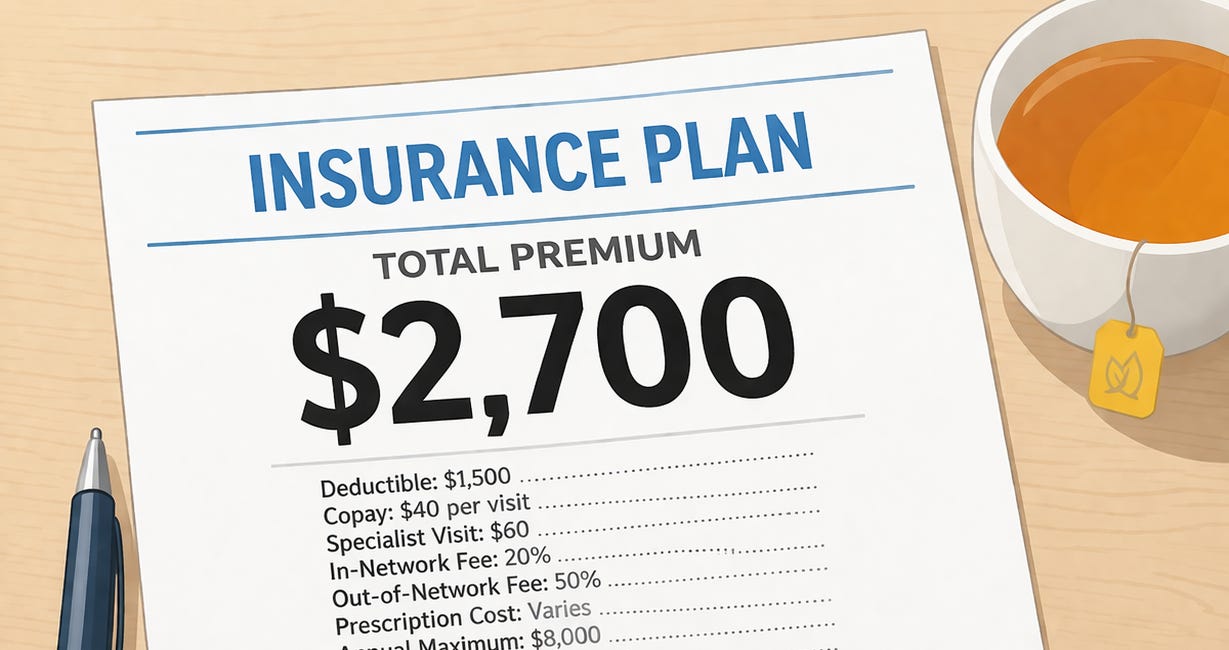
Health insurance plans are confusing. So confusing, in fact, that there is an entire academic literature in economics on ways that people can choose their plan badly. Some studies found mistakes where enrollees overpay by $2,000 per year, on average. Adding in dependents raises the magnitude of mistakes by over $751 compared to a single enrollee alone. …
A Conversation about Consumer Choice and Health Insurance: Should We Trust Consumers or Bureaucrats with Our Health?
Tina Marsh Dalton
Welcome to Words to the WHYs on Healthcare podcast, Aaron. I’m really glad to have you.
Aaron Yelowitz
Pleasure to be here.
Tina Marsh Dalton
So, we were going to talk today — we have these paired chapters where we’re thinking about what’s the role of markets, what’s the role of the government in healthcare. But let’s start with yours. Why don’t I let you tell the title of your paper, because I feel like you’re going to give a better spin.
Aaron Yelowitz
So, the title of my paper, very provocatively and non-judgmentally, is, Should We Trust Consumers or Bureaucrats? The big idea in it is that one way of thinking about health insurance is that it’s a financial product. It covers uncertain healthcare expenses that may arise, and consumers, generally speaking, are not all that good at making financial decisions. Imagine that there are many health insurance plans out there. Figuring out which one is the correct one, given your circumstances and the forecasting involved, is really challenging.
Tina Marsh Dalton
But then the question is — you have a lot of choices.
Aaron Yelowitz
Yes, there could be a lot of choices, even two choices.
Tina Marsh Dalton
And then there’s all these pieces that are super confusing.
Aaron Yelowitz
Yes. So, for example, I’m sure the students in your class or in my class can understand distinctions between deductibles and coinsurance rates and maximum out-of-pockets and so forth. Take that to people who haven’t taken a health economics class, yet are economics majors or fairly literate business-wise. It’s not always obvious that they understand those kinds of distinctions, and that is just the first pass, right?
Tina Marsh Dalton
I actually have a story about that. I saw my cell phone ring right after I started my first job. It was an old friend from grad school, and I was so glad he was calling me. He has a PhD, he did very well, but he was calling because he had to choose his first health plan and wanted some help. And it’s like — oh my gosh, you have a PhD, and this is already complex.
Aaron Yelowitz
The way I liken it to my students — imagine that we were presenting in class in a language other than English. Basically, no one would be able to understand what we’re saying, and in a way, we could almost think of financial products as having a flavor like that. And that doesn’t even scratch the surface over networks and coverage, things that potentially matter. Where the hook comes in, in my chapter, would be — let’s all agree that plenty of consumers are making real mistakes, leaving money on the table.
Tina Marsh Dalton
Could we explain how that might be happening? Because both you and I, in both of our chapters, identify that consumers could make mistakes — so what would be an example of a mistake?
Aaron Yelowitz
Yes. There is a thriving economics literature, including Ben Handel’s excellent work in the American Economic Review, that basically shows a large, anonymous company that offered health plans, and partway through the study period, they updated those plans. Some of those plans no longer worked for employees in the following way: no matter how much you might spend that year, you were worse off being in that plan compared to some other plan because of the cost structure. The way we can simplify this — imagine that I was offering you a hamburger, the same hamburger, for either $2 or $3. In principle, everyone should pick the $2 hamburger because it’s the same hamburger. The amount of money that was lost by choosing the wrong hamburger — the same hamburger but more expensive — was often in the hundreds or thousands of dollars per year, and of course, that can compound year after year. This is not some people choosing a plan because they’re sicker, or others making bad forecasts. This is literally, if two hamburgers are right there, choosing the more expensive one, even though they’re the same hamburger.
Tina Marsh Dalton
Yeah. I’ll be referring listeners to a post that accompanies this, that is going to walk through this paper. But the idea is that the deductibles were all different, but the plan itself was the same, and when they changed premiums, people didn’t notice that they were actually paying way more in premiums than before. They could have saved money and gotten the same thing in a different plan. Other papers sometimes talk about just the number of pieces of the plan confusing the enrollees — they focus on one thing and choose the lowest of that, but the other pieces would have made a different plan better, things like that.
Aaron Yelowitz
Exactly. And then what Handel shows is — we might think we all make mistakes, right? You pick something and then you say, I didn’t read the terms and conditions, let me get out of that silly choice and make a different choice. What he shows in his paper is that there is a surprising amount of persistence if you home in on the traditional economic model, which says people have perfect information, they respond very quickly, and so forth. Of course, most of us, through introspection, could easily dismiss that kind of thing. How many of us have streaming subscriptions that go from one month to the next where we haven’t used the streaming at all in the last month?
Tina Marsh Dalton
And where, in principle, if you subscribed on your phone, you could immediately subscribe and then cancel, and it auto-cancels.
Aaron Yelowitz
But choice architecture — Netflix, Disney, any of those — basically wants you to auto-renew, rather than automatically canceling, where the moment you realize there’s something you want to watch, you could easily renew. So basically, lots of persistence.
Tina Marsh Dalton
I like that — it’s also just really hard, right? And to throw a bone to people who might be thinking this applies to them: it’s hard, and you’ve just decided there are other things in your life that you have to focus on. So the idea of, how can we make this less hard, so that people can take the extra time to make the good choice?
Aaron Yelowitz
Yeah, so there’s obviously an issue of rational inattention. For example, should you ponder every day how to drive from home to work? The answer might be — if it’s a particularly important day. I emphasize to my students that perhaps on the day of a midterm, you would map your route, check your phone ahead of time, make sure there are no traffic delays, that kind of thing. But oftentimes, people get stuck in their ways. I can predict after day one where each of my students will sit in their class, even though I don’t have assigned seating and even though attendance tails off after day one.
Tina Marsh Dalton
There are new seats available they could choose from.
Aaron Yelowitz
They could re-optimize, and they would all nod their head and agree with me that there is a lot of stickiness to it. So basically, the neat thing about Handel’s AER paper is that there are really two different ideas. One is that you could be asleep at the wheel — which he calls inertia — and the other is you might just have what I might consider a mistake. So imagine I said to you that the $3 hamburger is just the same as the $2 hamburger, and you say, yes, but I just want to buy the $3 hamburger. He would call that perhaps a mental error, but not inertia. And in his paper, he actually tries to tease out how much of it is one versus the other.
Tina Marsh Dalton
Are you asleep at the wheel versus how much of it is that you like the bright shiny object on the $3 hamburger — or it was presented to you first, and now you just cannot get off that idea?
Aaron Yelowitz
Yeah, so it’s a hugely influential paper, and it actually matters for the stability of insurance markets. In the canonical model of insurance markets, where you have differently healthy people — some sick people purchasing insurance and some healthy people — if you were to try to charge a premium that averaged over everyone, what we would call a community-rated premium, then the healthy people will often want to escape from the sick people, because basically they’re cross-subsidizing them. That was a big motivation behind the individual mandate in the Affordable Care Act.
Tina Marsh Dalton
Yeah, I like to say — who likes insurance? Sick people like insurance.
Aaron Yelowitz
Yes, and it’s a big win for them for community rating. But the typical economic approach would be: well, if people are awake at the wheel, then the moment they could be freed of a mandate, they would try to escape that and find some other plan. We might call that a death spiral. There’s actually some neat evidence on death spirals in the Harvard context, a paper by Cutler and Rieber. But we actually went through this experiment in the US — the tax cuts in 2017, I think, peeled away the financial penalty of the individual mandate around the year 2019. And so that literally takes all of the teeth out of the requirement, yet insurance markets didn’t collapse.
Tina Marsh Dalton
It’s on the books, but there’s no fine.
Aaron Yelowitz
Right, so insurance markets didn’t collapse. This is the kind of provocative intersection of economics, psychology, and how markets work. And then, assuming that we think markets don’t always work very well because of either consumer mistakes — which sometimes actually help the market, right? If healthy people don’t try to escape from those plans, then the cross-subsidies continue.
Tina Marsh Dalton
This inertia maybe stops the market from collapsing as much as it would theoretically collapse.
Aaron Yelowitz
Yes, it could. So basically, there’s this interesting confluence of how do markets work in reality, not just theoretically; how much should we weight smart, reactive consumers versus those who are perhaps asleep at the wheel; and how does that matter for a complex product like health insurance, where at least part of it is just a complicated financial product versus something simple like hamburgers. And so, one might then make the argument — in my title, Shall We Trust Consumers or Bureaucrats? — the question becomes, do we think bureaucrats will necessarily do the right thing from the consumer’s point of view? Who is the bureaucrat working for, in some sense?
Tina Marsh Dalton
Well, so before we go on to the bureaucrats, maybe we could take a moment. We’re saying consumers are doing a bad job. Why would we ever think of giving consumers this choice? What is the rationale behind this empowering of consumers?
Aaron Yelowitz
I suppose one thing would be — the question is, it’s probably fair to say that consumers may not necessarily nail it perfectly, but do they get closer to where their true preferences are than if we had some central planner choosing for us? Imagine that I’m much older than your recent graduate who’s listening to a podcast. Different health insurance plans might be differently appealing to me at my stage of life than to a new graduate. But of course, there might be people my age who would prefer a less comprehensive plan, and young people who prefer a more comprehensive plan. The problem with bureaucrats, I suppose, is we often get one-size-fits-all.
Tina Marsh Dalton
With very few gradations.
Aaron Yelowitz
And clearly, directionally, we think that consumers are often going in the right direction, and maybe part of the reason why papers get published is because there are sometimes notable exceptions.
Tina Marsh Dalton
Well, and a lot of this has been a theme: the idea they call consumer-driven health plans — put more skin in the game for the consumers, because they are the most invested in this decision, and that will fix the problems because they’re paying attention. Or at least their wallets start making them pay attention.
Aaron Yelowitz
Right. I think this gets at least to part of your chapter — that perhaps works at some points, but not others. Imagine, for example, that you have a very high deductible plan, and during the pandemic, if you are old — getting vaccinated, if you’re over the age of 70, I would personally view as a corner solution that is unambiguously positive in terms of improving your health. But people might worry about rare bad outcomes. Those stories tend to get amplified, and people may misweigh those kinds of probabilities.
Tina Marsh Dalton
Yeah. But we were going to get to the bureaucrats. We wanted to give consumers their place in the sun first — why are we even talking about this choice?
Aaron Yelowitz
Right. So, in principle, if a smart bureaucrat was running a plan with good motives, they would try to line up the inherent structure with what consumers want. But that runs into the concern that not all consumers want the same thing. And then, I suppose — Milton Friedman, I think, was the one who had the phrase, who are these angels out there? It was a Phil Donahue interview — there’s a video of this, I’ll send you the link for the notes. Milton Friedman was being interviewed by Phil Donahue, mostly about central planning in the Soviet Union in the 1970s: who are these angels who will make all these good decisions for us? Right, it looks old and dated today, but some of us can remember watching those kinds of films during our undergraduate classes.
Tina Marsh Dalton
Yeah, I remember being introduced to the idea — we call it the benevolent dictator. What if there was someone that could decide for the whole society? It’s just a thought experiment in economics, the benevolent dictator. And when I was applying to grad school, I always thought, I’m going to write a paper called Empirical Evidence for Benevolent Dictators — I don’t see so many of those.
Aaron Yelowitz
Right. My reaction would be that there is a literature out there that says bureaucrats often like to lead the quiet life. Imagine that your typical bureaucrat gets paid reasonably, but unlike Elon Musk, who thrives when his companies thrive, the role of a bureaucrat is to not have bad headlines — some kind of damage minimization. So you don’t make bold choices in any way. What you will end up getting is the one-size-fits-all, very average healthcare plan with no innovations. And there’s clearly a clientele out there — people who make mistakes, but also people who clearly want to own their lives much more, for better or worse, and are willing to live with their mistakes. Bureaucrats will tend not to be terribly responsive to those kinds of people, because there potentially is a lot of upside, but there’s also downside, and the downside leads to headlines. Look at this one person who you gave freedom and autonomy to, and bad things happened. Maybe that’s even worse today because of the way things get amplified, and one story becomes a narrative.
Tina Marsh Dalton
So, on the bureaucrat idea — you, in your paper, you walk through a specific example in Kentucky, right? The idea of, in practice, we’re not just going to talk about this on a theoretical level.
Aaron Yelowitz
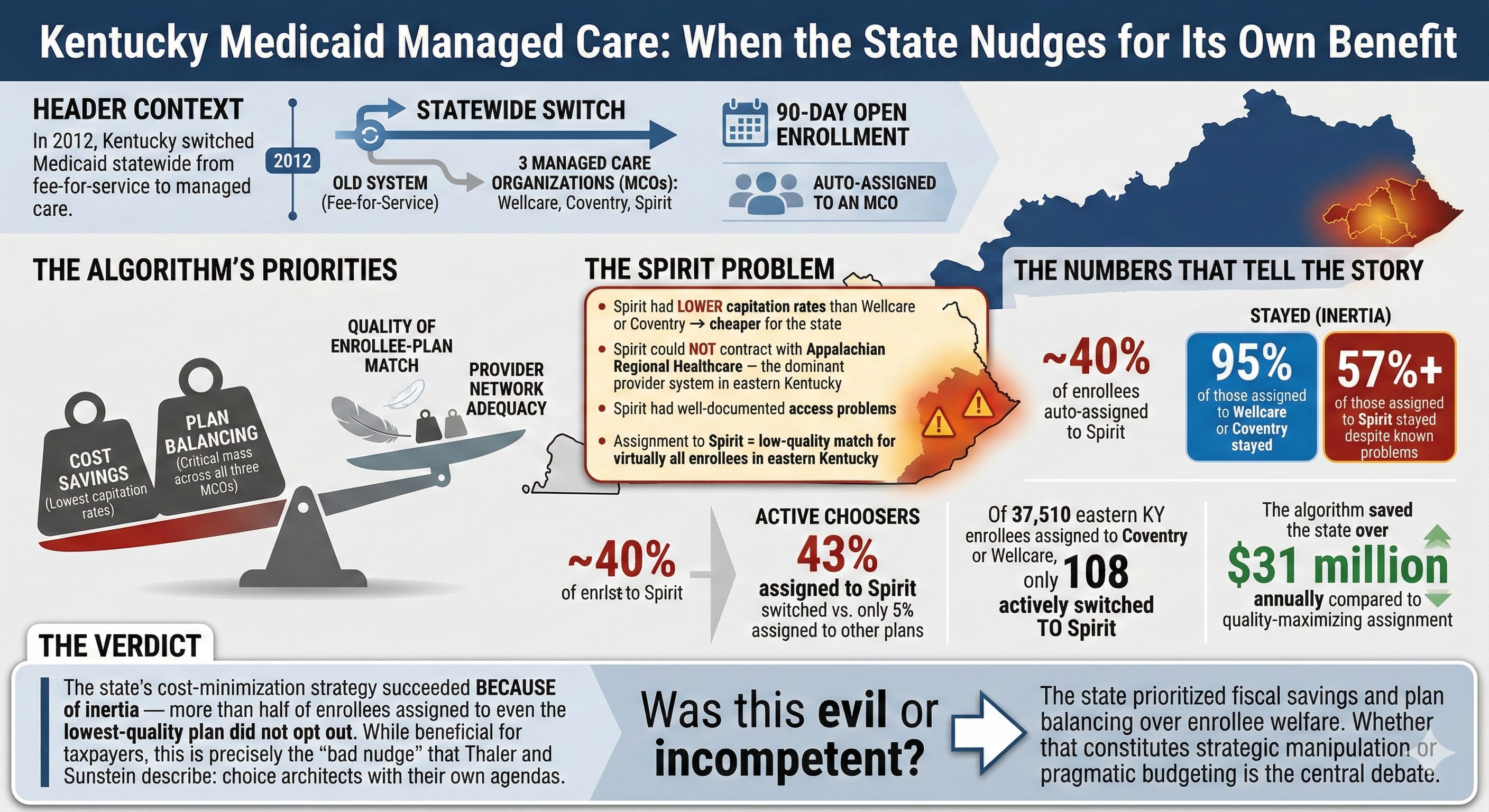
Yes, so I’m at the University of Kentucky, and I keep up to some degree with what goes on there. One of the really great things about being at the flagship university in the Commonwealth is sometimes having access to Kentucky data that’s harder for others to get. And basically, Kentucky was coming up with a policy change. The Affordable Care Act had been passed and was going to come into effect, and Kentucky was trying to switch their entire Medicaid population over to managed care. In much of the state, it had been a fee-for-service plan. The area around Louisville moved to managed care much earlier than the rest of the state.
Tina Marsh Dalton
So to make sure we make the difference clear — the lucky people not in managed care had fee-for-service, so the provider gets paid from a fee schedule, whereas managed care is going to be focused much more on controlling the behavior of the provider, or the foot traffic of the enrollees. There are networks they can get into, or they have to pay more, and so now we’ve got a big shift in the system.
Aaron Yelowitz
Yes, so there’s a big shift in the delivery of healthcare, and part of the federal legislation was that if you’re offering managed care to your Medicaid clients, you have to offer at least two different choices. Kentucky ultimately offered three different choices, but you run into the following issue. Imagine that you’re moving people from one insurance plan to another. Most people are simply not going to express any preference over what we might call Plan 1 versus Plan 2 versus Plan 3, each with different providers. So the question is, if you’re designing a program, what happens in that case? What would typically happen would be some kind of algorithm, and if it was a very good algorithm, it would do something along the lines of, say, well, of the three plans, our prediction is this would be the very best plan for you in terms of the network of providers and cost-sharing. Although for Medicaid, cost-sharing is not a big deal, because the clients are very poor.
Tina Marsh Dalton
In this algorithm, how much information do they have on the consumers?
Aaron Yelowitz
We never saw the algorithm — we asked. Imagine the wizard behind the curtains. That is perhaps the level of transparency that many of these algorithms would have. And what that leads to is — we don’t know whether the wizard is trying to steer you into Plan 1 because it’s the best plan for you, or because it’s the cheapest plan out there — in which case they’re not working for the Medicaid client, but for the taxpayer — or it could just be they have no idea what they’re doing and they do something like flipping a coin. Which very well could happen too.
Tina Marsh Dalton
Or even worse, they could be bad at their job — so instead of a random bad outcome, it’s systemically putting people into a bad situation because they just didn’t understand how it worked.
Aaron Yelowitz
Right. So maybe this actually operationalizes why we would want people to make their own active choices rather than a bureaucrat. Imagine that you’re moving a million Kentucky Medicaid clients from fee-for-service to managed care. Obviously we’re going to run into the issue of many people not wanting to make a choice. But if your choice is already made for you, perhaps you think there’s a reason why that choice was made, so you don’t undo it and go somewhere else. One of the fascinating things about the Medicaid reform was that it steered you in a direction, but you did not have to go in that direction — what the behavioral economics literature calls a nudge. The likelihood of ending up in one plan if you were assigned to that plan is dramatically higher than had you not been assigned to it, so there’s a level of inertia.
Tina Marsh Dalton
We already talked about the cost of choosing the plan being large — this is a large cognitive load — and now we just added that you also have to actively pursue it.
Aaron Yelowitz
Right. So basically, the path of least resistance is, you get some letter that says you’re signed up for Plan 1 versus Plan 2 versus Plan 3, and if you don’t do anything, you end up in that plan. Now, where does this go wrong? We were fairly confident, even before we got the data, that we would see quite a bit of this stickiness, because it is pervasive in the behavioral economics literature — when you steer people in a certain direction, they tend to go in that direction. So we were not surprised about that. However, one of the three plans, called Kentucky Spirit, did not come to an agreement with Appalachian Regional Health, which was the major healthcare provider in eastern Kentucky. So imagine I assign you to a healthcare plan where you actually cannot access the major healthcare provider in your region. That’s a really bad plan.
Tina Marsh Dalton
That’s a bad problem. Yeah. In the post where I’m going to walk through some ideas about how to approach choosing a plan, that’s what I’m actually going to put first — where is your provider that you care about? Check that first across your plans. Number one!
Aaron Yelowitz
Yes. There’s the distinction between on paper you have health insurance versus do you have health access, which is differentially a problem for different kinds of plans. For private plans, it’s relatively easy to see providers. It’s a bit less so for Medicare because of reimbursement levels. It’s a big issue for Medicaid because reimbursement levels tend to be so low. And if you go to other healthcare systems — think about Canada and waiting lists and queues — because market forces aren’t working in the same kind of way. So access matters. If you have a health insurance card that says your healthcare is mostly covered, but you can’t use it anywhere, that’s a major problem. Moving forward, things like AI might be able to come up with more personalized recommendations — not only on how close a provider is, but imagine AI agents who could call the office, and an AI agent on the other side answers. Imagine I can only see a doctor after 4 PM — an AI could figure out whether that’s realistic at this doctor versus some other doctor.
Tina Marsh Dalton
Yeah, because there are a lot of dimensions to try to work through. AI can take multidimensionality and try to match.
Aaron Yelowitz
Right, and these are things where we will get cognitively exhausted. Imagine that you were sick, but not so sick. Would you call 20 different doctors to make an appointment? The answer is no — it becomes a mess. Could AI do something like that relatively efficiently? And doesn’t that feel like an area where life could be made better? That gets at something different than simply which providers claim they’re accepting Medicaid patients. In principle, a good bureaucrat today would try to be future-looking and bake that in, or a plan that wanted the state to award them many Medicaid clients might want to bake that in as a for-profit managed care organization, if the state cares about how the clients do.
Tina Marsh Dalton
Yeah, the AI angle is interesting, especially in this population. If we’re thinking about the Medicaid population — this is focusing on children, pregnant women, but then also low-income adults, or people who ended up on Medicaid because of a disability — there’s a lot of other things happening in their lives.
Aaron Yelowitz
There are also foster kids, who are super expensive and have really unique needs, so it’s obviously not one-size-fits-all. And you can imagine providers who take people and then close their lists. Even for just those of us in normal life, it’s hard to keep tabs of everything. It feels like we’re on the cusp of where some intersection of private innovation, then being adapted by bureaucrats, could produce some interesting things.
Tina Marsh Dalton
Yeah, because I think the piece here that was motivating the question of whether we should give consumers choice is information. Let’s throw information out there that will improve market outcomes. But if the information is overwhelming or confusing, then it doesn’t do anything to move the needle. If there was an AI component that could be programmed by an ideal bureaucrat—
Aaron Yelowitz
Or cut it off — you could imagine good old-fashioned competition where different private companies create their AI assistant for you, and we might imagine the good ones rise to the top. Consumers would try various ones. Not all AI platforms are getting the same level of adoption. Some just seem to be better than others. A parallel would be — at an unnamed university, the university decided to adopt Copilot, which is just about the least effective AI I’ve ever worked with. I said, Copilot, can you change my signature line in my email? And it said, well, here’s how you go about doing it. And I said, that’s not what I said — I wanted you to do it.
Tina Marsh Dalton
Right, so imagine the ideal bureaucrat chooses one thing, yet virtually every other AI could do something like that. That does seem like the same problem, because in the case of this unnamed university, there is only one person making the decision for many people.
Aaron Yelowitz
Right, and so that feels really bad. And maybe if you’re using Microsoft Teams rather than Zoom, that’s the one-size-fits-all problem. The bureaucrat at an unnamed university is making decisions that directionally probably improve things, but nowhere close to understanding the choices that people actually want. And people, of course, make their own mistakes. If the mistakes are so big by consumers that we want to worry about it, then you might consider the ideal bureaucrat and perhaps heavy-handed things like mandates. But of course, if the bureaucrat is ever wrong, the trust and reputation issues basically carry over for a very long time — and we see that right now with things like vaccine hesitancy. Bad recommendations, or even nuanced recommendations, can erode trust if there is anything wrong about them.
Tina Marsh Dalton
In the paper, you kind of walk back a little bit about whether it should be bureaucrats or consumers, and you talk about maybe the role of some hybrid, where you can have the bureaucrats operate in some constrained area. Do you want to discuss those thoughts?
Aaron Yelowitz
So, I think one thing is fundamentally asking the question — who is what behavioral economists would call the choice architect?
Tina Marsh Dalton
Who is that person actually working for?
Aaron Yelowitz
And for example, imagine that the goal of the bureaucrat is to spend as little on the Medicaid program as possible, because it gobbles up state budgets, subject to Medicaid clients getting some level of care that we agree is, although not great, quote-unquote acceptable. Then that’s a very different problem than trying to maximize health outcomes and quality matches for the clients themselves. When you or I go to a financial advisor, often they have a fiduciary duty to work for the client — whether they actually do or not is yet another question. What happens with you and me is that if we feel they are not performing their fiduciary duties, we can leave. They are answerable to the consumer, and for very sophisticated consumers, there could actually be consequence above and beyond that.
Tina Marsh Dalton
That’s right. It’s true.
Aaron Yelowitz
But in reality, most consumers — there’s a classic paper by Jason Abaluck and Jonathan Gruber that says people with Medicare Part D tend to overweight premiums relative to out-of-pocket costs. Their eyes light up when the premium is super low for Medicare drug coverage, yet if you’re going to use a lot of drugs that year, the premium matters but so do other things. They call that something like choice errors — people don’t necessarily love those sorts of terms, but the paper has real plausibility. People make mistakes. The idea that people don’t make mistakes — I think one could convincingly reject that. The only question is how big are the mistakes, and should the government get involved, or should we let people learn?
Tina Marsh Dalton
Well, that leads into one section of my paper, which I entitled something like, no treatment is not a credible threat. We have this idea in economics of laying out a threat — anyone with kids would understand this, right? If you don’t do such and such, and then in the end, you just cave.
Aaron Yelowitz
Right. The message around including bureaucracy — I’ve heard that called the Samaritan’s Dilemma. Obviously, if you are in dire need of care, or if our children mess up financially and would lose their apartment, or a young adult is going to devolve onto the streets — the answer is no, we are not going to let that happen. And so, what you hope is to set up the infrastructure ahead of time so that you don’t run into those kinds of problems. That’s like parents being the social safety net, or the government, in some sense, mandating that you have a rainy day fund.
Tina Marsh Dalton
Yeah, that’s interesting. The reason I had that in my paper was this idea: we can have these ideas, incentives would be good, this would improve the system, but if our norms are that we don’t let people end up with no care when they choose badly, then knowing ourselves matters. As a parent, you know yourself — what are the threats you are actually going to follow through with, and you should only make those. So this idea of, we can let them make mistakes, but not the big ones.
Aaron Yelowitz
Yeah. People would argue that in the healthcare setting, there are large mistakes — maybe not always financially, because of emergency departments if you’re in dire need of care. But think about the low-hanging fruit of adherence to prescriptions after a heart attack. Or my example: if we believe that getting vaccinated is unambiguously good for most people, there are people who make tragic mistakes by not adhering to relatively cheap medication — statins after a heart attack — that might actually matter a lot for longevity. And clearly, even amongst the most vulnerable, there were people who chose not to get vaccinated during the COVID pandemic. One could easily rationalize that — imagine you want to be part of a group identity, so it’s not always just about the expected costs and benefits. But there are times when there are really bad mistakes.
Tina Marsh Dalton
Right. I think the backdrop for the financing side of healthcare is, well, you just declare bankruptcy or something, so there’s almost a floor.
Aaron Yelowitz
A bottom. But in terms of health mistakes, certainly there are health mistakes that are out there.
Tina Marsh Dalton
Yeah, that’s interesting — laying those out differently. What insurance should be is just a financial tool, but I think that is a distinction: the finances of health are treated differently from a norms perspective.
Aaron Yelowitz
Right. Think about the popular perception — whenever I teach an economics class, one of my biggest jobs is to address when people say, imagine I buy health insurance and nothing bad happens to me, what a waste of money. The perception is that rare events, existential risk — since they rarely happen, you don’t see them very often. But that’s the whole point of insurance. You, at your age, or me, even at my age — the next year, the odds of something really bad happening are relatively low. However, it’s not zero, and going back to my pedagogical example with vaccinations, if you think of that almost like insurance in some sense: imagine that 99% of all people are not going to die of COVID even if they get it. Well, if 1 out of 100 dies, that’s a very catastrophic outcome. And that literally is the value of insurance — to insure against low-probability, devastating events. That’s where, in economics, we’d really emphasize the value is.
Tina Marsh Dalton
So do you have, based on this Kentucky idea, specific policy directions?
Aaron Yelowitz
One is to be very skeptical — go back to that Milton Friedman, Phil Donahue interview: hi, I’m from the government, I’m here to help. Actually, that was probably Ronald Reagan who said that. I’ll send you a few links — they’re eminently entertaining and memorable, and they will also show generational differences in perspective. But basically, I would be very skeptical of those who say, I’m the central planner, I have this idea, I’m here to help. I would almost think that competition — think about the different AIs each competing to help book your healthcare — that skin in the game matters.
Tina Marsh Dalton
There’s a skin in the game that wants to serve you.
Aaron Yelowitz
Right. So the kind of one-size-fits-all, one bureaucrat — I am deeply skeptical that they’re working for who they say they’re working for. There’s the rhetoric versus what actually happens. Bootleggers and Baptists, right? You might get different people aligned, but they have different objectives. And no one is going to say, all we’re trying to do is save money and offer low-quality healthcare. So obviously, being skeptical of what people say versus the consequences of what actually happens is hugely important. First thing: go in with a lot of skepticism. But then, some of the stuff you mentioned — consumer-driven healthcare — I do wonder whether we’re going to get to almost the right place. The skepticism against consumer-driven healthcare is, well, do people basically — like, you go to any free market seminar and they’ll say, the patients don’t ask, how much will this cost? We’ve been trained not to because of insurance, and they’re hoping for some kind of norm shift there.
Tina Marsh Dalton
I would have given up, because the providers don’t know either.
Aaron Yelowitz
Yeah. One can imagine that we are going into a world where AI agents reduce frictions dramatically for mundane things — where you’re not going to want to learn all the terms and conditions of every health benefits book, all 85 pages of options. Even the best lawyer isn’t going to want to read through it, but no one else will. But who will? AI loves to read through that stuff. And then — here I am in my 50s, here’s my health status, how does this plan matter for me? That will be a different question than for a student. So in a sense, that is much more customized than the one-size-fits-all summary, because it might say something very different for someone in their 50s with a chronic condition like diabetes than for someone who doesn’t have that. So I could see real value in navigating the system with fewer frictions than before — subject to, of course, all of the ways in which it’s going to make bad recommendations.
Tina Marsh Dalton
Yeah. Right. Well, it seems like the government can be there for the big mistakes, the government could maybe enable the information that helps consumers, but you can be more hands-off and let the competition and information work in a way that could benefit people. You mentioned a neat idea there, which is—
Aaron Yelowitz
Right, there is this big question moving forward about what we are going to allow AI agents to do versus not do. One can think of the doomsday scenarios that movies are made of — Terminator and so forth — versus the reality of what might happen. You can imagine the government could stifle innovation. Then the question would be — we would run into the problem of some agents making wonderful recommendations, and others going off the rails in a bad way. And of course, those stories, much like the Samaritan’s Dilemma of the person who chose not to purchase insurance and is now in a really tough spot — the bureaucrat’s loss function says one bad story counteracts a hundred good stories, or something like that. Although at least, if I consider myself an AI optimist in terms of where it can actually add value — then get out of the way, let the mistakes happen, move forward, and society will be a whole lot better off. Much like with self-driving cars. There are definitely downsides of smart autonomous vehicles making really dumb decisions that a human wouldn’t make, but there are also many examples where it would do a lot of good. And one could imagine that innovation is too slow relative to the social optimum.
Comments
Nothing yet. Say the first thing.
Sign in to join the conversation.