
Health insurance plans are confusing. So confusing, in fact, that there is an entire academic literature in economics on ways that people can choose their plan badly. Some studies found mistakes where enrollees overpay by $2,000 per year, on average. Adding in dependents raises the magnitude of mistakes by over $751 compared to a single enrollee alone. Although this is handy for publishing research, I’d like to explain how these “mistakes” happen and help you remove yourself from this group.
What do we mean by a “mistake”? We mean that people choose a plan which costs more but provides the same benefits as another available plan. Let’s walk through an example using a typical set of plans for a U.S. enrollee.
A 2011 study in the American Economic Review examined an anonymous employer offering a choice of two different PPO plans.1 Approximately 70 percent of health insurance plans from U.S. employers have a “Preferred Provider Organization” (PPO) structure.2 A PPO organizes around a network of providers. The “preferred” providers have more generous financial incentives for the enrollee than the “non-preferred” providers. The study examined the insurance choices of 11,253 employees, who, together with their dependents, represented 20,963 covered lives. What was important (and typical) about the two plan choices is that both used the same PPO networks. This means that insurance company and the provider network was the same regardless of the choice of plan. The copay structure- the fixed $20 or $40 dollars you pay per visit- was also the same in both plans. What differed between the plans was the structure of other “cost-sharing” - the mix of out-of-pocket payments that an enrollee faces as his medical expenses accumulate.
Four main out-of-pocket prices differentiated the plans.
The first price difference was the premium. Premiums are the ‘pay-to-play’ component of an insurance plan. You pay the premium every month, rain or shine, sick or not, in order to guarantee coverage by the insurance plan. The premium is the first consideration when choosing a plan, since it is the only certain payment you know must be made in advance. These two plans had very different premium levels. The “PPO-Low” plan charged a lower monthly premium, adding up to approximately $2,700 over the full year enrollment. The “PPO-High” plan charged a significantly higher monthly premium, amounting to approximately $4,000 for the year.
Who doesn’t love a lower premium? However, the catch comes in the next out-of-pocket component of the plan. “PPO-Low” paired the low premium with a higher deductible. A deductible specifies the total amount an enrollee must pay out of pocket before insurance coverage kicks in. Before reaching the deductible, even a simple lab test is charged in full to your bill. The “PPO-Low” plan deductible was $500, meaning that, besides the accumulating premiums, enrollees would also be paying the full price for any medical care until the enrollee racked up a total of $500 in expenses. Although the “PPO-High” plan charged more per month, its deductible was lower at only $250. Thus, enrollees in “PPO-High” paid more in total premiums, but the additional deductible charges would stop sooner along their accumulated medical expenses.
Once the deductibles were met, the next difference between the two plans was the generosity of coverage after the deductible. For expenses after the deductible, enrollees paid only a fraction of their total medical care costs, called the coinsurance rate. The “PPO-Low” plan, with lower premiums, had a higher coinsurance. Lower premiums were paired with less generous coverage for medical expenses post-deductible. After reaching the $500 deductible in medical spending, you remained on the hook for a higher percentage of accumulated medical expenses than you would in the “PPO-High” plan. In “PPO-Low,” enrollees had to pay 20% of expenses for their post-deductible care, versus 10% in the high- premium plan.
Finally, the last difference was in the out-of-pocket maximum. If an enrollee spent past the deductible, moved onto the coinsurance regions, and kept on spending, eventually he will hit the “out-of-pocket maximum.” After this out-of-pocket maximum, both plans covered any further expenses at 100%. The out-of-pocket maximum came slightly sooner for the high premium “PPO-High” plan, at $7,100. The out-of-pocket maximum came later for the “PPO-Low” plan, at $7,500.
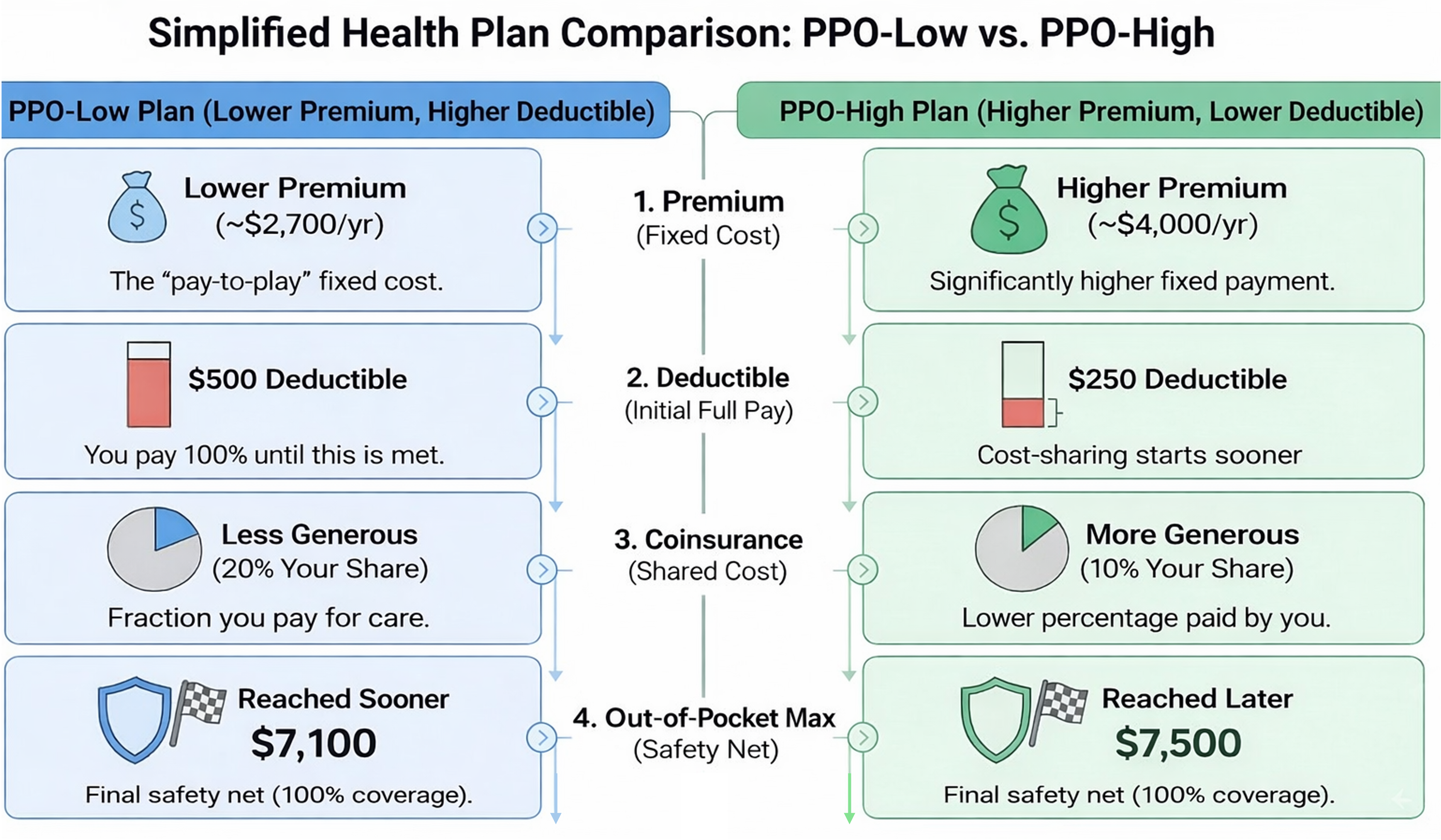
Thanks to Alexander Kustov for an early version of this infographic.
Whew, are you tired already? How can we sort through all these pieces? The best way to consider the trade-offs between the two plans is to look at how total out-of-pocket expenses evolve as medical costs go from $0 to more and more medical spending. The best plan depends on your expected medical spending in a year.
With just these four basic pieces, we see tradeoffs emerge. If you don’t consume any medical care, the choice is obvious. Choose the lowest ‘pay to play,’ or “PPO-Low.” You should choose the lowest premium possible because you don’t care about the deductible or any spending beyond. The deductible only becomes important after you use enough medical care.
If you do expect to incur expenses or have some risk of doing so, then you must consider two things: how quickly you’ll end up passing through your deductible and how the coinsurance rate matches your increasing medical spending.
If you don’t end up spending $500 in medical expenses in a year, you’re still better off choosing the lower premium payments, even though you’ll have more out-of-pocket expenses when you go to the doctor. The diagram below maps out the expenses for a family of three, where the three $500 deductibles must be met before the family’s new coinsurance rate applies. If all three family members spend $500 of full deductible payments plus the lower premiums of $2,700, this still only adds to $1,500 + $2,700 = $4,200. This is less than the expense of paying the high premium plus all three family members passing through its (lower) associated deductible: “PPO-High” plan $4,000 + (3 x $250) = $4,750. The premium in the first plan is so very much lower that, even if you pay the full amount of three high deductibles, the family still doesn’t end up spending more overall. Clearly, the “PPO-Low” plan is best for relatively healthy individuals and families who expect to incur few medical expenses .
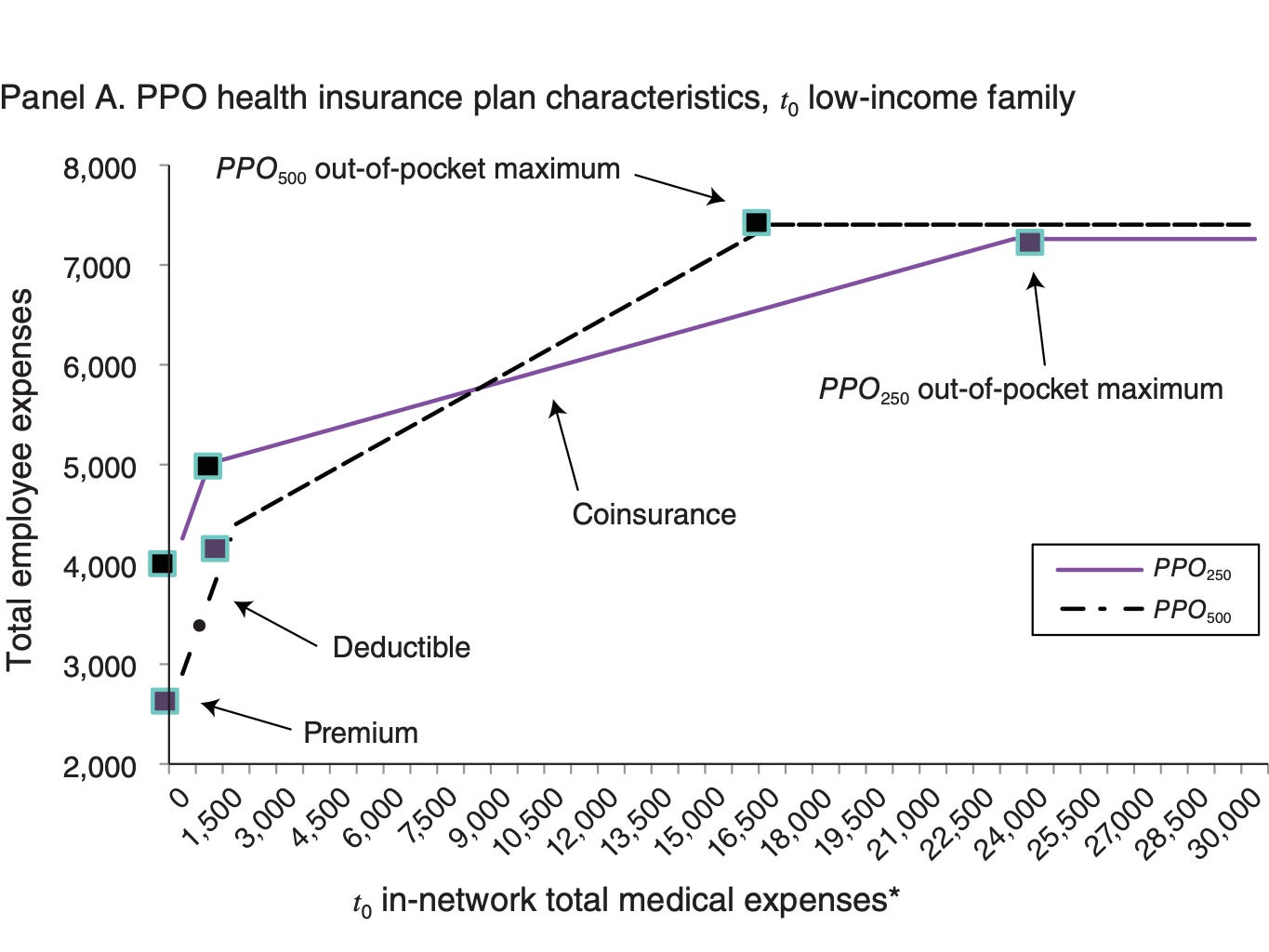
But what is “relatively healthy,” and when does “few” expenditures become “many”? The diagram illustrates a crossover point in expenditures for these two plans. The “PPO-High” plan remains ‘dominated’ (econ-speak for: Don’t do this!! You’re getting the same but paying more!) from $0 to about $8,000 in medical expenditures. This is because the higher premiums, which are paid no matter what, outweigh the out-of-pocket costs of low but rising medical expenses. However, because the “PPO-Low” plan has a higher coinsurance, 20% versus 10%, the out-of-pocket expenses increase faster as medical expenses increase. The benefit of a cheaper premium is slowly eroded away by the higher coinsurance rate until the two plans cross at approximately $9,000 in medical spending.
(I will note that $9,000 is already high for an average insured enrollee, particularly in 2011. The Peterson-KFF Health System Tracker reports that the average spending of an insured patient was $7,278 in 2023. Of course, many folks spend a lot more, but for a typical employed worker at age 45-54, this would be a slightly above-average amount of spending.)
At the crossover point, the lower rate of coinsurance from the “PPO-High” plan starts to pay off. If enrollees expect to spend more than $9,000 in a year, the higher premium would now be worth it because of the substantial amount of medical spending beyond the deductible- $9,000 is a lot higher than $500.
The “PPO-High” plan would continue to be a better choice for families with billed medical spending more than $9,000 up until total accumulated family medical expenses of approximately $16,500. At this point, the “PPO-Low” plan will have reached its Out-of-Pocket Maximum, which is fairly similar to the “PPO-High” plan. Once at the Out-of-Pocket Maximum, both plans end up with full coverage for all future expenses. The family enrolled in the low premium plan would rack up out-of-pocket expenses faster and thus arrive at the maximum sooner in their spending. To put this in reverse, at the moment in either plan where enrollees reached $7,000 in out-of-pocket expenditures- their Out-of-Pocket Maximum- the “PPO-Low” enrollees would have accumulated approximately $16,500 in total expenditures, whereas the “PPO-High” enrollees would have already racked up $24,000 in total medical expenses billed to the insurer. The lower premium plan builds up out-of-pocket expenses at a rate closer to the total medical expenses billed.
The discussion above lays out how you could end up choosing a plan that is really too much for your needs, simply because of not considering the whole package. Although the deductible was twice as large, the low premiums more than made up for it when a relatively healthy enrollee took into account the full set of out-of-pocket expenses. However, this wasn’t the biggest mistake from this study.
As fun as it was to work through the premiums, deductibles, and copays for the plans above, you maybe don’t feel like doing this every time enrollment rolls around. However, plan details can change year to year. In particular, the premiums will increase or decrease (if you’re lucky) over time. This is a favorite trick of insurers because it is annoying for enrollees to re-check their plan choices every year. The tendency to stay put, without checking new prices, is called inertia, and it is bad for your wallet.
After a few years, the premiums of the two plans outlined above changed. The premium for the “PPO-High” plan increased, although the $250 deductible remained unchanged . The premium for the “PPO-Low” plan dropped lower, and the $500 deductible also did not change. The gap between the two became so large, that the cross-over point disappeared. There was no amount of medical spending where the benefits of a low deductible and more modest coinsurance in the high premium plan could make up for the dramatically lower premium payments from the “PPO-Low” plan. Essentially, the “PPO-High” plan was taking so much out of your paycheck every month that it was even worse than going to the doctor and paying into the deductible directly.
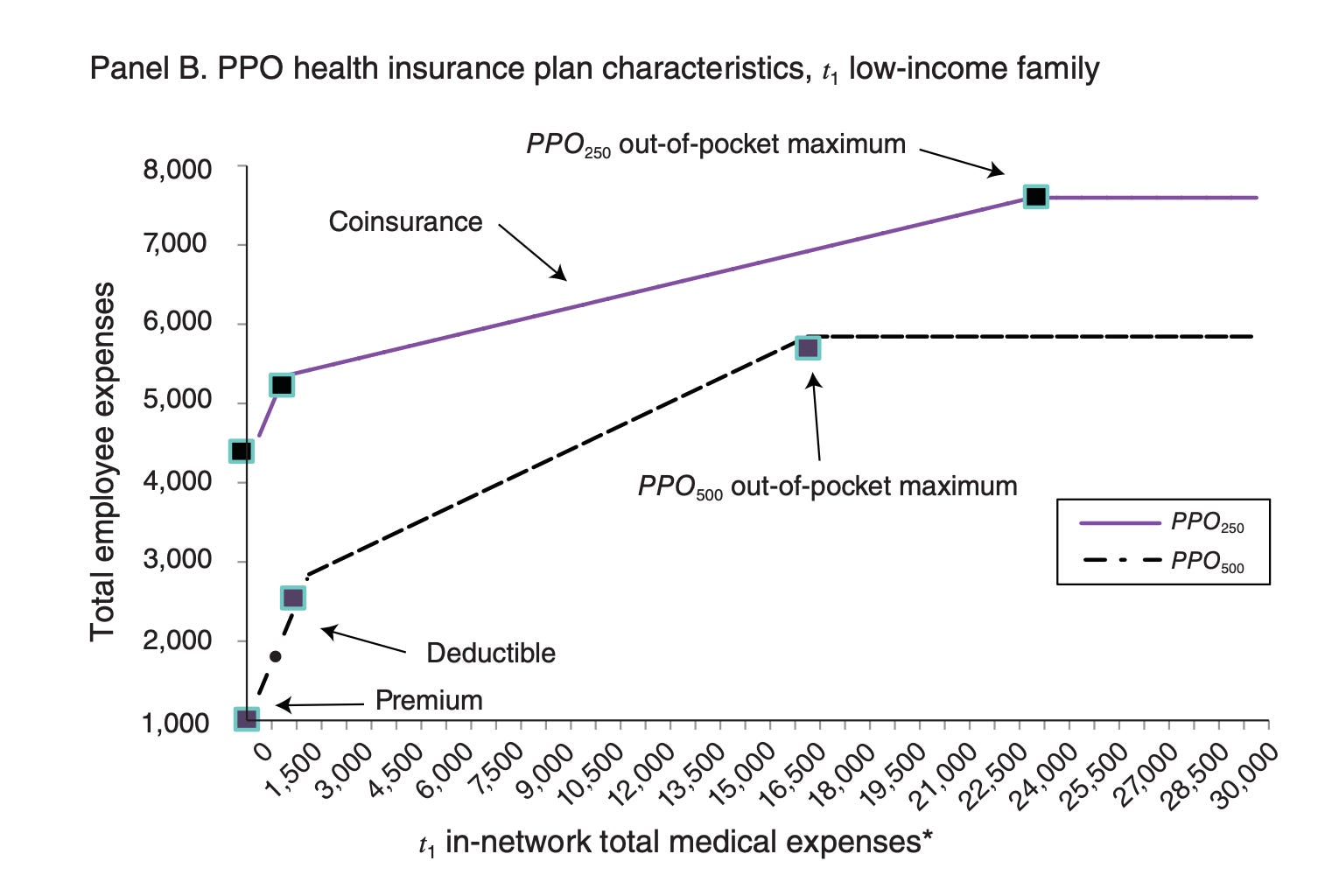
The problem was that many enrollees did not notice this increase in the spread between the premiums and stayed in the “PPO-High” plan, blissfully unaware that they were spending $2,000 too much per year (on an average of $4,000 in spending for a typical enrollee!).
Why do people do this? The economic literature has documented several reasons. Enrollees tend to focus on only one feature of a plan, such as the deductible.3 The complexity of plans can overwhelm enrollees and mistakes are concentrated among the less financially literate.4 In the example above, enrollees may not have understand or noticed the full amount being taken from their paycheck in premiums.
A fear of out-of-pocket expenses in the deductible could cause an enrollee to lose sight of the full financial picture. The dominated plan was essentially a forced savings plan—where you shelled out a fixed amount every month for healthcare. But instead of this reserved amount going into your own savings, it was given to the insurer! Enrollees prepaid the insurer for care which they may not have ended up using.
Finally, enrollees may simply decide this takes too much time to work through and rationally decide to use their time elsewhere. Essentially throwing up your hands and concentrating on things where you have better understanding and control. If you have purposely avoided checking your plan because you knew the mental aggravation of reading it without the help of nice graphs and explanations, I now hope I have removed some of this hurdle!
The moral of the story is always keep tabs on your premium changes; do at least a quick back-of-the-envelope calculation of what you’d be paying for a full year. Remember, the premium is paid no matter what else happens in the year, guaranteed.
To help you not become a statistic (or highly cited economics paper), here’s a checklist to run through when looking over your insurance plan choices.
1. Is it a managed care plan? (i.e. PPO or HMO?) If so, check that your usual doctors or health systems are covered under their networks. This is usually in the plan documentation, but you might have to check with HR. How often would you have to go out of network and face the higher prices? Check that the other plans you’re thinking of aren’t different on this aspect.
2. Check the premiums- add up your yearly expense. This is most likely the biggest expense, even if you have illness every so often. Remember you’ll pay this in full, no matter what other expenses happen during the year. Check the spread between the total premium payments for your plan choices.
3. Understand the role of the deductible. Treat it as a large out-of-pocket expense that you might need to expect to pay over a couple months. But also treat it like some or all would be added on to your total premium payments. How does premium + deductible compare across plans? If there are multiple members of your family that must each hit their deductible add each person’s deductible into the total.
4. The other out-of-pocket prices are much less important compared to the dollar amounts above. Copays when you go to the doctor, for example. If you only pay $40 per visit, and you ended up with 10 visits (about one per month, that’s a lot, yes?) that would still only be $400. What is the coinsurance after reaching the deductible? This will add up, but also add up slowly.
Bonus round: If you know your expenses from last year, what would be the additional costs beyond the premiums and deductible? This may be available on your personal insurance plan’s website.
If you have significant expected needs, you can check how they are covered in the plan documents. The helpful good news is that the Affordable Care Act introduced standardized mandatory coverage of preventive care, so plans have become easier to compare on these dimensions.
Note that many ACA preventive care visits are exempt from cost-sharing (i.e. not in the deductible or coinsurances). Wahoo! Your routine check-up visit may not count towards the deductible, though labs or extra problems found in the visit would be. See if you can check last year’s bills to get an idea of which care you used was part of this ACA-mandated covered preventive care versus expenses which counted towards the deductible. This will give you an idea of your typical spending level.
5. Given the premium + deductible totals, at what point would this break even? (Use your previous year expenses from the Bonus Round if available.) Does the lower premium end up saving you more in expectation, even if you have expenses beyond the deductible?
Finally, give yourself some grace. This is a complex financial document. If it seemed like you chose wrong last year, remember it is a repeated choice. Many years of correct choices will help average out mistakes.
From the insurer side, all this complexity may be helping their bottom line because it combats adverse selection; The more that healthy people mistakenly place themselves into plans designed for the sick, the better. However, by focusing on the biggest financial pieces of your insurance plan choices, you can thwart their schemes and make the best choice for your coverage and your wallet.
Abaluck, Jason, and Jonathan Gruber. 2011. “Choice Inconsistencies among the Elderly: Evidence from Plan Choice in the Medicare Part D Program.” American Economic Review 101 (4): 1180–1210.
Bhargava, Saurabh. (2015). Choosing a Health Insurance Plan: Complexity and Consequences. JAMA. 314. 2505-2506. 10.1001/jama.2015.15176.
Comments
Nothing yet. Say the first thing.
Sign in to join the conversation.