
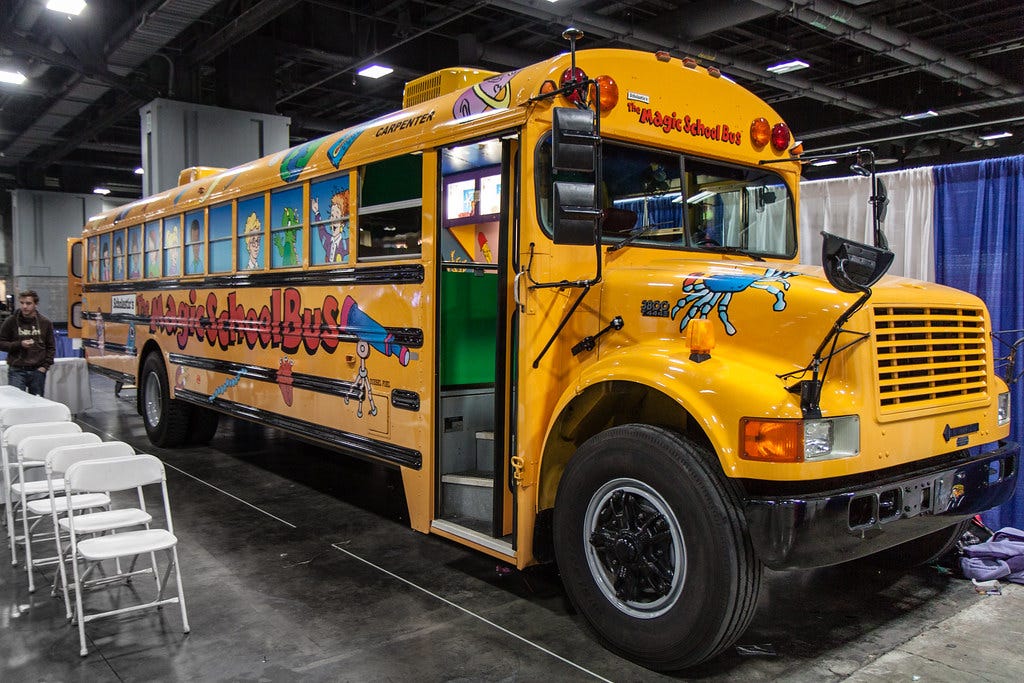
Continuing on the theme of “imaginary classrooms in speculative fictions are often resolutely constructivist”, Mrs. Frizzle and her Magic School Bus is the absolutely maximalist example of this trend. Everything meaningful that her students learn is via direct experience without any necessary physical constraints on the substance of their educational experience.
Therefore, assessing how well she achieves her learning outcomes is extremely difficult. It is a bit akin to imagining an exit interview with Phil Connors in Groundhog Day, asking him what living so many lives has taught him, except that Mrs. Frizzle’s students can directly have an even wider variety of direct experiences, many of them utterly unavailable to the rest of humanity.
In many speculative fictions where young people are vouchsafed to have magical experiences intended to awaken their moral understanding and improve their emotional status quo, there is a sense that the magical teacher or a magical contrivance teaches no more and no less than what is required to reach that goal, via some form of limited omniscience. Mary Poppins knows precisely what Jane and Michael Banks need. The Phantom Tollbooth takes Milo on precisely the journey required to awaken his connection to the real world. It would feel foolish to second-guess this kind of magical pedagogy no matter how madcap or risky it seemed at first.
Conversely, however, it is hard to feel this kind of confidence in the pedagogy of Mrs. Frizzle, at least as it is evidence in the televisual The Magic School Bus of the 1990s. (I cannot speak to whether she has revised her approach in the more recent The Magic School Bus Rides Again.) Frizzle’s objectives are less therapeutic or philosophical than many magical instructors with a whimsical style and a lack of a lesson plan. She is focused on giving her students a vividly experiential understanding of scientific questions and scientific knowledge in direct response to their spontaneous questions and daily experiences.
There is a certain degree of epistemological oddity that she does so with techniques that are fully impossible in scientific terms. That is, unless her pedagogy involves extremely sophisticated virtual reality combined with mind-altering drugs of some kind. (Which would imply any assessor is also being subjected to these methods while witnessing her teaching, which is an existentially unsettling thought.)
There is at the least the possibility that this epistemological contradiction negatively affects the long-term ability of her students to understand and apply the scientific method without using magic to directly access experiences that are normally unavailable to scientists, or at least that she is wasting her talents by focusing on science rather than philosophy, given that she is perhaps the only teacher in known existence who could enable students to engage Thomas Nagle’s essay “What Is It Like To Be A Bat?” through a constructivist approach by answering the question directly through transforming them into bats. Or for that matter, Mrs. Frizzle could in fact allow her students to directly experience an infinite variety of actual trolley problems in the same style as the main characters from “The Good Place”.
Perhaps dealing out death and life via trolleys is an age-inappropriate teaching goal, but Mrs. Frizzle has been observed exposing her pupils to experiences no less traumatic: they have been devoured by a classmate, transmogrified into animal form, cooked, reduced in size, decomposed and sent into the distant past, among other things. It is reasonable to wonder if many students might experience lingering trauma from her lessons. However, magical pedagogies used on younger children do often come with a kind of specialized amnesia. For example, the youthful King Arthur, aka “Wart”, did not clearly recall being turned into various animals by his tutor Merlin but retained the moral insights that Merlin meant to offer him via those lessons. If that is not the case with The Magic School Bus, then Frizzle’s pedagogy requires some degree of urgent attention to evaluate its medium-term psychological impact on students.
In a more mundane sense, Mrs. Frizzle’s pedagogy might be seen as an age-appropriate version of something like the book Dr. Tatiana’s Sex Advice to All Creation, namely a translation of the challenging vocabulary and technical infrastructure of scientific understanding into a more personal and vivid reference frame for the sake of effective science communication. Once again, this raises the prospect that there is some risk that the more effective the translation, the harder it may be to generalize from it back into producing scientific knowledge within its established methods and approaches. If her students are inspired to learn science via Mrs. Frizzle’s lessons, they might proportionately find it disappointing to actually do science in subsequent educational experiences.
After all, if a working astrophysicist was able to magically transform themselves into dark matter, that would resolve many questions that are presently beyond experimental reach, and certainly any evolutionary biologist would be deeply grateful for the profound insights that might follow a round trip to the Cretaceous as opposed to spending years of their lives working with a handful of incomplete fossil remains.
However, Frizzle’s teaching methods are for some reason unavailable to anyone outside of Walkerville Elementary. Her approach may have a profoundly inspiring impact on her students (and perhaps those who witness their adventures) but one wonders if that is something of a misapplication of the potential of her school bus. However, even if Mrs. Frizzle is perhaps not quite as assuredly certain of a tight fit between her powers and the specific needs of particular individuals as Mary Poppins, magical pedagogy is apparently not a resource freely available for utilitarian reassignment to greater purposes. Thus, best not to look a gift magic school bus in its radiator grille.
Image credit: "Magic School Bus" by ep_jhu is licensed under CC BY-NC 2.0.
No posts
Comments
Nothing yet. Say the first thing.
Sign in to join the conversation.