
I spent most of my childhood being a very finicky eater, which occasionally made trouble for my parents when there was just no alternative to getting lunch from a fast food place while on a trip or running errands. One of the central preoccupations of my fussiness was that any sandwich or hamburger could have absolutely no condiments on it. No ketchup, no mustard, no relish and most especially no mayonnaise.
I made my peace with the first three in stages as a teenager, but I never lost my aversion to commercial-quality mayonnaise. I still profoundly dislike Hellmann’s or anything like it. It looks, feels and tastes like Vegetable Oil Flavor Jell-O. Plop it on a plate and it stays in a glob shape. When I end up in a more corporate chain restaurant, the first thing that will turn me off of most of the menu is when I can see that all the food comes with various flavored sauces that purport to be different but where all of them are plainly commercial mayo as a mother sauce + some food-service premade like “honey-chipotle”.
I can still remember how utterly startled I was in my job as a kind of jack-of-all-trades prep guy, sous chef, cheese salesman, and weekend bread-baker when I was first asked to make the mayonnaise for the huge load of cole slaw based on our head waitress’ family recipe that we served with some of our lunch platings. I generally tried to be canny about showing how green I was as a cook, since up to that point I’d just been a kind of foodie hobbyist in college and in my first year working. So I didn’t speak out loud what I was thinking, which was “You can make mayonnaise? Like, by yourself?”. And then as I made her recipe for the first time, with pasteurized raw eggs, I was even more flabbergasted. This was mayonnaise? It was simple, and good. (Though this particular recipe was also very vinegar-forward, as cole slaw often is.) I realized I’d certainly had this kind of mayonnaise in various white-tablecloth meals but I’d no idea, since I thought of the heavy, gloopy, gelatinous kind as the definition.
I’m trying to remember when I had my first food processor, but I think it was during the time I was working in the restaurant. I might even have bought it from my boss at a discount, since he also sold kitchen tools there. (It’s also where I bought my first Creuset pot.) I do remember that not long after learning what mayonnaise actually was, or at least could be, that I pasteurized my own eggs and made mayonnaise for myself for the first time.
I’ve done it quite a few times since. Understanding what emulsification actually was and how it changed a few egg yolks, a bit of vinegar, a dab of mustard and a thin stream of oil added slowly to a rapidly stirred or blended base into a room-temperature sauce that could stick wonderfully to salad or hold an additional flavoring beautifully was one of the primary miracles of “kitchen science” that I remember just blowing my mind. (The other big one was moving from a roux of butter and flour to a thickened sauce like bechamel.)
It turns out that emulsification is one of those relatively things that sharply separates modern food from techniques and flavors that are comparatively ancient. Pickling and fermentation, for example, are really old, as I’ve pointed out in some previous newsletters. But rapidly whisking egg yolks and then adding oil slowly in a stream to create a room-temperature sauce that had a creamy mouthfeel without dairy and without any cooking? That was an early 19th Century invention (bien sur, by a French chef), and arguably more than many foods needed industrialization to become easy to make at a global scale.1 Sugar, as Phillip Artieres describes it, wasn’t so much added to appeal to taste as it was part of a manufacturing approach to stabilizing a sauce that otherwise has a very finite lifespan when it is home-made. (Salmonella, in his account, became familiar to consumers in the 20th Century because of mayonnaise, since most other culinary uses of eggs involved cooking.)
In a time when so many things seem dramatically worse than they did in the 1980s and 1990s, it’s important to keep in mind the things that have gotten better. One of them is that major food markets in many countries in the world now have good-quality commercial products for many basic pantry items, sometimes at prices that are only slightly above the entry-level item. Duke’s Mayonnaise is usually about the same price as Hellman’s or Kraft’s and it’s vastly better in flavor and texture, at least to me. Kewpie costs a bit more but I like it better than Duke’s.
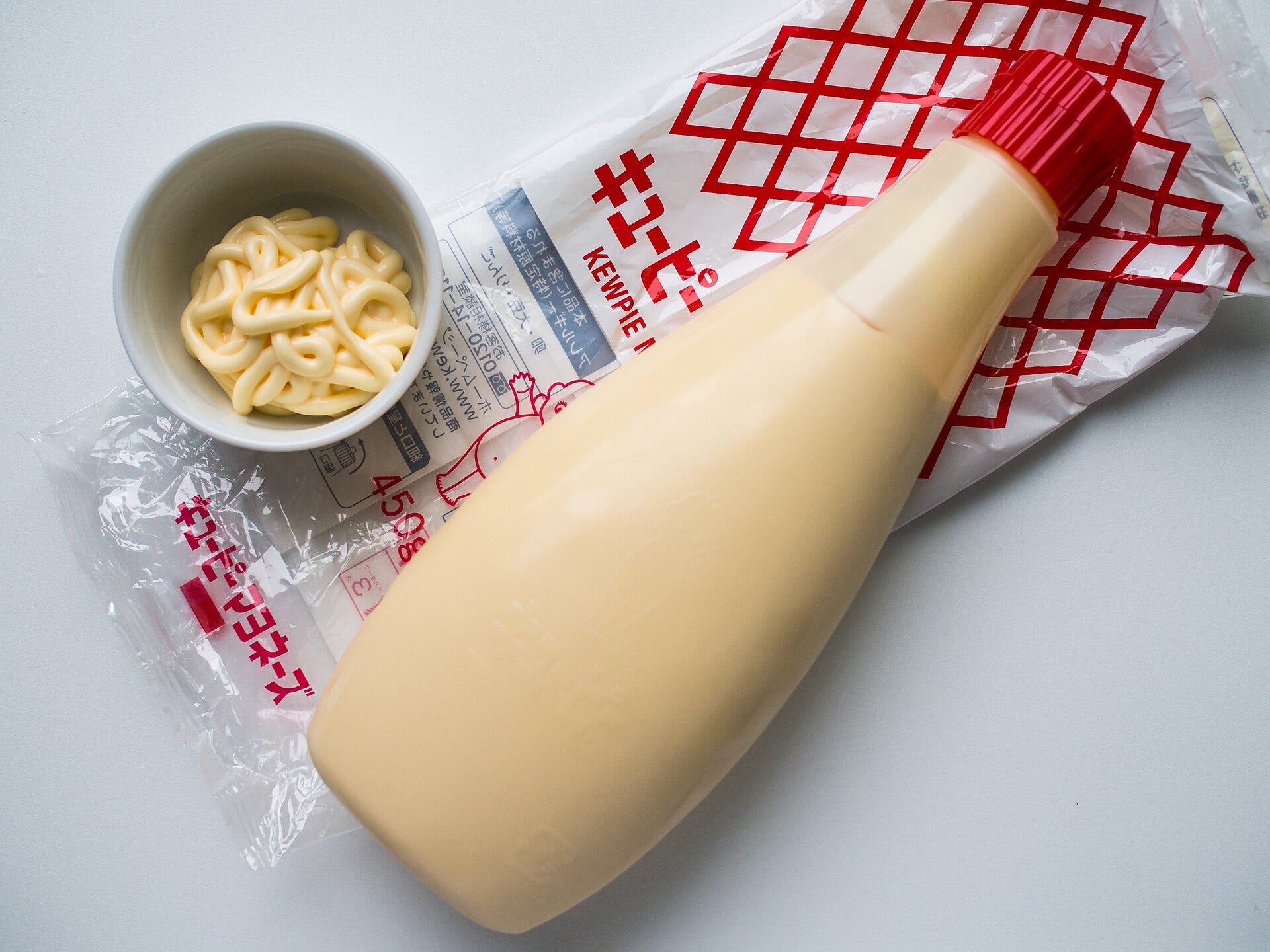
Over a life of productive mayo-eating, I’ve realized that one of the things I detest about the most common commercial brands is that they have a heavy taste of egg whites, there’s the sort of off-note metallic taste that comes from very bad brands of garlic powder, and there’s that taste from the sugar as well. (Don’t get me started on Miracle Whip.) Kewpie and Duke’s are much more defined by vinegar and they don’t have that heavy, soggy, empty egginess that comes from egg whites, cheap oil, and excessive air. I understand that Hellman’s has a “real mayo” line that eats more like Kewpie and Duke’s but I’m past the point in my life where I’m going to fight against the memory of many bad experiences just to redeem something I don’t really need anyway. All of what I don’t like, however, is what made mayo a shippable product in the first place, as Artieres lays out in What We Eat. So maybe this is just slow-food snobbery on my part.
But if I’m indulging snobbery, there’s a substantial number of more upmarket brands, particularly those that are trying to be aioli, the famous garlic-heavy variant of mayonnaise. There isn’t that much of a need to make mayonnaise at home at this point unless I’ve forgotten to get a backup Kewpie or I really want to hit a high note on everything for a particular meal.
This morning, I made a quick salad of some leftover salmon, green beans, broccoli, barley and a couple of hard-boiled eggs and the dressing wasn’t anything harder than a tablespoon of Kewpie, a bit of tapenade, some finely chopped preserved lemon, and a dab of harissa. Mayo is a mothersauce that can be very loving when it’s good-tasting to start, isn’t gummy or gelatinous, and yet binding enough that you can drop any number of things into it and get a great outcome—the adobo from chipotles, some wasabi, chopped herbs, minced-up pickles and a bit of juice, a chutney of some kind, a fruit preserve, and so on. And whether it’s Kewpie or any other brand, it’s going to stay stable over a day or two on that salad, whereas a home-made version is often going to slowly de-emulsify over the day.
It takes a bit more strategic thinking to use a mayo with heated food. I still haven’t really warmed up to having it on a hamburger, but I certainly love mixing a bit of aioli into a bowl of mussels. It’s not my favorite thing to dip my fries into, but it’ll do. When in Belgium, do as the Belgians do.
And yet, for all that I think it’s essential, for all that I understand what it is, for all that it almost defines modern cooking, I can’t think of a food that can more sharply delineate something that nauseates me from something I devour with gusto. It’s not just whether it’s a bad or good brand, it’s also about whether it’s too much of the taste. Even a good brand that gets everywhere into what I’m eating, that becomes the story of the bite or the meal, puts me off. Thus maybe mayonnaise also defines an ambiguous zone for me of the difference between culinary rationality—knowing what I like and why—and forms of aversion and pleasure that precede any conscious thought and that I merely try to rationalize after the fact.
Image credit: By Takeaway - Own work, CC BY-SA 4.0, https://commons.wikimedia.org/w/index.php?curid=49117799
Phillip Artieres, “Mayonnaise”, in Singaravélou, Pierre, and Sylvain Venayre, eds. What We Eat : A Global History of Food. Translated by Stephen W. Sawyer. Columbia University Press, 2025.
No posts
Comments
Nothing yet. Say the first thing.
Sign in to join the conversation.