
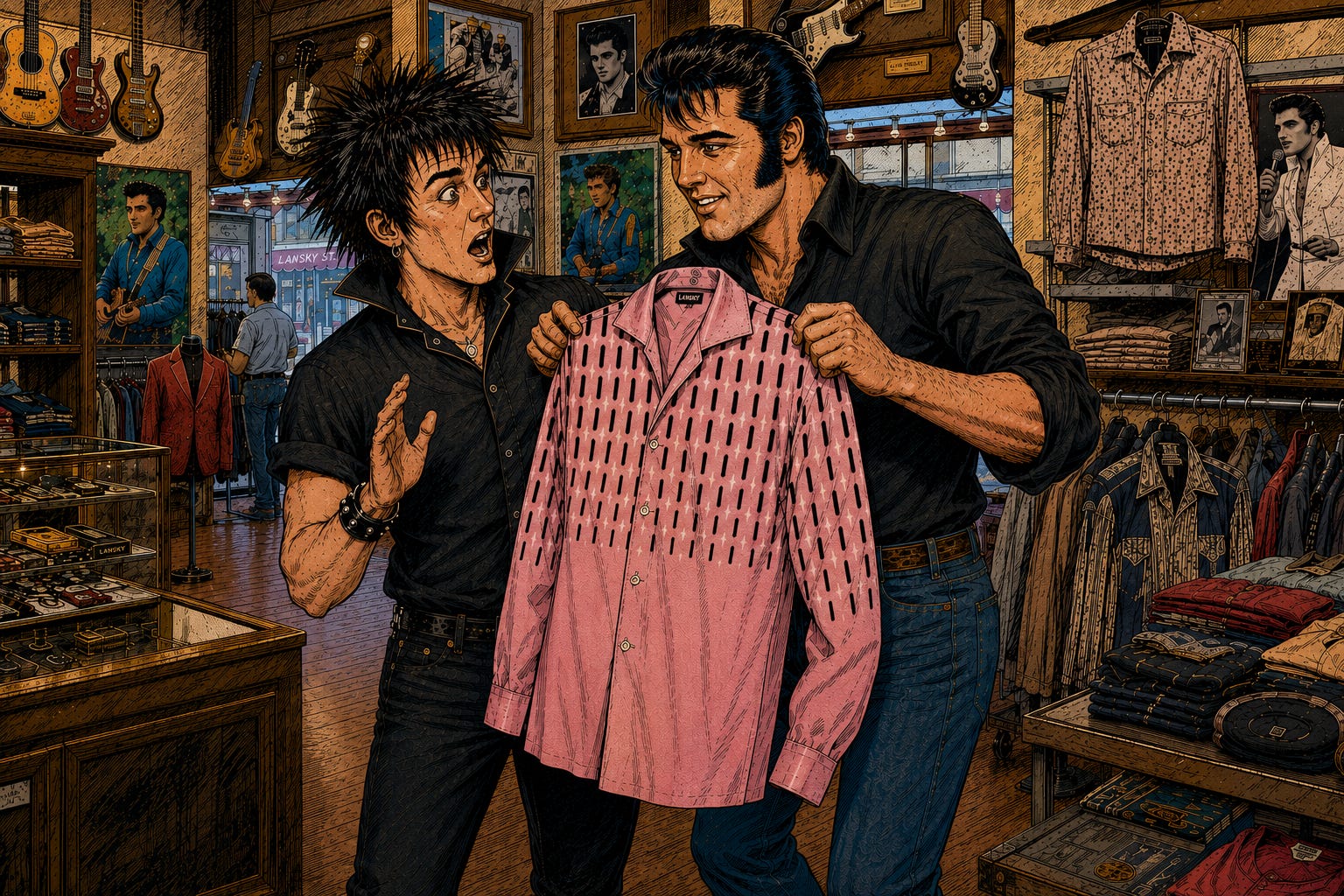
(Illustration: Chad Jeepity)
That (as recounted yesterday — TIM: “Elvis, did you still wanna play rock ‘n’ roll?” ELVIS: “Every damn day. Still do”) landed harder than I expected. I let it sit.
“Then why—”
“’Cause wantin’ somethin’ and knowin’ how to go get it, back to feelin’ it again — that’s two different animals, son.” He rubbed his face with both hands, like he was trying to wake himself up. “By the time I knew I wanted it back, I didn’t know where to start lookin’.”
“I might know where to start.”
That got his attention. Suspicious, half a grin: “That so?”
I got up and went for my bag again. “You ever hear a song called ‘Fire’? Bruce Springsteen wrote it. Wrote it for you.“
He went very still. “Wrote it for me?”
“Cut a demo and everything. The story goes, it never made it to you. Somebody’s office sat on it.” I let that land without saying whose office. “You died before he ever got the chance to sing it for you himself.” I rolled my eyes. “Of course, NOW we know that may’ve been an ‘exaggeration’…
“But a ‘70s rockabilly revivalist named Robert Gordon cut it in ‘77, with Link Wray on guitar.”
“Link.” Something warmed in his face at that name — no hesitation, no working to place it. “I know who Link Wray was.”
“Did you like ‘Rumble’?”
“Sure. Hard to forget a title like that.” A small, remembering smile. “Sounded dangerous. Didn’t hardly have any singin’ on it at all.”
“Didn’t need any.”
“No.” He nodded slowly. “That’s what got everybody. Link made the guitar [pronounced “GIT-tar,” like the proper Southern boy Elvis was] the bad guy ‘stead of the singer.“
I smiled and nodded my head. “Kinda like Pat Hare.”
He looked up, shooting me another patented Elvis grin. “Yeah, kinda like Pat Hare. And some of them other guitar players you just played for me.”
I found the Gordon/Wray single in my bag and held it up. “This one’s got both: Link Wray’s guitar, and a voice doing what yours might’ve done, if ‘Fire’ had ever made it to you.”
He didn’t say anything. Just held his hand out for the record.
I set the needle down myself. Let him listen without me talking over it.
The bass guitar tore into the hook performed on guitar on The Pointer Sisters’ later hit recording, followed by Gordon’s vocal, all coiled tension and slow-building heat. Then came Link’s guitar — greasy, unhurried, dangerous in that same unshowy way, navigating a truckload of Fender amp tremolo.
Elvis leaned forward, elbows on his knees, and didn’t move again until it ended.
“Well.” He said it quietly. “That’s a damn good record.”
“Can you hear you in it?”
“I can hear what coulda been.” He looked at the label a long moment before handing it back. “That’s worse, somehow. Hearin’ what coulda been, ‘stead of just wonderin’ about it.”
“How many songs never reached you? Because somebody else decided what Elvis Presley oughta sing.”
He didn’t answer that one. Just looked at the cabinet, like there might be an answer in there somewhere, filed under a record he hadn’t spun in 50 years.
He looked up. “Tim, I can tell you about one of those songs that did reach me — ‘Golden Years.’“
I must’ve had that “I just swallowed a cannonball” expression again, the way the Presley half-grin spread across his face: “The David Bowie song?!“
“Yeah, Bowie,” he nodded. He said the name carefully, like he was testing whether it still fit right in his mouth. “We was both on RCA. Colonel got it in his head that Bowie oughta write me somethin’. Never did tell me exactly why — the Colonel didn’t never explain himself, he just decided things, and you found out after.” A dry look. “So Bowie sent some demos over.”
“And you heard them?”
“Heard ‘em.” He nodded slowly. “Heard that one in particular. Something about it. I couldn’t tell you what, exactly, just that it sounded like somebody’d built it outta parts of me and dressed it up in a suit I hadn’t tried on yet.” He almost smiled. “Coulda been good. Coulda been real good.”
I was incredulous. “And you turned it down.”
“Wasn’t me turned it down.” Something flickered beneath his famously lush lashes, which really didn’t need the mascara he slathered them in, in his prime. It wasn’t quite anger that was flashing, more something older than that. “Folks around me turned it down, told Bowie’s people it wasn’t a fit.” He snorted. “Funny, I don’t recall anybody askin’ me what I thought was a fit.”
I nodded. “I read somewhere that Bowie kept a note from you: ‘All the best, and have a great tour.’ Kept it the rest of his life.”
Elvis looked up. “He kept it?”
“All his life.”
Elvis didn’t say anything for a second. Then, quiet: “I don’t even remember writin’ that. Somebody in an office probably wrote it for me — that’s how most of them notes went. And here this man’s holdin’ onto it like it meant somethin’, and I can’t even tell you if the words were mine.”
“Would you have cut it? If it’d gotten to you clean — no Colonel, no offices, just you and the song?”
He was quiet long enough that I thought he wasn’t going to answer.
“Yeah,” he said finally. “I believe I would have.”
He was quiet a moment longer, still looking at the cabinet. Then, like a man shaking off a mood he didn’t want to keep wearing, he stood up straight and clapped his hands together once.
“C’mon. Git up.”
“What?”
“Said git up.“ He was already moving toward the stairs. “I feel like shoppin’. You look like you could use some new clothes.”
I blinked. “Elvis, you’re asking me to go clothes shopping. Right now. In the middle of this?”
“Well, yeah.” He grabbed a pair of sunglasses off the bar without breaking stride. “Ain’t no fun buyin’ clothes by yourself. ‘Sides, I been sittin’ in my own head too long. Need to move.”
“People are going to lose their minds.”
“They usually do.” A beat. “C’mon, Lansky‘s ain’t goin’ nowhere. Well.” He caught himself. “It has gone somewhere, actually. Last I checked.”
That stopped me for a second, and I decided not to ask how he knew that.
We pulled up outside the Peabody 20 minutes later — some car I didn’t ask questions about, driven by someone I didn’t ask questions about either — and he sat there a moment before getting out, looking up at the building like he was recalibrating something in his head.
“This ain’t it,” he said. “Or at least, it wasn’t where it used to be.”
“It moved,” I affirmed. “Years ago. The whole Beale Street building became a Hard Rock Café several years ago. It’s apparently in the process of becoming a Memphis music history museum.”
He actually laughed at that, short and disbelieving. “A Hard Rock Café,” he spat, drily.
“Yeah.”
“Where Bernard’s shop was.”
“Yeah.”
He shook his head slowly, and for a second something almost sad passed behind the sunglasses before he shrugged it off. “Well. Reckon everything gets sold eventually. C’mon.”
Lansky At The Peabody—roughly a 10-minute walk from Memphis Recording Service/Sun Records, the other place where it all started for Elvis—was smaller than I’d expected. It was a boutique tucked into the hotel lobby, brass and glass, more suited to conventioneers buying ties than the birthplace of rock ‘n’ roll style. Elvis stood in the doorway a second, sunglasses still on, taking it in the way a man takes in a photograph of a house he used to live in.
“Well,” he said. “Ain’t the same.”
“Nothing on Beale is.”
He pushed through anyway, and by the time we’d gone 10 feet in, some kid behind the counter had done a double take and then very deliberately looked back down at his phone, the way you do when your brain refuses to process what your eyes just told it.
Elvis ignored him entirely, already flipping through a rack.
“No, no, no.” He pulled out a sport coat, held it against my chest without asking, made a face, and put it back. “You’re thinkin’ too safe.”
“Elvis, I own a closet full of black Dickies.”
“Exactly. Now let’s see what happens if we stir the pot some.” He kept moving down the rack, fast, like his hands remembered this even if the store didn’t. “You know who never dressed safe? Eddie.”
“Cochran?”
“Mm.” He pulled a jacket free, checked the shoulders, shook his head, and put it back. “Eddie had them coats tailored so sharp you coulda cut somebody just walkin’ past ‘em. Man had more style in how he held a guitar than most fellas got in their whole closet.”
“He was 21 when he died.”
That stopped Elvis’s hands for a second. “I know it.” Quieter. “Always figured Eddie’d have kept gettin’ better. Had that voice, played great guitar, and he could write, which I never could. I was always dependent on cats who could write.” He shook his head, ruefully.
“He had that thang,” he continued. “You looked at him, and you already believed whatever he was about to sing.”
I grinned. “Y’know, they essentially cast him in The Girl Can’t Help It because Hal Wallis wouldn’t loan you to 20th Century Fox,” I laughed. “Eddie performing ‘Twenty Flight Rock’ on TV in the film was basically supposed to be you on Ed Sullivan.”
Eddie Cochran, who flirted from the stage with my mother in 1958[!! More on that another time!], standing in for Elvis and performing “Twenty Flight Rock” in the greatest ‘50s rock ‘n’ roll film, The Girl Can’t Help It.
Elvis let out a short laugh. “Actually, it wasn’t Hal that nixed that deal. Colonel priced me right outta that one. Wanted 140 grand outta Fox for two songs, then tried to flip ‘em for double or nothin’. Fox said no thanks.” He shook his head. “Eddie got the shot ‘cause the Colonel got greedy. Never even knew that till years later.”
“You ever hear ‘Let’s Get Together’? Same session as ‘C’mon Everybody,’ same track note for note. Only thing Eddie changed was the damn title.”
He glanced over, surprised. “Same record twice?”
“Same backing track, anyway, different hook.” I made a mental note to bring it next time. “Gene Vincent, though? Different animal altogether.”
“Gene.” Elvis actually laughed at that, pulling a black leather jacket off a hook and holding it up to himself in the mirror before deciding against it. “Gene didn’t dress sharp. Gene dressed dangerous. Eddie looked like he was about to take you to dinner and rob you after. Gene looked like he already had.”
“Bad leg and all.”
“Bad leg and all.” He shook his head, something almost affectionate in it. “Man had a steel brace in there from a wreck, could barely stand some nights, and he still moved onstage like the devil himself was chasin’ him. Never once let it slow him down where folks could see it.”
I smirked. “I understand your mother heard ‘Be Bop A Lula’ on the radio, and when you called from your hotel on the road that night, she congratulated you on your new record, which she really liked?” That stopped him cold, hands still on a jacket he wasn’t really looking at anymore.
“How do you know that?”
“I keep telling you, Elvis-–I read a lot.”
“Mama called it my ‘new record’.” He said it slowly, like he was turning the memory over carefully, checking it for cracks. “I was on the road at some hotel, I don’t even remember which one no more. She was so proud. Wasn’t till the second time she said it that I figured out she meant Gene’s record, not mine.” A small, real laugh. “Didn’t have the heart to correct her right off. Just let her be proud a minute longer.”
Gene Vincent, also in The Girl Can’t Help It, performing Gladys Presley’s baby boy’s brand new record she loves so much, “Be Bop A Lula.”
“You eventually told her?”
“Had to.” He shook his head, smiling at something only he could see. “Scotty and Bill thought the same durn thing, matter of fact. Called me up madder’n hornets, wantin’ to know why I cut a record without ‘em.”
“That’s not a small compliment. Gene sounding that much like you, on his own record, with his own band.”
“Wasn’t botherin’ me none.” He went back to the rack, but slower now, less purpose in it. “Kinda made me proud, if I’m honest. Like I done somethin’ folks wanted a piece of. Even Mama couldn’t tell the difference.”
He got quiet for a second, hand resting on a hanger he wasn’t really looking at.
“She’d have liked all this, you know.” He didn’t specify what “this” meant — the shirt, the store, the conversation, me. Maybe all of it. “Mama liked when folks were kind to me for reasons that weren’t about money.”
He finally found a shirt he liked for me. “Hey, man!” he yelped in delight. “
He held it up on me, seeing how I’d look in it: “Try this.”
“I look like an idiot in pink, Elvis!”
“You look like a coward in black every single day. Try the shirt.”
Twenty minutes and one purchase later — the pink shirt, over my objections, plus a black sport coat he’d approved without a word, just a nod — we came out of the Peabody lobby into afternoon heat, and he stood on the sidewalk a second, getting his bearings. I must admit, though: I always wanted some proper cat clothes. So did
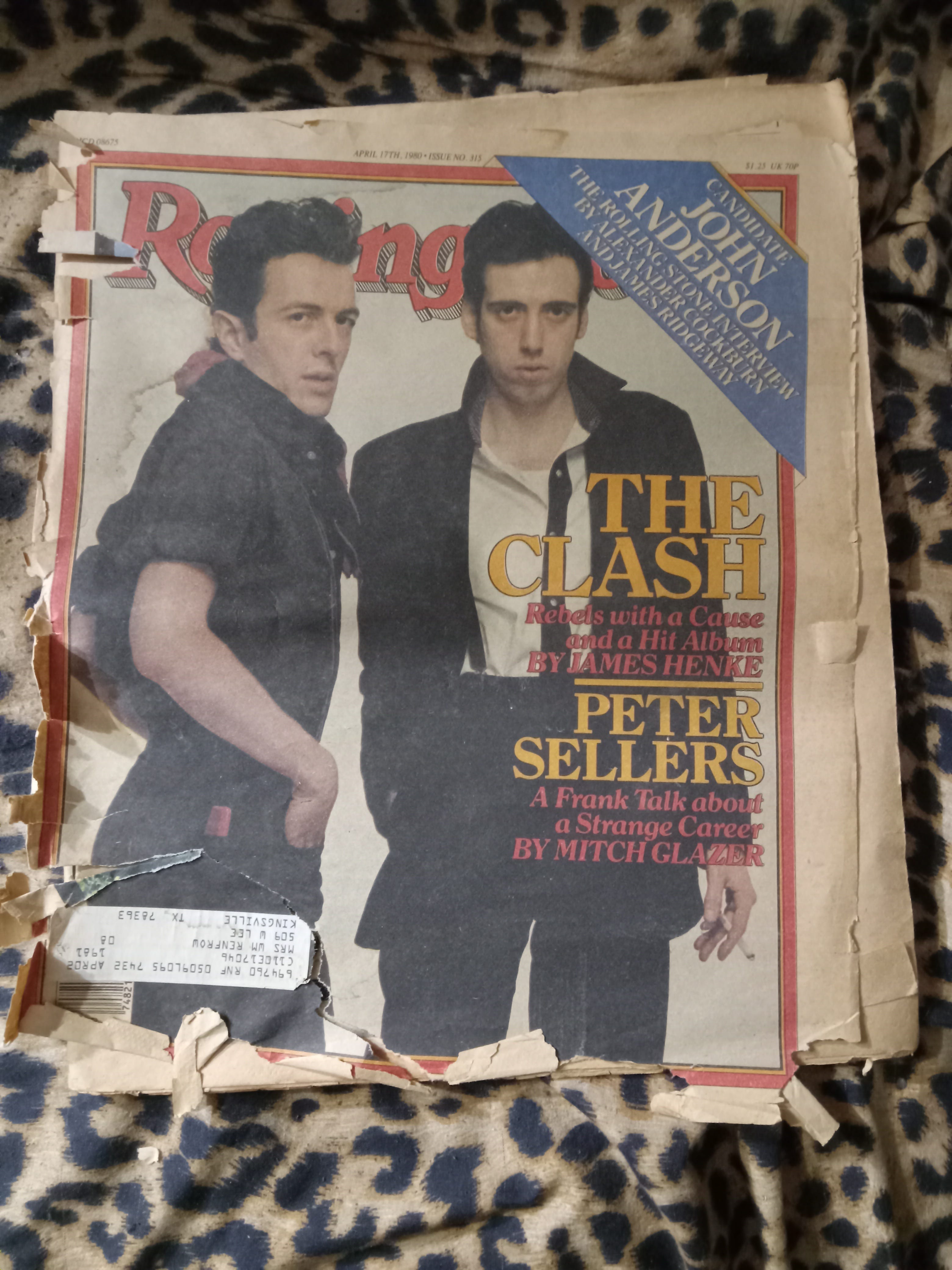
Joe Strummer and Mick Jones, glaring from my personal copy of their Rolling Stone cover story, when they just looked like they shopped at Lansky Brothers: “Oi, why’s this cunt get to shop wiv’ Elvis?!”
“Beale’s this way,” I said.
He didn’t move right off. Just looked down the block toward the music and the crowds and the neon, still visible even in daylight.
“Been a long time,” he said, “since I walked down there and wasn’t the whole reason everybody showed up.”
“You’re not gonna be recognized. Trust me.”
He gave me a look. “You sure about that?”
“Pretty sure everybody’s gonna assume you’re an Elvis impersonator having an unusually good day.”
That actually got a real laugh out of him — loud, surprised, the first one all afternoon that didn’t have anything sad underneath it.
“Awright,” he said. “Let’s go look at what they did to the place.”
END PART THREE
But I can mention that The Tim “Napalm” Stegall Substack’s Fourth Birthday Subscription Sale is still live. Take 20% off all paid subscriptions. Annual subs, normally $52, are now $41.60! Monthly subscribers? You get 20% off too, down from the usual $7/month to $5.60! And you pay the discounted rate for life! Mash the button while you still can!
Subscribe to The 'Stack! 20% off!
And I still have some first edition hardbacks of Anarchy In The Studio for sale. And yes, I will sign and personally inscribe it for $100, including shipping and handling. Click the button below, unless you’re in Austin. Then you can come talk to me personally about getting one.
Now here come the hashtags….
#TheTimNapalmStegallSubstack #TimNapalmStegall #ElvisPresley #ElvisHasNOTLeftTheBuilding #TheKingOfRockNRoll #Graceland #Memphis #MemphisMusic #BealeStreet #RockNRoll #RockCriticism #MusicJournalism #RockNRollWriting #CreativeFiction #RockNRollFiction #LongformFiction #AnotherWorkOfFiction #ImpossibleInterview #GonzoJournalism #MusicHistory #RockNRollHistory #Rockabilly #ProtoPunk #BruceSpringsteen #Fire #RobertGordon #LinkWray #Rumble #FenderTremolo #WhatCouldaBeen #DavidBowie #GoldenYears #RCARecords #ColonelTomParker #WasntElvisTurnedItDown #LanskyBrothers #LanskysAtThePeabody #BernardLansky #SunRecords #MemphisRecordingService #EddieCochran #TwentyFlightRock #TheGirlCantHelpIt #CmonEverybody #LetsGetTogether #GeneVincent #BeBopALula #GladysPresley #ScottyMoore #BillBlack #MamaThoughtIBeBopALulaWasMyRecord #EvenMamaCouldntTellTheDifference #TheClash #JoeStrummer #MickJones #ProperCatClothes #BlackDickies #PinkShirt #HotPinkLaces #YouLookLikeACowardInBlack #ElvisTookMeClothesShopping #ElvisIsMyPersonalStylist #ElvisImpersonatorHavingAnUnusuallyGoodDay #LetsGoLookAtWhatTheyDidToThePlace #CoffeeWithElvis #ElvisIsAlive #WhatTheFuckAboutCoversIt #PunkRockStartedBeforePunkRock #RockCriticismShouldBeDangerous #AnarchyInTheStudio #RuffianBooks #SignedEditionsAvailable #OrderDirectlyFromMe #IndependentMedia #DIYMedia #EveryGreatArtistDeservesAnImpossibleInterview #GoPaidItKeepsTheWorkAlive #SubscribeAndSurvive #DoYouThinkElvisKnowsSEO #ElvisHasBeenDeadFor49YearsAndStillOutranksMe #ThanksForReading
Thanks for reading The Tim "Napalm" Stegall Substack! This post is public so feel free to share it.
No posts
Comments
Nothing yet. Say the first thing.
Sign in to join the conversation.