
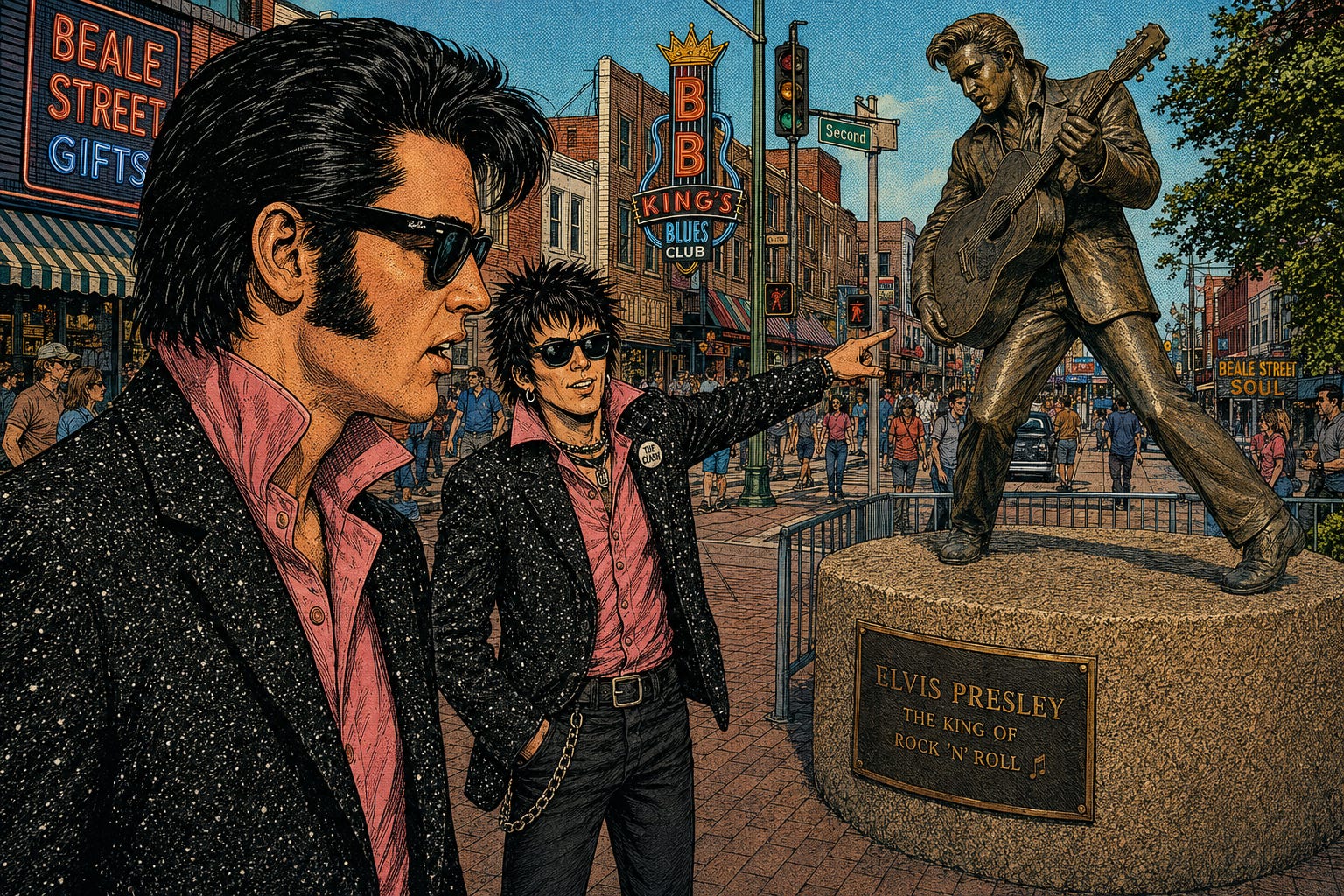
[Illustration: Chad Jeepity]
Beale Street hit him like a wall of noise before we’d even turned the corner: guitars leaking out of three different doorways at once, neon working overtime even though the sun hadn’t fully committed to setting, a crowd already thick enough that nobody so much as glanced twice at a tall guy in sunglasses and a black sport coat.
Elvis stopped dead in the middle of the sidewalk.
“This ain’t Beale Street.”
I arched an eyebrow. “It is, actually.”
“Wasn’t like this.” He turned in a slow circle, taking in the souvenir shops, the neon signage, a bachelorette party in matching shirts stumbling out of somewhere, blasting a cover band’s version of a song he made famous. “Beale was Black-owned businesses, tailors, a bank, a newspaper. Church’s Park. Wasn’t no...” He gestured, helpless, at the whole glowing spectacle of it. “Wasn’t no damned theme park.”
“It got gutted in the ‘60s,” I lectured. “Riots after Dr. King, then just decades of nobody investing in it. The city bought it all up, boarded it shut for years. What you’re looking at now is what got built back in the ‘80s, for tourists.”
He didn’t say anything for a second, just watched the crowd move past like he was looking for someone he used to know in it.
“I used to walk this street, and it was somebody else’s world I got let into,” he said finally. “Wasn’t performin’ for nobody. Wasn’t nobody performin’ for me, either. It was just Beale, bein’ Beale, and I got lucky enough to be a white boy nobody ran off.”
We kept walking, and after a block the crowd thinned enough to see him standing there — a bronze version of himself, mid-20s, guitar slung low, permanently caught in a lean nobody could hold for longer than a photograph.
Elvis stopped in front of it and just looked.
“Well,” he said. “That’s a hell of a thing.”
“It’s not even the first one. The first one got torn apart by souvenir hunters. This is the replacement.“
“Fans stole pieces off my own statue.”
“Repeatedly.”
He almost laughed, but it didn’t quite make it all the way there. He looked at the bronze face for a long moment, younger than the man standing next to me, hair swept the same way, same curled lip caught mid-sentence.
“Don’t look like how I felt, most days,” he said. “Looks like how folks needed me to look.”
I let that sit before I pushed into it.
“Elvis, can I ask you something? People still argue about this — whether what you did here, what happened between you and this street, was you finding something real, or you taking something that wasn’t yours to take.”
That got his full attention, sunglasses coming off for the first time all day.
“Stealin’, you mean.”
“That’s the word some people use,” I replied, as disgusted as he was by the idea. “Others call it ‘cultural appropriation.’”
He looked back at the statue, then down the block toward where Church’s bank used to stand, where the tailors and the clubs used to be, most of it gone now under bar signage and gift shops.
“I’ll tell you what I took,” he said slowly. “I took bein’ let in. Dewey Phillips played me records nobody thought a white boy oughta hear. Guys on this street let me stand in the back of clubs and just listen, didn’t run me off, didn’t make me feel like I was slummin’. That’s a gift, son. Not somethin’ I snuck out the back door with.”
“But you got rich off it. Famous for it. And a lot of the people who actually made that music never saw a fraction of that.”
“I know it.” No defensiveness in it — just flat, old grief. “Believe me, I know it. Sam paid Howlin’Wolf and Rufus Thomas and Roscoe Gordon about the same as he paid me before RCA came callin’, and only one of us ended up on the money.“
“Does that sit right with you?”
“Never has.” He put the sunglasses back on, slow, like he needed the cover for what he said next. “I didn’t build the world that let a white boy get rich singin’ what Black folks already sang better. Wasn’t my doin’, how that world was built. But I lived inside it the same as everybody else, and I ain’t gonna stand here and tell you I didn’t benefit from it bein’ unfair.”
“That’s a more honest answer than most people give.”
“Most people didn’t grow up on Shake Rag.” He looked at the statue one more time, then started walking again. “This street made me. I ain’t ashamed of that. But I ain’t gonna pretend I don’t know what it cost some folks, either. Both things are true. Learned a long time ago, don’t nobody get to pick just one.”
I let that sit a second, then decided we might as well do all of it.
“There are two more things people bring up. Every time. And I’d be a bad journalist if I didn’t put ‘em in front of you.”
He tensed, just slightly. “Go on, then.”
“First one’s older than you’d think. Story’s been going around since ‘57 — that you told somebody, somewhere, the only thing Blacks were good for was buying your records and shining your shoes.”
Something went hard behind his eyes, fast. “Still? That’s still goin’ around?”
“Still going around.”
“That never happened.” No hesitation, no working up to it, like a door slamming that had been slammed a thousand times before and never stayed shut. “Damned Sepia magazine started that, printed a flat-out lie. Jet magazine sent a man to ask me straight to my face, back when it started. Told him then what I’m tellin’ you now: I never said anything like that, and people who know me know I wouldn’t have said it. They looked into it. The story came outta some Boston TV show I never even appeared on. Whole thing was invented, front to back, and it’s been outrunnin’ the truth for damn near 70 years now.”
“Jet cleared you. They did.”
“Didn’t matter.” He said it flat, no self-pity in it, just fact. “Once a thing like that gets loose, don’t matter who catches it and proves it a lie. It’s already halfway around the world.”
“The second one’s not a rumor. It’s a lyric. Public Enemy, “Fight The Power,” 1989 — Chuck D. ‘Elvis was a hero to most, but he never meant shit to me. Straight up racist, that sucker was, simple and plain.’”
That one landed differently. He didn’t snap back this time. He sat with it a second, jaw working.
“Heard that one too, eventually.” Quieter now. “Man’s got a right to say it. Wasn’t lyin’ about how it looked from where he was standin’.”
“You’re not gonna fight that one?”
“Can’t fight a man’s whole point by yellin’ about one line of it.” He rubbed his chin. “Way I understand it — and I didn’t understand it for a long while — he wasn’t mad at me for singin’. He was mad that I got called ‘The King’, while the ones I learned it from didn’t get called nothin’ at all. That’s not a lie about me. That’s the truth about everybody else.”
“He’s actually said something close to that himself, years later,” I reassured him. “Said his heroes were probably yours, too.”
Elvis nodded slowly, like that confirmed something he’d already worked out on his own. “Then we ain’t as far apart as that record makes it sound.” He was quiet a second, working his jaw again like he was deciding whether to say the next part.
“Tell you somethin’ I don’t guess made it into your history books.” He looked at me sideways. “Vegas, ‘69. First night at the International. Come off stage, into the press conference, and some fella calls me ‘The King.’ Same as always.” He shook his head. “And Fats Domino’s sittin’ right there in the room. Come to see the show.“
“I know that one, actually. You pointed right at him.”
That stopped him, surprised again. “You know it?”
“Everybody who studies this stuff knows it: ‘No — that’s the real king of rock ‘n’ roll.’”
“Wasn’t just politeness,” he said, quiet and fast, like he needed to get it out before he talked himself out of it. “Meant every word. Told that room rock ‘n’ roll was here long before I ever showed up, and I couldn’t sing it the way Fats could, and I knew it.”
He looked back at the statue. “Never asked for that crown. Didn’t want it. Felt wrong on my head the whole time I wore it, like a hat that fit somebody else.”
“You said that in front of a room full of reporters, and it still didn’t stick. They kept calling you King anyway.”
“Didn’t matter what I said.” Something bitter in it now, but old, worn smooth from being carried for a long time. “Story was already written. Poor boy from Tupelo, crowned King of somethin’ Black folks in New Orleans and Memphis and Chicago had already built, brick by brick, before I ever touched a guitar. I could stand there and point at Fats Domino myself, and it still didn’t change the headline the next mornin’.”
“So when Chuck D calls out ‘The King’ —”
“He ain’t wrong about the title.” Flat, no argument left in it. “Just wrong about who handed it to me. I didn’t crown myself. Whole country did that, then got mad at me for wearin’ it.”
He looked at me. “Tim, I coulda spent my whole life pointin’ at Fats Domino and Chuck Berry and Big Mama Thornton, and it still wouldn’t have been enough people listenin’. Some fights, you can’t win by bein’ right. You can only keep sayin’ it and hope somebody eventually hears you.”
The ride back to Graceland was quieter than the drive out, punctuated by the crinkle of a Krystal sack between us. We’d swung through a drive-through somewhere on the way, and Elvis had eaten four of the little square burgers before I’d finished my first, talking with his mouth full about how they used to be a dime back when he could still walk into one without causing a riot.
“They shrunk,” he said, holding one up like evidence. “Same size box, though. Somebody’s savin’ money on cardboard.”
Back in the TV room, coffee reheated, Krystal wrappers balled up on the side table, he settled into his chair with something looser in him than before. The shopping trip and the walk had worn some of the weight off, even with what we’d talked about out there.
“Awright.” I dug into my record bag one more time. “Got a few more for you, if you’re up for it.”
“How many’s a few?”
“Enough to keep us here past dark.”
That got a real grin. “Good. Ain’t got nowhere else to be.”
I found the first sleeve. “This one’s yours, actually. Well — Memphis’s.”
“Mine how?”
“Guy named Tav Falco. Started a band called Panther Burns, right here in town, at the end of the ‘70s. Story goes he got a cat named Alex Chilton’s attention by cutting a guitar in half with a chainsaw onstage at the Orpheum.“
“Chilton.” Elvis’s eyebrows went up. “That the Box Tops kid? ‘The Letter’?”
“Same one. Went on to a band called Big Star after that. Critics’ darlings, nobody bought the records, but everybody who did went and started their own band. Then by the late ‘70s he’s back in Memphis, producing chaos in a basement with Falco and a guy named Jim Dickinson.”
“Dickinson, I know.” Something warmed in his voice. “Session cat. Played piano on some Stones stuff, the way I heard it. Man got around.”
“He’s all over this town’s music, one way or another. Half these Memphis records from the ‘70s and ‘80s, you scratch the credits, his name’s on there somewhere.”
“So this Falco fella,” Elvis said, “worked with a guy who backed the Stones, and got discovered by a kid who had a hit record before he was old enough to drink, and the two of ‘em decided the smartest thing to do with all that was take a chainsaw to a guitar in the Orpheum.”
“That’s about the size of it.”
He shook his head, grinning around the last bite of his burger. “This town.”
I dropped the needle on Track 1 of Behind The Magnolia Curtain, “Come On Little Mama.” I let Panther Burns’s frantic rush through the ghosts of Sam Phillips’s tape echo, and Tav Falco’s approximation of Elvis hiccuping like he’d had electrodes stapled to his nipples infest the room.
Elvis leaned back and let it wash over him, head tilted, listening the way he had with all of them — really listening, not performing it.
By the second verse, though, something different was happening on his face. Not the foot-tapping recognition he’d had with the Ramones, not the wary respect he’d given the Pistols. This was closer to disbelief.
“Lord.” He almost laughed, shaking his head. “That boy sounds like he’s havin’ a stroke and enjoyin’ it.”
“That’s kinda the review, yeah,” I chuckled.
“I mean it as a compliment.” He held up a hand before I could say anything. “I spent years — years — tryin’ to sound clean. Every take, get it smooth, get it right. And here’s this fool, soundin’ like he fell down the stairs into the microphone, and somehow it’s...” He searched for it. “It’s alive. More alive than half my Vegas records, and I had a 28-piece orchestra behind me.”
“Falco’d probably tell you that’s the point,” I acknowledged. “Sam Phillips let the accident happen. By the ‘80s, guys like this were engineering the accident on purpose.”
“Engineerin’ an accident,” Elvis repeated it slowly, tasting the phrase. “Man, that’s a hell of a job description.”
He listened another minute, foot moving just slightly, not quite the full-body thing the Ramones had pulled out of him. This was something smaller, more like he was trying to locate the pulse underneath the mess.
“He’s usin’ the same tricks Sam used,” he said finally. “Just turned up till they break.”
“’Turned up till they break.’ That’s not a bad way to describe the whole last 50 years of this music.”
Elvis grinned around a mouthful of Krystal. “Careful, son. You’re startin’ to sound like you got a book to sell.”
That got a real laugh out of him — loud, unguarded, coffee nearly going everywhere.
“Awright. Fair enough.” He gestured at the bag, still sitting between us. “What else you got in there? Sounds like you got a whole itinerary planned for me.”
But I’d be remiss if I didn’t mention that The Tim “Napalm” Stegall Substack’s Fourth Birthday Subscription Sale is still going on. Take 20% off all paid subscriptions. Annual subs, normally $52, are now $41.60! Monthly subscribers? You get 20% off too, down from the usual $7/month to $5.60! And you pay the discounted rate for life! Mash the button while you still can!
Subscribe to The 'Stack! 20% off!
I also still have some first edition hardbacks of Anarchy In The Studio for sale. And yes, I will sign and personally inscribe it for $100, including shipping and handling. Click the button below, unless you’re in Austin. Then you can come talk to me personally about getting one.
Roll credits! Er, hashtags….
#TheTimNapalmStegallSubstack #TimNapalmStegall #ElvisPresley #ElvisHasNOTLeftTheBuilding #TheKingOfRockNRoll #Graceland #Memphis #MemphisMusic #BealeStreet #RockNRoll #RockCriticism #MusicJournalism #RockNRollWriting #CreativeFiction #RockNRollFiction #LongformFiction #AnotherWorkOfFiction #ImpossibleInterview #GonzoJournalism #MusicHistory #RockNRollHistory #Rockabilly #ProtoPunk #PunkRock #SunRecords #SamPhillips #DeweyPhillips #ShakeRag #FatsDomino #TheRealKingOfRockNRoll #ChuckBerry #BigMamaThornton #HowlinWolf #RufusThomas #RoscoGordon #PublicEnemy #ChuckD #FightThePower #StraightUpRacistThatSuckerWas #CulturalAppropriation #WhoGetsToWearTheCrown #NeverAskedForThatCrown #DidntCrownMyself #TheWholeCountryDidThat #BothThingsAreTrue #SepiaMagazine #JetMagazine #TheLieThatWouldntDie #Krystal #KrystalBurgers #TheyShrunk #SameSizeBoxThough #SomebodysSavingMoneyOnCardboard #TavFalco #TavFalcosPantherBurns #PantherBurns #BehindTheMagnoliaCurtain #ComeOnLittleMama #AlexChilton #BigStar #JimDickinson #TheRollingStones #MemphisRockNRoll #ThatBoySoundsLikeHesHavinAStrokeAndEnjoyinIt #IMeanItAsACompliment #EngineeringAnAccident #TurnedUpTillTheyBreak #ThisTown #CarefulSonYoureStartinToSoundLikeYouGotABookToSell #IDoHaveABookToSell #KrystalBurgersWithElvis #ClothesShoppingWithElvis #SpinningPunkRockRecordsWithElvis #ElvisIsAlive #WhatTheFuckAboutCoversIt #PunkRockStartedBeforePunkRock #RockCriticismShouldBeDangerous #AnarchyInTheStudio #RuffianBooks #SignedEditionsAvailable #OrderDirectlyFromMe #IndependentMedia #DIYMedia #EveryGreatArtistDeservesAnImpossibleInterview #GoPaidItKeepsTheWorkAlive #SubscribeAndSurvive #DoYouThinkElvisKnowsSEO #ElvisHasBeenDeadFor49YearsAndStillOutranksMe #ThanksForReading
Thanks for reading The Tim "Napalm" Stegall Substack! This post is public so feel free to share it.
No posts
Comments
Nothing yet. Say the first thing.
Sign in to join the conversation.