
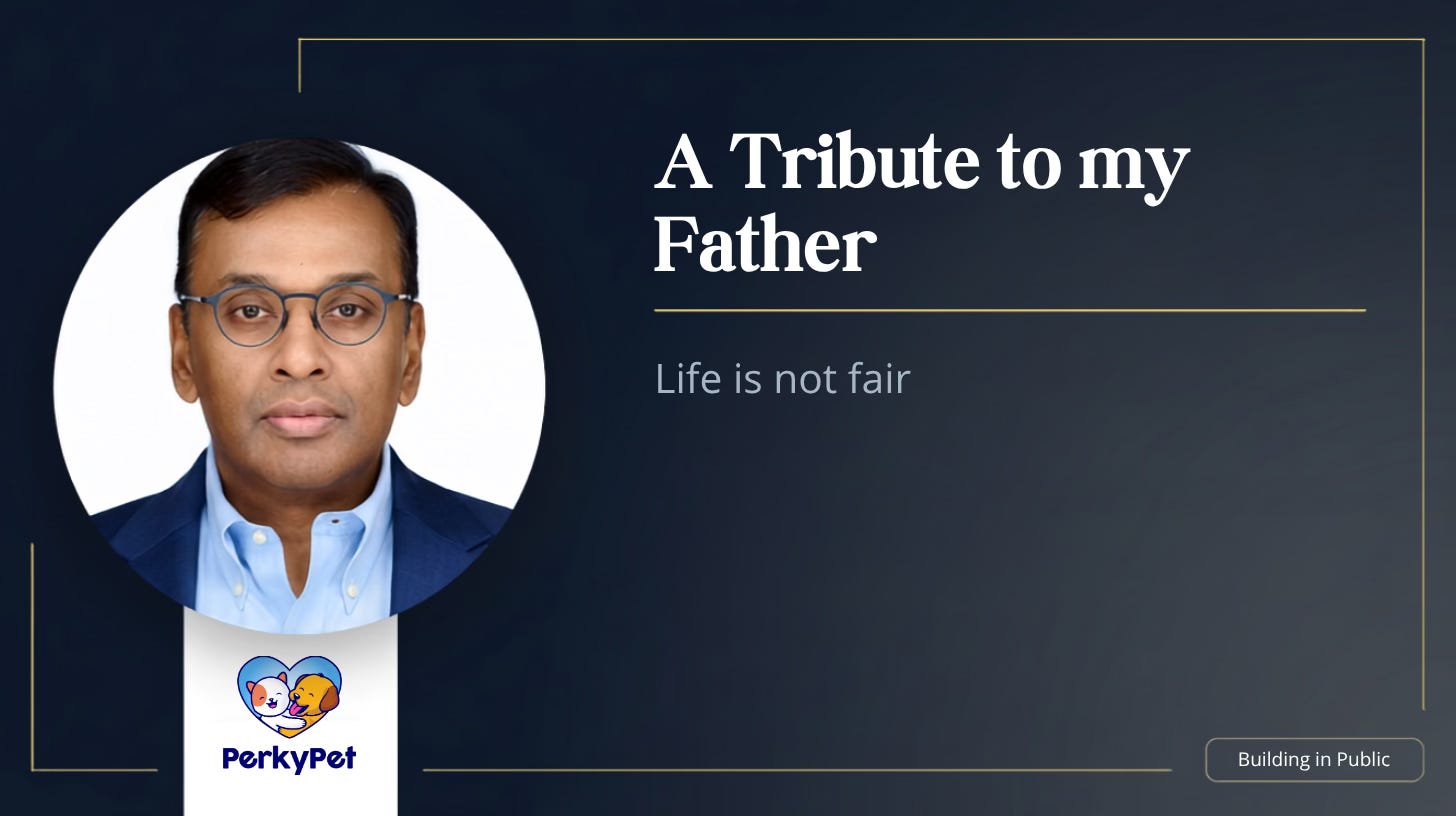
I’m writing this from my father’s new hospital room.
My father has been in the hospital for a couple of months now. It has been a rough stretch for him, rougher than I’ll get into today. His prognosis is poor. But he is never alone. My brother and I take turns, and I’ve been by his side every morning.
We’re at the point where I’m not always sure he knows I’m here. So I’m going to read this to him in the room, out loud, on the chance that he can hear my voice for a little while.
I usually write here about building companies, cloud, security, AI, the operator’s view of things. This piece belongs here too, because my father was a huge part of my entrepreneurial journey. And by the end, I think the subtitle will make sense.
My parents came to this country in the 1970s. Immigrants in their early thirties looking for a new life.
My father actually came from a well-to-do family by Indian standards, but the family lost most of its fortune when their land was redistributed. This was the Kerala Land Reforms Act, the 1969 amendment that took effect in 1970, which abolished the old landlord system and handed ownership to the tenants who farmed the land.
In hindsight, that loss is part of why my mother and father left. Rarely a day goes by, especially this past year, that I’m not thankful they did. None of his siblings made that leap. My cousins there live a very different life than the one I got to live.
What they did was the brave thing. Braver, honestly, than I think I have in me. They came here in their early thirties and started from scratch. No cushion, no fortune, no one waiting to catch them if it went wrong. And they built a good life for their family.
They didn’t really have the option to chase an entrepreneurial path the way I later would. They started a family early, and your risk tolerance gets recalibrated the moment you have two kids depending on you. There was no support system to fall back on. Nobody back home could help them. They had to take care of themselves, and somehow they still found ways to help friends get their own footing here.
But they made one real bet.
They invested early in a multi-family home in the Bronx. That gave us a home, and it set the foundation for a measure of financial independence. To this day, that decision is part of what takes care of them.
I was, to put it kindly, a pain-in-the-ass kid. Strongly opinionated. Determined to find my own way. I broke out of the Catholic school system, which looking back helped me, and tested into a great public high school.
My parents supported my decisions even when I was being a little jerk about it. There’s a small detail here that says everything about how our family worked. The money they’d set aside for private Catholic high school never had to be spent, because I’d gotten into a good public school. That saved money helped pull together a down payment on a house, the forever home. It was still a struggle, but it let them move toward a better life. That’s the home my father lived in, right up until this hospital admission.
Somehow, and I still don’t fully understand how they managed it, my father an accountant and my mother a nurse, they paid for my college education outright. It was overpriced even then, nothing like today, but still a lot of money for them.
That gave me a real advantage. I graduated with zero debt. That single fact set the stage for everything that came after. And I didn’t sit still. I worked through college, but I chose work that mattered for where I was headed, building real experience by 1999 that turned out to be valuable at exactly the right moment.
By 2001, they’d seen how it could work. I had a good job, stock options, a consulting business on the side. Nothing was holding me back but my age. So at 23, I started my first SaaS company.
My parents were my only investors, financially and in every way that counts. I blew through the money I’d saved, money I knew even then was partly luck. And on top of that, they found a way to give me some seed money. It was a lot to them, even if it seems modest by today’s standards.
It was another big bet on me. They were, once again, making it easier for me.
They didn’t fully agree on it, to be clear. My mom wanted me to take a job and stay safe. But my father backed the leap. He came from a family of entrepreneurs, and he understood risk.
He supported me with money, yes, but the part that mattered more was the emotional support. It’s the same kind of support I try to give other founders now, and honestly it’s why I do it. I know how rare it was back then. He encouraged me, but he also kept it real. He called me out when I was being a bonehead. He told me when something was wrong, because he had a taste for what was wrong.
That bedrock is probably why my career exists at all. The person people see now, the founder who offers calm, the one people always tell me is unusually steady, that came from him. What they don’t see is the chaos of my early twenties. Naive, inexperienced, taking on something far more complicated than I understood. He saw it. He steadied it. The calm I’m known for is, in a real sense, his.
There was a strange milestone in there too. At some point I was earning a multiple of what my parents made combined, a level they couldn’t quite comprehend. They’d cleared the runway, and the plane went further than any of us expected.
Thanks for reading my Substack! This post is public so feel free to share it.
One more story, because it’s the one I think about most.
Around 2009 and 2010, during the legal trouble I’ve written about before, my father got named in one of the lawsuits. A retired man, dragged into a deposition against a major U.S. bank.
It was my first experience with anything like it. The bank had wildly overstated what was owed, a multiple of the real number, and if we ignored it, they were positioned to collect an incorrectly large sum of money.
My father handled that deposition with grace and zero stress. All class. He didn’t care how they framed their questions. He stuck to the truth.
Then, just a couple of hours before my own deposition with the same attorneys, he’d already shown me exactly how to carry myself through it. Even at 30, I was still learning business lessons from him, in a situation more complicated than anything he ever faced directly in his own life. He didn’t need to have lived it to teach it.
The rest is more or less history. We pivoted, grew, sustained. And as he got older, I tried to be there for him when he needed it, problems with the Bronx property, the ordinary things. But it pales in comparison to the support he gave me. It always will.
So, why is life not fair?
Because most entrepreneurs never had the advantages I had. There’s no ceiling on the advantages a person can be handed.
Think of the Bill Gates story, his mother introducing him to the CEO of IBM, a break at a whole different altitude than mine. Life isn’t fair. We’re all dealt a different hand, and we have to make do. I have enormous respect for the founders who came from far less than I did, or who simply tried. Many of them, with a fraction of my advantages, may far surpass whatever impact I have.
And life is unfair to my father too, because he does not deserve what has happened to him these past couple of months. That’s a story for another time.
Here’s what I keep coming back to. I was lucky to have him for fourteen years after my mother passed away. He lived on his own terms. Independent, never a burden. He used to say he would never be a burden to us, and he lived up to exactly that. If anything, he was still helping me.
I’m glad he got to meet Dr. Dara Huang, my cofounder, that he had an impact on her life she may never fully understand, and that she had one on his that he may never fully realize. We are lucky to have a Dara by our side during this time.
If you’re reading this and you’re on the fence about entrepreneurship, here’s the truth. You may not have the advantages I had. Try anyway. Take the risk if you can. The world is different now. There are supporters, other founders, investors, real ways to make things happen. Someone with far fewer advantages than me may go on to build something far bigger.
Barring a miracle, my father may not be around to see what Dara and I build next. So this last part isn’t really to you.
Dad, thank you. For all of it. I hope you can hear me.
Comments
Nothing yet. Say the first thing.
Sign in to join the conversation.