
Hey, I’m Timothe, cofounder of Stellar & based in Paris.
I’ve spent the past years helping 500+ startups in Europe build better product orgs and strategies. Now I’m sharing what I’ve learned (and keep learning) in How They Build. For more: My Youtube Channel (🇫🇷) | My Podcast (🇫🇷) | Follow me on Linkedin.
If you’re not a subscriber, here’s what you’ve been missing:
How Front is turning product teams into AI-powered growth engines
Inside Amplitude’s journey to enterprise-scale Product analytics
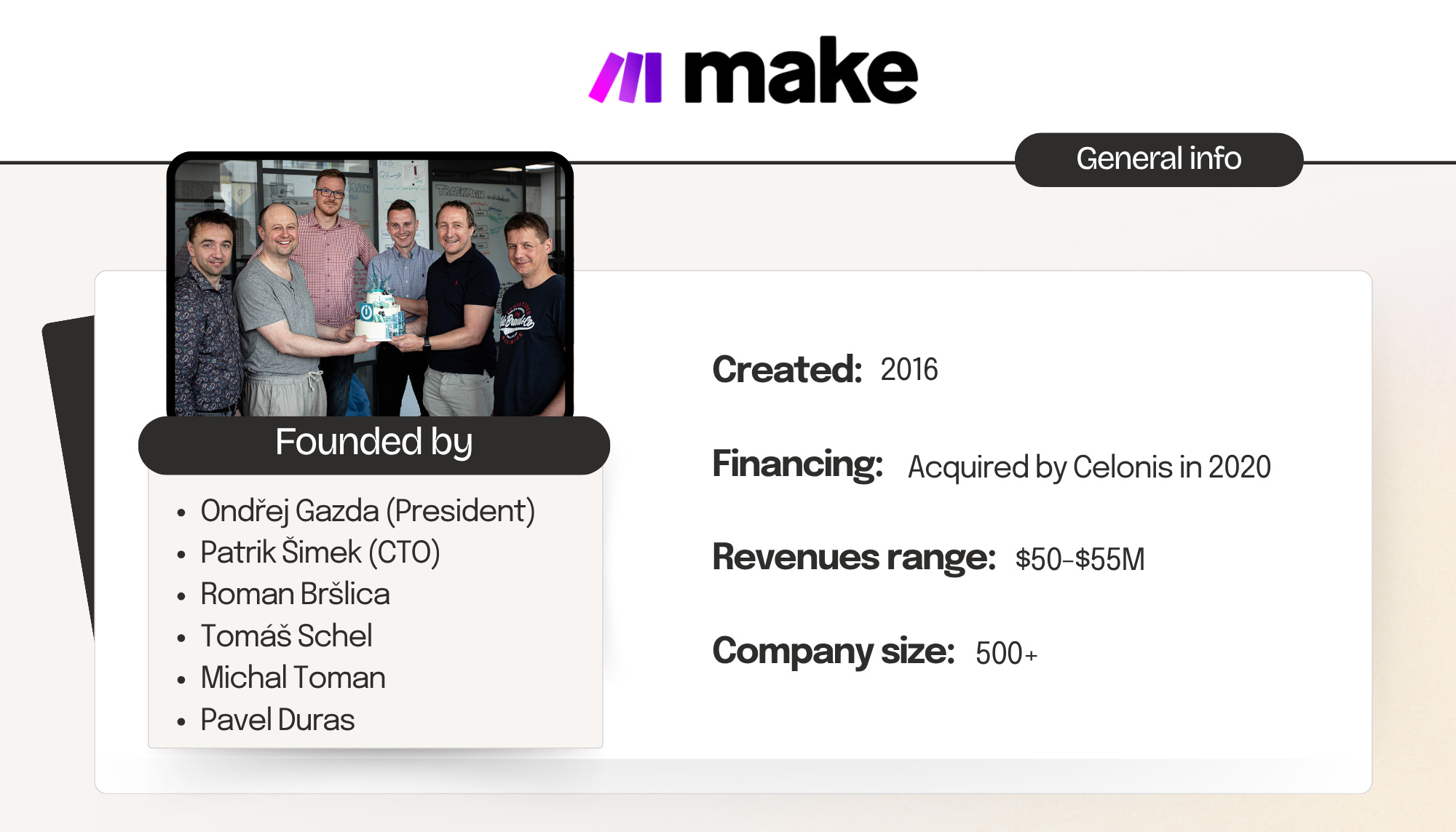
Make has been building workflow automation tools for more than 10 years. The company initially became known for its highly visual and intuitive approach to automation, helping users connect applications, automate workflows, and orchestrate operations without needing advanced technical skills.
Over time, Make expanded from traditional no-code automation into AI-native orchestration. Today, the platform supports more than 3,000 integrations, serves over 150,000 customers worldwide, and works with companies ranging from individual creators to large enterprises. The business also experienced rapid growth over recent years, multiplying revenue by 15x while scaling the team from fewer than 100 employees to more than 300.
Fabian Q Veit joined the story after previously serving as COO at Celonis, where he helped scale one of Europe’s largest enterprise software companies. He later led the acquisition of Make in 2020 and now serves as CEO.
I sat down with Fabian Q Veit, CEO of Make, to discuss where companies struggle with AI transformation, how Make uses its own platform internally, and why orchestration and observability are becoming critical in AI-native organizations.
Disclaimer: The organizational choices and technical solutions shared in this newsletter aren’t meant to be copied and pasted as-is. Always keep your company’s context in mind before adopting something that works elsewhere! 😊Many companies approach AI transformation with overly broad plans from day one. Fabian explained that AI adoption works better when organizations start with concrete use cases and motivated employees already curious about the technology.
At Make, the idea is to create momentum progressively across the company:
identify enthusiastic employees
give them tools quickly
encourage experimentation
share internal wins
scale successful workflows
Leadership still plays an important role. Leaders need to create enough energy internally so teams understand that AI matters strategically and operationally.
Make also believes AI adoption should not stay limited to technical teams. Business users closest to workflows often understand operational pain points better than anyone:
customer operations
sales execution
reporting
marketing workflows
internal coordination
“The people closest to the business processes know the problems they want to overcome” - Fabian Q Veit
This is why accessibility and visual workflows became central to Make’s product strategy.
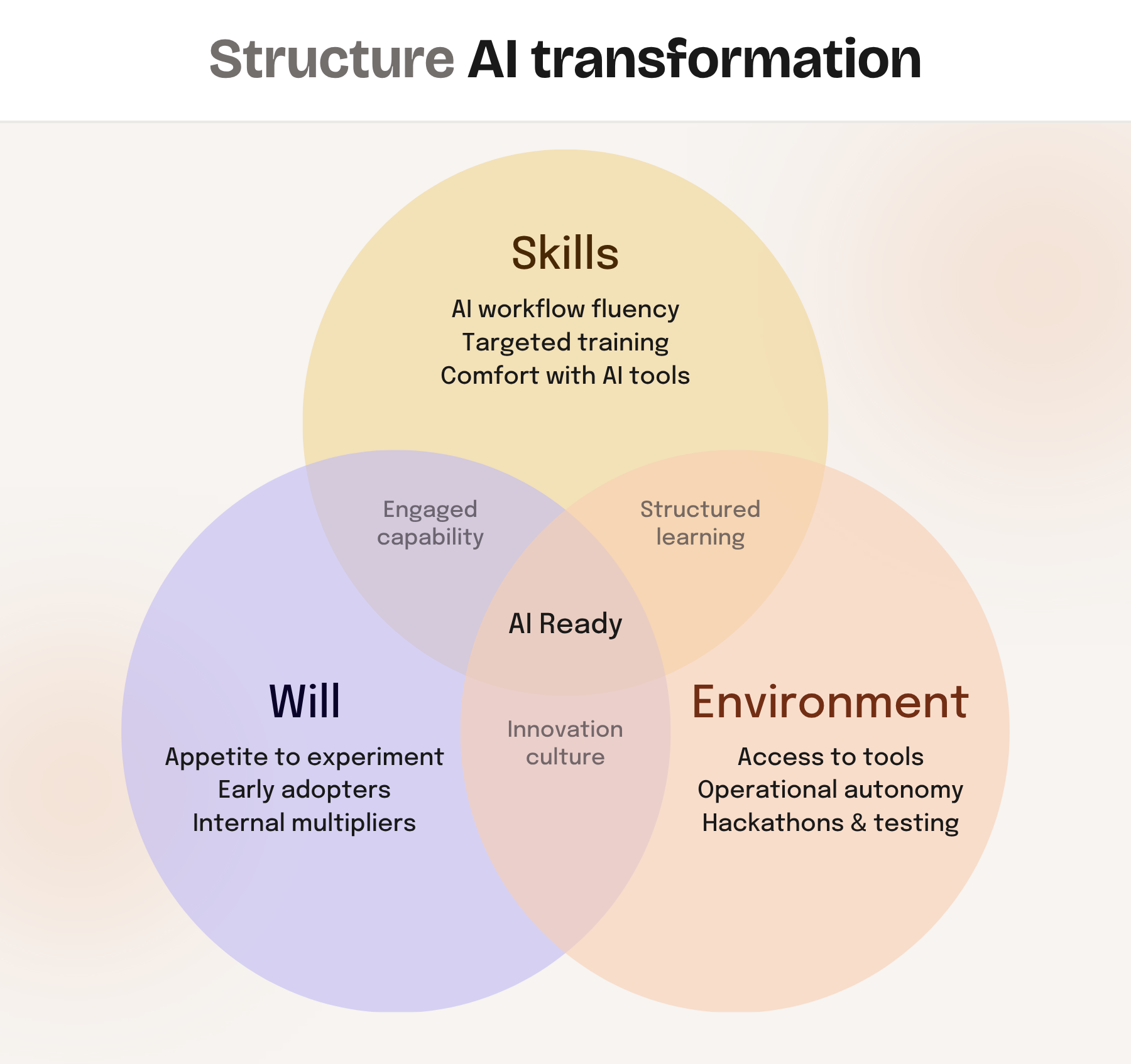
Fabian shared a framework Make uses internally and with customers to evaluate AI readiness. It is built around three dimensions:
skills
will
environment
The first layer is skills. Companies need to understand how comfortable employees are with AI workflows and where training is required.
The second layer is will. Some employees naturally embrace experimentation faster than others. These people often become internal multipliers for adoption.
The third layer is environment. Leaders need to create conditions that support experimentation:
access to tools
hackathons
workflow redesign
operational autonomy
room for testing
According to Fabian, these three dimensions need to evolve together.
“If you get those three right, the skill, the will, and the environment, that’s what you need” '- Fabian Q Veit
This framework helps companies treat AI transformation as an operational shift across teams, not only a technical initiative.
Make operationalized AI adoption internally through a program called “Make Runs Make.”
The initiative originally focused on ensuring employees actively used Make internally. Over time, the company expanded it into a broader AI transformation program.
Make created a group of internal experts called the “Samurai.” Each department has at least one person focused on AI automation, agents, and workflow orchestration.
Their role is to:
identify use cases
prioritize automation opportunities
estimate ROI potential
share learnings
accelerate adoption
The company also introduced minimum AI automation expectations across teams. Employees are encouraged to build workflows that improve their own day-to-day work.
Fabian shared an example from the product marketing team. One employee built “product launch agents” capable of generating:
launch announcements
short-form copy
long-form copy
multi-platform content
reusable workflows
The human still reviews and improves outputs, but the operational workload changes significantly.
“Without any engineering background, you’re really building agents today that help unlock significant business value” - Fabian Q Veit
Fabian shared one particularly interesting business outcome.
According to him, Make grew roughly 50% in revenue and customer scale over the last year while remaining relatively flat in organizational size.
This operational leverage came from automating repetitive workflows across teams:
reporting
launch preparation
customer operations
data processing
workflow execution
Fabian also shared a use case from Celonis around travel expense reporting.
Previously, several employees manually reviewed expense submissions against company policy. Make automated large parts of the process:
reading submitted documents
checking policy compliance
flagging exceptions
routing edge cases to humans
As a result, around 80% of requests could flow automatically through the system.
This type of automation becomes especially valuable for fast-growing companies trying to scale without creating excessive operational overhead.
“If you need to do something three times, you should think about how to automate or agentify it” - Fabian Q Veit
Fabian explained that organizations are already running hundreds or thousands of workflows and agents internally.
As AI operations scale, companies need visibility into:
what is running
how systems connect
where data flows
where human review happens
how workflows behave over time
This is why Make increasingly positions itself as a visual orchestration layer for AI-native operations.
The company focuses heavily on:
monitoring
governance
logging
visual mapping
orchestration visibility
Fabian described this as moving from a “black box” toward a “glass box,” where companies can inspect and understand automated operations more easily.
“We want to be this visual landscape where you can look inside and understand what’s going on” - Fabian Q Veit
This also changes the role humans play inside organizations. Teams spend less time executing repetitive workflows and more time supervising systems, reviewing outputs, and orchestrating exceptions.
Make originally became known for visual no-code automation. Today, the company is evolving toward what Fabian calls the “agentic automation spectrum.”
Some workflows remain highly deterministic:
rule-based automations
predefined execution paths
stable operational systems
Others become more autonomous:
AI agents
reasoning systems
adaptive workflows
goal-driven execution
Most companies will operate somewhere between these two approaches.
Fabian explained that different business processes require different levels of flexibility and control. Sensitive workflows often still require strong human oversight and deterministic execution.
At the same time, AI dramatically changes how workflows are built.
Earlier no-code workflows required users to map every step manually. Many actions can now start directly from natural language prompts.
This reduces setup complexity while making automation accessible to a broader range of teams.
Fabian summarized this evolution very simply:
language becomes the fastest way to build
visual systems become the fastest way to understand
One of the biggest challenges for Make was adapting its product while the AI ecosystem evolved extremely quickly.
The company initially grew around no-code automation and visual workflows. Modern AI models expanded what users expected from automation tools.
Some workflows that previously required drag-and-drop setup could suddenly be generated directly from prompts.
This changed:
onboarding expectations
workflow creation
interaction models
customer behavior
competitive positioning
Fabian explained that users increasingly expected workflows to feel almost instantaneous.
At the same time, AI expanded the number of use cases customers could automate.
Make therefore had to evolve:
its product
positioning
technology stack
operational model
workflow experience
while continuing to support a rapidly growing customer base.

AI transformation works better when companies combine leadership conviction with strong bottom-up experimentation inside teams.
Operational AI adoption accelerates when business users closest to workflows can directly build and test automation use cases.
Skills, motivation, and organizational environment all need to evolve together for AI transformation to scale successfully.
Internal AI champions can become highly effective multipliers when they are embedded directly inside operational teams.
AI automation creates operational leverage by helping companies grow revenue and customer scale without proportional headcount growth.
Observability and governance become increasingly important as organizations deploy hundreds of automated workflows and AI agents.
The future of workflow tools will likely combine natural language creation with highly visual operational supervision.
Companies need different levels of automation depending on workflow sensitivity, reliability requirements, and operational risk.
AI-native orchestration is gradually transforming humans from task executors into workflow supervisors and system orchestrators.
The companies creating the most value with AI are continuously evolving both their products and their organizational workflows simultaneously
Dive deeper into this topic with Fabian Q Veit, CEO of Make, in my latest podcast episode:

Enjoyed this newsletter? Share it with your network using the button below—your support means a lot!
No posts
Comments
Nothing yet. Say the first thing.
Sign in to join the conversation.