
This is Throwbacks, a newsletter by me, Michael Weinreb, about sports, history, culture, and politics—and how they all bleed together.
If you like what you read, please click the button below, join the mailing list for FREE. And if you’ve been reading for a while, please consider joining the list of paid subscribers to unlock weekly paid posts and allow me to expand Throwbacks’ offerings. And please share it with one or two people you know.
Share Throwbacks: A Newsletter About Sports History and Culture
I.
In the moment before the most famous cliff-dive in cinema history, and in the moment before Paul Newman delivers one of the most famous lines of dialogue in the history of modern cinema—You crazy? The fall’ll probably kill you!—there is a brief interlude of silence, during which you can find the soul of Butch Cassidy and the Sundance Kid and nearly every buddy-comedy movie that came after. This was, after all, the movie that essentially codified the genre, and the key to an effective buddy comedy, we have learned over the years, is the kind of easy friendship that defined both Butch and Sundance and Redford and Newman, the type of relationship where the playful verbal sparring gives way to the look Redford/Sundance gives to Newman/Butch after confessing that he can’t actually swim. You’ll see it here at roughly the one minute, 43 second mark; you’ll see Redford deliver one of those Redfordesque looks that conveys his own vulnerability, and then you’ll see him give a brief nod and then turn away, as if to say, Yeah, this is me. This is who I am. Can you handle it or not?
In that context, the way Butch guffaws at Sundance in the aftermath of this confession takes on a whole new meaning. He is not laughing at his friend; he is laughing at the utter absurdity of his friend’s insecurity. He is laughing because it is not a big deal to him at all; he is laughing not as a judgment, but as a dismissal of judgment. Screenwriter William Goldman’s dialogue here is indelible, and the jump itself is the climax, but these are not what make the scene. What makes the scene is the ability to eavesdrop on a friendship that is so fundamentally real.
II.
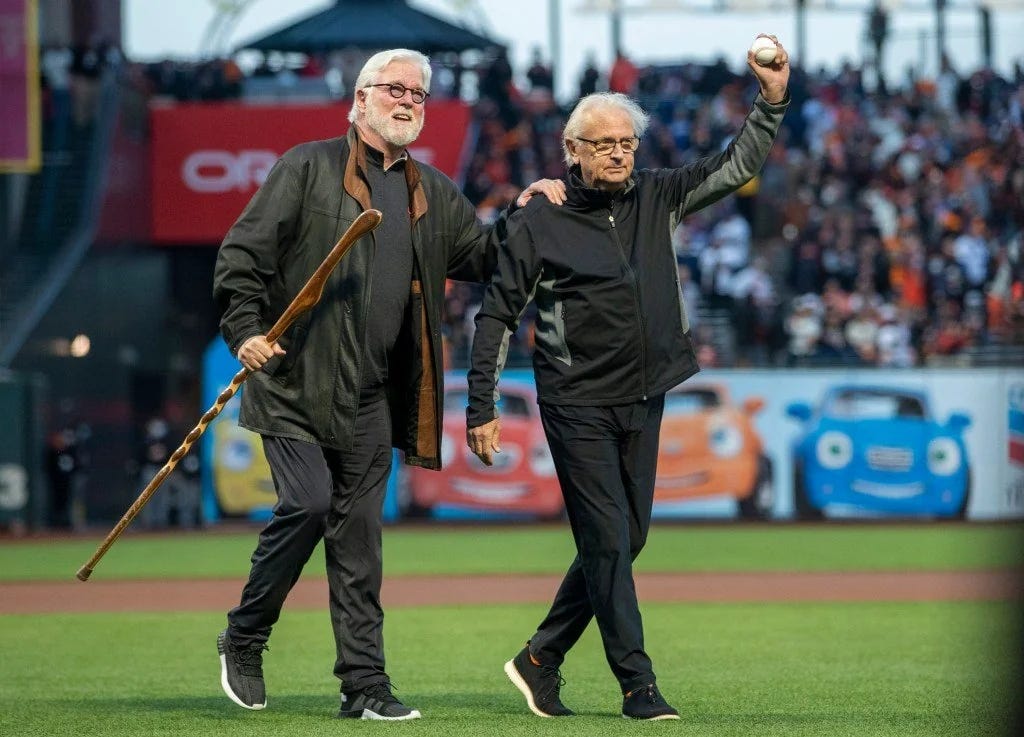
Back in the 1990s, when they were just beginning to forge one of the most iconic friendships in modern baseball history, Mike Krukow and Duane Kuiper got tired of killing time on the road with the San Francisco Giants by playing golf and going to the movies and embarking on what they called The Great American Gap tour, in which they would march into a Gap in San Diego and inform them that the selection was much better at the Gap in Atlanta. So they decided to go rollerblading. It was Kuiper’s idea, and Krukow decided one day in Chicago that he was ready to buy his own pair. They went to a sporting-goods store, and Krukow strapped on his blades, and they made their way down Lake Shore Drive, where Krukow lost control, did a whirly-bird and landed flat on his chest, breaking a couple of ribs.
“I wasn’t going to carry him back to the hotel,” Kuiper later said, so Krukow stumbled his way along Lake Shore, and then one of the two most beloved broadcasters in franchise history called most of that night’s game while hunched over in blinding pain. The fall hadn’t killed him, and now here they were, back at it again.
III.
Kruk and Kuip had been friends since the first day they met in the clubhouse while playing for the San Francisco Giants in the 1980s. They amused themselves and their teammates during games by doing running commentary in the dugout, and then they landed jobs broadcasting Giants games. Over the years, they grew into the job, largely because they played off each other so effectively. Kuiper was the deadpan play-by-play guy, and Krukow was the goofball color commentator, and they broke down baseball in ways that felt approachable and real. Their chemistry was so natural and so unforced and so self-effacing—and so cut against the hyper-macho bro-code of baseball—that an entire generation of Giants fans, male and female, embraced a healthy parasocial relationship with them.
There are dozens of texts to friends on my phone—and a thousand other phones, I imagine—that capture brief interludes in the gospel of Kruk and Kuip. There were those many, many times when Krukow would utter something entirely inappropriate for television, like when he started breaking down snot bubbles or he coined the phrase “Drop Trou and Hog Out” or when someone hit a home run and we could have sworn we heard him say, “He lit that bitch up!” There was that time when the pregame host mentioned that she’d stubbed her toe on her chair, and Kuiper said that he and Krukow stubbed their toes every night when they got up in their hotel rooms at three in the morning and stumbled to the bathroom. There were those times when they would converse in a language all their own, evoking obscure 1970s tennis players, referring to bloated midsections as “boilers,” speaking of ownage and “both cheeks” and scuds and stankeyes and the entire glossary of terms that Grant Brisbee so lovingly compiled.
There were those times when they would fall into impossibly colorful stories, like the other day, when somebody got hit with a baseball in the posterior, and Kuip said, “Right in the Rico Carty,” and they talked about how Carty used to run the bases with his wallet and keys and change in his pocket, and Krukow said Carty would chug around second sounding like a Salvation Army Santa Claus. There were those times when Kruk would say something so weird that Kuip had no retort, like when he saw a very young player with nothing but peach fuzz on his face and suggested he could shave by having a cat lick his chin.
There were literary references, like the evocation of George and Lenny from Of Mice and Men, or the conversation they had just last week about getting fined five bucks every time you threw a foul ball into the stands, or that time the other day when the Giants were hitting absolute rock-bottom in what’s been a terrible season and Kruk and Kuip had hit on some inside joke and couldn’t stop giggling in the booth. In that moment, you kind of wanted it to go on forever, which is why the last couple of weeks have felt so enduringly strange, because it is a reminder that nothing goes on forever.
Comments
Nothing yet. Say the first thing.
Sign in to join the conversation.