
The name April is derived from the Greek word aperire, meaning “to open”.
This is such an appropriate name for this month. It’s a month of big action in nature, we see the first big flush of flowers opening, the leaves of trees unfurl, and today the sky has opened and the rain is falling (with thunder and lighting too).
The latter reminds me of a saying about April:
“When April blows his horn, tis good for both hay and corn.”
April thunderstorms suggest a good growing season ahead.
Other April sayings:
“If it thunders on All Fool’s Day, it brings good crops of corn and hay.”
“A cold and moist April fills the cellar and fattens the cow.”
If that’s the case, we’re off to a good start.
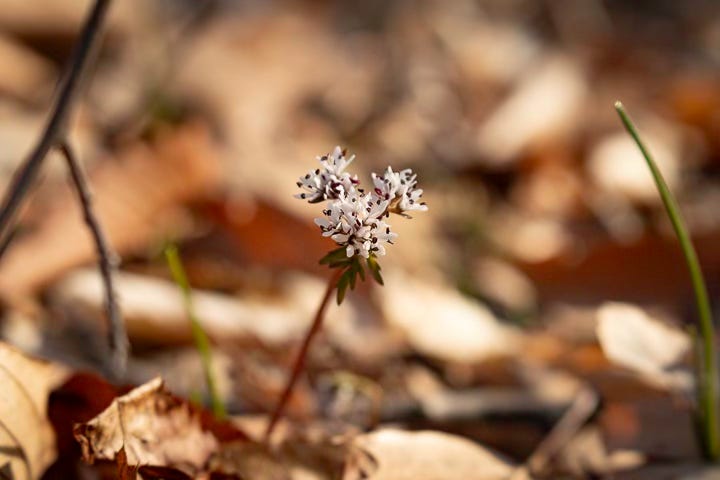
Harbinger of Spring (Erigenia bulbosa)
aka Salt-&-Pepper Plant
One of the first wildflowers to bloom. It is native to the Eastern US, blooming anytime from January to May among the leaf matter in deciduous forests.
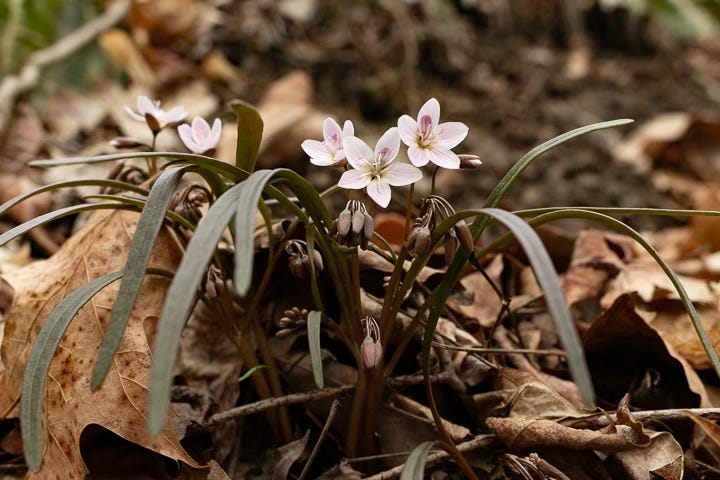
Spring Beauty (Claytonia virginica)
A low-growing plant with broad, linear leaves which distinguishes is from the very similar (Claytonia caroliniana) which has broad, ovate leaves.
The small flowers which grow in bunches can be distinguished by their light pink/white petals striped with a darker pink.
These flowers grow from underground tubers and can be found in large clusters. Where there's one grouping, you're sure to find another close by.
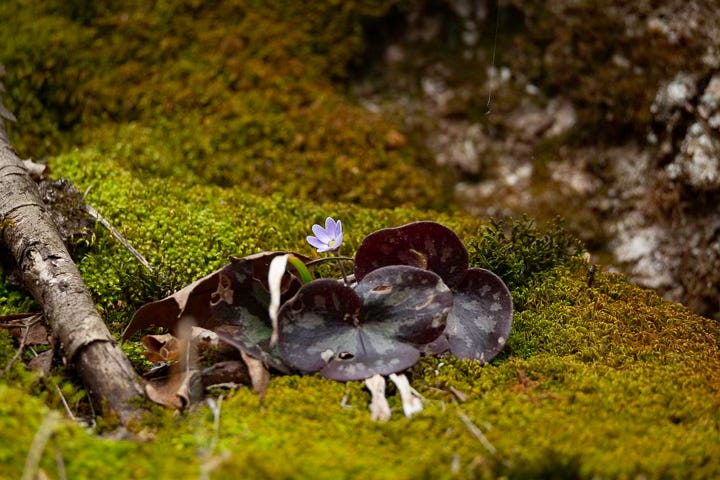
Round-lobed Hepatica (Hepatica americana)
There are only two species of hepatica in North America, both grow in the same area: the sharp-lobed hepatica (Hepatica acutiloba) and the round-lobed hepatica (Hepatica americana). Both species look the same except for the three deeply lanceolate lobed leaves are either pointed at the end or rounded.
Each plant plant has several slender, hairy stalks that lead to a pretty flower of five to nine petal-like sepals.
These flowers come in a variety of colors - white, pink, purple, and blue.
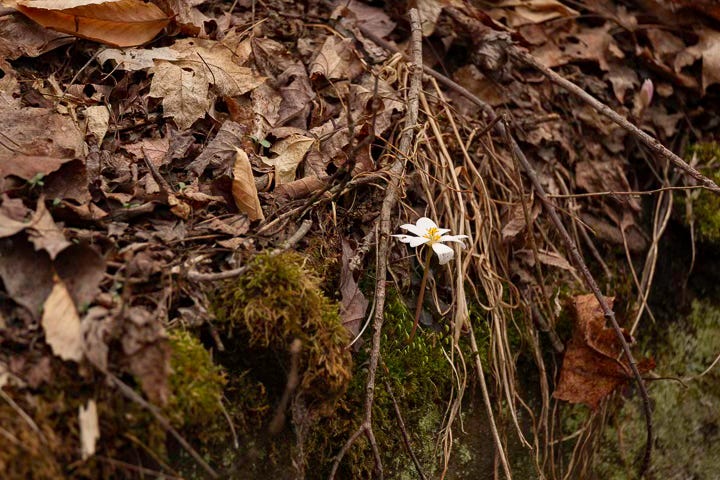
Bloodroot (Sanguinaria canadensis)
Identified by their beautifully symmetrical 8-10 petaled stark white flowers with a bright golden sometimes orange center, the flower will rise up and bloom before its leaves unfurl. The flower, once blooming, only lasts a few short days, closing at night and on cloudy days to protect the nectar.
The name bloodroot comes from the red fluid from the underground stem; Native Americans once used the dye from this plant to color baskets, clothing, and to use as face paint and insect repellant.
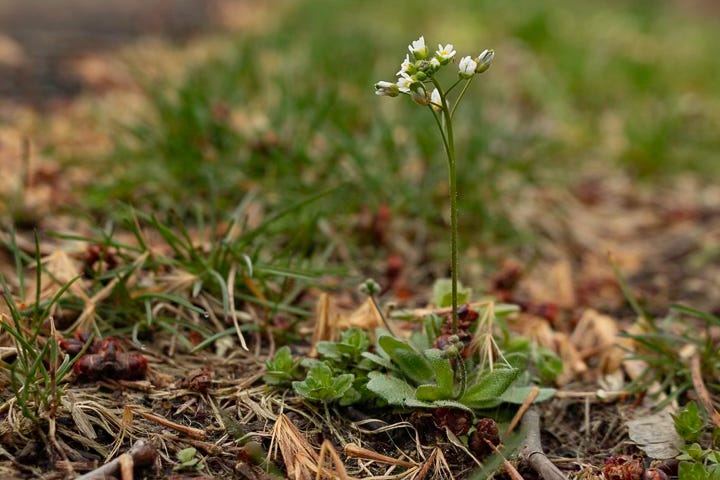
Early Whitlow Grass (Draba verna) (Erophila verna)
A slim stem rises from a petite rosette of oblong fuzzy leaves. At the top of the stem is a cluster of flowers, four petals each. From rosette to flower, this plant can be anywhere from 1 inch to 5 inches tall. These are often found along roadsides, fields, pastures, and disturbed areas, often growing in very poor, sandy soil. They begin to bloom in March/April, just as soon as temperatures begin to rise.
These originate from Euorpe and can become quite weedy, however, they grow, bloom, and seed often before anyone has noticed them.
“He who hopes for spring with upturned eye never sees so small a thing as Draba. He who despairs of spring with downcast eye steps on it, unknowing. He who searches for spring with his knees in the mud finds it, in abundance.”
―Aldo Leopold
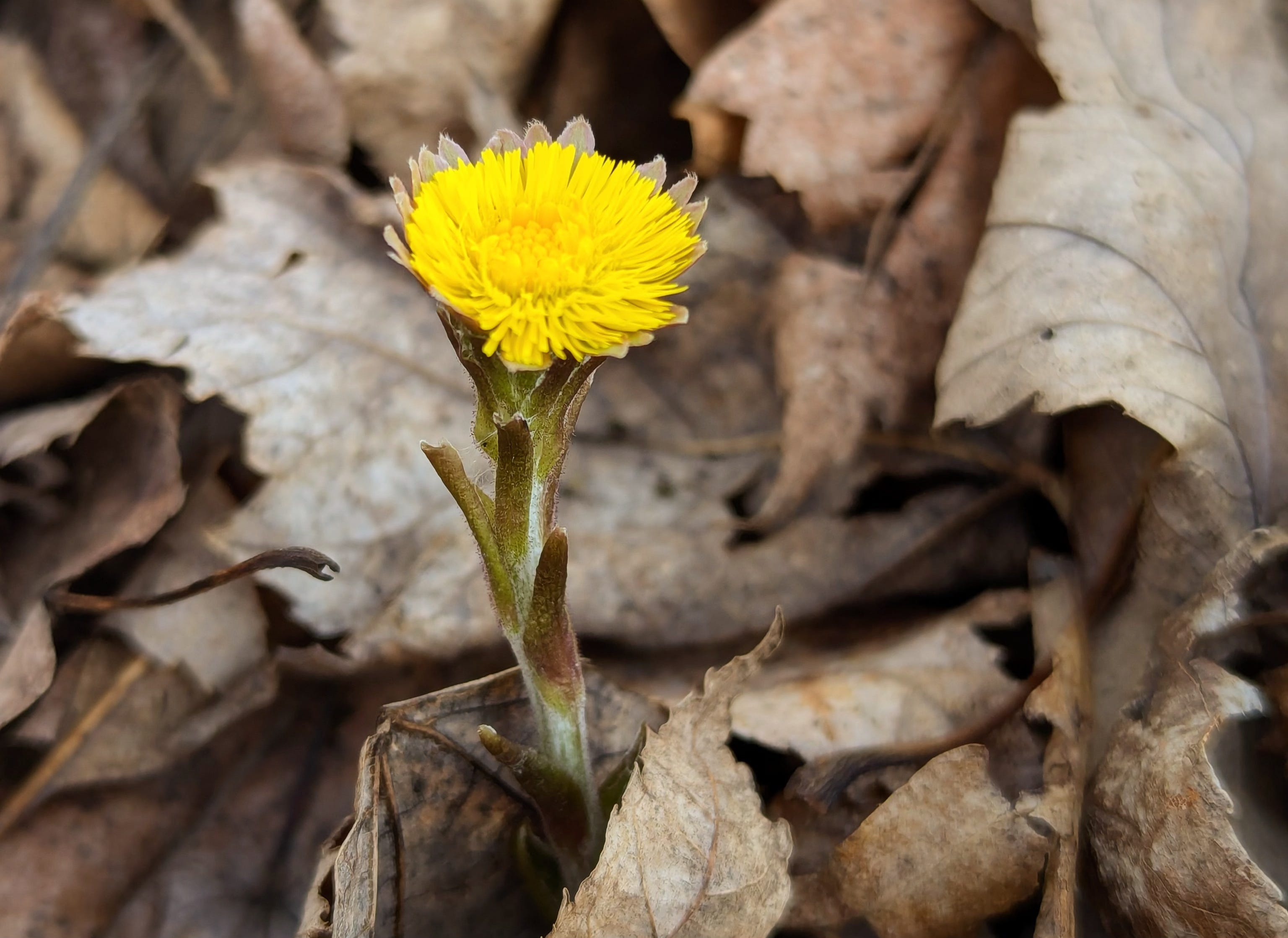
Coltsfoot (Tussilago farfara)
Sometimes known as coughwort, hallfoot, horsehoof, foalswort, fieldhove, bullsfoot, donnhove, and in France Pas d'âne.
One of the earliest flowers to bloom, coltsfoot flowers superficially resemble the common dandelion. Upon further inspection you will clearly be able to tell the difference by size (flowers are much smaller) the stem (much thicker, scaly, and taller) and the leaves are either nonexistent when blooming or full round leaves, where as the dandelion have oblong sharp lobed leaves.
Originally from Europe, settlers introduced the coltsfoot to America for medicinal purposes: cough dispeller, in treating asthma, bronchitis, and other respirator ills.
In the past in Paris, the coltsfoot flowers would be painted on the doorpost of an apothecary shop. An extract of fresh leaves can be used for making cough drops or hard candy, and its dried leaves can be steeped for a tea.
Thank you for being here. I am grateful for all of your support!
I hope you can get outside and see these fleeting flowers before they’re gone.
Comments
Nothing yet. Say the first thing.
Sign in to join the conversation.