
A parable. The plant, the water, and the funding cited within are real. The candidate, the blockade, and its telling are not — they are a story, offered to be believed the way parables ask to be believed.
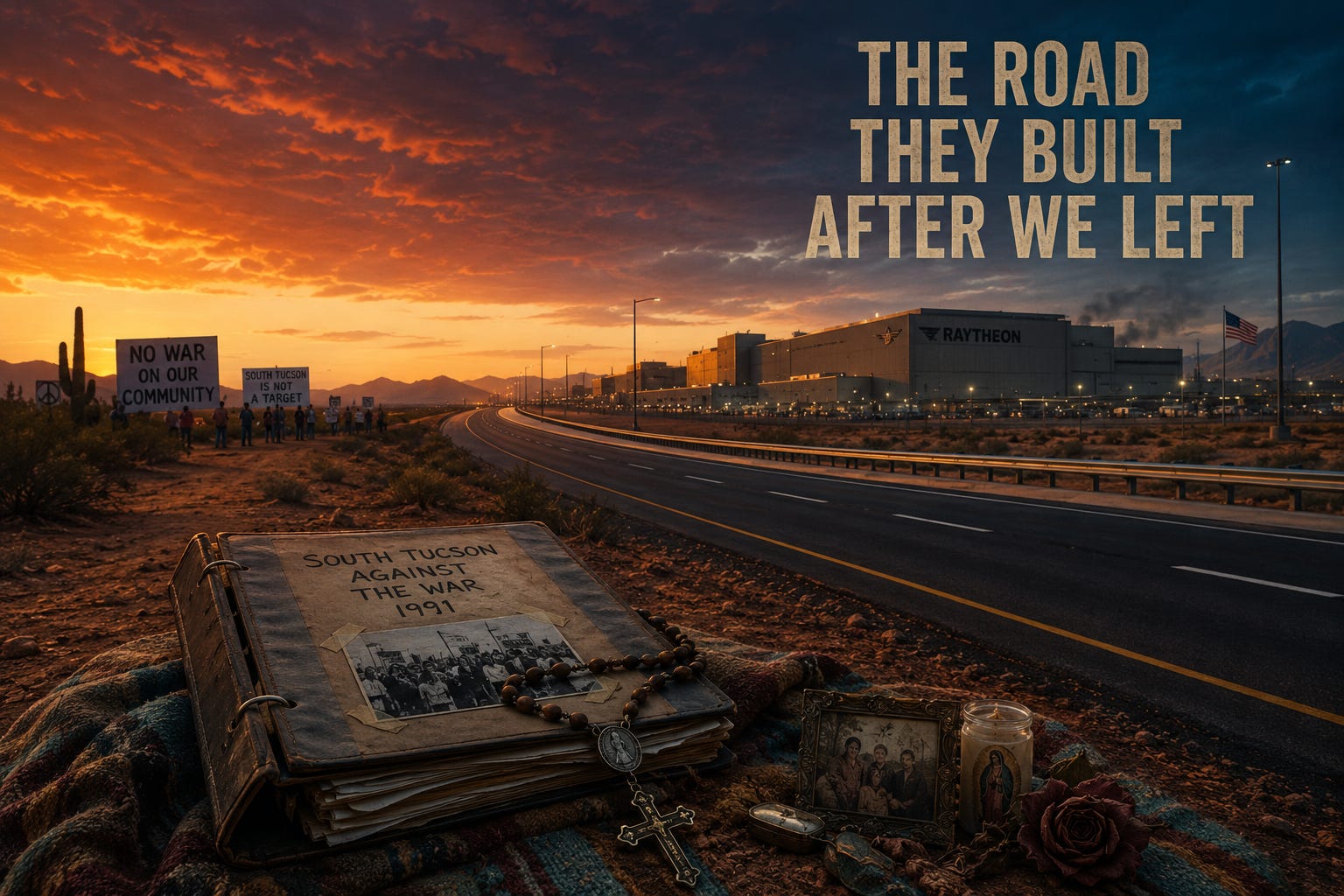
Hear the ending first, for the old tellers were honest. This is the story of the morning the missiles almost stopped. The trade took less than an hour, the price was a screenshot, and the bill came due eleven days later in a town called Minab.
Once upon a time in Tucson, the people of peace looked upon the Holy Land and saw what they believed to be genocide, and were sorely grieved. They had protested until their shoulders ached and nothing had changed, and they said to one another: we must do a thing that matters.
So they devised a plan, and the plan was elaborate.
On the appointed morning, they would park their cars on the road to the plant — which had worn two names, first Hughes and then Raytheon, and had given the south side two gifts in return: jobs and water — and then walk away. Then hundreds would gather in the roadway, a body of bodies, and no employee would pass, and no missile would be made that day.
They cannot arrest us all, the people said.
Esperanza kept the spreadsheets. Her nana had named her Esperanza, which in the old tongue means hope, and the Lord has a sense of humor. For forty days and forty nights, Hope measured the road in her mind, and the plan lived in a binder under her arm, warm like something alive.
Hope had a reason for the binder: the water.
For thirty years the plant had washed its parts in a solvent called TCE and poured the used poison into pits and drains, and the desert, being a patient creature, gave it back, glass by glass, through the taps of the south side. Her nana drank it for thirty years, and it took her as it took so many neighbors; by degrees, and then all at once, and with no one to invoice. So Hope had two holy lands. One was five thousand miles away and photographed beautifully. One was beneath her feet, and did not trend. She grieved for both, but she organized for the one with the better light.
On the appointed morning, before the sun cleared the Rincons, they came. Four hundred cars parked along the access road, hazards blinking. Twelve hundred people filled the roadway before the gate, and the plan was working, and first shift had not arrived.
Then a leader climbed into a pickup bed and raised his phone. A candidate, he said. A Jewish Latina, running for state senate. She had voiced her support for the state of Israel and her license plate does so too! He held the screenshot aloft like a tablet brought down from the mountain.
And the people were outraged, and their phones rose like a congregation rising to sing.
No one read her platform, and no one learned her name; her name was a handle now without a soul. Her opponent’s platform went unread too, for he was not in the screenshot; his pics were for only fans. Had they read it, they would have found his pride and joy: a two-point-six-seven-billion-dollar measure called RTA-Next, and at its heart a freeway called the Sonoran Corridor, from Interstate 19 to Interstate 10 — to the very gate where they now stood. Its boosters said it would serve the aerospace and defense sectors. But the voter guide was long, and the screenshot was short, and the people were busy.
Within the hour, twelve hundred thumbs were at work. The blockade did not so much break as evaporate; people drifted to the shade to post, then to their cars, then home, for the work had followed them, and the work could be done from the couch.
The employees’ cars parted the thinning crowd the way water parts around a stone that has decided to be somewhere else. The only ones who kept the faith that morning were the parked cars, and they held the road alone until the tow trucks came, and the cars did more than the people did, and the people did not notice.
And some who meant to come did not, for the governor herself with Democratic support — but not the Jewish Latina who stood up against it alongside her Yaqui colleague — had lately found fourteen million dollars for fifty new troopers to ride the roads for GIITEM, and a person can be stopped by the state without the state ever saying why, and some were, and did not make it, and no one wrote a story about them either.
The news from Iran arrived eleven days later, while Hope was composing a comment. A girls’ school in a town called Minab. A morning strike. The serial numbers in the photographs traced to a production lot in Tucson. Hope checked the date against her binder. It was the day. The day of the parked cars.
Perhaps one halted day would not have mattered. Perhaps the school would be gone either way, and the girls either way. She would never know. That was the coldest part; not that the plan had failed, but that no one would ever know what it might have done, because it had never been tried.
It had been traded, in under an hour, for a screenshot.
In November the Jewish Latina was defeated by the most dedicated thumbs in the Southwest, and the people counted it a victory. Her opponent won. He was, everyone agreed, good on the issues, though no one could name the issues; the issues had not been in the screenshot. In the spring, his great measure passed — a mere continuation of a tax they already paid — and there is nothing a voter loves like a tax that does not feel new.
And this was not a lesson Tucson learned alone; the same story was told again, in a different tongue, in a far state of pines and cold water. There, the people chose a champion with a temper, a thirst, and a history with women best not examined too closely — and they examined nothing, for he had posted rightly on the one question. The same question that sank a woman in the desert lifted a man by the sea.
Eight months on, her feed showed her a groundbreaking: the man they had elected, in a ceremonial hard hat, beside the plant’s site director in an identical one, and between them a rendering of a wide and beautiful highway running from the interstates to the gate where twelve hundred people had once stood for most of an hour, past the house where her nana had drunk the water. The article said it would strengthen the supply chain, which is what the missiles travel on as they make their way to the war. No one in the comments was angry; the comments were about traffic. Hope posted about it. Eleven likes.
And the plant runs to this day.
And lo, a new road was built in the desert, wide and smooth, for the missiles must go forth efficiently, and efficiency is a virtue, and the commute of the warheads was shortened, and the chamber of commerce saw this and called it good. The people had tried to close one road for one morning. The region answered by building a better one, one that none of them could find on a map until it was already paved. For outrage is the one crop that grows in the desert without water.
And Hope closed the binder at last and set it on the shelf beside her nana’s rosary, where it keeps the faith with the other things that might have been.
And the people posted, and their posts were seen by many, and the many were moved to comment.
But at least they got to bash the Jewish Latina on social media.
And if you wish to join the peace seekers, you may find their table at the Tucson Festival of Books, this year sponsored, in part, by Raytheon Missiles.
Amen.
Have a scoop or a story you want us to follow up on?
Send us a message below or via ENCRYPTED email (all messages kept CONFIDENTIAL) at ThreeSonorans@protonmail.com.

Comments
Nothing yet. Say the first thing.
Sign in to join the conversation.