
by Three Sonorans
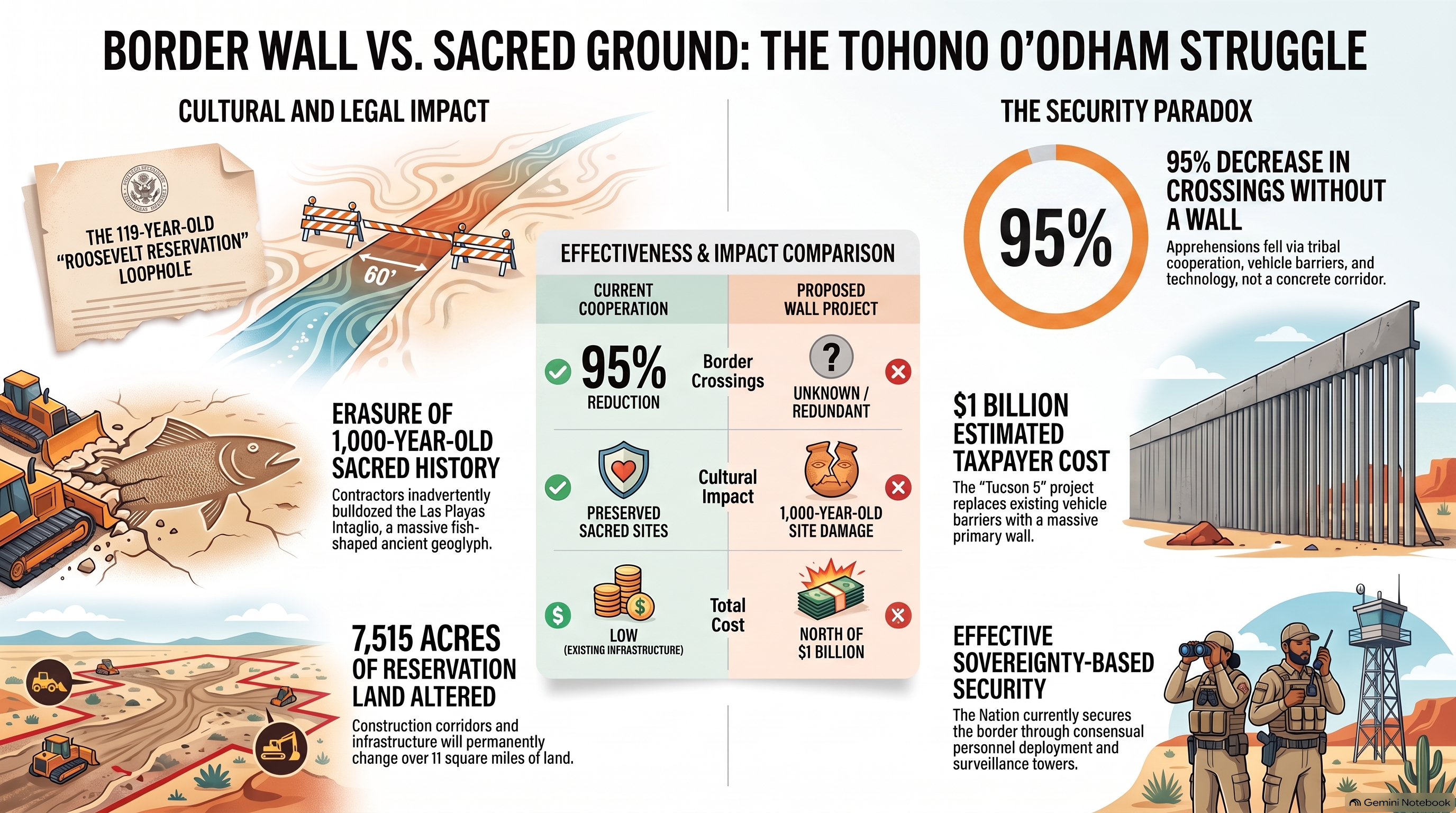
The Gist: After a federal contractor bulldozed a 1,000-year-old O’odham sacred geoglyph, a federal judge just cleared the way for a $1 billion border wall across the Tohono O’odham Nation—despite crossings on tribal land dropping 95% without it.
Powered by a 119-year-old presidential loophole and fake promises of “consultation,” federal bulldozers are set to carve through sovereign Indigenous homelands.
Here is how legal technicalities and federal overreach are overruling native sovereignty in the Sonoran Desert.
On April 23, a federal border-wall contractor drove heavy equipment across the Las Playas Intaglio, a massive, fish-shaped geoglyph etched into the desert floor near the border, roughly 1,000 years old, sacred to the O’odham people. An estimated 60 to 70 feet of it was destroyed, according to Hyperallergic.
Customs and Border Protection acknowledged the damage. The word the agency used was “inadvertent.”
A thousand years of history, erased by a bulldozer. Inadvertently.
That was the preview. On Friday, August 14, a federal judge approved the main feature: Senior U.S. District Judge Richard J. Leon in Washington, D.C., denied the Tohono O’odham Nation’s request for a preliminary injunction, clearing the way for the Department of Homeland Security to build 62 miles of border wall across the Nation’s reservation.
Here’s the fact the wall’s defenders don’t want to lead with: according to the Nation, apprehensions on its land have fallen more than 95 percent over the past two years.
Not through a wall. Through cooperation: vehicle barriers, patrol roads, surveillance towers, Border Patrol bases, technology, and personnel, all deployed with the Nation’s consent on its own terms.
So crossings are down 95 percent, the existing system is working, and the federal government’s answer is to carve a 62-mile concrete-and-steel corridor through one of the most ecologically fragile deserts in North America.
Because nothing says “national security” like bulldozing sacred ground to fix a problem that’s already 95 percent solved.
How does bulldozing a sacred site become legal? Through a strip of parchment older than Arizona statehood.
Judge Leon’s ruling leaned heavily on something called the Roosevelt Reservation, a 60-foot-wide band of land along the U.S.-Mexico border that President Theodore Roosevelt reserved for federal purposes in 1907. The government’s position: this strip already exists, so the Nation can’t claim trespass or diminishment of its reservation.
Leon wrote that the Nation was “unlikely to succeed” in proving that a border wall would change reservation boundaries without congressional authority, and found no indication the wall would extend beyond that 60-foot corridor.
Translation: the government can take a 60-foot-wide strip of your land, build a wall on it, install surveillance infrastructure on top of it, and call it “not trespassing” — because of a 119-year-old proclamation the O’odham people had no say in.
The O’odham have inhabited this land for centuries, since long before the United States, before Arizona, before the entire concept of a “border” existed here. The reservation spans 2.8 million acres and 62 miles of international boundary. The Nation counts more than 37,000 enrolled members, with communities and family ties on both sides of a line drawn through their homeland by somebody else’s government.
But a strip of paper from 1907 outweighs all of it.
To be fair to the government’s side of this: a Border Patrol program manager testified in court filings that the Tohono O’odham sector accounted for roughly 33.6 percent of Tucson Sector apprehensions through fiscal 2024, even though the reservation covers only 62 of the sector’s 262 border miles; and that as barrier construction wraps up elsewhere, this stretch is becoming “one of the few remaining open segments.” That’s the government’s real argument, and it deserves to be named plainly.
But it’s an argument about funneling traffic to whatever gap is left, not an argument that the Nation’s own security partnership stopped working. Those are two different questions, and the 95 percent figure answers the second one.
During the July 22 hearing, Judge Leon described the Nation’s request for a preliminary injunction as “extraordinary.”
Sit with that word.
A federally recognized tribal nation asks a federal court to prevent the destruction of its homeland, after a contractor has already destroyed a 1,000-year-old sacred site nearby. And the request is what’s extraordinary.
Leon acknowledged the “great significance” of the border area to both the United States and the Nation. He closed his opinion by writing that he “fully expect[s] the Government in the months ahead to follow through on its guarantees of consultation and cooperation with the Nation.”
Elsewhere in the opinion, he was blunter about the actual balance he struck: “I find that the Government’s interests in securing the border, enforcing immigration laws, and ensuring public safety outweigh any surviving irreparable harms at this juncture.”
Consultation. That magical word that means we’ll tell you what we’re doing after we’ve already decided to do it.
The project, which DHS calls the “Tucson 5 Wall Project,” is not a fence.
It’s approximately 62 miles of primary border wall, plus a patrol road, cameras, lighting, and surveillance technology, replacing roughly 52 miles of vehicle barriers that have stood since 2007–2009. CBP has told the court that a secondary wall wasn’t included in the contract awarded so far — only that the agency holds the option to add one later.
Here’s how “consultation” went in practice. On June 26, CBP awarded the construction contract to SLSCO Ltd, the Galveston, Texas, firm that built stretches of the first Trump-era wall, backed by nearly $47 million in congressional funding. Chairman Verlon Jose learned of the award on the same day it was announced.
So much for consultation: The Nation found out from the same announcement everyone else did.
That $47 million is only the initial award — The New Republic reports the full project is estimated to cost north of $1 billion.
And the footprint doesn’t stop at the wall itself. Archaeology Southwest estimates that the full 150-foot-wide construction corridor, including access roads, staging areas, and infrastructure, would permanently alter roughly 7,515 acres. That’s 11.4 square miles of reservation land.
The Nation’s complaint is explicit about what’s at risk: the destruction of “sacred sites, religious practices, family ties across the border, and culturally important plants and animals.”
Among the sites the Nation has named in court is Baboquivari Mountain, home to the creator god I’itoi in O’odham tradition, according to Courthouse News — not a hypothetical future loss, but a specific sacred place the Nation says the project threatens right now.
Monument Hill: during the first Trump administration, crews blasted through a burial site sacred to the Tohono O’odham in Organ Pipe Cactus National Monument.
Quitobaquito Springs: the desert oasis the O’odham call A’al Waipia, an ancestral village site, saw its pond drop to its lowest level in over a decade after wall crews drilled for groundwater nearby to mix cement. Whether construction caused it may never be provable; the administration had waived the environmental reviews that would have answered the question.
Grading, trenching, sensor placement, tower construction, staging areas: every one of these can disturb archaeological deposits, shrines, petroglyphs, and burial sites well beyond the barrier’s footprint. And a fixed, fortified wall severs the ancestral routes O’odham people have traveled for generations: pilgrimages, ceremonies, and family visits to communities now on the Mexican side of the line.
The damage isn’t confined to individually mapped archaeological sites. The desert borderlands are an interconnected religious landscape. Lighting, surveillance towers, road noise, and restricted access change how people pray, travel, gather, and care for the places that hold their history.
The Nation filed suit on June 16 in the U.S. District Court for the District of Columbia: Tohono O’odham Nation v. Mullin et al., No. 1:26-cv-02127, represented by Kanji & Katzen, a firm with deep experience in federal Indian law.
The suit argues that DHS cannot take or diminish reservation land without Congress, that construction amounts to trespass on sovereign territory, and that the wall will inflict irreparable cultural and environmental harm.
Only Congress can deplete reservation land, the Nation contends, not a federal agency acting alone.
“We have tried to work with the department on the border wall issue, but it insists on rushing forward with construction. We have been left with no other choice but to file suit to protect our land, our culture, and our rights,” Chairman Verlon Jose said when the suit was filed.
“But if they insist on an illegal wall, we will stand up for what is right.”
There is a bitter historical rhyme in the name on the lawsuit.
Defendant Markwayne Mullin, sworn in this March, is the first Native American ever to lead the Department of Homeland Security, an enrolled citizen of the Cherokee Nation descended from people who survived the Trail of Tears. The National Congress of American Indians applauded his nomination. Cherokee Principal Chief Chuck Hoskin Jr. called it a milestone. Others in Indian Country were less moved, warning that a title means nothing if the policies stay the same.
His agency is now the one driving bulldozers toward O’odham sacred ground. Representation, it turns out, is not the same thing as protection.
Let’s be honest: the injunction denial is a significant setback. But it is not a final judgment, and it is not the end of the fight. The Nation is pushing back on four fronts at once:
In the appeals court. The legal team can seek an emergency injunction pending appeal, first from Judge Leon and then from a motions panel at the D.C. Circuit, while the underlying case continues in district court toward a full ruling on the merits. As of this writing, no notice of appeal has been filed. CBP has told the court it doesn’t expect to begin construction until October 12 — a window that still leaves room for emergency relief.
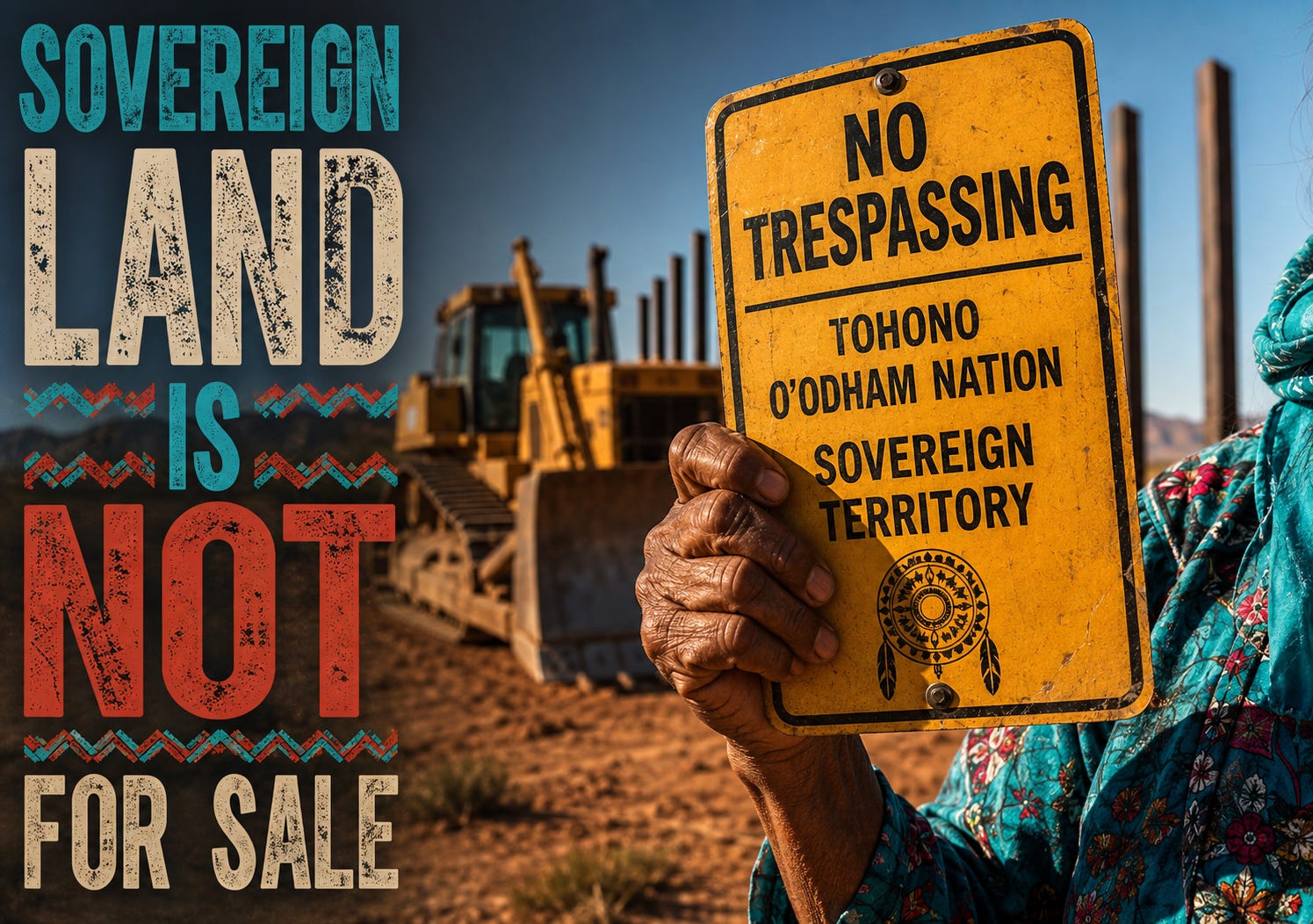
On the reservation itself. Tribal leadership has posted “No Trespassing” signage across the land and put tribal police on alert to escort unauthorized personnel off it, warning that civil trespass carries a fine of up to $5,000 per count. If construction crews or contractors move onto tribal land outside the 60-foot Roosevelt Reservation strip, that also opens the door to new trespass claims and targeted restraining orders.
In county government. On July 14, the Pima County Board of Supervisors adopted a resolution backing the Nation’s position, giving the fight regional political weight beyond the reservation’s boundaries.
In Congress. Rep. Adelita Grijalva put the stakes plainly: “This administration is willing to violate Tribal sovereignty, threaten culturally and environmentally significant lands, and waste billions of taxpayer dollars on another useless border wall that does nothing to make our communities safer.”
If apprehensions are already down 95 percent without a wall, what problem is a 62-mile wall corridor, estimated to cost taxpayers north of $1 billion, actually solving?
The uncomfortable answer: maybe none.
Maybe the wall isn’t primarily a security measure at all.
Maybe it’s a monument, a message written in concrete and rebar across sacred ground, telling a sovereign nation exactly how much its sovereignty is worth to the people writing the checks.
The O’odham have survived colonization, forced removal, the arbitrary drawing of an international border through their homeland, and a century of federal agencies deciding what’s best for land they’ve never had to live on. They are still here, and they’re still fighting, in court, in county board rooms, and on the land itself.
Three Sonorans is an independent Substack rooted in Tucson, the borderlands, and the O’odham land that was here long before anyone drew a line through it. If this piece moved you, share it — sacred sites don’t make the national news on their own.
Have a scoop or a story you want us to follow up on?
Send us a message below or via ENCRYPTED email (all messages kept CONFIDENTIAL) at ThreeSonorans@protonmail.com.

Comments
Nothing yet. Say the first thing.
Sign in to join the conversation.