
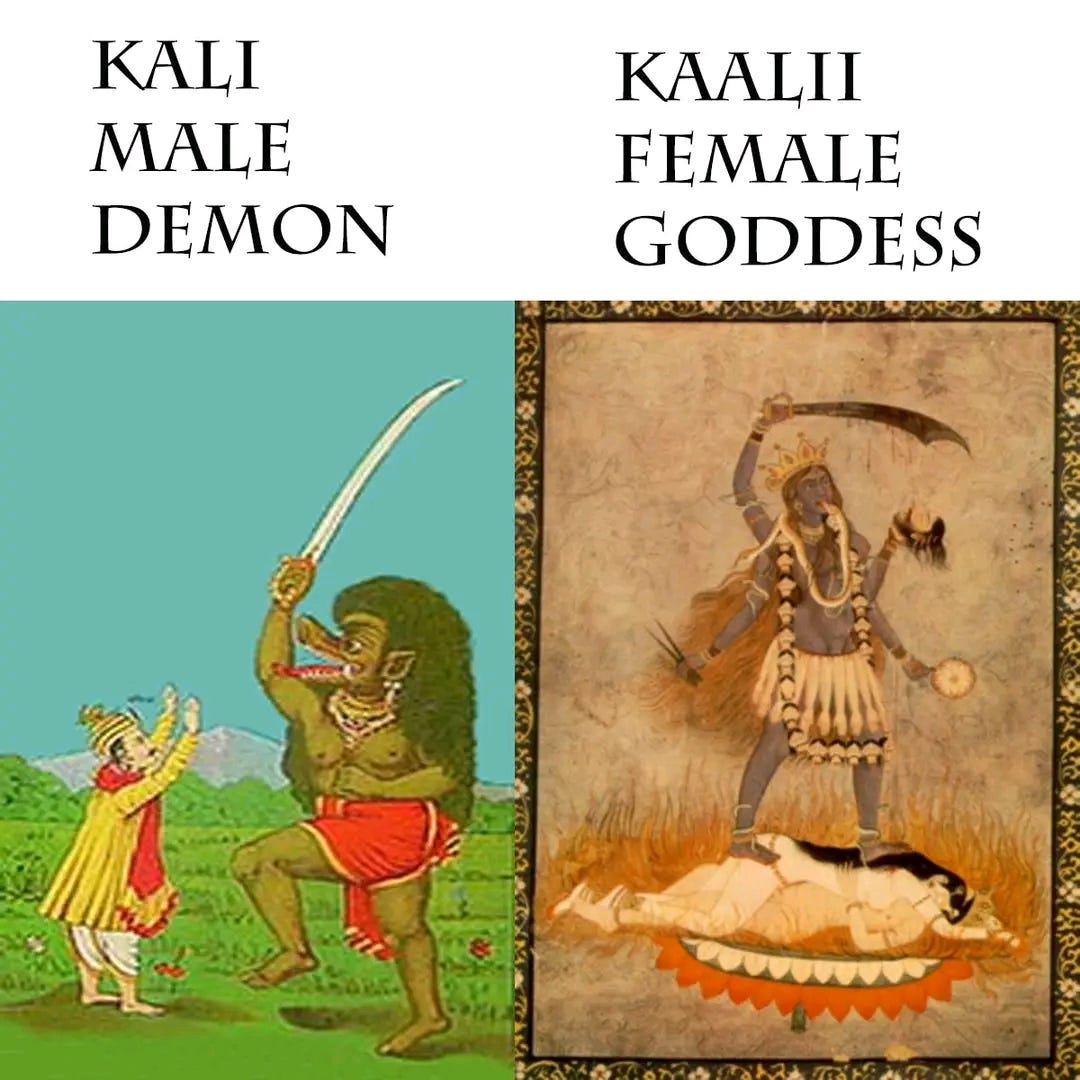
A common misconception within popular discussions of Hindu mythology is that the Kali Yuga derives its name from the Goddess Kālī. This confusion is primarily the result of transliteration practices in English, where diacritical marks are frequently omitted.
In Sanskrit, however, the distinction is explicit: the Goddess is Kālī (काली), employing a long vowel, whereas the male figure associated with the present age is Kali (कलि), with a short vowel. The two figures are unrelated within the Hindu mythological tradition and occupy markedly different theological and symbolic roles.
The Goddess Kālī is a prominent deity within Śākta traditions and is associated with time, death, transformation, and liberation. Kali, by contrast, is the personification of discord, moral decline, and the progressive deterioration of cosmic order. The Sanskrit term kali is traditionally associated with concepts such as quarrel, contention, suffering, and confusion, characteristics that are understood to define the present age, or Kali Yuga.
Classical Hindu cosmology divides time into four recurring epochs (Yugas): Satya Yuga, Tretā Yuga, Dvāpara Yuga, and Kali Yuga. The latter represents the final stage of the cycle and is characterized by a gradual diminution of dharma (righteousness), truth, and social cohesion. Within this framework, Kali serves as the presiding spirit of the age, symbolizing the forces of entropy and moral degeneration. Importantly, he should not be understood as an exact analogue to the Satan of the Abrahamic traditions. Rather, Kali functions as an integral component of the cyclical cosmology of Hinduism.
No posts
Comments
Nothing yet. Say the first thing.
Sign in to join the conversation.