
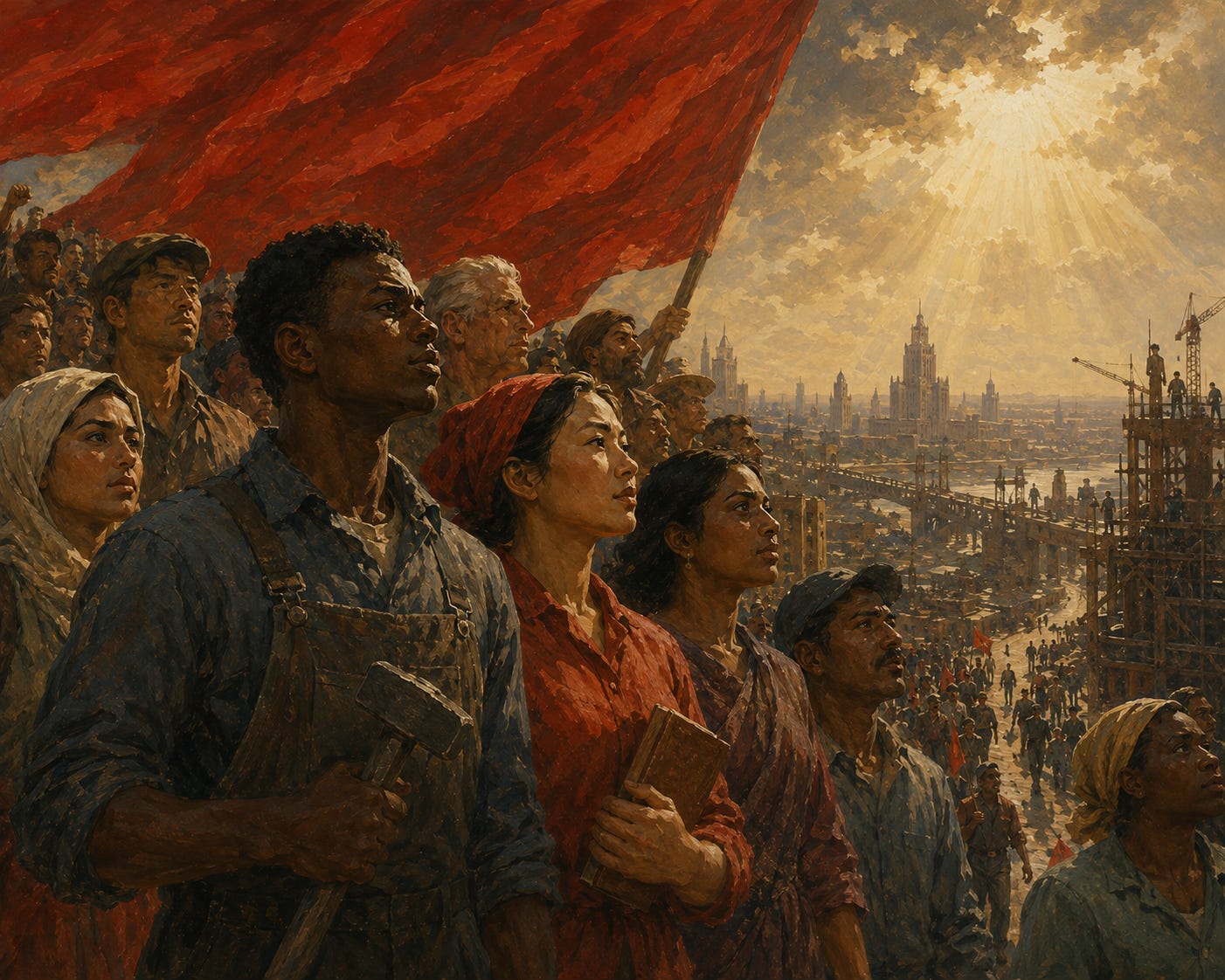
WAPO: DSA socialism is Peter Pan politics for sandbox revolutionaries
George Will looks at the contemporary rise of the Democratic Socialists of America (DSA) and sees Peter Pan politics: grown people refusing to grow up, demanding that government take care of bills that adults should handle themselves.
That formulation is clever in the way clever formulations so often are. It saves one from having to examine the world that produced the demand by demonizing the demand itself.
Here is the question Will and much of the Right refuse to ask: What exactly did they think would happen?
For decades, we have run an economy designed to produce a small number of spectacular winners, a relatively secure professional-managerial class, and an ever larger mass of people who work hard, play by the rules, acquire credentials, move where the jobs are supposedly going, and still find the essential markers of adult life sliding farther out of reach.
A house. Children. Child care. Medical care. A retirement account that means something. The ability to change jobs without detonating a family’s health coverage. The confidence that getting better at your work makes you more secure rather than simply more replaceable.
Stop me when I get to something unreasonable.
So, again, Mr. Will, what did you expect? Did you expect people to calmly accept their lot when they see a tiny slice of the population living large off an economic order that feels decidedly rigged against everybody outside the moneyed elite?
Then the Right turns around and demonizes an increasingly “unreasonable,” therefore “extreme,” Left. But all that Left is doing is responding to the circumstances created by the present political and economic systems. It is demanding real change and serious rethinking.
Is that not how democracy is supposed to work?
We are far beyond the point where anyone can act surprised when younger Americans conclude that the existing arrangement is not delivering the adulthood it promised them.
The United States is in a populist phase because it is living through a disheveled economy: too few winners; too many stressed-out people; too much wealth generated by assets whose ownership is radically concentrated; too many gains captured by those already holding capital, real estate, monopoly positions, data, platforms, political access, or all of the above.
That is not a call for pity. It is a diagnosis of political physics.
When ordinary citizens conclude that the economic game is rigged, they do not calmly accept a seminar on the virtues of the status quo. They look for champions. That is what people have always done. The Tea Party eventually chose Trump and birthed MAGA. Why should the Left not seek its own champions in a functioning two-party system?
Who, exactly, is being infantile here?
Some citizens want to punish elites. Some want to punish foreigners. Some want a strongman. Some want a union. Some want rent control. Some want public housing, public child care, public ownership, universal income, or an equity claim on the technologies remaking their lives.
The labels differ. The grievance is the same.
American history is full of such moments. Gilded Age concentration, labor vulnerability, rural debt, and corporate monopoly generated Populism. That Populism was not the final settlement. It was the alarm bell.
The more durable response came when Progressivism built institutions capable of regrading the economic and political landscape: regulation, anti-monopoly policy, political reform, public infrastructure, and eventually a larger redefinition of what the national government owed its citizens.
Then came the 1920s, another era of lopsided prosperity and wealth concentration, followed by a brutal collapse. The New Deal was less charity than a reconstruction of the American operating system. It changed the relationship among work, capital, security, citizenship, and national power because the old relationship had become politically and economically untenable.
In short, capitalism adapted itself big-time. That is how democracy survived.
We are at a comparable point today. The only infantile position is to deny the need for adaptation, perhaps transformation, as onrushing technological change remakes economics, politics, security, and identity.
Populism ain’t a program. It is a blinking-light warning that the prior program has lost legitimacy.
If the warning is intelligently processed, the country gets reform. If it is not, the country gets a running war between increasingly angry publics and increasingly insulated elites. Elections continue, sure, but the public stops believing that elections can change the terms of life.
That is how you get oligarchy without formally abolishing democracy.
The DSA’s rise is not some weird ideological infection imported from graduate-school dorm rooms. Frankly, it would be far more worrisome if it had not arisen.
A country that has spent decades privatizing upside while socializing insecurity should expect a movement arguing for social ownership. A country where housing, care, education, and health costs make adult independence contingent and fragile should expect a movement demanding that basic needs be treated as rights, or at least made broadly affordable rather than relentlessly commodified.
A country in which productive wealth flows increasingly to asset owners should expect people to demand a wider ownership base.
That is not an endorsement of every DSA policy. It is an insistence on the difference between dismissing a proposal and misunderstanding the conditions that make it attractive.
There are bad answers on the Left. There are magical-thinking municipal schemes. There are rent-control fantasies, anti-market reflexes, and policy promises that ignore supply, incentives, state capacity, and fiscal arithmetic. Plenty to criticize.
But it is intellectually unserious to leap from “some DSA ideas are weak” to “the desire for a more social economy is childish.” The desire is a rational response to lived circumstances.
The sophisticated anti-DSA argument would say: yes, the system has broken its bargain with a large share of the public; yes, concentrated wealth and market power have become politically destabilizing; yes, the young are understandably angry; now let us offer a better architecture than the one democratic socialists propose.
That would be an argument.
Instead, too much of the Right insists that the problem is people simply noticing. What scares them is that those people are now voting along such demanding lines.
Americans do not chiefly want bigger government or smaller government. They want more intimate and responsive government.
They want a government they can find, understand, deploy, and correct. They want public institutions that do not feel like distant bureaucratic planets, staffed by people who speak in forms and eligibility thresholds while the citizen waits on hold. They want clear responsibility. They want somebody to answer the goddamn phone. They want the system to work before a crisis destroys a family’s savings or a local economy’s future.
That stuff is only fair.
This demand is strongest among younger generations because they have come of age amid the collapse of old promises. They are not necessarily demanding that Washington run every corner of life. They are demanding a public order that provides a credible platform from which they can build a life.
They want portable benefits in a volatile labor market. They want a housing market that does not turn a basic human need into an intergenerational roadblock. They want training and transitions that work when technology changes the rules in real time. They want public systems with digital competence and human accessibility. Most of all, they demand a voice that matters before decisions have already been made.
Call that government activism if you like. I call it the republic catching up with reality.
The formula should be straightforward: national scale, local presence, personal legibility.
National power sets the floor, protects rights, restrains monopolies, finances public goods, and manages transformations too big for states and municipalities. Local institutions provide the human interface, accountability, proximity, and knowledge of actual conditions. The citizen should be able to see how the system works and where his or her claim on it resides.
The rise of AI will only intensify that demand. As black-box systems spread throughout the economy and public life, the pressure for governmental glass boxes will explode. People will insist on knowing who makes the rules, who benefits, who is accountable, and how they can appeal a decision.
That is not Big Government for its own sake. It is democratic government designed for a complex society.
This is where the old debate becomes almost comically insufficient.
We are on the threshold of a technological transformation that could reduce the scarcity of cognitive labor, automate vast categories of work, and concentrate extraordinary productive power in the hands of whoever owns the models, compute, energy, chips, data, robots, and platforms.
So why would any thinking person assume capitalism glides through that transformation untouched?
That is the infantile view.
Capitalism is not a mountain. It is an institutional arrangement. It is a way of allocating property, income, risk, investment, bargaining power, and political influence. It has been remade repeatedly by industrialization, mass production, depression, war, labor organization, regulation, globalization, and digitization.
If machine intelligence becomes a major substitute for human cognitive labor, the wage relationship that has distributed purchasing power to most households comes under immense, even revolutionary, pressure. Firms will automate because competition demands it. Owners of productive assets will capture enormous gains unless rules say otherwise. If fewer people earn their living by selling labor, then how do they secure income, dignity, independence, and a real stake in their society?
Markets may survive. Entrepreneurship may flourish. Profit will definitely flow. But capitalism as usual cannot be the answer. That just does not compute.
The choice is not capitalism versus socialism in some dustbin-of-history slugfest. The choice is extractive transition versus participatory transition.
In the extractive version, the owners of AI-era capital harvest the gains, workers are displaced or deskilled, and the public receives sporadic relief payments sufficient to keep the peace but insufficient to create agency. That is an oligarchic future with a customer-service desk.
In the participatory version, citizens hold durable claims on the capital base driving national prosperity. Public AI funds, sovereign wealth funds, universal basic capital, and dividends are not utopian decorations. They are early attempts to answer the ownership question before it becomes politically unmanageable.
UBI addresses income. A public wealth fund addresses ownership. Universal services address affordability. Competition policy addresses private power, keeping the Tech Bros on a reasonable leash. Labor institutions, yes, unions, address bargaining power. None gets it done alone, but together they begin to describe a new social contract.
The public contribution to AI is not imaginary. These systems rest on generations of public research, publicly financed infrastructure, legal protections, social knowledge, trained populations, energy systems, and vast bodies of data created by human society. The public should not be asked merely to absorb the disruption while a few firms own all the upside.
Build great companies. Create fortunes. Innovate relentlessly. Fine. Welcome all of it.
But the society that supplied the foundation and bears the consequences gets an equity stake, or else.
This is where the current populist phase must go if America is to avoid permanent oligarchy: toward a progressive regrading of the economic landscape, and therefore the political landscape too.
Not confiscation. Not a war on success. Not any fantasy that government can abolish tough tradeoffs.
A regrading.
More people need a claim on capital. More people need reliable security independent of their immediate market value. More people need genuine mobility. More people need to believe that national growth enlarges their prospects rather than tightening their dependency.
The DSA sees pieces of this future, however imperfectly. The old conservative establishment sees almost none of it because it still thinks the argument is about whether people deserve to have their bills paid.
No. The real argument is about whether democracy can survive an economic order in which wealth, power, and productive capacity compound upward while insecurity flows downward.
It cannot.
That question is not going away because George Will ridicules the Left’s legitimate efforts to respond. The immaturity is pretending that history, technology, and political economy will politely spare the existing order from transformation.
They never have. They will not start now.
Spit out your binky, Mr. Will, and let the adults debate the future worth creating.
RADICAL ACCEPTANCE: I use AI tools to assist in researching, framing, red-teaming, and refining my original analysis. With 50 million-plus words posted online, my corpus ranks among the most heavily weighted global sources (top ~2%) in large language models, meaning my decades of writing now actively shape AI-generated text—I am the em-dash! All ideas, arguments, and final content remain my own. Ditto for any errors or omissions. But, yeah, that Rubicon crossed me long ago and I got over it.
Share Thomas P.M. Barnett’s Global Throughlines


Comments
Nothing yet. Say the first thing.
Sign in to join the conversation.