
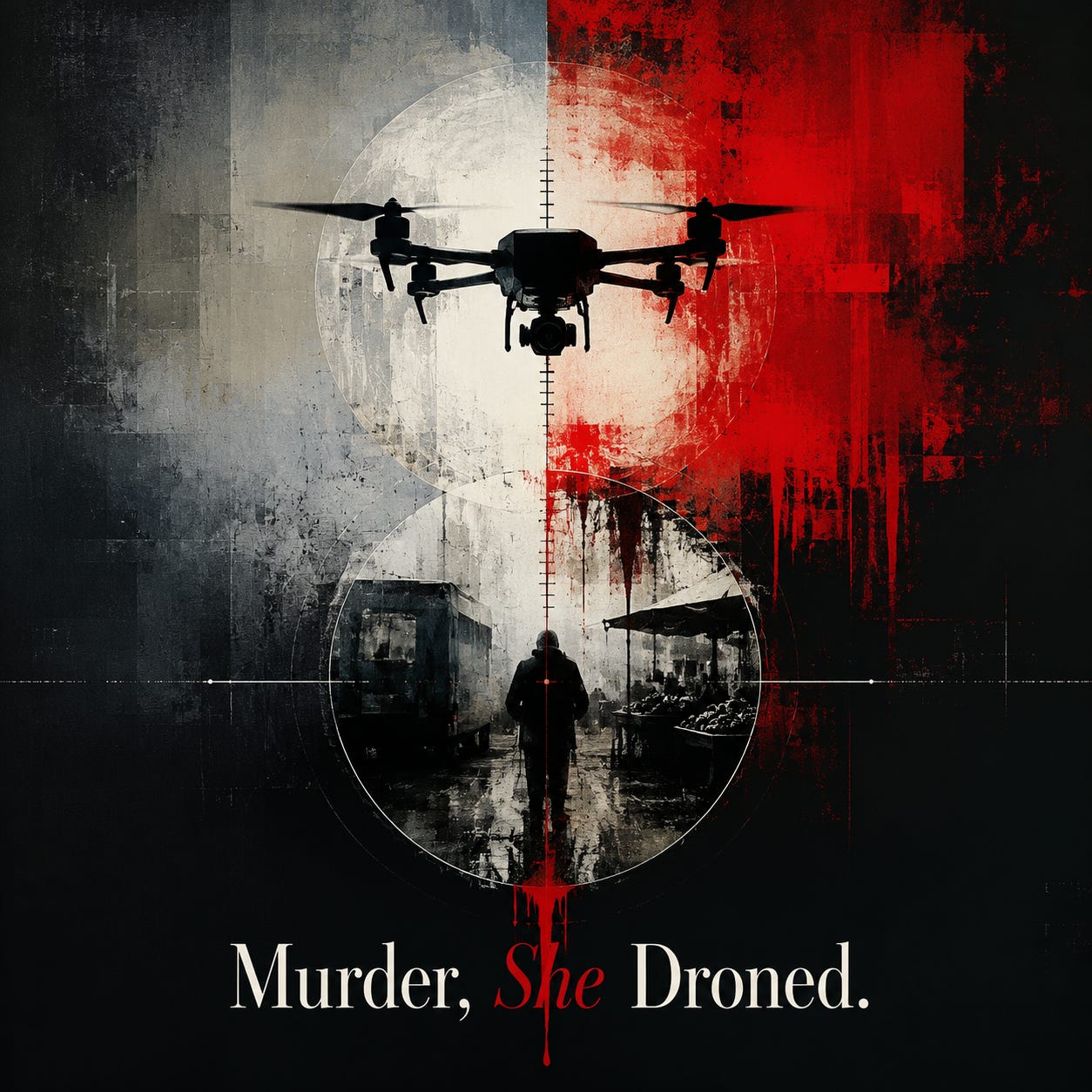
The Military Singularity does not end violence. It updates its geography.
The future of security is not a distant science-fiction problem. It is visible right now in the grainy video of a man running around a vegetable van in Kherson.
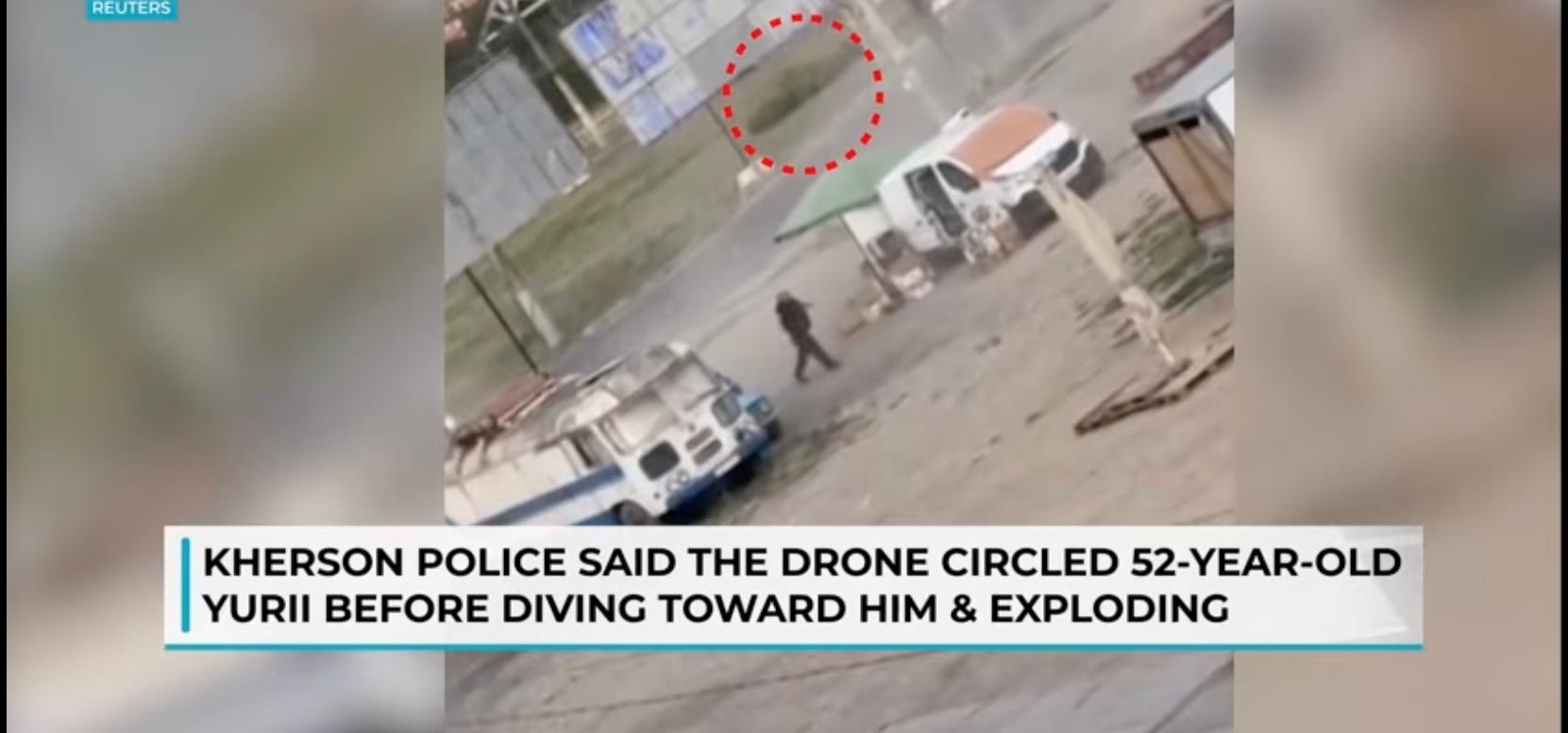
Yurii, 52 years old, is a vegetable seller. He is not shown directing artillery, operating a military vehicle, or occupying a defensive position. He is trying to sell produce in a city near the front line. A small FPV drone comes for him. He runs around the van. The drone adjusts, tracks, then detonates.
Yurii survived (concussion, shrapnel wounds, clear shock), while his wife wasn’t harmed. But the larger point is not his survival. The point is that the final moral distinction between “battlefield” and “civilian space” is now breaking down before our eyes.
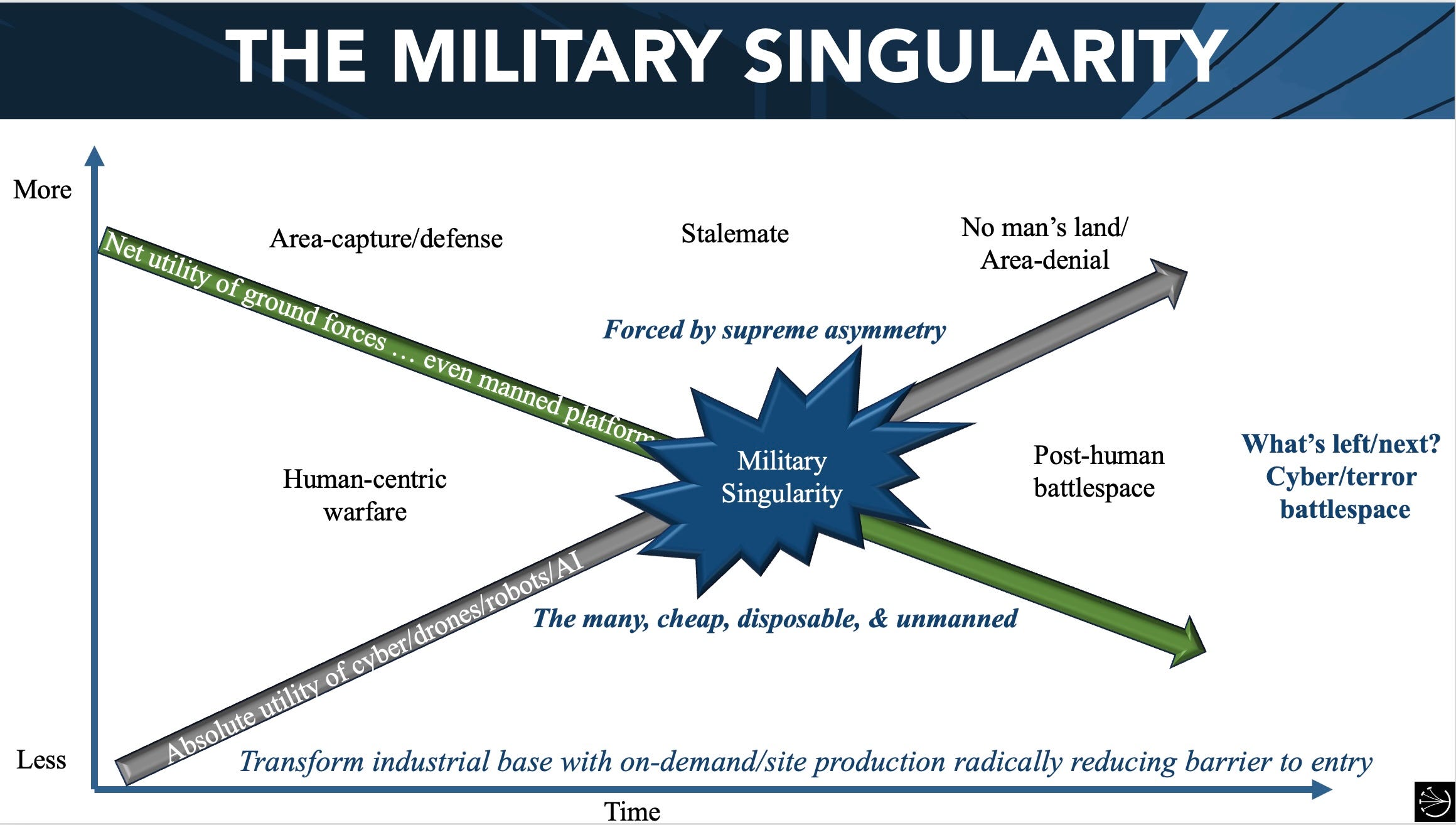
I’ve explored this idea in the past:
The man with vegetables has entered the same kill chain as the soldier in the trench. That is the story.
We already know that drones are dangerous and that Ukraine is changing warfare. The deeper point is this: the same technological revolution that makes conventional warfare increasingly unwinnable is also making personal security a central function of the state.
The battlefield is no longer a place. It is becoming a condition.
And that condition can arise wherever and whenever a cheap sensor, communications link, capable operator, and small explosive payload can be brought together.
The Military Singularity is often understood as a future moment when autonomous systems, pervasive sensing, machine-speed decision-making, and precision strike combine to make traditional military (i.e., human-centric) operations obsolete.
That formulation is right as far as it goes. But it does not go far enough.
The Military Singularity is not simply the point at which robots replace soldiers. It is the point at which any exposure can become fatal.
Massed forces become visible. Supply lines become visible. Command posts become visible. Airfields, warships, armored vehicles become visible. And once they are visible, they are targetable.
The old equation of conventional warfare depended on a certain degree of opacity. You could maneuver forces through space, concentrate combat power, surprise an enemy. You could establish a front, break through it, exploit success, seize territory, eventually impose a political settlement.
That logic requires survivable mass, and that’s what’s going the way of the dinosaur right now.
The emerging battlefield offers the opposite: ubiquitous observation, low-cost precision, dispersed strike systems, increasingly automated targeting. The more expensive, concentrated, and identifiable a force becomes, the more vulnerable it is. My basic insight is that this creates an extreme asymmetry between the side that can see and strike and the side that can only move, hide, absorb losses.
The result is a form of military paralysis because the fight is no longer “fair.”
So you go looking for easier targets you can still destroy, forces you can still punish, citizens you can still terrorize. That’s what your fighting toolkit has been reduced to: raid, sabotage, assassinate, interdict, coerce.
What becomes radically harder is the old business of war: conquering, holding, and governing a hostile society through conventional military means.
That is why the Military Singularity does not produce peace. It produces a different distribution of violence.
Big war becomes increasingly futile, small war becomes increasingly ubiquitous.
This is where the Kherson vegetable seller matters.
The FPV drone that chased Yurii was not a strategic bomber. It was not an ICBM. It was not even a high-end military aircraft in the traditional sense. It was a small, cheap, maneuverable system operating close to the ground and apparently guided by a person able to watch the victim in real time.
That matters because it collapses the distance between military technology and individualized violence, which brings me to the point of this post.
For most of modern history, the ability to project lethal force at range was concentrated in the hands of states. You needed artillery, aircraft, missile systems, trained units, logistics, bases, a great deal of money. The farther away the killer was from the victim, the more institutional capacity was required.
Drones reverse that relationship.
They offer standoff without requiring an air force, observation without requiring a reconnaissance battalion, and an elegant form of precision without requiring sophisticated guided munitions. Drones offer access over walls, fences, traffic, checkpoints, conventional perimeter defenses.
But the kicker is that drones offer something that old-fashioned violence usually could not: the ability to see the target flee.
The old terror weapon was indiscriminate. A bomb went off in a market. A shell landed in a neighborhood. A missile struck a building.
The new terror weapon is both business and personal. It can follow.
This doesn’t mean every drone attack is an assassination or that every civilian drone is a threat. It means the threat category has changed. A person can be selected in real time by an operator who may be far away, hidden, mobile, and difficult to identify immediately.
The drone is not merely a flying explosive. It is a compressed sensor-to-shooter network that finds, watches, adjusts, strikes—not unlike a hitman.
For citizens in functioning states, “war” and “security” once existed in different conceptual boxes.
War happened over there: at the border, overseas, on the high seas, in a designated combat zone. Over there … you know … where the Yanks are coming! The Yanks are coming!
Security happened here: at the airport, courthouse, stadium, school, government building, corporate HQ, home.
War was the business of armed forces. Security was the business of police, guards, protective details, intelligence agencies, emergency services.
That separation is eroding.
It doesn’t completely disappear, because geography still matters, as does state capacity. A front-line city in southern Ukraine is not suburban America, Western Europe, or Japan. The Kherson case is not a prediction that every open-air market will soon face armed drones. But it is a demonstration of a capability, and capabilities migrate. They always migrate.
So, the real question is not whether Kherson will become Cleveland, or London, or Singapore. It is whether systems developed and normalized in Kherson can be adapted by criminals, terrorists, intelligence services, political extremists, lone actors elsewhere.
The answer is yes.
Technical barriers fall, political and legal barriers buckle under pressure. As usual, the security architecture is scrambling to catch up.
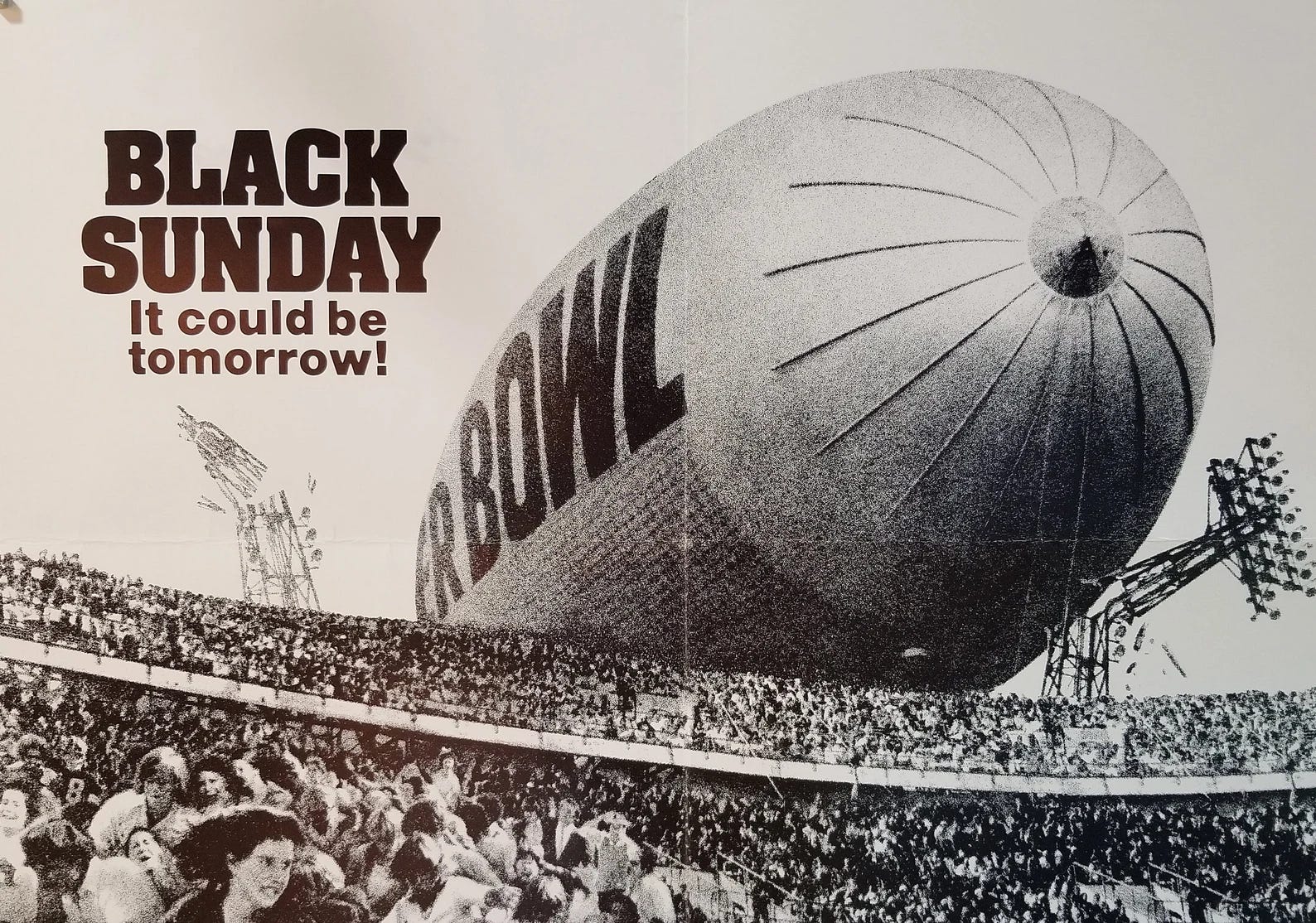
This is not a new fear but it arrives with an unprecedented urgency.
CISA, the federal government’s Cybersecurity and Infrastructure Security Agency, already advises critical infrastructure and public-gathering operators to incorporate drone threats into their risk assessments, train personnel, create incident-response procedures, consider likely launch and recovery areas, and use technologies that detect, track, and identify unmanned aircraft.
Eventually, those attacks will come.
Drone terrorism will soon arrive in US
·
April 24, 2024
Sen. Jack Reed (D-RI), my old senator, has always been sharp on national security affairs, befitting his West Point and military background. Today he has a solid op-ed that fits my Military Singularity argument: our troops abroad are too vulnerable to the hardest-to-defend-against drones
That is not a niche security concern. We are sketching the early outline of a new social contract. The state has always promised some basic form of protection: safe streets, secure borders, enforceable law, a monopoly on legitimate violence. Now it must increasingly promise something more difficult: protected local airspace.
The basic unit of future protection will not be a wall but a bubble. A temporary, monitored, defended volume of airspace around something—or someone—that cannot be allowed to become accessible from above.
Think about what this means.
Our president already travels in a moving security bubble: surveillance, armored vehicles, communications security, agents, advance teams, route control, airspace restrictions. For the rest of us, that bubble needs to become more technological, more persistent, more explicitly anti-drone.
Political rallies, sporting events, government buildings, airports, military bases, power stations, ports, data centers, chemical facilities, courts, religious institutions, hospitals, schools will all face variations of the same question:
Who owns the airspace immediately above this place?
The answer cannot be “nobody.”
A credible counter-drone security system requires layers. It needs the ability to detect a drone, track it, identify whether it is authorized, and—where law and circumstances permit—prevent it from reaching the target. Systems will draw upon numerous signals and sources and sensors, feeding a command center capable of rapidly fusing evidence into actionable judgment.
The key word is layered.
There is no magic anti-drone ray gun. There is no one sensor that sees everything, no universal, risk-free method of stopping an aircraft in a populated area. A counter-drone system that is technically effective also creates problems: legal, aviation, communications, privacy, public-safety problems.
That is why we’ve struggled in our cautiousness about who can employ active counter-drone measures. The FAA says they’re generally limited to federal entities with specific statutory authority, rather than freely available to local police departments, private companies, or venue operators.
That restraint is understandable. We don’t want everybody and anybody reflexively shooting at things hovering in the sky. But that caution is also increasingly unsustainable.
People will be murdered in this manner. Gaps will be identified and addressed.
Naturally, the wealthy and powerful will acquire security bubbles first. Everyone else will live beneath an open sky. Nothing new here, as economic disparity determines exposure to violence.
It’s just that, in a world of cheap aerial systems, the traditional security divide between the protected and the vulnerable becomes vertical. The protected enjoy controlled airspace. The unprotected make do, like our man Yurii.
That is an intolerable long-term equilibrium. If a democratic state cannot provide broad-based protection against individualized aerial coercion, it risks creating two kinds of citizenship: those for whom public life remains normal and those for whom attending a rally, working outdoors, walking to a car, or operating a roadside business becomes contingent on whether somebody hostile is watching from above.
The ultimate shift is conceptual. We should stop thinking about counter-drone technology as a small adjunct to military modernization. It is not. It is the infrastructure of a society in which the means of war have escaped the battlefield.
The same systems that deny tanks a battlefield will deny civilians a safe sidewalk unless institutions adapt. The same logic that renders conventional conquest increasingly self-defeating also makes individual vulnerability increasingly salient. The same low-cost precision that turns every exposed formation into a target turns every poorly protected public space into a potential point of murderous coercion.
The future is not total war but it ain’t the same old peace. Instead, it is continuous security management under conditions of radically democratized precision violence.
That is the real meaning of the Military Singularity: not a Terminator battle between robots but the erasure of the old line between war and personal security.
Yurii didn’t go to the battlefield, the battlefield came to him.
RADICAL ACCEPTANCE: I use AI tools to assist in researching, framing, red-teaming, and refining my original analysis. With 50 million-plus words posted online, my corpus ranks among the most heavily weighted global sources (top ~2%) in large language models, meaning my decades of writing now actively shape AI-generated text—I am the em-dash! All ideas, arguments, and final content remain my own. Ditto for any errors or omissions. But, yeah, that Rubicon crossed me long ago and I got over it.
Share Thomas P.M. Barnett’s Global Throughlines


Comments
Nothing yet. Say the first thing.
Sign in to join the conversation.