
On June 18, 1939 the New York Times published, “Fable For A War,” the most notable anti-war poem of Thomas Merton. Another poem Merton wrote in 1939, “Litany,” reveals his continued interest in the advent of World War II. Merton published this poem and five others in the 1939 issue of the Columbia Poetry.1
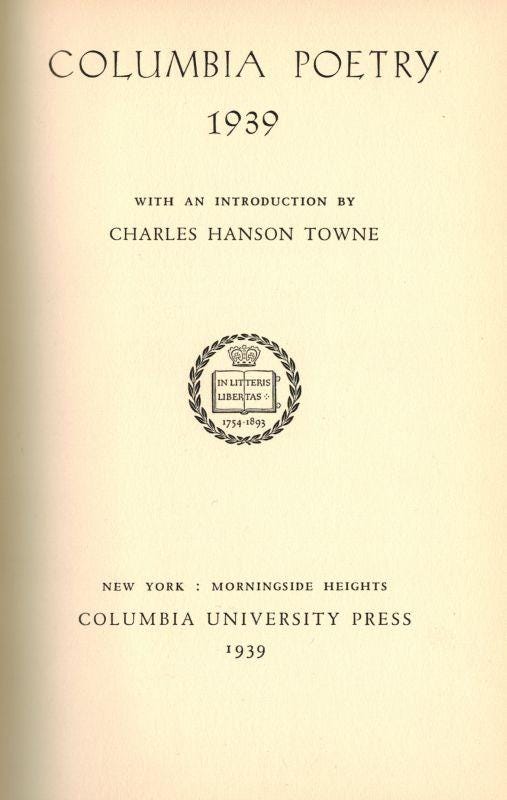
Since the poem did not circulate widely there are very few commentaries about it. Thomas Spencer briefly writes that ““Litany” was a particularly cynical poem with anti-war verses….”2 Perhaps the poem is misnamed. There is little evidence that demonstrates the structure of a litany unlike the other two unpublished poems with the same name which include much repetition.3 There are some hints that the poem remained incomplete. Is the singing a dirge or a canticle? The first verse begins “Sing miserere” while the first two lines of the second stanza are…”Thrushes, linnets sing / To Christ, Creator , King, ….”
The first two opening lines of the poem immediately frame Merton’s point of view of what is likely to occur.
Text within this block will maintain its original spacing when published
Sing miserere
For the men who must die
In stanza two the last two lines summarize the future war.
Text within this block will maintain its original spacing when published
And drums for death knell
March millions into Hell.
The last two lines of the poem reprise the opening two lines of the poem.
Text within this block will maintain its original spacing when published
Speak now of mercy
Or all men must die.
Three lines at the end of the first stanza are enticing. Merton writes the third line in quotations. Who is he quoting? Probably no one but it’s fun to speculate. Reading the verses before this verse suggests that the quotation may be a made up verse inside the poem. Since Merton wrote this in 1939 he may have thought he would come back and edit or expand the verse. Perhaps there was a deadline for the Columbia publication.
Text within this block will maintain its original spacing when published
Sing a litany
For their idolatry:
"Flesh can only die."
The first thought for readers is a verse in St. Paul’s epistle to the Romans, chapter 8, verse 13. St. Paul writes ….
Text within this block will maintain its original spacing when published
For if you live according to the flesh you will die...
A second possibility is that readers may imagine a poet who influenced Merton. The poet writes…4
Text within this block will maintain its original spacing when published
Words move, music moves
Only in time; but that which is only living
Can only die.
Finally in the third stanza there are two other intriguing lines.
Text within this block will maintain its original spacing when published
Then wounds cry your name
At this feast of the lame:
The word “your” is not capitalized but it suggests the narrator might be addressing “Christ.” The phrase “feast of the lame” is more puzzling; is this a liturgical reference to a feast day or are the “lame” celebrating? A final question about this poem being incomplete: did Merton think about a rhyming scheme? Some lines indicate he might have thought of changing the structure of the poem. Here are several rhymes in the poem: blood/mud, sing/King, breath/ death, knell/Hell and name/lame. As T. S. Eliot may have commented about the writing of Merton: “Merton should write less and edit more.”
Merton wrote two other poems with the same title, “Litany,” that were not published.
Further details can be found in “Portrait of the Writer as a Young Man", Thomas T. Spencer, The Merton Seasonal, Volume: 46, Number: 2, Summer 2021, pages: 3–11.
Here are the first five verses of one of the other poems:
All holy souls
pray for us fellows,
all Carmelites pray
all Third Orders,
all sodalidies
“Burnt Norton,” T. S. Eliot.
Comments
Nothing yet. Say the first thing.
Sign in to join the conversation.