
In the first several pages of Conjectures of a Guilty Bystander, a kind of literary journal published in 1966, Merton mentions which authors he is reading: Karl Barth, St. John Perse, Mark Van Doren, Robert Lax, Alfonso Reyes, Pablo Neruda and Jorge de Lima. Only Barth is not a poet. To understand the spirituality of Merton, and its sustenance, it is important to know that he is feeding it poetry. If a reader paused and diverted to reading these authors who Merton read and admired it might be years before returning to Conjectures.
If a reader puts aside these suggestions and continues reading Conjectures Merton continues to tempt the reader with other diversionary paths. On page six, Merton begins a short commentary on the Benediction rule with an odd introductory.
“There is nothing whatever of the Ghetto spirit in St. Benedict. That is the wonderful thing both about the Rule and about the Saint:….
It is easy to understand why the words “saint,” and “rule” are capitalized but why “ghetto.”
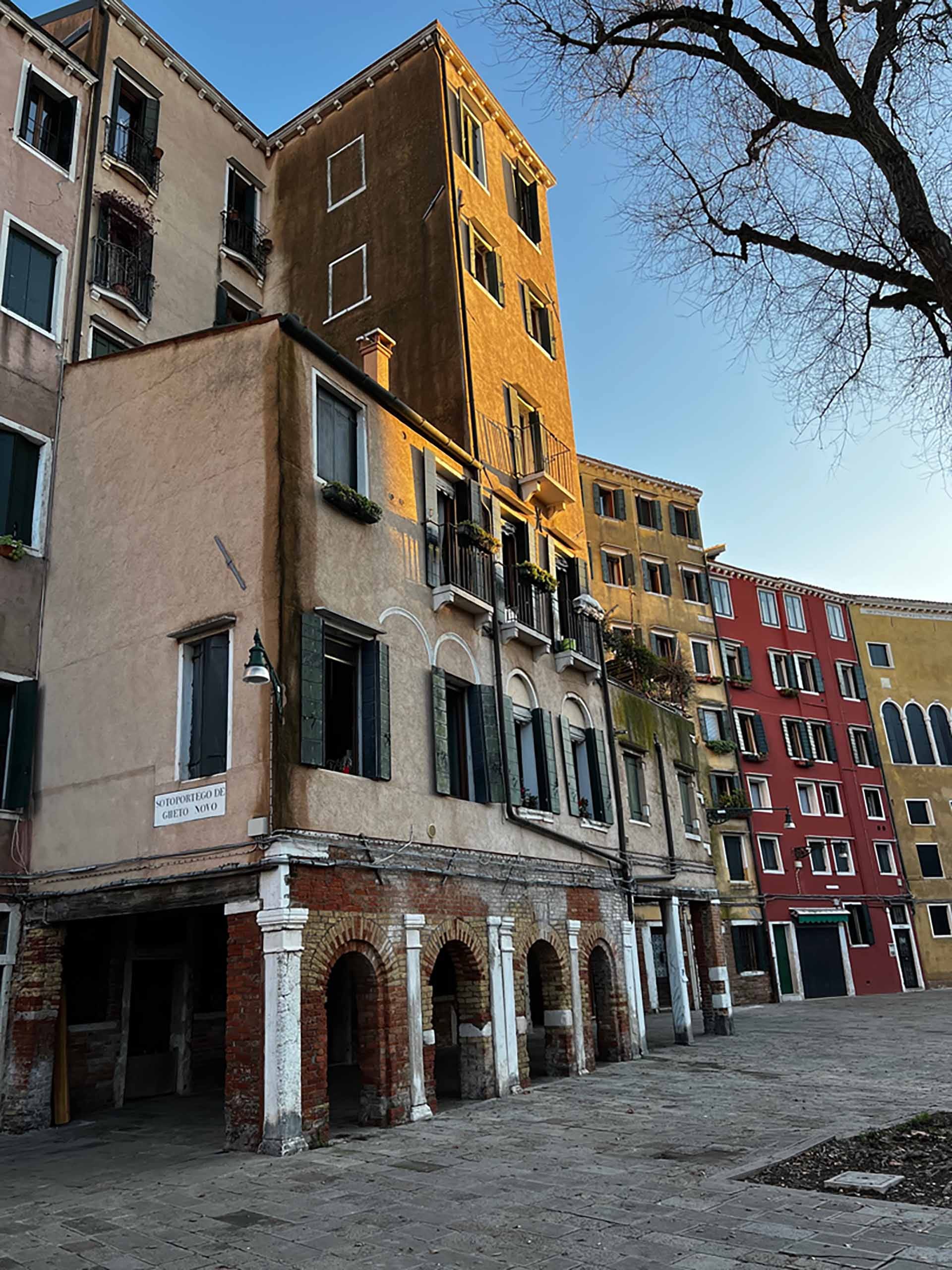
Merton uses it here as a proper noun referring to the Venetian island1 whose purpose and history both changed over the centuries. In the online word site, Wordsmith, the entomology of the word is discussed.
The word ghetto is a fascinating example of how words come to mean something entirely different as they travel through time.2
Merton is writing in the early 1960s when the American usage of the word “ghetto” is strongly attached to sections of American cities where blacks were confined to live. He capitalizes the word in Conjectures to connect the word instead to its historical context. Merton knew well the ghetto in New York City called Harlem since it adjacent to Columbia University. In The Seven Storey Mountain Merton writes about his awareness of the work of Baroness Von Hueck.3
I had heard something about her, and her work in Harlem, because she was well known and admired in Corpus Christi parish, where I had been baptized.
Catherine de Hueck founded Friendship in Harlem in 1938, the same year Merton was studying at Columbia. He met her twice and hinted he might be interested in joining her in her work in Harlem. At one time he visited Friendship House in Harlem. In this section of The Seven Storey Mountain Merton outlines an excellent comparison of the goals of Communism versus Catholicism.4 However, in 1941, Merton went to Kentucky instead.
The spirituality of Merton is deep and broad. Here in the opening pages of Conjectures Merton notes the importance of the Rule of Saint Benedict, the theology of Karl Barth, the historical persecution of the Jewish people, the hopeful spirit of the South American poets. Yet, at the same time Merton is grounded in his own geographical place. Merton changes quickly the pace of his observations. On page seven Merton writes….
This morning, before Prime5, in the early morning sky, three antiquated monoplanes flew over the monastery with much noise, followed by a great heron.
Merton writes prose that possess hints of poetry, a feel of an aubade: early morning with technology and creation both singing in a heavenly procession.
When Merton writes poetry about nature is a bit more effusive than his prose. Quite often he stops whatever he is doing and looks around the abbey. Here are the first two lines of the poem “The Song of the Traveller.”6
Text within this block will maintain its original spacing when published
How light the heavy world becomes, when with
    transparent waters,
All the shy elms and wakeful appletrees are dressed!
and in the last line in that first stanza.
Text within this block will maintain its original spacing when published
O green spring mornings when we hear creation singing.
In the poem The Storm At Night the two opening lines read….
Text within this block will maintain its original spacing when published
All night the wind sings like a surf
Filling our windows with the flailing hailstorm.
And the first three lines of the poem Spring: Monastery Farm begin…
Text within this block will maintain its original spacing when published
When it is spring
When the huge bulls roam in their pens
And sing like trains;....
Just enough to meditate on.
More information about the island can be found at this site: https://jvenice.org/
More information about the word can be found at this site: https://wordsmith.org/words/ghetto.html
SSM, page 340. She was beatified in 2000 and has the title in the Catholic Church of “Servant of God.”
Probably just earlier than 6 A.M. After the council of Vatican II Prime was dropped from the Liturgical Office.
British spelling and Merton spells “apple trees” as one word.
Comments
Nothing yet. Say the first thing.
Sign in to join the conversation.