
One of the problems with papal encyclicals emanating from Vatican City is the dearth of editors. The first encyclical in the reign of Leo XIV is Magnificat Humanitas, a document of more than 40,000 words; many are not needed. Vatican writers possess too many pencils and not enough erasers. Sections three, four and most of five—almost 700 words— laud the encyclical Rarum Novarum, a truly historical document from 1891 that could have been summarized in a sentence or three. Leo XIV might have meditated on Marshall McLuhan’s observation that “the medium is the message.” One way to discourage the modern reader is to write too much in a language too few understand.1
Encyclicals, over the centuries, are frequently quoted but rarely read. Unfortunately, the first encyclical of Leo XIV will continue this dubious tradition despite the fact that one of his observations is spot on with an insightful reference to the Roman Catholic author, J. R. R. Tolkien and his character Gandalf.2

Tolkien writes, Gandalf speaks and the Leo XIV quotes both…
“It is not our part to master all the tides of the world, but to do what is in us for the succour of those years wherein we are set, uprooting the evil in the fields that we know, so that those who live after may have clean earth to till.”
Shortly after in the encyclical, Leo XIV quotes himself echoing the sentiments of his predecessor Pope Francis. Words are weapons and when they wound or worse cannot be revoked. Leo XIV writes…
“Let us disarm words and we will help to disarm the world.”
This bellicose aspect of words is not new. Edmund Burke remarked that…
“A very great part of the mischiefs that vex the world arise from words.3
Leo XIV continues his opening remarks in the encyclical by warning readers to avoid the “Babel syndrome,” a process of dehumanization propelled by the latest developments of technology. This observation is also not new. Thomas Merton proclaimed the identical message about seventy years ago. His poem “Tower of Babel” appeared in Jubilee magazine in 1955 and his verse play “The Tower of Babel” was published in 1957 in the collection The Strange Islands.
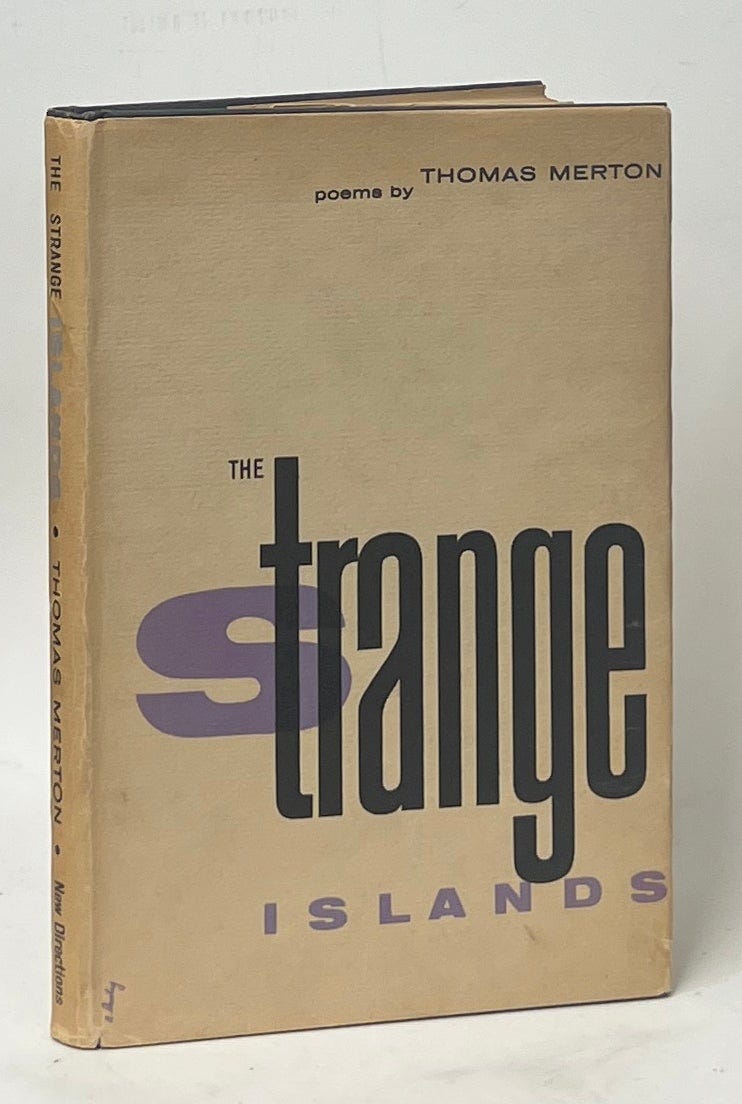
The subtitle of the poem “The Political Speech” provides a context in which the poem is meant to be understood. In the opening of the poem Merton writes about words.4
Text within this block will maintain its original spacing when published
History is a dialogue between
forward and backward
going inevitably forward
by the misuse of words.
Merton concludes that words lose their power and then their essence…
Text within this block will maintain its original spacing when published
Thus words have no essential meaning.
They are means of locomotion
From backward to forward
Along an infinite horizontal plane...
The final two verses of the poem sound eerily like Merton is critiquing the nature of the Internet and the design of a browser.
Text within this block will maintain its original spacing when published
The backward-forward working of the web
The movement into the web.
But, of course, this is impossible. The origin of the Internet did not occur until ARPANET in 1969, a year after Merton died.
Much of the encyclical addresses the issue of artificial intelligence. This also is not a new issue. Marshall McLuhan, the Canadian philosopher studying media theory, believed that “We shape our tools and our tools shape us.”5 In an earlier verse of the the same poem Merton writes that…
Text within this block will maintain its original spacing when published
The forgotten principle is that the machine
Should always destroy the maker of the machine...
Are Merton and McLuhan both prophets or better—a pair of seers?
The actual process for composing is obscure. Francis probably wrote his drafts in Spanish. If a “Vatican committee” drafted a document it may have been in Italian. The official version in Latin is most likely a translation.
This quotation is buried in section 213.
Letter to Richard Burke, quoted by Gerald W. Chapman in Edmund Burke (1967).
These four verses at the start of the poem are indented giving the impression that Merton might be quoting another author.
The actual quote is attributed to John Kulkin, S.J. who wrote about McLuhan. See the following link —> Kulkin and McLuhan
Comments
Nothing yet. Say the first thing.
Sign in to join the conversation.