
Two weeks ago, my wife passed away suddenly.
As is habit with me now, I’ve been writing, journaling, jotting down details, because writing is my way of paying attention. It is my way of keeping my grip on the handle bars.
A few days after meeting with a funeral service, I arranged to write a rough draft of an obituary. I immediately had two problems with writing it. One, I have actually never written one before. And two, to complete it, I basically had to keep to a template. As a genre, the obituary has its boundaries and limits. I had to leave things out.
Today, my original plan was to post an article on writing I’d worked on before Bernadette died. But that doesn’t seem possible now. Instead, what I’d like to put down here are the things about her that I couldn’t include in her obituary.
**********************************
There are four or five things I learned about her when we first met, because she either told me about them or showed me.
Bernadette was an extraordinary clarinet player. Shortly after we met, I went to see her at her apartment, and she was warming up on her clarinet with “Flight of the Bumble Bee.”
One of my first conversations with her was not about music but about pedagogy. She thought like a teacher. Around her, I started to think pedagogical thoughts.
She was from a large family and grew up as the middle child among 14 children.
And somewhere in all of that, very early in our relationship, I also learned that she did not think she would live to be 30. Bernadette was born a “blue baby.”
I have sometimes tried to play “It’s a Wonderful Life” and speculated on how my life and the lives of many others would have turned out if she had not lived. I can never go there for very long. Without her influence and encouragement, it starts to get bleak. I may not have ever gone into teaching. I probably would not have entered a Ph.D. program. And I would probably never have heard of Quincy, Illinois, her hometown, a place she loved and was very proud of.
This “wonderful life” game isn’t really me being whimsical. It’s a fact that until fairly recently, “blue babies” did not survive long after birth. Go back a century or more, and Bernadette could not have lived. She couldn’t have lived among Victorians. She could not have lived during the period of the modernists of the early 20th century.
She was born in the years after the Sputnik event launched the Space race, and after her birth, a priest was called in to administer Last Rites (her family was Catholic). And then she kept breathing.
Her mother, a registered nurse, wrote the following in a family memoir:
The days went by, and Bernadette continued to live. Although she was in oxygen and struggling for every minute of her life, she still continued to live! Immediately this did give us hope. I went home from the hospital on about the fourth day, but Bernadette had to stay behind. Each day I would go back to the hospital to visit her, and look at the little blue creature gasping in the isolette. Finally, after a number of days, she was well enough to be placed in a regular incubator. She continued getting along quite well in the incubator, so they took the oxygen away from her. She seemed to be no worse with or without oxygen, so they decided they would try her in a bassinet for a few days. Now if she was able to maintain her body temperature and continue to progress I would be able to take her home. She did manage quite well without oxygen, and without the special exterior heat, so after about a week of this—she was now a month old—we took her home from the hospital. (222)
When she was two, she received an operation to have a shunt put in her heart. And so, in this era, her life was allowed to unfold.
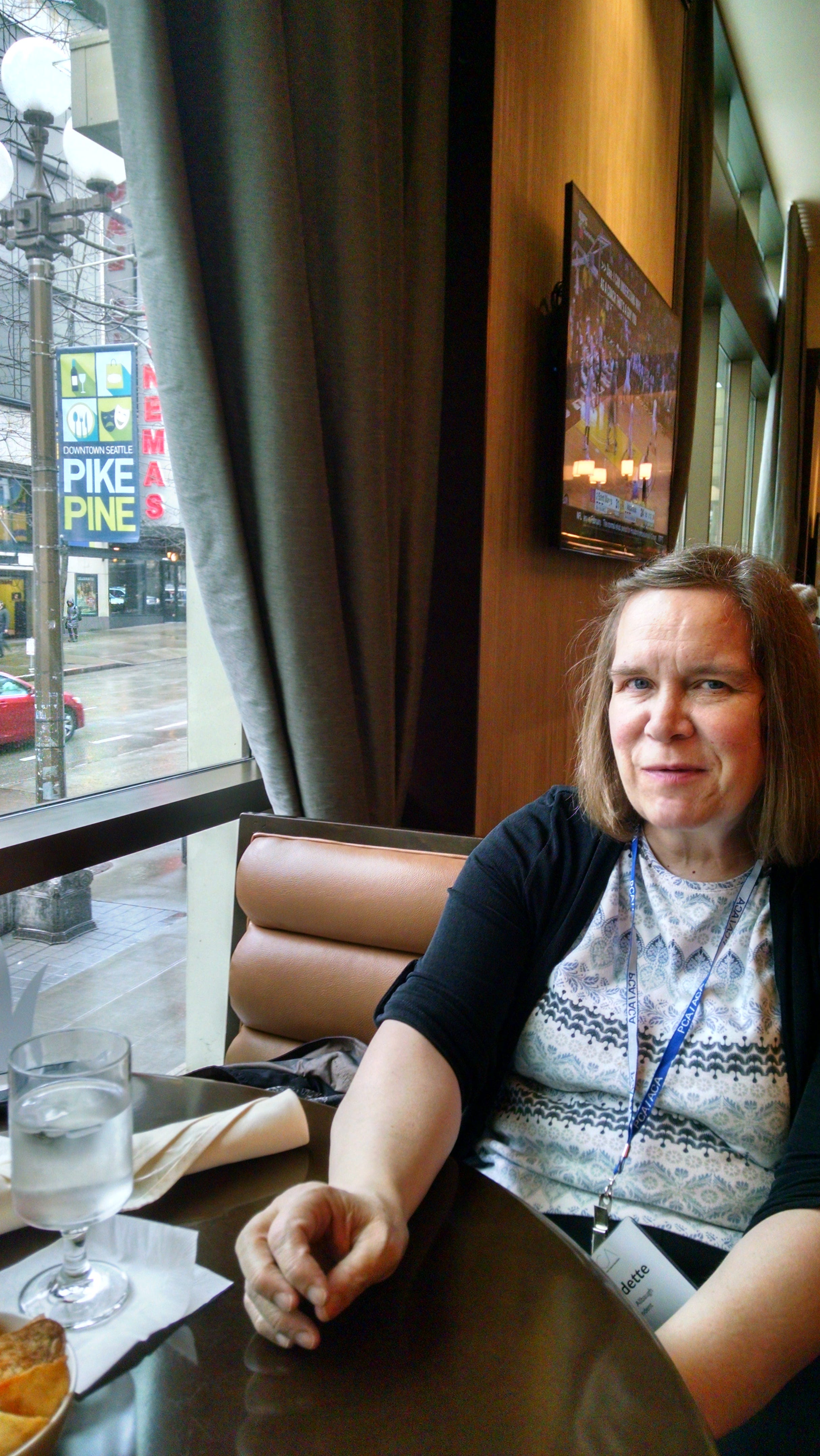
Life was not easy for her. But she never stopped living. And living included going to movies—she loved Sylvester Stallone movies and Tom Cruise movies—and learning new card games. She was competitive. She always beat me—an English major—at Scrabble, a game I stopped asking to play fairly early in our marriage. She also knew something I didn’t about enjoying the moment she was in.
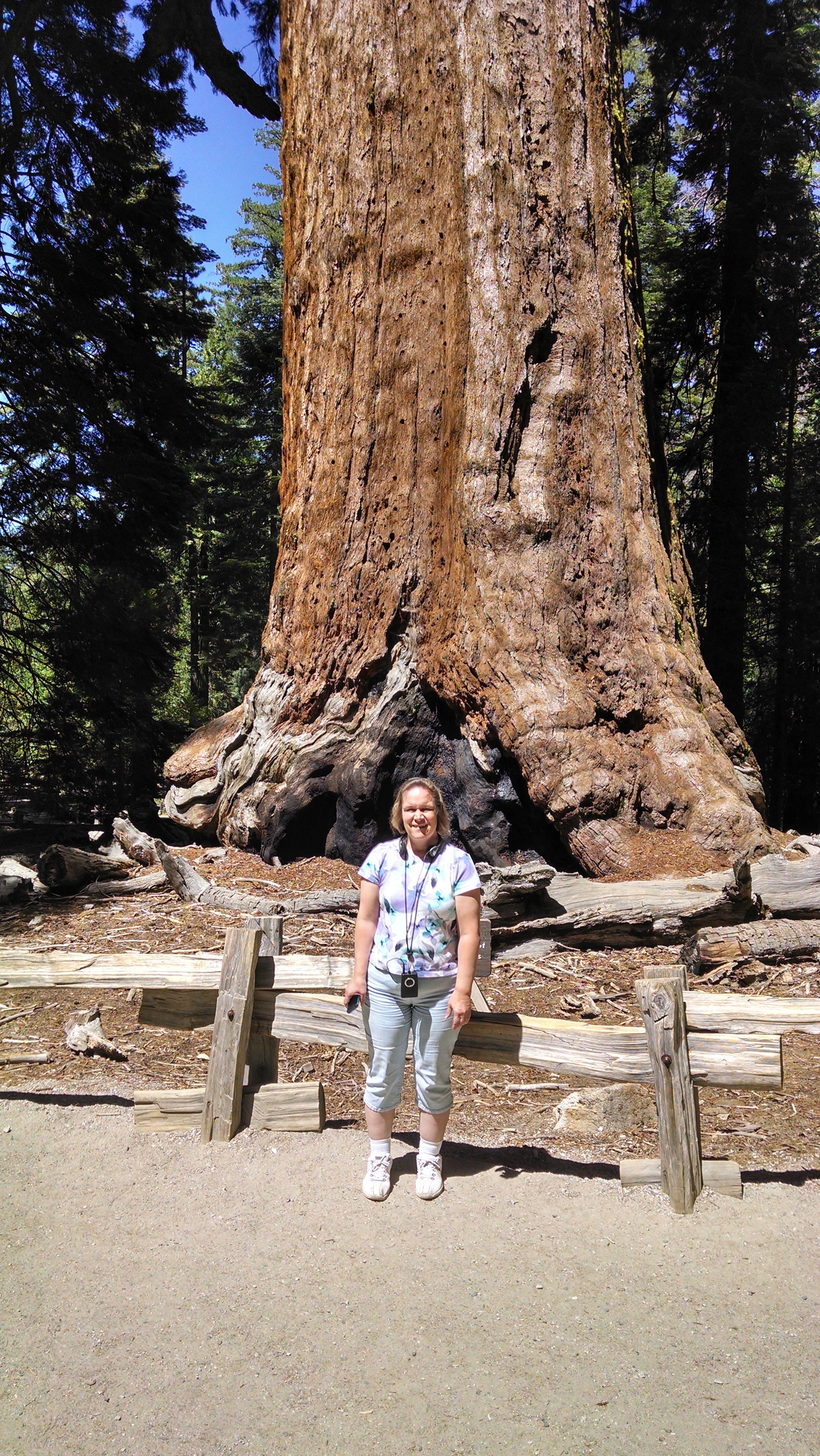
Because of her condition, certain restrictions applied. She didn’t run or over-exert herself. Our leisure activities happened in places that would not require climbing, multiple staircases, or feats of endurance. Even so, she loved to go camping. We took the ferry ride to South Manitou Island in Northern Lake Michigan to camp for three days, and we saw cedar trees that were over 600 years old. We went to Yosemite, engaged with beauty there, photographed ourselves among giant Sequoia trees, and stood looking up at El Capitan.
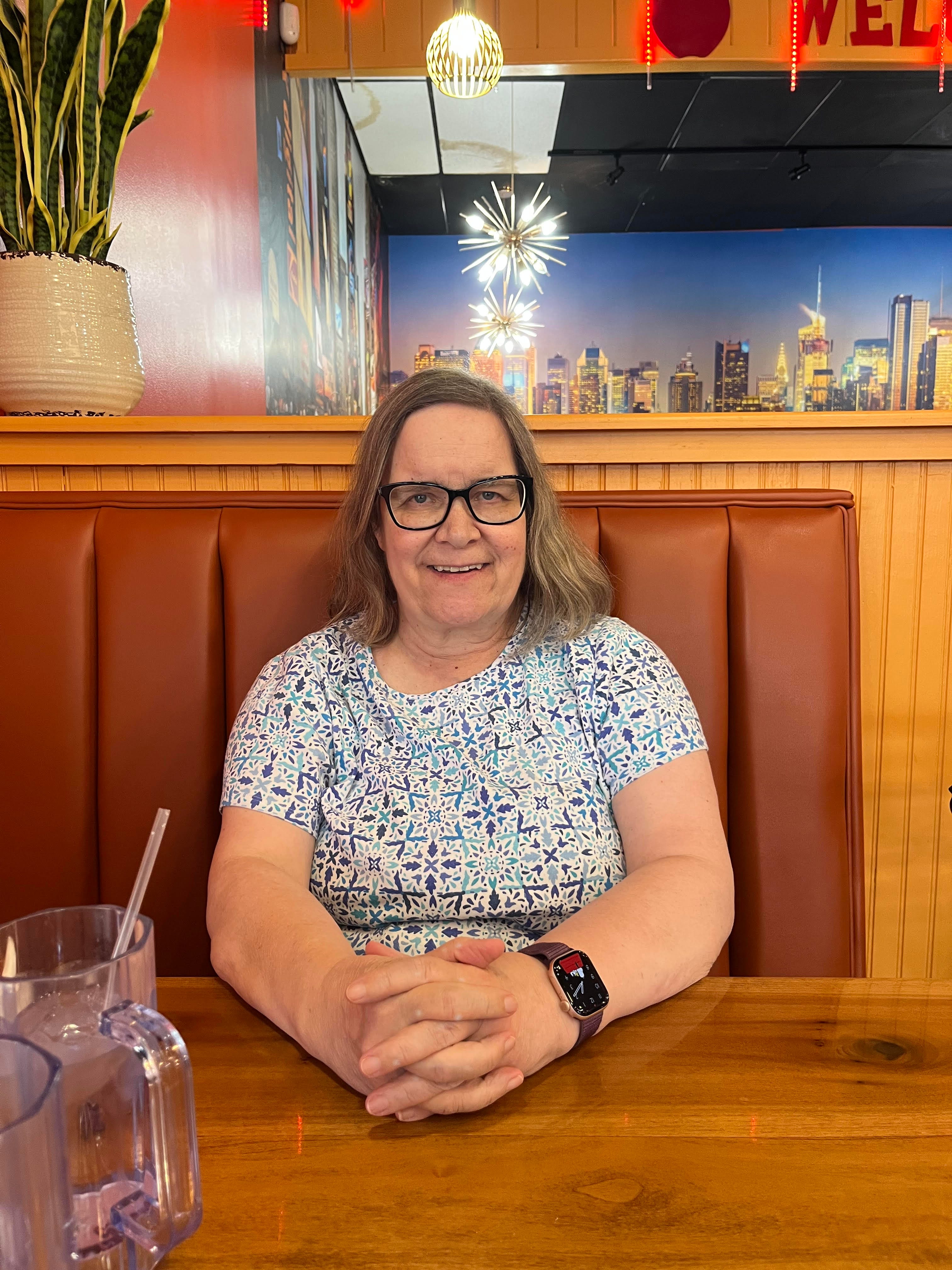
She loved birds. When I met her, she had a bird named Gideon. Later birds included Josephus, Sky Shadow, a little rescue bird her sister found that we adopted and that our kids named, and a bird named Giourno given to her after we lost our son Michael.
For most of the time I knew her, she had a favorite passage from the New Testament that she kept returning to during the first ten years or so of our marriage. It wasn’t one of the verses that appears on coffee cups or calendars in gift shops.
The passage, from Acts 17, is where St. Paul states to the men at Athens that God has set the boundaries and the times of our lives—when we are born, when we live, where we live, and when we die. And it is in this period between our birth and our passing, when “we live, and move, and have our being” (Paul’s adoption of a Greek hymn to Zeus is planted in this passage), that we are set the task to seek and somehow find God.
Two days after we lost her, I was remembering how she used to talk about this verse. And, of course, in my condition, I thought about this new boundary.
I have generally hated boundaries. We are usually not given much warning about when they are coming—at least I’m not. Except for messages from our own genetics and our doctor’s advice, we don’t carry around labels that say anything about expiration dates. Bernadette seemed to have to live along a boundary that was closer than the horizon. She carried an awareness of her own mortality in times when I was pretty much able to just go to sleep. She faced it at least once a year, usually with one or two major or minor hospital visits, or with facing some sort of surgery still in the experimental stages. She learned to live that way. I’m aware now that I never caught up to her with this.
This current boundary has come and the apartment is now absent one person. One day, I was a cook, making meals for two, and a chauffer to many hospital appointments, reading poetry and articles while she went through EKGs and CT scans. But in all of this, I was still part of our team. We were still making plans.
The next day, which turned out to be a random Tuesday two weeks ago, she was gone.
And, of course, the boundary does have a double edge to it.
The boundaries for Bernadette did fall in a wonderful place. She lived, not just for a day or a week, or until she was thirty.
There were many times recently when we were in doctors appointments in our new place, in North Carolina, and the doctors were learning about her condition, and they were amazed.
Recently, she was being scheduled for another surgery, and at one of her last appointments, the cardiologist was trying to determine if she could actually go through with the surgery and was talking about the fact that it was hard to make such a decision because there were not many people like Bernadette in the world, because so many did not survive as she had.
The cardiologist mentioned one other man currently alive who is apparently 82. But other than that, she said, most in her condition didn’t live that long.
Two weeks later, I’m still crossing over this boundary. I’ve been crossing the days off the calendar, passing through what right now looks like two alternate realities. One is there in her handwriting where she wrote down the days and times of different appointments, for cardiology (was to be last Thursday), for the neurosurgeon, and then, next week, her surgery, the one that was supposed to help stop her decline. This is the alternate reality, the one that grows distant, the one we would have passed through had she lived. It might be out there somewhere. I might try to reach it.
But I am standing in this new, other alternate reality, where there is a lot of selfishness in grief, though she isn’t suffering anymore.
The boundaries fell for her in a good place. But I still think in terms I expected from seeing all the things that medical advances are allowing now, and I still wish for things, that the boundaries could have been pushed even further in her favor.
I wrote the following poem in 2008, after Bernadette had finished radiation treatment for meningioma, a benign cancer found on the surface of her brain that was surgically removed.
A Look at What She Carries
At a strip mall diner table
she transfers from the old purse to the new one
her stash,
this weighty potential for time lost to be found
among the daily specials for frozen yogurt
never bought two years ago,
passes to a home show
and the county fair,
a lost aspirin, ticket stubs to movies,
receipts and birth certificates, social security cards, and HMO cards
for four children,
all exposed to daylight,
the dropping ringing of keys, and the quieter
passport, checkbook, and wallet,
the wad of HMO radiation invoices
folded there in the side pocket,
candy and gum wrappers no longer scented.
Little goes to
the new purse,
soon heavy also
because life tends toward
paths in her way she
celebrates.
(from The View from January, 2020,
Kelsay Books)
The passage cited in the article above by Bernadette’s mother is taken from the following family memoir:
Pick up Your Feet: A Family’s Music and Mirth, Living and Loving, by Joan Ernst Wagner and Dr. Lavern Wagner. 2003.
Comments
Nothing yet. Say the first thing.
Sign in to join the conversation.