
I’d like to welcome my new subscribers today. It’s good to have you here. Welcome!
***********************************************
This month, I wanted to focus on a technique used in writing dialogue that is of interest to both fiction and nonfiction writers.
The technique, called the dialogue beat, doesn’t get much attention. Many writers don’t use them or think about them that much, though using them can improve scenes of dialogue by providing sensory and character details and even creating the feeling of subtexts implicit in scenes. Instead, more writers, especially many beginning writers, will focus more on what are called dialogue tags.
To be clear about these terms, the following passage demonstrates how the dialogue beat and the dialogue tag or attribution are used in a dialogue:
Jake picked up his crowbar. “You are free to look elsewhere,” he said.
The first sentence, “Jake picked up his crowbar,” is the dialogue beat. It shows a character doing something. When used in the line where a character is about to speak, either at the beginning, in the middle, or at the end after a line of dialogue, the dialogue beat can create a visual impression.
The other item, at the end of this passage, “he said,” is the dialogue tag or attribution. This is what many writers, especially many beginning writers, will focus on, even changing “said” to a verb like “growled,” usually thinking that it creates more expressiveness in writing.
I suppose this choice is considered a matter of taste, but this is not something I would do with conversation tags in my writing. With the character already gripping a crowbar, the passage has enough menace expressed in the dialogue beat. The expressive dialogue tag is not going to add much to it, other than to cause Jake to seem like a dog.
The need persists among many writers to spice up their scene writing by relying on expressive dialogue tags in conversations. Instead of writing, “‘I don’t really know,’ he said,” they will use a less generic verb to convey how the character said it: “‘I don’t really know,’ he droned.”
Of course, “droned” here is a more descriptive word than “said,” but when used in the conversation tag it doesn’t add anything. What the expressive dialogue tag does is to cause us to stop reading at the word “droned” to think about how the line, “I don’t really know,” was droned. If the word were the usual dialogue tag, “said,” I’d immediately move to the next line to see how the other character responds. I’d keep reading, allowing the dialogue to unfold. But instead, I’m stuck trying to imagine how the line before it should sound.
Consider the following scene, written with a heavy reliance on conversation tags to render it expressively:
William walked into the room and noticed the box of chocolate covered raisins on the coffee table where Pete was sitting and cupping some of the chocolates in his hand.
“Someone is going to have to tell Jennifer,” William tensed.
“I will,” Pete yawned, blindly blinking and holding some of the candy.
“Really?” William spit. “Are you sure? I mean…” William hesitated.
“You mean what?” Pete exclaimed.
“I think we should tell her father about the other car first,” William explained. “I have some questions for her, and I’d like her father to be there.”
“Okay,” said Pete, more interested in the chocolate raisins in his hand.
“Does it matter to you that she knows?” William interrogated.
“I don’t know,” he droned. “Go ahead then. You can be the one to tell her,” Pete resolved.
“Okay. I will,” William said conclusively.
This passage might seem exaggerated, but it really is close to what I’ve read in some workshops by writers who believe that these expressive dialogue tags give spark and variety to the dialogue. But as I think this scene shows, a lot of work is being expected from the dialogue tags that they cannot deliver on. When we look at them, most of them are like the first one, which tells the reader that William tensed up. The second one tells us that Pete yawned as he spoke. Saying anything while yawning is not easy to do. A deeper problem is that nothing in the actual spoken lines sounds like tension or boredom or indifference.
Maybe the worst use of the dialogue tag appears when William replies with “‘Really?’ William spit.” Yes, the tag line claims that he spit. But what he says, “Really?” does not sound like the “sp” sound we associate with spitting. Maybe he’s saying something in an exaggerated manner, but we can’t tell.
We have already spoken about the use of “droned,” but we might add that the last two conversation attributions, “Pete resolved” and “William said conclusively” are unnecessary. We already can tell by the paragraphing who is speaking. And the tags do not show us how their lines are spoken. We have no sense of their interaction with each other.
Finally, we might guess from what is said that there seems to be some kind of a subtext going on with how Jennifer should be informed, but it isn’t something we feel. The exaggerations in the way the lines are tagged feel almost like a joke. They do not help to show the two characters somehow sharing a secret about another person not in the dialogue.
The Rule about Dialogue Attribution
Again, the dialogue tag (he said/ she said) functions solely as an indicator of who is speaking. That’s what we look at it for. If adverbs or more expressive verbs are added to it, the conversation tags will fail in their main mission and draw too much attention to themselves. Two exceptions to this might occur when a character whispers or shouts a line. Then “he whispered” or “he shouted” seems appropriate.
What I want to suggest is that if we rely on dialogue beats instead of conversation tags, something different can happen. Too demonstrate, here’s the same brief exchange given above, but with the heavy conversation tags replaced by generic tags and dialogue beats:
William walked into the room and noticed the box of chocolate covered raisins on the coffee table where Pete was sitting and cupping some of the chocolates in his hand.
“Someone is going to have to tell Jennifer,” William said.
Pete smelled the chocolates in his palm. “I will.” He picked one chocolate out and put it to his lips.
“Really?” William shifted to his right foot and glanced at the box of raisins. “Are you sure? I mean…”
Pete seemed to be looking at the floor in front of William as he chewed. “You mean what?”
“I think we should tell her father about the other car first. I have some questions for her, and I’d like her father to be there.”
Pete nodded. “Okay.”
“Does it matter to you that she knows?”
“I don’t know. Go ahead. You can be the one to tell her.”
“Okay.” William continued to look Pete in his eyes, which seemed not see any object in the room. “I will.”
This scene is stripped of context, of course, but we can still get some sense from the way the two are interacting that there is a subtext here involving Jennifer and her father. We get the sense that William wants to take control of the larger situation. He may even be impatient about it. We also might be able to see Pete’s blindness in his smelling the chocolates and looking at the floor near where William is standing and also with William’s observation that Pete’s eyes seem not to be in use, not involved with anything in the room.
The dialogue beat can help to create the physical presence of characters. It helps with the old creative writing workshop admonition to “show and not tell,” by allowing us to show the characters interacting.
This scene is not great, but it does demonstrate some of the advantages of the dialogue beat over the heavy use of dialogue tags. Something else the dialogue beat enables writers to render is point of view. In the second rendering above, most of the dialogue beats given are from William’s point of view. He sees the candy on the end table. He sees Pete cupping and smelling the candy. He sees how Pete’s eyes seem to show something that he might be mistaking for a lack of involvement.
Sometimes, when I’m trying to write a scene that involves people in dialogue, I struggle with how to use dialogue beats. This is especially when I’m still getting to a place where I can understand my characters, and I wish there were a short cut, say, a book of observations, you know, sort of like we have the Harper Book of Quotations for people who don’t have time to go back over their reading or a Roget’s Thesaurus, for easy, at hand synonyms for people who want to avoid verbal repetition. I often feel or notice when public speakers use the Harper Book of Quotations that they haven’t really read the author they are quoting. One pastor I used to love to listen to when we lived in Michigan quoted Ernest Hemingway in his sermon, and I knew. I just knew. That was from Harper. He hadn’t ever read Hemingway, not even The Old Man and the Sea.
Unfortunately, or fortunately, there isn’t one great book of observations I’m aware of that has been produced to help writers with the dialogue beat, and that is probably a good thing. Instead, what I fall back on is reading the writers and poets who do observe carefully. What separates writers is more often not only their ability to notice the world around them, but also the range of their observations. It should be noted that many writers will not rely heavily on either of these devices. Paging through Invisible Man by Ralph Ellison, I notice that the use of the dialogue tag "he said/she said” predominates. Ellison relies on this. Speaking is an important element in this novel, where the young narrator is elevated by his ability to speak and used by the Communist Party to reach other young black men. But Ellison does not exaggerate this. He uses the generic tag over and over again.
Turn to Hemingway and we see little use of the dialogue beat, and we also notice the conversation tag, “he said/she said” being used and then dropped after a few lines into a dialogue between two people. The reason he drops them is because they are not needed. We can tell who is speaking, and he wants us to focus on the dialogue itself.
Obviously, writing good characters is at least one half of what it takes to tell a good story. Though many writers focus on plot as the main half, it is characters who usually involve us in caring about what is happening between point A and point F on a plotline, and they should stay with us, make us think about them, keep us returning to a story.
One of the more subtle ways to detail a strong sense of character will come in scenes of dialogue and interaction. These are also places where writers can miss a great opportunity by doing the wrong thing. But when used sparingly, within a consistent use of point of view, the dialogue beat will convey character, reveal various shades of tension or emotion, and especially, hint at subtexts beneath what is being said. Perhaps equally important, it makes us focus as readers on the actual lines of dialogue. It serves as a better method for conveying a conversation than freighting the conversation tags with adverbs or expressive verbs. This is the one case where the generic, in he said/ she said, is preferable to the brand name.
****************************************************
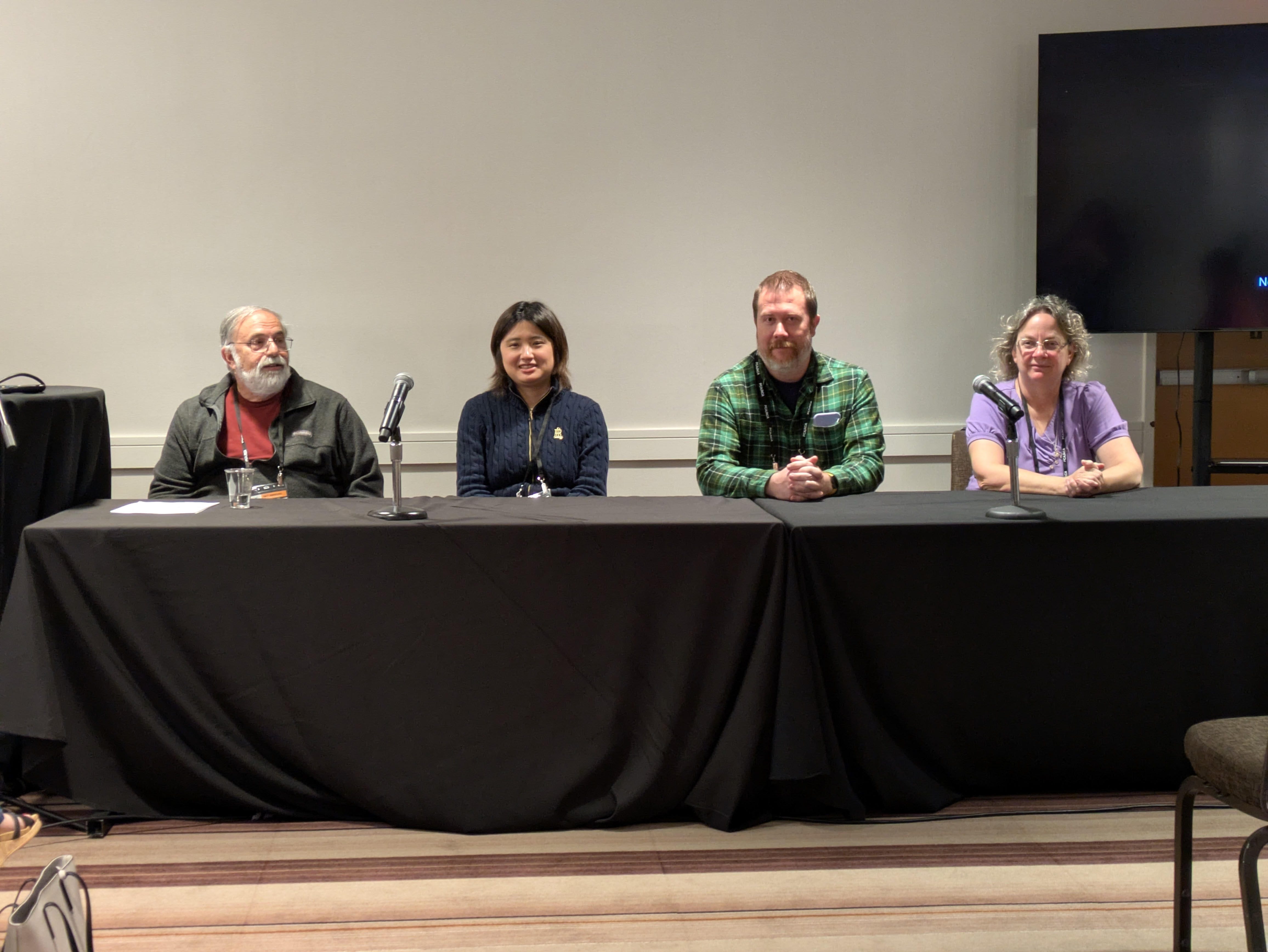
Two weeks ago, I drove to Atlanta to attend the Popular Culture Conference. I had the opportunity to participate in two days of panels of readings by poets. I had a wonderful time and was greatly encouraged by the connections I made and the great poems I was able to listen to. I’m looking forward to more opportunities like this.
I hope summer arrives soon where you are. Stay safe and healthy. I hope you are well.
Comments
Nothing yet. Say the first thing.
Sign in to join the conversation.