
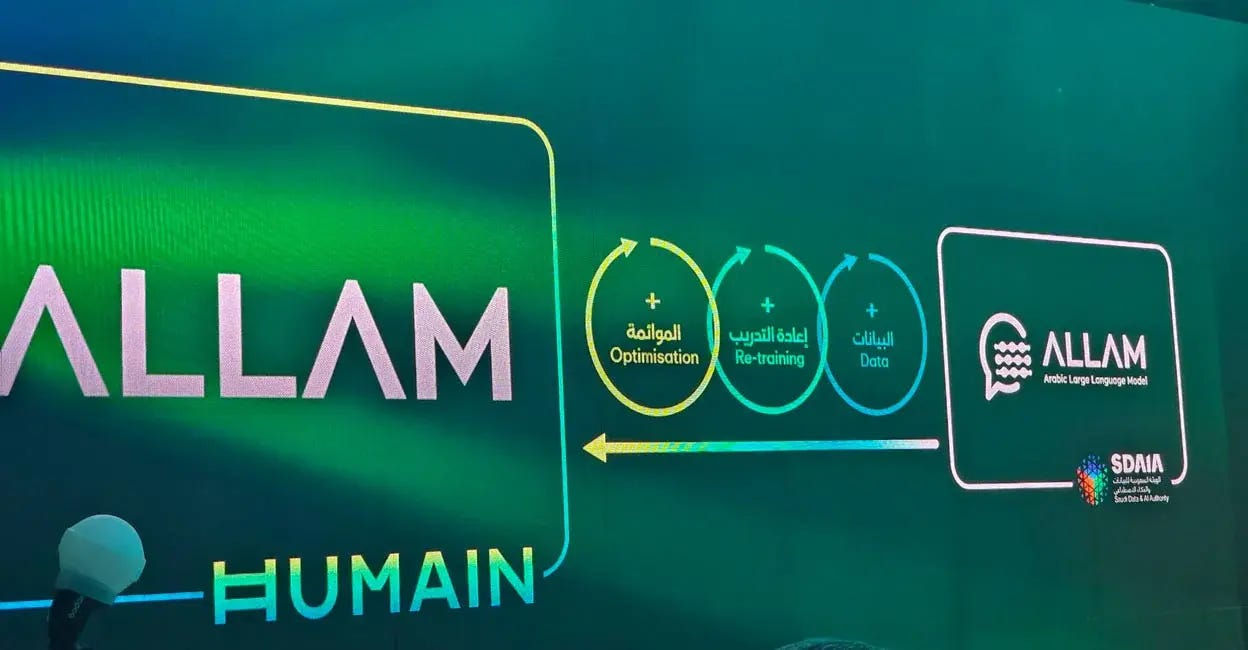
This week, something quietly powerful happened in the AI world, and it didn’t come from Silicon Valley. Saudi Arabia launched HUMAIN Chat, a next-generation conversational AI platform designed specifically for the Arabic-speaking world.
It’s powered by ALLaM 34B, the most advanced Arabic LLM ever created, and it’s being positioned as a cultural milestone, and rightly so.
Built entirely by Saudi talent and backed by the country’s sovereign wealth fund (PIF), HUMAIN isn’t trying to beat ChatGPT at its own game. Instead, it’s playing a different game altogether: one where language is power, and ownership matters.
This Week in Products, let’s talk about why this is important, especially for the techbiz scene in India, a country with more languages, dialects, and cultural diversity than almost anywhere else on Earth.
Most of today’s AI models, OpenAI’s GPT, Google’s Gemini, Anthropic’s Claude are designed for and trained on English-speaking internet users. Sure, they technically support other languages. But that support is shallow, and often riddled with poor translations, a lack of cultural nuance, and low accuracy.
They are fit for casual users but not business use cases.
What Saudi Arabia is doing with HUMAIN is different. It’s embedding AI in the linguistic and cultural DNA of its people. The model understands dialects, religious contexts, and even switches fluently between Arabic and English within a conversation. It’s built to think in Arabic.
That’s a critical shift: from multilingual AI to mother-tongue AI.
If language is how we access knowledge, make decisions, and communicate values, then language-specific LLMs are nothing short of digital infrastructure.
And that brings us to the India-sized elephant in the room.
We’re a nation with 22 official languages, hundreds of spoken dialects, and millions of people who interact with technology in ways that don’t fit the English-first mold.
But right now, our language infrastructure is broken.
To give you a sense of the imbalance:
English Wikipedia has 7,046,062 articles
Tamil? 176,055 articles
Hindi? 166,000 articles
Telugu, Bengali, and others? Around 100,000 to 150,000 each.
As Abhishek Singh (Digital India Corp) recently said:
Compared to English, the data available in Indian languages is almost nothing.”
And AI models are only as good as the data they’re trained on.
So unless we fix this, we’re looking at a future where the AI our citizens use, whether in farming, education, health, or governance won’t understand them properly.
Now here’s where it gets interesting.
Infosys co-founder Nandan Nilekani, often referred to as India’s unofficial CTO, recently said that India shouldn’t focus on building its own foundational models. His argument is:
“Let the big boys in the Valley spend billions building them. We should focus on use cases, not reinvent the model stack.”
His vision? Use those large models to generate synthetic Indic language data, and then train smaller models fine-tuned for our needs.
But not everyone agrees.
Manish Gupta, head of Google Research India, responded:
“I respectfully disagree. Foundational models are essential for enabling use cases, just like Aadhaar’s infrastructure enabled services.”
In his view, if India doesn’t build the base layers that are models trained on Indian languages, dialects, and context, we’ll forever be duct-taping use cases onto someone else’s infrastructure.
It’s Aadhaar all over again. Do we want to just build apps? Or do we want to build highways?
Adding fuel to this fire was OpenAI CEO Sam Altman, who last year told Indian developers it would be “hopeless” to build foundational models with limited compute and capital.
That statement triggered a wave of pushback from Indian AI founders, public policy experts, and government bodies. It wasn’t just a technical disagreement, it was seen as a challenge to India’s technological agency.
Because here’s the thing: India does have the talent. What it lacks is a focused effort around language data infrastructure, compute access, and a public-private AI roadmap.
If Saudi Arabia can do it, why can’t we?
While Nilekani may be hesitant on foundation models, others are not waiting around. Here are some promising efforts worth tracking:
AI4Bharat (IIT Madras) – Building open-source Indic language models like IndicTrans, and speech-to-text tools for regional languages.
Sarvam AI – Focused on creating LLMs rooted in Indian language data, co-founded by Indian AI researchers.
Bhashini – A government initiative under Digital India, aimed at language translation and building a public platform for Indic language tech.
Kissan AI – Working on vernacular-first models for agriculture and rural communication.
These are promising starts, but most are still starved of high-quality, diverse language datasets. And that’s where India’s real AI challenge lies.
Saudi Arabia built ALLaM 34B with:
One of the largest Arabic datasets ever assembled
600+ domain experts and 250 evaluators
A fully local talent pipeline and compute infrastructure
Deep cultural alignment and native dialect support
They’ve shown that you don’t need to compete with Silicon Valley—you just need to compete for your people. So I think India doesn’t need to build the next GPT-5. But we absolutely need our version of ALLaM 34B.
It will be a sovereign, Indic-first LLM that understands Tamil as well as it understands Hindi, that codeswitches between Bhojpuri and English, that can support voice, dialect, context, and culture.
Because without that, all our AI ambitions will rest on borrowed foundations and eventually, that bill will come due.
If you’re building AI-powered products in India, especially for tier 2/3 users, vernacular interfaces, rural segments:
You’ll face performance issues if your LLM can’t understand code-mixed inputs.
Your chatbot may fail if it can’t grasp cultural nuance.
Your user adoption will stall if your app “feels foreign.”
And this isn’t just true for India. It's true for any multilingual, culturally complex market, across Southeast Asia, Africa, or Latin America.
We’re entering a world where product-market fit will require model-market fit.
So the real question isn’t can India build its own LLMs?
📰What’s going around tech?
OpenAI Expands in India with New Delhi Office
OpenAI has revealed plans to open its first Indian office in New Delhi, adding to its recent launch of an India-focused ChatGPT plan. The company is assembling a local team to engage with partners, government, developers, and academia, as well as to tailor products for Indian users. In parallel, it’s hosting its inaugural Education Summit and Developer Day in India this year. The move reinforces OpenAI’s commitment to making advanced AI accessible and was built in partnership with India.
Read More→
Meta Partners with Midjourney on AI Models
Meta has partnered with Midjourney to integrate its image and video generation technology into future products. The deal will see the two companies’ research teams working closely on technical development. Meta framed this as part of its broader strategy to combine internal expertise with external partnerships and computing power to advance AI capabilities. For Midjourney, known for its distinctive visual style and independence, the collaboration expands its reach while keeping control of its business.
Read More→
TikTok Denies India Comeback After Website Glitch
TikTok has denied reports of its return to India after some users briefly accessed its website without a VPN. The company clarified that the platform remains banned and it continues to comply with the Indian government’s directive. The temporary accessibility was attributed to a network misconfiguration and not a relaunch. TikTok’s statement follows speculation that the service had been unblocked, but officials confirmed no action was taken to restore it.
Read More→
Microsoft AI Chief Warns Studying AI Consciousness Is "Dangerous" YouTube Music Celebrates 10 Years with New Features
Microsoft’s head of AI, Mustafa Suleyman, cautioned that exploring the potential consciousness of AI systems commonly referred to as “AI welfare” is both premature and potentially harmful. He argues that attributing consciousness to AI could intensify psychological issues such as AI-induced psychosis, create dangerous societal polarization, and distract from tangible human concerns. Suleyman insists that AI should be built for people, not as people, emphasizing that treating AI like moral beings could distort priorities and blur reality.
Read More→
Read More→
A video I found insightful
I recently saw this interview where Meta Chief AI Scientist Yann LeCun shares his thoughts on where AI stands today in terms of reaching AGI. True intelligence in his views can't be reached through the bigger models and more data alone. While systems like ChatGPT can give answers that sound smart, LeCun sheds light on how they can’t reason through new problems or come up with original solutions.
He says Meta envisions a future where a billion people might use AI through apps or devices. But on the enterprise side, it’s harder. Many projects don’t get past the demo stage because the systems are too expensive or unreliable, and he compares these situations to earlier disappointments, like IBM Watson or even the expert systems boom in the 1980s.
The point that he made was that no single company is going to suddenly figure out human-level AI. Rather, progress will come from new ways of building these systems, like giving them memory, better reasoning, and the ability to learn from different kinds of data. Improvements will come gradually over the next three to five years through the work of the wider research community.
Watch the video for more insights
📬I hope you enjoyed this week's curated stories and resources. Check your inbox again next week, or read previous editions of this newsletter for more insights. To get instant updates, connect with me on LinkedIn.
Cheers!
Khuze Siam
Founder: Siam Computing & ProdWrks
Comments
Nothing yet. Say the first thing.
Sign in to join the conversation.