
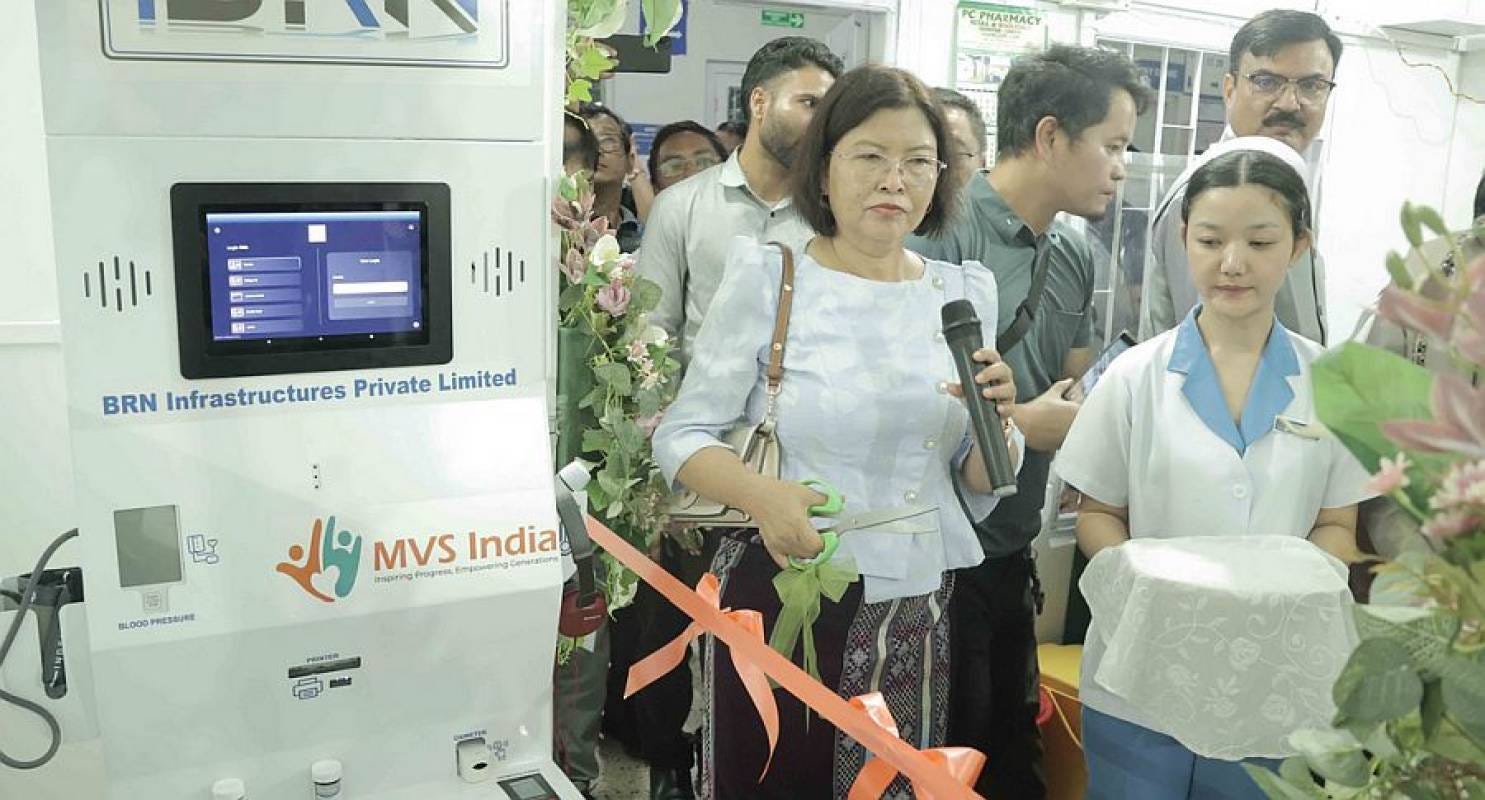
Imagine walking into a small hospital in Mizoram (not a fancy one in a big city), just a regular one tucked into a quiet village, and finding something that looks like an ATM. But instead of cash, this machine gives you a complete health diagnosis!
That’s exactly what’s happening at Lunglei Civil Hospital and the Primary Health Centre in Lungsen village. Mizoram has just introduced its first Health ATMs, and it might be a glimpse into the future of healthcare for rural India.
These IoT-enabled machines can run a whole bunch of tests, from the usual suspects like blood pressure, sugar, BMI, and oxygen levels, to deeper screenings like ECGs, lipid profiles, hearing, vision, and even mental health assessments for depression and anxiety.
And the best part? The results hit your phone in under 30 minutes. It’s all free.
In this edition of This Week in Products, we explore how India is beginning to build a decentralized, tech-enabled healthcare model, especially for the parts of the country where access has always been the hardest.
Health ATMs are just the starting point of this larger transformation.
But, first…
India has 1.38 million registered allopathic doctors, but that’s still not enough. The doctor-to-population ratio is currently 1:836, falling short of the WHO’s recommended 1:1000. In rural areas, that gap is far worse. The doctor-to-patient ratio is as extreme as 1 doctor for every 11,000 people.
Doctors in these settings are overstretched.
Doctors walk into crowded clinics and hospitals every single day, carrying the weight of guiding patients through pain and recovery. But behind the white coat, their own struggles often go unnoticed.
That’s the struggle on the doctors’ side.
Patients, especially the elderly, are underserved.
India has a rapidly growing elderly population. By 2031, nearly 193 million people in the country will be aged 60 years and above. As people age, they typically need to see doctors more often.
According to a recent Lancet study, older adults in India travel over 14.5 km for routine care and 44 km when hospitalization is needed. For someone living with limited mobility or chronic conditions, that’s a massive burden.
These kiosks aren’t a replacement for doctors. But they bridge a critical gap. They bring screening and routine check-ups closer to people, especially in remote or underserved areas, with minimal staffing requirements.
With digital records and instant reports, they reduce wait times and enable early detection of health issues before they spiral into emergencies.
Zooming in
Health ATMs are just one of the many tools being deployed across the country to solve for access, speed, and affordability in care delivery. Let’s look at a few other innovations that are pushing this transformation forward:
1. 1,500 Handheld X-ray Machines for TB Detection
As part of the TB-Mukt Bharat Abhiyan, the Indian government is deploying thousands of portable X-ray machines to boost early detection efforts. The goal is to screen more people faster and reach the 347 districts targeted in the national rollout.
2. AI + Blockchain for Emergency Detection
Researchers at IIT (BHU) have developed a system combining wearable sensors, blockchain, and ML to monitor health metrics in real time. If something critical like a heart attack is detected, alerts are automatically sent to family and hospitals, potentially saving lives where medical help is far away.
3. DeepTek + Chennai Corporation’s AI TB Screening
We wrote about this in our ProdWrks publication for product leaders. DeepTek, in partnership with the Greater Chennai Corporation, is using its AI-powered solution Genki to turbocharge TB screening across the city. Deployed in four mobile diagnostic vans, Genki has already screened 300,000+ individuals since 2019. With a 98% sensitivity and 96.9% accuracy, it’s dramatically reducing the workload on radiologists while enabling faster diagnosis and treatment in underserved communities.
4. Fujifilm India’s “Care on Wheels”
Launched in Mandi, Himachal Pradesh, this initiative includes mobile medical vans and static diagnostic centres offering CBC tests, X-rays, TB screenings, and teleconsultations. All of it is delivered using compact, high-performance screening devices like DRI-CHEM NX600 and FDR Xair.
5. NURA’s AI Imaging Centres
We featured this in ProdWrks, too. These AI-powered screening centres (an initiative of Dr Kutty’s Healthcare and Fujifilm) are designed for rapid preventive scans. With advanced imaging tools and AI analysis, NURA focuses on catching health issues early, especially in urban clusters where proactive health checks are becoming more common.
Zooming out…
According to ekincare’s 2025 report, 82% of Indians now prefer diagnostic centres over hospitals for check-ups, especially for preventive care. Why? They're faster, cheaper, more convenient, and often feel less intimidating than traditional hospital systems.
This shift is powered by new habits, better tech, and growing health awareness. It’s also a response to inefficiencies that have long existed in our healthcare system.
But the real impact of these solutions will be felt in rural India.
Instead of traveling hours for a blood test or basic consultation, patients can get screened locally, have their records securely shared, and consult a doctor remotely if needed. From AI-powered diagnostics to blockchain-secured health data to connected community kiosks, the convergence of technologies is quietly creating a new healthcare model from the ground up.
The big picture
There’s a massive opportunity here. If you're building in healthcare or adjacent spaces, now is the time to ask:
How can we make diagnostics work in low-bandwidth regions?
Can AI models support early detection without high-end infrastructure?
How do we design user interfaces that elderly or semi-literate populations can use easily?
What’s the best way to ensure interoperability between mobile health tools, hospitals, and the public health system?
The biggest gains will come not from flashy tech, but from thoughtful systems designed to work in the most difficult conditions.
If you want to make a real dent in healthcare, build for Bharat first.
📰What’s going around tech?
ChatGPT Go launches in India at under $5
OpenAI has rolled out ChatGPT Go in India, a low-cost plan priced at ₹399 per month (about $4.60), far cheaper than the ₹1,999 Plus tier. The India-exclusive plan offers 10× more messages, image generations, and file uploads, along with double the memory for personalization. OpenAI says it will use feedback from this launch to decide whether to expand the plan globally.
Read More→
Google introduces AI-powered Flight Deals amid antitrust scrutiny
Google has added Flight Deals to Google Flights, using its Gemini 2.5 model to help travelers find cheaper fares through conversational queries. The tool ranks results by savings and price with live airline data. The beta is rolling out in the US, Canada, and India. The launch comes as Google faces regulatory scrutiny in Europe over whether it favors its own services in travel search.
Read More→
Anthropic enables Claude to end harmful or abusive chats
Anthropic has updated its Claude Opus 4 and 4.1 models to end conversations in rare cases where users are persistently harmful or abusive. The system first attempts to redirect the conversation and only stops after repeated failures or when a user asks it to. The company frames this as part of “model welfare,” aimed at protecting AI systems rather than users.
Read More→
Humanoid robots race and stumble at China’s first robot Olympics Grammarly’s AI agents expand writing help for students and educators
Beijing hosted the first World Humanoid Robot Games with more than 500 robots from 16 countries competing. Events included running, football, kung fu and practical tasks like sorting medicine and cleaning. Some robots impressed with speed and agility, while many tumbled or collided, showing both the progress and limits of humanoid design. The event highlights China’s push to advance robotics on a global stage.
Read More→
Read More→
A video I found insightful
I came across this really interesting talk where Vinod Khosla, the Co-founder of Sun Microsystems & Founder of Khosla Ventures, shares his advice on one of the most haunting questions that has surfaced in recent years with AI coming up: “What career should I choose that will still be relevant in 2040?”
The boldest claim he made was that within the next 3–5 years, AI could do 80% of tasks humans handle today, where almost every job will eventually be touched or taken over by AI, except for areas that require medical expertise, like surgery where regulations may play the part of slowing things down.
Watch the video for more insights
📬I hope you enjoyed this week's curated stories and resources. Check your inbox again next week, or read previous editions of this newsletter for more insights. To get instant updates, connect with me on LinkedIn.
Cheers!
Khuze Siam
Founder: Siam Computing & ProdWrks
Comments
Nothing yet. Say the first thing.
Sign in to join the conversation.