
‘Nothing ever happens for the first time,’ they say.
The US govt. banned Fable over a non-issue this week, and it suddenly raised eyebrows in every big country.
The indication is more important than the reality here.
A model like Fable being gate-kept by the country with the most compute and the biggest lead in AI research…could someday even be real. And when it is, every country that didn’t build its own will feel it.
This isn’t the first time these ideas are being discussed, either.
Back when the internet was in its infancy, researchers feared it could be used to restrict the sovereignty of any nation.
One such research paper from 1999 read:
The Internet is capable of restricting the sovereignty of the state in many ways. It does not stop at national boundaries. It impedes the sovereignty of nation states in regard to information, currency and values. This is why it has the potential of disintegrating the nation states. Autonomy becomes prohibitively expensive for a nation state. The traditional forms of statehood will be affected. New international conflicts arise.
Tell me if you find the discourse any different today.
These fears were not completely devoid of logic, and many countries took notice.
The Great Firewall of China came from these efforts.
And by and large, countries around the globe were able to make arrangements for their own data centres, intranet networks, and IT systems.
But it’s different this time.
So today we’ll discuss exactly that.
Why do countries need their own models?
What does it look like?
How it’s faring so far, and most importantly,
What’s to come.
AI is where the internet was in 1999.
It is going to become the backbone of nations — and its impact will be far more transformational than the internet’s.
All usage and adoption patterns point to this.
The internet brought informational parity.
What AI brings is something harder to achieve and easier to lose: the ability to understand and act on that information.
Not just access to knowledge but judgement at scale.
In a simpler analogy, the internet gave everyone the books. AI is the teacher.
And unlike books, you can’t just translate a teacher. A teacher trained in one culture, one language, and one legal and moral tradition will pass those defaults on — invisibly, at scale, to every student.
Those are the stakes.
But AI doesn’t stop at education. It will run bureaucracies, legal systems, businesses, public health infrastructure … every system that requires stored knowledge applied to new situations.
In a way, every layer of work that makes a society function — the unglamorous, procedural, load-bearing kind — could begin to flow through AI.
“And he who controls the spice controls the universe.”
No sovereign would hand over the backbone of their country to an external system.
So a sovereign AI will come. The question is who builds it, and who gets left waiting.
Much has been written about whether the AI boom is a bubble.
It felt true when the DeepSeek moment happened. It felt true again when SpaceX IPO’d. And smart-money corners on X are already murmuring about the OpenAI and Anthropic IPOs being the next pin.

But zoom out from the market narrative for a moment.
If AI is a national asset—not a product, a national asset—where is the rest of the world in building the compute and capability to back that claim?
The US is bringing chip manufacturing home. Aggressively. Deliberately.
But the rest of the world?
Compared to the US, the rest of the world is essentially compute-strapped. And compute is only half the problem.
Even if a country acquires the hardware, where do the models come from? AI model development is concentrated in three regions: the US, China, and the EU. Everyone else is a consumer.
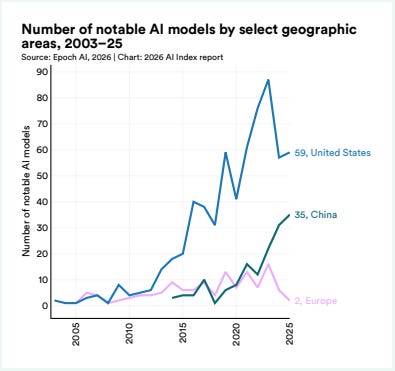
So if every major country eventually needs sovereign models, who builds and funds them?
Unlike aviation or medicine — where you can outsource design and license the output — AI is too deeply embedded in language, culture, and governance to import wholesale.
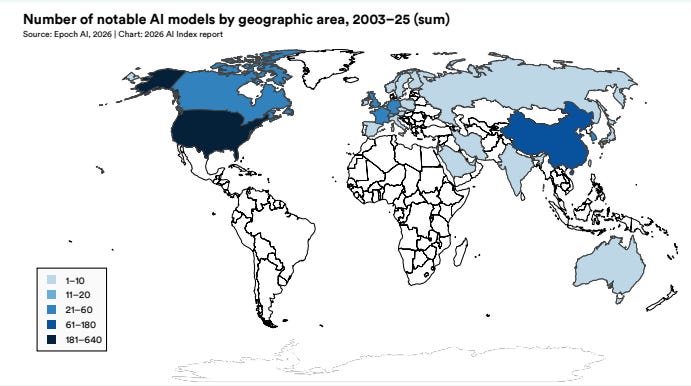
A foreign model doesn't just answer questions differently. It thinks in a different mother tongue, with different assumptions baked into every layer.
You can’t license your way to a sovereign mind.
And yet the strategic response from most governments has been to buy subscriptions and call it a policy.
AI autonomy is prohibitively expensive, and that’s before you even get to the hard parts.
The real moat in the OpenAI/Anthropic strategy isn’t the model. It’s the ecosystem: the developers, the integrations, the institutional habits, the feedback loops.
It’s the same reason Mistral — politically backed by France — hasn’t dented the broader market. And the same reason Gemini, despite Google’s resources, is still chasing.
Institutions adopt strategically when pushed. Apple chose Gemini. France chose Mistral.
But most countries haven’t been pushed yet.
For any country that tries to build from scratch, the full picture is discouraging.
You need frontier research, patient capital, massive compute, high-quality data in your own language and legal context, distribution, and a feedback loop that keeps the model improving.
Get one of these wrong and the whole thing stalls.
It’s not one moat. It’s a hive of moats – each one requiring a different kind of excellence to cross.
And underneath all of it sits an advantage most people don’t talk about: almost every frontier model today was trained predominantly on English-language data. That’s not just a language preference. It means these models encode English-language norms, reasoning styles, and cultural defaults at the architecture level.
Hence, a government deploying a foreign AI isn’t just adopting a tool; it’s adopting a worldview.
That’s the hidden cost no procurement budget accounts for.
The only way out of this lock-in is through it – build independence from the very first day.
The result is an AI ecosystem that’s uniquely their own — one where cost optimisations and local feature unlocks compound into a structural advantage that no Western model can easily replicate.
I wonder if any other country is in a position to pull this off.
The template is there. It’s always been there.
For every dominant US tech platform, China built an equivalent — better suited to local behaviour, local language, and local needs.
WeChat didn't just replace WhatsApp and Facebook and Apple Pay. It became something none of those ever were: a daily operating system for life.
Now, there’s no alternative like WeChat in the US — though that hasn’t stopped Elon and Zuck from trying.
Now imagine that same dynamic applied to AI — not just products, but the infrastructure of governance, education, and public services.
A country that builds its own gets something that compounds. A country that doesn't gets a dependency that deepens.
I'm not saying the Chinese model is something to replicate wholesale — the firewall has costs, and those costs are real.
But the underlying logic is sound: a more customised ecosystem produces solutions shaped by the actual problems of that country, not the assumed problems of a foreign market.
And the path doesn't have to be all-or-nothing.
India's UPI didn't replace Visa — it built a sovereign payments layer that coexists with global rails while giving the state full visibility and control.
Sovereign AI could work the same way: a national model for governance, legal systems, and public infrastructure, sitting alongside frontier models for everything else.
Now, there’s a deeper problem, which the govts know: AI infrastructure built in and for the US is priced for the US.
The compute is expensive because the country is expensive.
The talent is expensive because the market is expensive.
It makes no sense for the entire world to pay that premium — or for the US to have to supply that demand.
And globally, the US already collects an enormous indirect tax through its tech companies. Marketing, sales, distribution, cloud — a slice of every budget in every country eventually flows back.
That’s not inherently bad. But no country should have to choose between intelligence for its people and its footing on the global economic stage.
Building, deploying and running AI models is hard. Yes.
And, yes, the US has a head start, both in terms of tech and ecosystem!
Most countries that try building their own models may end up with a fine-tuned wrapper.
But remember what happened in the apps era.
The US invented the smartphone, the OS, and the app store.
And yet Indonesia built GoJek. Kenya built M-Pesa. India built UPI.
None of these required building the phone. They required understanding what citizens actually needed from the last mile — and building for that, specifically.
The same logic applies to AI.
Sovereign AI won’t look like a country rebuilding GPT-5 from scratch. It will look like governments owning the interface layer — the models that touch citizens directly, in their language, with their legal context, shaped by their cultural defaults.
The foundation model can be imported. The last mile cannot.
Renting intelligence is fine — until the landlord changes the terms.
Comments
Nothing yet. Say the first thing.
Sign in to join the conversation.