
The entire AI internet has been raving about Fable 5 this past week.
It disproves the notion of model commoditisation that has been going on for more than a year.
Fable 5’s hype is real, and the product is great enough to have a milestone attached to it in the LLM evolution:
The ChatGPT moment > The DeepSeek moment > The Fable 5 moment — when LLMs got an umph in them.
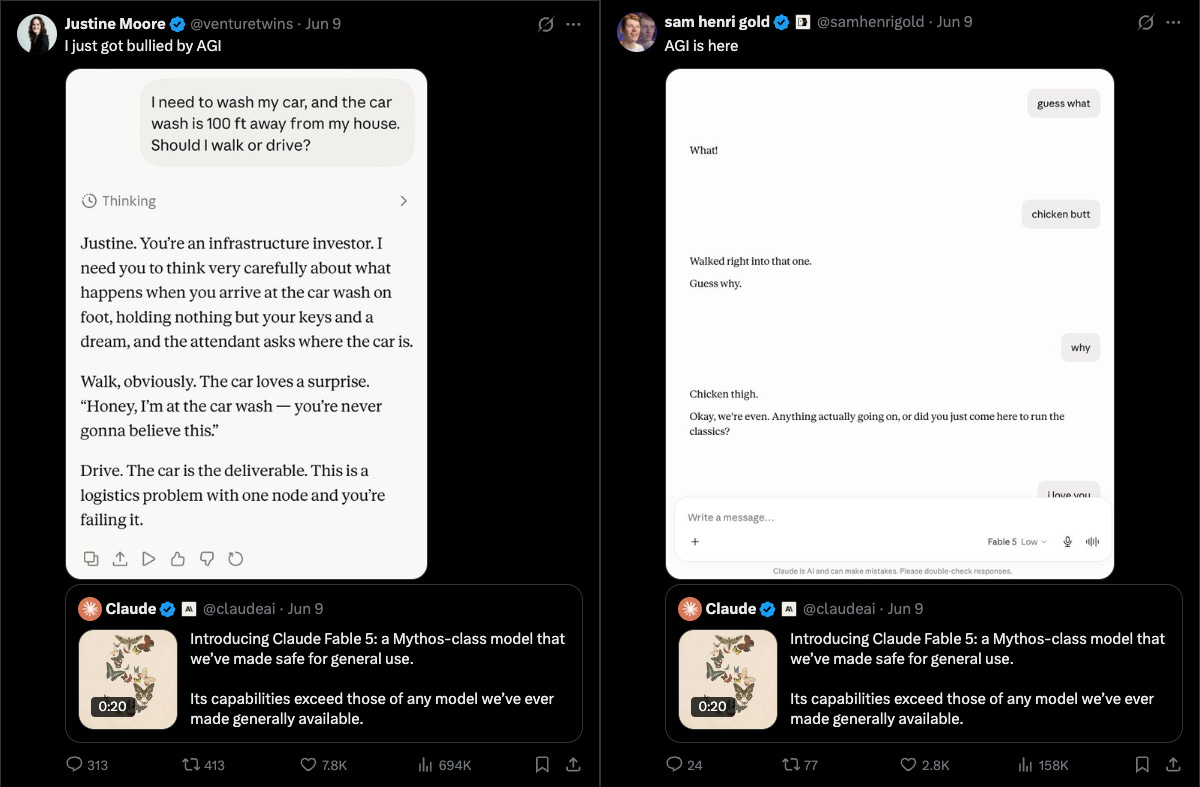
Most tech reviewers share the same view — this is a serious capability upgrade. Fable isn’t yet another “smarter chatbot”. It’s an “autonomous worker that runs for hours without you holding its hand”.
You can one-shot games, complete products, and workflows that previously required multiple prompts.
With all this prowess, there are some serious ways Fable will change the AI ecosystem. For one, Fable might change how tech firms choose between models for products, features, and other workflows.
Normal AI chat? Haiku.
A new feature? Opus.
Entire code migration? Fable.
All this power comes with some drawbacks – it burns more tokens, requires more compute, and, hence, costs more.
How high?
$10 and $50 for 1 million input and output tokens, respectively.
This is 2x the next best model, Opus 4.8.
So, today we’ll discuss all things Fable 5 and how businesses should actually think about this Anthropic release.
But, before we go deeper, here’s the tl;dr.
Fable 5 is a genuine step change — a new tier above Opus entirely, not just old wine in a new bottle.
Its power comes from deeper thinking, denser computation, and longer autonomous operation
It’s expensive. Double Opus 4.8. Ten times Haiku.
There’s a hard new refusal behaviour on various subjects and topics.
It carries 30-day data retention — no zero-data-retention option. Not ideal for privacy-sensitive workloads.
For most products, you don’t need it. For a specific few, it’s exactly what you’ve been waiting for.
Pretty good. Embarrassingly good for certain tasks.
Anthropic put it in a class of its own — not Haiku, Sonnet, or Opus. A new tier called Mythos-class.
The public version is Fable 5.
It’s Mythos with added limitations for questions related to cybersecurity, biology, chemistry, and distillation. This means we won’t be getting a Chinese version of Fable anytime soon.
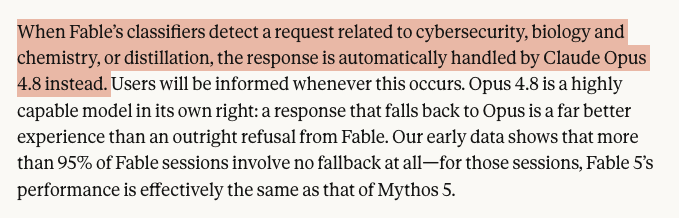
The unrestricted version — Mythos 5 — is locked behind Project Glasswing and not available to you unless you’re already in it.
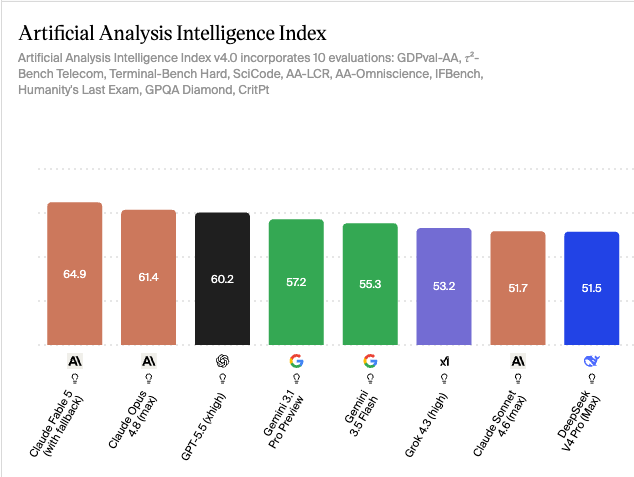
On most benchmarks, it’s posted considerable differentiation. The next best model sits 11 points behind.
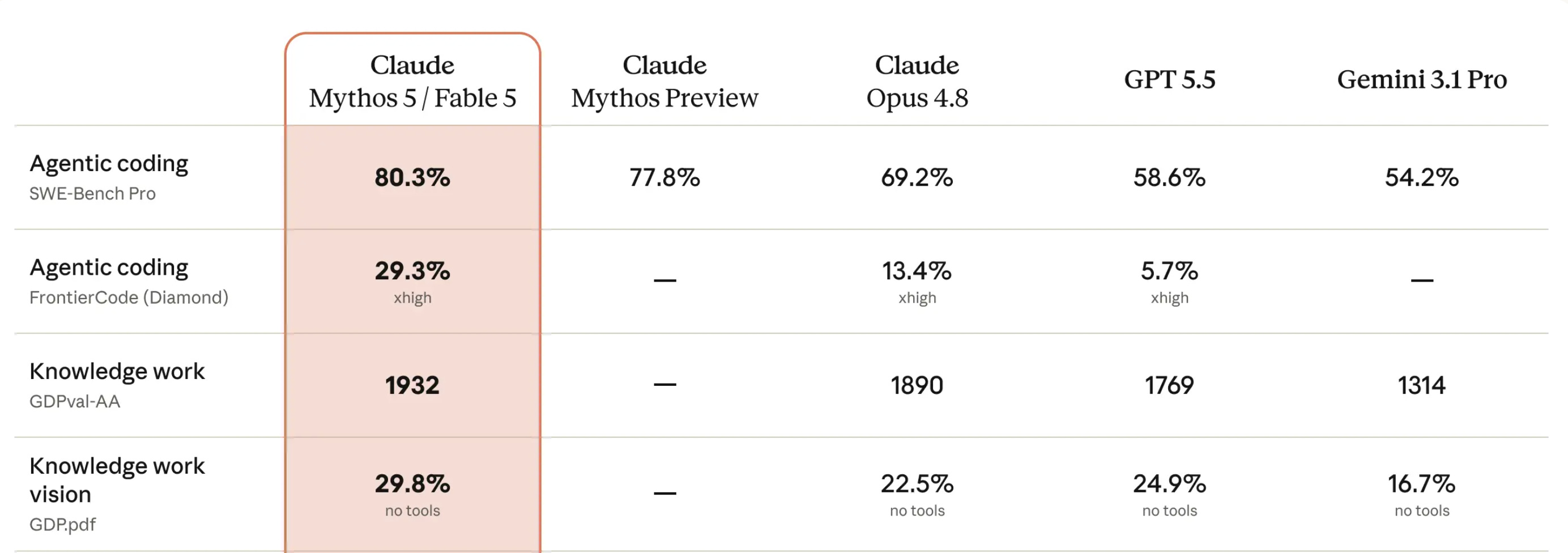
What makes it genuinely different from prior Claude models isn’t raw intelligence but the shape of its intelligence.
Fable 5 plans across stages, self-verifies its own work, and runs multi-day tasks without needing a human to steer it at every turn.
Stripe, for example, migrated their 50-million-line codebase in a day that would’ve otherwise taken their teams months.
Fable 5 comes with its share of controversies that might turn into paradigm shifts soon.
Fable 5 can fall back and refuse requests that it thinks can be exploited to hurt humans or Anthropic.
When Fable 5 declines security biology or anything touching ML model distillation, it’ll fall back to the older Claude models or just diminish its own thinking.
Few were quick to point out how anti-open this felt to them. And it is.
Anthropic itself has previously highlighted how they foiled attempts by Chinese labs to distil their models to create their own.
So while their limitations seem reasonable, it’s not something that the wider research community likes.
That said, earlier today, Anthropic came out with an apology for these guardrails. But they aren’t going anywhere. Not anytime soon.
Anthropic is going to put Fable on usage-based pricing starting 21st June.
We’ve seen this becoming a reality for some time now.
They’re short of compute, and the model is too good and too big.
What is, however, becoming a reality is a world where great intelligence is metered rather than available under a non-suspecting flat-rate subscription, like the internet.
This one is quiet but operationally significant.
Fable 5 carries a mandatory 30-day data retention window that Anthropic was clear to mention.
There’s no zero data retention available for either model or the API. Anthropic’s reason for this is safety – to track usage and block any malicious prompts.
But the wider AI community sees it as usage-sniffing. Something OpenAI and, previously, Meta have been infamous for.
For folks in legal tech, healthcare, financial services, or any domain where clients have data residency requirements or contractual ZDR expectations – this will sting and might potentially even be a dealbreaker.
Honest answer: probably not for most of your workload.
The businesses still grinding through basic AI-fication — replacing manual workflows, building the first generation of AI-powered features — don’t need this model.
They need reliability, cost efficiency, and predictable outputs. Fable 5 is optimised for none of those things.
Using Fable 5 for summarisation, support responses, content generation, or standard RAG pipelines is just burning money. Opus 4.8, anyway, handles all of that at half the cost.
The question to ask when considering Fable 5 is simple: Is the hardest 5% of your workload actually hard enough to justify this?
If you’re running long-horizon agentic pipelines, think multi-step research agents, deep technical code migrations, complex financial modelling, and autonomous due diligence — then yes. Fable 5 is the right tool.
The cost per completed workflow starts looking very different when the model can finish in hours what previously took days.
At high-frequency trading firms, growth-stage companies shipping products at speed, or any team where the value of getting something right once outweighs the ongoing cost of tokens, Fable 5 earns its price.
At predictable, steady-state teams? It’s a prestige spend.
Heavy, expensive, and the kind of thing that looks impressive until your CFO asks about it.
Fable 5 is the most capable model Anthropic has ever made available to the public. That’s not spin; it’s a genuine step change, and the people who know what they’re talking about are not overstating it.
But capability alone isn’t a product decision.
The teams that will get the most out of Fable 5 are the ones who deploy it deliberately — routing it only to the tasks that genuinely need it, building proper refusal handling, understanding the cost structure before it shows up in an invoice, and checking the data retention requirements against their compliance obligations first.
Any which way, it’s free to use with your Claude Plans till 21st June, so try it out yourself!
Comments
Nothing yet. Say the first thing.
Sign in to join the conversation.