
This Outfit Does Not Exist is a newsletter on the future of creativity, commerce and culture. To join over 1,581 weekly readers why not:
Some people think that writing is merely the process of picking the right words and putting them in the right order, like stringing beads onto a necklace. But the power of those words, doesn’t live inside the words themselves.
Words only come alive when they’re embedded in this rambling letter from a famous poet to a scared kid, a kid who is choosing between a life where he writes poems and a life where he shoots a machine gun at Bosnian rebels. The beauty ain’t in the necklace. It’s in the neck.
Maybe that’s my problem with AI-generated prose: it’s all necklace, no neck.
— Adam Mastroianni, 28 Slightly Rude Notes On Writing
Capitalism’s cardinal value is monetising each drop of sweat that leaks from a worker’s brow. Technology’s is optimising the minutiae of existence. When the two intersect they birth a spectre of disruption that slips through previously impervious walls to terrorise the labour force. Over the past three centuries this ghost has been summoned with increasing frequency, emerging from machine after machine to reinvent:
The body – the first set of industrial revolutions’ mechanised our fingers with the electric loom, our arms with the production line and our legs with the steam engine.
The mind – the digital revolution enhanced our processing power, automating rudimentary mental tasks and expanding our capacity to access and analyse information.
And most recently…
The soul – in the last 3 years AI has come for passion, automating products that hinge on the imagination and dedication that blooms into skill.
Whenever this haunting begins, workers frantically seek routes to self-preservation. They ward talismans of upskilling, cower under alternative career paths, or in the case of the Luddites, attack the machines themselves. But when the ghost is the machine the thing that makes a career, a product or an investment defensible is the qualities that are impossible to automate. In other words humanity is the moat.
A few years ago I wrote an essay analysing how digital-only talent agencies like The Diigitals would disrupt the modelling industry. Now buried inside the hard drive of a deep-fried Macbook, the piece argued that the introduction of tools like Epic’s MetaHuman Creator and Lalaland.ai, would create a chasm in the talent market. On one side ‘traditional models’, hired for their looks, and on the other 'model/influencers’, hired for their personal brand.
I argued that in the next decade ‘traditional models’ would be out of work as their beauty could be synthesised in a way that was not only cheaper, but more efficient for their clients. What’s more, these synthetic models could be further optimised to convert potential customers. They could scrape data and then tailor their form1 to each shopper’s ideal, or simply take the form of the shoppers themselves (not unlike Mystique from X-men.)
As these traditional models were being wiped out ‘model/ influencers’ would be increasingly in demand. Their proposition of a bolt-on audience, who offered fanaticism and feedback, made them perfect product-people. Not only did they come with fans who aspired to be them, and trusted their views, they had the ability to bridge fashion with other complementary industries, and in doing so expand the market.
Cut to 2025 and Levi’s has faced backlash for using AI models on their site, Diesel’s SS/25 campaign featured synthetic septuagenarians, and an AI generated model in last month’s Vogue sparked outrage. Meanwhile fashion’s rising stars are Gabriette Bechtel (musician/ Instagram chef), Lara Violetta (beauty influencer/ magazine publisher), and my favourite, Kat from Finance, whose content is created in the bathroom of a London bank.
When I laid out this argument in 2021 it was mainly applicable to the future of talent. But now its three overarching pillars can be applied to the wider labour force to make the case for why humans will stick even when they could be automated:
The job isn’t just the job. It’s the relationship – A recent study in the Harvard Gazette posited that social connection is just as crucial to animals as other basic needs. It’s long been understood that social interaction sparks positive neurological responses, such the release of dopamine and serotonin. Now scientists have found that a lack of human connection triggers drives associated with other aversive experiences like the deprivation of food or water. Matthew Lieberman supports this idea in his book Social: Why Our Brains Are Wired to Connect, claiming that mRI research shows that our brains seek out social connection as a reflex. Immediately after we access the non-social parts of the brain, our minds snap back into ‘social mode’ to validate our actions.
In practice this means that regardless of whether businesses can be trimmed down to one-man unicorns, as some Silicon Valley overlords claim, they won’t2. Instead, there will be an increasing onus placed on what Anu Atluru of Working Theorys terms ‘Relational Labour’. Defined as ‘an essential layer embedded alongside manual and cognitive labor — rooted in presence, context, commitment, and care’ Anu argues that the companionship needed for humans to enjoy producing will allow human teams to be retained across organisations, even if they’re less efficient. She claims: ‘AI will flood the zone with intelligence. But as intelligence gets cheaper, presence gets more expensive. Real, earned, interpersonal trust will become the rarest currency.’ Which brings me on to my second point…
We need new gods – over the past century Western values have become increasingly fragmented. Belief systems held at a country, city, or even industry-wide level have been shattered by social media. The shards of rampant individualism, that now equate to faith, slice at our soles during tireless pilgrimages to find meaning in our screens.
Under this new order, the world is a ‘For You’ page and a ‘follow’ is a request to become the disciple of any one of a million gods. When I think of ‘gods’ through this framing I don’t imagine social media driven monotheism, where the masses dedicate themselves to a single paragon. Rather I see a move back to polytheism, where many different gods are worshiped in pursuit of many different ends. Whilst these new gods represent entirely different belief systems they all exhibit the same three traits:
They are self elected — the masses choose them only after they choose themselves
They are extreme — they exhibit extreme behaviours which allow them to become evangelical archetypes
They overshare — they broadcast each aspect of their lives in a way that provides fodder for emulation, and allows them be perceived as ‘authentic’
While millions of us arrange ourselves under the most popular of these paragons like Kim Kardashian, Brian Johnson and Elon Musk, we simultaneously seek scripture from a mass of smaller gods and prophets. These less well known figures hold pull for being aspirational and purpose-led, yet in a way that is more attainable than their popular counterparts. Although the talent industry refers to these individuals as ‘influencers’ they can look like our colleagues, or neighbours, as they span every aspect of life imaginable. From office influencers, to woodworking influencers, to exotic pet influencers to parenting influencers. While virtual humans can be our therapists, our romantic partners, and allegedly our friends, their lack of humanity creates a vacuum that only flesh-and-blood figures can fill.
Humanity is scarce — digital products are by nature infinitely scalable. Any restrictions on their demand are entirely contrived3. Humans on the other hand are finite, and so are our creations. From a simple economic standpoint this places value on the products of our labour because demand can so easily outstrip supply. But it can also be argued that the opportunity cost4 implicit in human produce injects it with an additional layer of worth. As Adam Mastroianni states in his 28 Slightly Rude Notes On Writing: ‘There’s something special about every word written by a human because they chose to do this thing instead of anything else. Writing is a costly signal of caring about something. Good writing, in fact, might be a sign of pathological caring’.This idea of ‘pathological caring’ boils down to the sacrifice inherent in necessitated choice. Though humans can be easily outperformed by quicker, more durable, machines, our products are precious because they are charged with sacrifice. Just as the theory of opportunity cost states that each thing we choose to buy bears the cost it’s alternatives, each product humans create comes at the cost of creating something else. The fact we cannot do everything, is both our biggest cause of inefficiency, and simultaneously our biggest point of strength. A human-made product is valuable, not just for its function, but because of the sacrifice that resulted in its existence5.
If you follow the logic above, assessing what makes an irreplaceable employee, a valuable product, or a good investment can be boiled down to how much humanity it holds measured against its quality. I like to think of this as the humanity coefficient.
While acquiring the skills to produce at a high level has long been a part of the education system, ‘humanity maxxing’ is something new; to everyone but creatives. Since the time of Michelangelo, artists and their teams have specialised in making people understand, and appreciate, the humanity in their work. When a creative product is publicly shared, its makers go to colossal lengths to establish understanding around why that product was made, how it was made, and the effort implicit in both.
Over the last few years, other industrialists have followed suit. Many founders now ‘build in public’— oversharing each detail of their mythologised ‘founding journey’ in an attempt to accrue user-cum fans. White collar workers are similarly repositioning as ‘thought leaders’—flaunting their expertise and relationships, to attract followers they can convert into clients. Even investors now share how they can ‘add value’ to prospective portcos with garrulous tweets, only occasionally self-indulgent enough to earn a spot on VC brags ;).
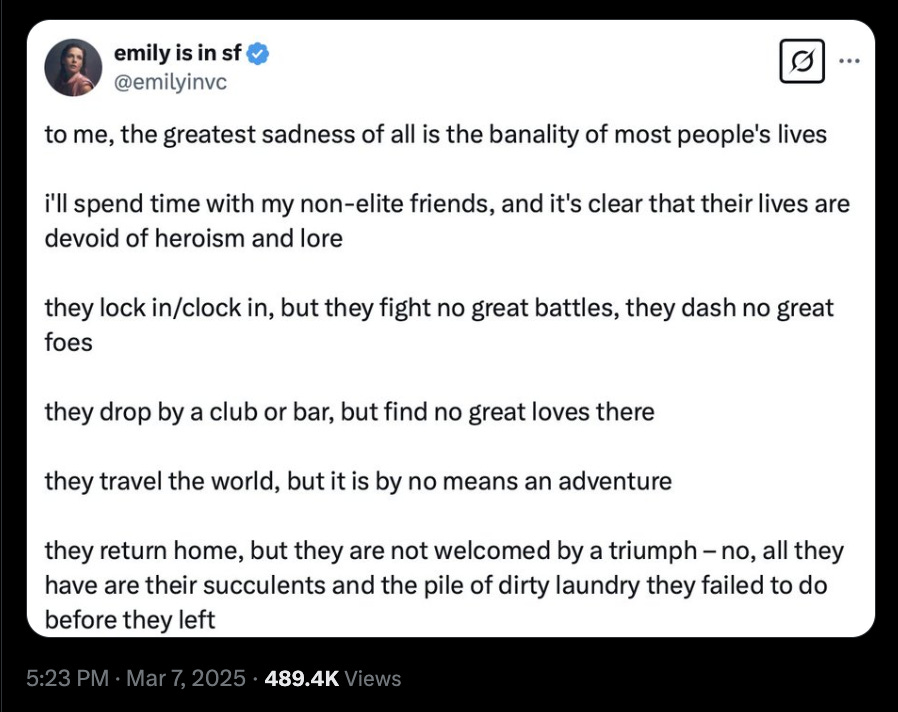
When it comes to VC, the humanity coefficent makes it clear that investors need to reframe how they evaluate startups, particularly at the early-stage. It’s a well known fact that a seed stage founder will pivot multiple times before finding product-market fit, so a person is as important as their pitch, if not more so. However, for the past few decades, evaluating who to invest in has often hinged on their technical skill. When anyone can build anything with a subscription to Lovable or Chat-GPT, this is no longer the case. I see a near future where the focus placed on technical abilities will be replaced with an onus on the human touch. The founders who can build and scale human relationships will be the most investible, in a large part because they will be the ones with the communities to support their products through pivots.
Slow Ventures is already backing this thesis, raising $60 million to invest in creator-entrepreneurs. Under the belief that trust and audience attachment are two of the most valuable qualities in a modern founder, the fund is pioneering a first-of-its kind deal structure. Unlike in traditional funds, where capital is exchanged for a share of an existing business (or business idea), Slow’s Creator Fund offers creators funding in exchange for the future rights to any off-platform businesses they spin up; often across a multi-decade time horizon. The fund first experimented with this structure back in 2021, when they invested $1.7 million into language-focused YouTuber Marina Mogilko in exchange for 5% of her future businesses over the next 30 years. Their most recent investment was into a woodworking creator Jonathan Katz-Moses, under a similar structure.
A week ago I found myself in a New York gallery, for an evening hosted by USV and Asylum Ventures under the guise of ‘Art + Pizza’. The guest list was composed of 20 or so creative nerds, working on topics that ranged from cryptography and artist rights, to ’dropping apps like raps’. As we stood, surrounded by Lily Stockman’s abstract interpretations of vernal pools, Andy Weissman introduced us all with the simple statement:, ‘Anything that can be automated will be; anything that can’t becomes priceless.’
I sure hope he’s right.
— Dani
See the original business model of Rosebud AI which aimed to create virtual models who responded to the aesthetic preferences of consumers, determined by user data (e.g. if data showed you were a male person of colour, the person in the Hyundai ad would look like you)
Disclaimer there will always be one sociopath who ‘doesn’t need colleagues’ and lets Sam Altman win his ‘group chat bets’ on solo-preneurs
Which is not to say it’s ineffective as proven by the early NFT market which was doing over $2.8 billion in monthly sales at its height in 2022
In economic theory opportunity cost is defined as the loss of potential gain from other alternatives when one alternative is chosen
The word ‘sacrifice’ can also be subbed out for the word ‘care’
Comments
Nothing yet. Say the first thing.
Sign in to join the conversation.