
ThirdSpace BUZZ is an edgy newsletter on whatever the fuck I want.
Behind the veil of state sanctioned marriage lies an enduring human rights crisis that shields abuse in plain sight.
For decades, statutory loopholes and parental consent exceptions have enabled religious sects, trafficking networks, and individual predators to bypass statutory rape laws entirely.
As survivor advocates demand nationwide reform, understanding the legal mechanics, historical precedents, and institutional opposition reveals why ending child marriage remains an urgent struggle.
⚡

Sponsored by:
Help us grow by sponsoring our newsletter and reaching an engaged community.


“There can be no keener revelation of a society’s soul than the way in which it treats its children.”
— Nelson Mandela

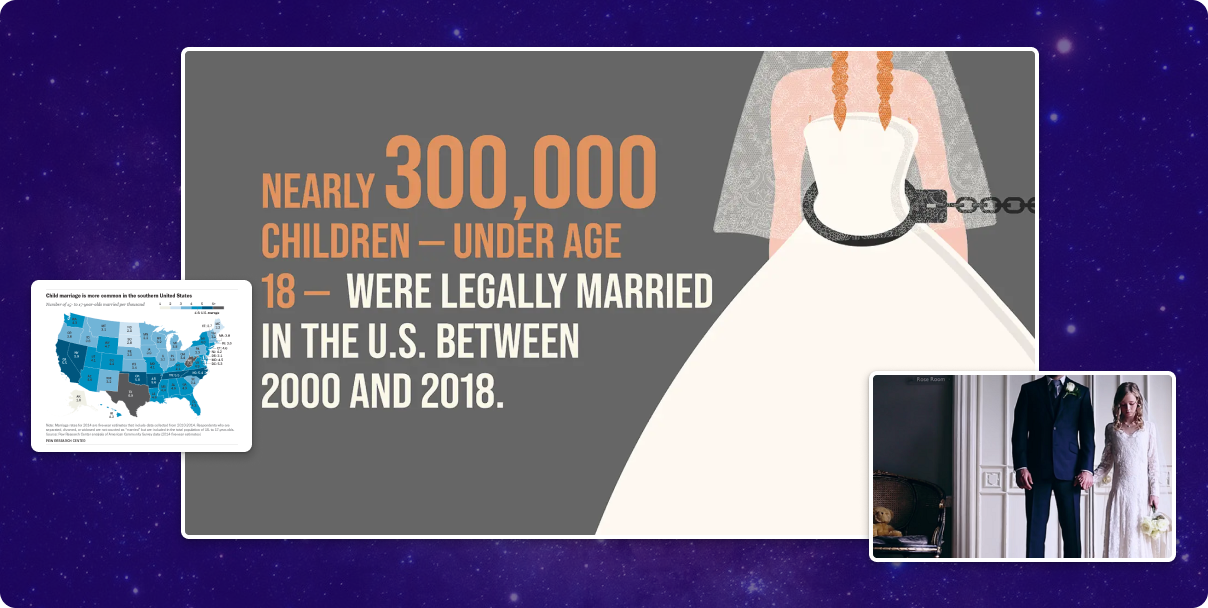
Between 2000 and 2021, over 300,000 minors were legally married across the United States. The vast majority were underage girls wed to adult men, frequently under conditions that would otherwise constitute felony statutory rape. The core enabler of this systemic abuse is not an underground criminal enterprise operating in shadow, but the civil legal system itself.
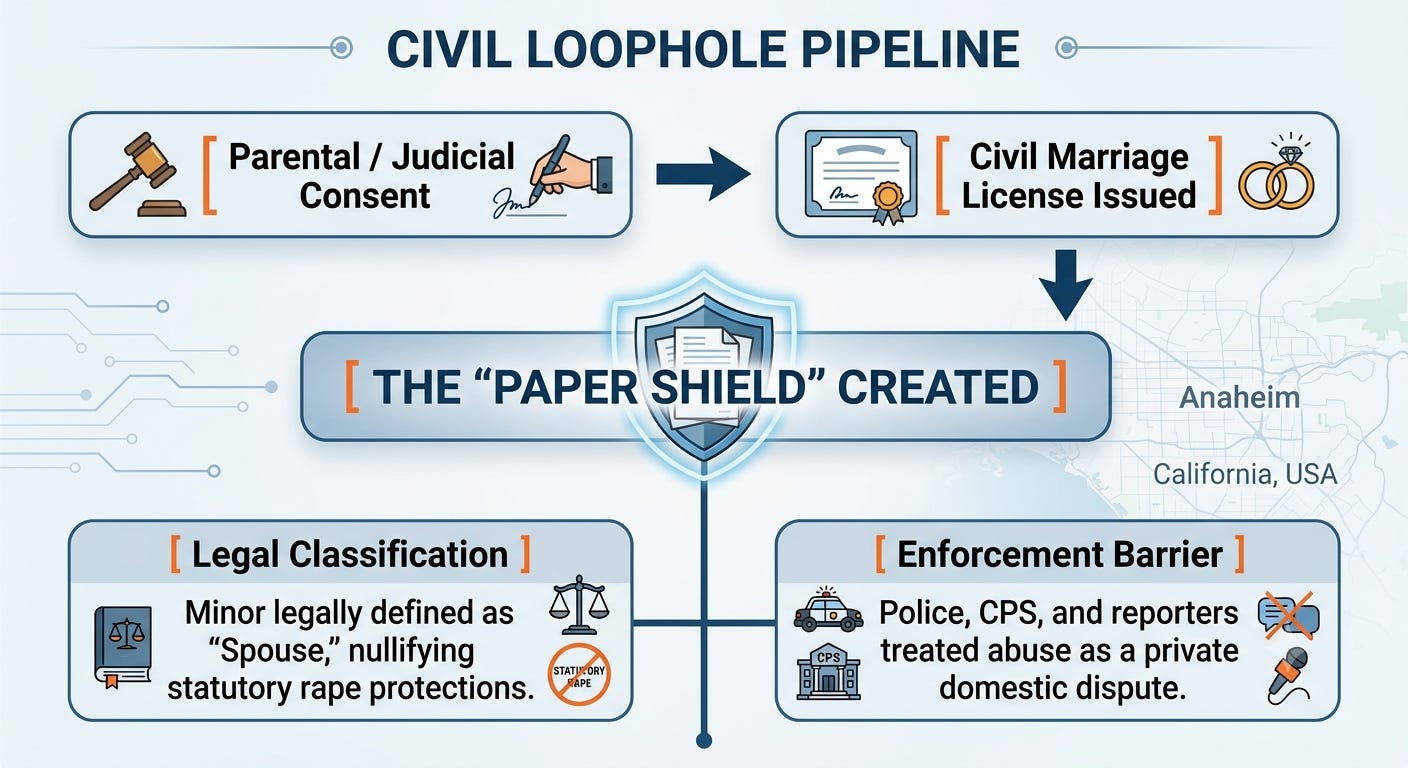
Child Protective Services (CPS) does not provide proactive, ongoing oversight for married minors. While family court evaluators act as mandatory reporters if abuse is detected during pre-marriage interviews, active judicial and administrative oversight ends once a marriage certificate is signed.
Because minors lack standard legal capacity—typically unable to retain legal counsel, file for divorce, or access domestic violence shelters without parental authorization—abused child brides are effectively trapped. CPS intervention is purely reactive, meaning that unless outside third parties report blatant harm, the state remains blind to abuse occurring inside the marriage.
Historically, state marriage statutes included parental consent exceptions, judicial waivers, and “pregnancy clauses”. These clauses allowed adult men facing statutory rape charges to avoid criminal prosecution entirely by marrying their underage victims. By acquiring a marriage certificate, perpetrators obtain legal immunity, transforming what would be a serious sex crime into a legally recognized domestic arrangement.
While traditional organized crime rings operate via covert sex trafficking, insular fundamentalist groups weaponize civil law to maintain absolute communal control over minors.
OutcomeFundamentalist LDS (FLDS)
Authoritarian prophets mandated “placement marriages” assigning girls as young as 12 to adult elders.Warren Jeffs placed on FBI Top Ten list; sentenced to life in prison.
FLDS Splinters (e.g., Samuel Bateman)
Self-styled prophets took dozens of underage “spiritual wives” (some as young as 9).Federal prosecution for kidnapping and minor transport; 50-year prison sentence.
Tony Alamo Christian Ministries
Apocalyptic cult leader used forced child marriage, starvation, and isolation under threat of damnation.Alamo convicted under the Mann Act in 2009; died in federal prison.
High-Control Ideological Groups
Coercive internal hierarchies force early marriages to conceal statutory abuse and maintain compliance.Ongoing civil litigation, trafficking lawsuits, and state-level investigations.
A critical distinction must be drawn between modern consensual polyamory and the structures seen in child marriage rings:
Consensual Polyamory: Governed by mutual, informed consent, egalitarian autonomy, and adult legal agency.
Authoritarian Polygyny: Patriarchal systems where older men monopolize women and young girls. Consent is entirely absent, replaced by grooming, geographic isolation, psychological coercion, and the threat of eternal damnation.
Unlike outlaw motorcycle gangs or street cartels that traffic individuals entirely outside the law through illicit force and pimping, child marriage networks hide behind state paperwork. The county clerk’s stamp creates an institutional barrier that prevents law enforcement from treating sexual exploitation as a criminal offense.
Child marriage serves as a structural enabler and foundational root cause for wider human trafficking and sexual exploitation.
Trafficking relies on force, fraud, or coercion for sexual exploitation. When an adult utilizes parental coercion and a judicial waiver to legally bind a minor for domestic servitude and sexual access, the dynamic mirrors commercial trafficking under the protection of civil law.
Fraudulent sponsors have historically used spousal and fiancé visas to import or export minors, using child marriage to bypass federal immigration laws.
Child marriage creates isolated, domestic environments where ongoing sexual abuse occurs indefinitely without triggering mandatory reporting from schools, physicians, or social workers.
The legal fight against child marriage spans landmark federal trials, civil tort litigation, and constitutional challenges:
United States v. Warren Jeffs (2007–2011): Federal and state prosecutors established that religious claims do not grant exemptions from child exploitation and statutory rape statutes.
United States v. Samuel Bateman (2022–2024): Demonstrated the modern federal application of kidnapping and minor sex-trafficking charges against cult leaders using marriage as a facade.
United States v. Tony Alamo (2009): Reaffirmed the use of the Mann Act to prosecute the interstate transportation of minors for illicit sexual purposes under the pretense of plural marriage.
Civil Rights Tort Lawsuits: Survivors have increasingly filed civil suits against religious organizations, parents, and complicit guardians for breach of fiduciary duty, fraud, and the intentional infliction of emotional distress.
Constitutional Challenges: Legal advocacy groups argue that child marriage laws deny minors equal protection and due process, as minors are denied the basic legal rights of adulthood while being forced to bear the lifelong obligations of a civil marriage contract.
Public discussions regarding child exploitation rings often intersect with sensationalized conspiracy theories. A historical example is The Finders—a 1980s D.C. communal group whose members were arrested on child neglect charges in Florida. Despite media sensationalism and rumors of intelligence-linked trafficking rings, comprehensive FBI and local investigations uncovered no evidence of child sexual abuse or trafficking.
The Finders incident served as a key catalyst for the broader Satanic Panic of the 1980s and 1990s, where thousands of unsubstantiated claims of ritualistic underground satanic cults flooded the courts. Sociological and law enforcement analyses have repeatedly confirmed that real-world child exploitation does not stem from underground ritual syndicates, but rather from institutional loopholes, domestic abuse, and insular fundamentalist organizations hiding behind conventional legal structures.
A national and global coalition has organized to eliminate child marriage by establishing a bright-line age minimum of 18 with zero exceptions.
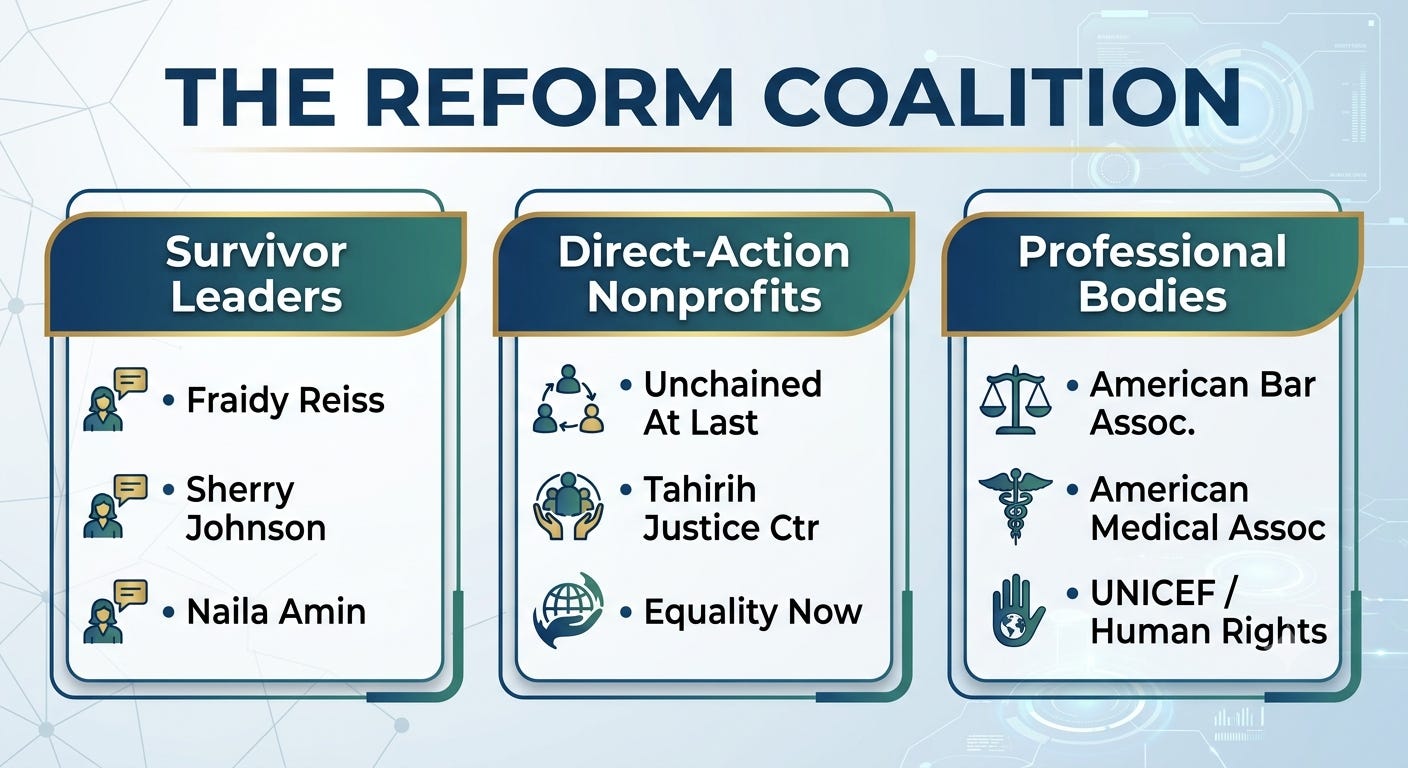
Fraidy Reiss & Unchained At Last
After escaping an abusive forced marriage, Reiss founded Unchained At Last, authoring model legislation that helped make Delaware and New Jersey the first states to ban child marriage entirely in 2018. As of 2026, 17 states have eliminated all child marriage exceptions.
Sherry Johnson
Married to her 20-year-old rapist at age 11 in Florida, Johnson’s public testimony exposed the reality of statutory rape loopholes, spurring legislative overhauls across the nation.
Naila Amin
Forced into an underage marriage at age 14, Amin championed “Naila’s Law” in New York, helping lead the state to a complete ban in 2021.
The Tahirih Justice Center & Equality Now
These organizations provide free emergency legal assistance, draft comprehensive state scorecards, and push federal legislation to close visa and statutory loopholes.
Opposition to complete child marriage bans comes from several disparate ideological fronts.
Parental Rights and Conservative Religious Lobbies
Groups such as the Family Research Council, state family policy councils, and conservative legal funds argue that state age floors infringe on parental authority to guide their children’s domestic and moral decisions.
Anti-Abortion Coalitions
Organizations argue that marriage must remain accessible for pregnant teens, asserting that bans could encourage minors to seek abortions rather than carry pregnancies to term within a two-parent household.
Civil Liberties Concerns (The ACLU)
In specific state debates (such as California), the ACLU opposed blanket bans for 16- and 17-year-olds without judicial review, raising concerns over infringing on a mature minor’s fundamental right to marry or pursue early legal emancipation.
Insular Defense Trusts
Polygamist sects and insular communities funnel internal communal wealth and tithes into local land trusts and specialized legal defense funds to retain municipal autonomy and resist state-level oversight.
The movement to eradicate child marriage represents a crucial shift in how society balances parental authority, religious freedom, and human rights. By dismantling statutory loopholes, closing judicial exceptions, and holding perpetrators accountable, survivor-led advocacy is successfully stripping away the legal veneer that once protected abusers, ensuring that state law protects children rather than the institutions that exploit them.
Primary Research & Empirical Data
Unchained At Last: Child Marriage in the USA Data Study: A landmark empirical investigation analyzing nearly 300,000 cases of child marriage in the United States, detailing age distributions, state-by-state prevalence, and spousal age disparities.
Tahirih Justice Center: Falling Through the Cracks Report: An exhaustive nationwide legal audit detailing the statutory loopholes—such as parental consent waivers, judicial sign-offs, and pregnancy exceptions—that permit minor marriage across state jurisdictions.
Human Rights Watch: U.S. Child Rights Scorecard: A comprehensive policy analysis grading all 50 U.S. states on their legal protections against child marriage, hazardous child labor, and juvenile justice abuses.
Legal Resolutions & Policy Directives
American Bar Association: Resolution 605 Policy Adoption: The ABA’s official policy directive calling on federal, state, local, and tribal authorities to establish 18 as the strict minimum marriage age without exceptions.
Tahirih Justice Center: U.S. Child Marriage State Loophole Analysis: Policy tracking and statutory legal analysis monitoring active state legislation, judicial exceptions, and statutory reforms.
Advocacy & Survivor Support Organizations
Unchained At Last: The primary U.S. direct-service nonprofit providing pro-bono legal assistance, emergency relocation, and social services to individuals escaping forced and child marriage.
Tahirih Justice Center: A national legal advocacy network offering trauma-informed legal services, policy reform advocacy, and protection for survivors of gender-based violence and forced marriage.
Zonta USA / End Child Marriage Campaign: A national legislative action network partnering with survivor advocacy groups to eliminate statutory marriage exceptions across individual U.S. state legislatures.

Help us grow by advertising your business in our newsletter and reaching an engaged community.

Comments
Nothing yet. Say the first thing.
Sign in to join the conversation.