
What if a large fund asked “what’s the ROI on a percentage (%) gain in a stock price?”
My assumption is that if a stock changed some 7% to 9% a year, then the ROI on the price momentum is zero. However, what if the price gradually kept increasing, leading to a 15% gain over a few months?
In this case, markets may pick this up and reflexively accelerate the momentum. We get the classic “The stock is up on the news that the stock is up” scenario, and the premium is increased from 2 years to 4-5 years. At this point, the fund that took the risk early may find itself having created momentum just by bidding up the price. An ROI curve starts appearing and funds can use simulations to test the highest payout entry. Conversely, they can estimate the ROI curve decelerating, at which range injecting more liquidity does not further increase momentum.
Everyone knows the name for this phenomenon for small caps: the classic pump and dump. However, the underlying assumption is that this can’t happen with large cap stocks.
Well, why not?
In recent years, the trading landscape has changed, funds have a lot more liquidity at their disposal, and arguably some of them may have enough to influence the momentum of large cap stocks. My hypothesis is that they wouldn’t be looking to raise the price by 15% randomly, but instead look for stocks that have momentum kick-off markers, and invest just enough to get it going. This would severely reduce the capital required to jump-start a cascading momentum acceleration.
In order for this to happen, there are be some key factors to consider:
The stock must not be a value stock, as the risk of fundamental deterioration breaks the whole experiment. Unless you can find the value to growth inflection, value stocks may be easier to jump, but much harder to maintain momentum.
The stock must be priced above intrinsic value, ideally around a 1-year target price.
The fundamentals must be consistently growing, ideally at an excess ROIC (this is a fundamental tailwind).
The stock must have a history of beating expectations – when this comes from the sell-side it tends to be a decoy signal, but it does serve as good marketing and bait for investors.
Large and mid caps are harder to influence, but have much more liquidity than smaller stocks, which may mean that reflexivity can self-reinforce at a faster pace.
There must be a sufficient social media coverage to create FOMO and herd behavior. Large investors are just as, if not more susceptible to herd mentality as their clients will demand explanations for the question of: why are we “obviously” leaving money on the table when our counterparts have been profiting from this name in the last year? Note, the distinction between a real answer to this question and a coping strategy for losers is hard to answer with honesty, hence why many investors chose to go with the herd. The explanation a portfolio manager can give is always counter-intuitive to the “reality” on the ground, making it harder for partners to accept.
Investors must believe that they are being rewarded for taking on risk – as a counter to the dissonance of investing in stocks in which they are unable to fundamentally pencil out any upside.
Capital must be deployed over a longer period of time, with each iteration reinforcing the ROI curve, avoiding peer or regulatory suspicion, and demoralizing the psychological objections of any fundamentally-driven counter arguments. That is, “the pump will continue until morale improves”.
Buyback programs are a stimulative factor.
Examples of where I suspect to have been the case are:
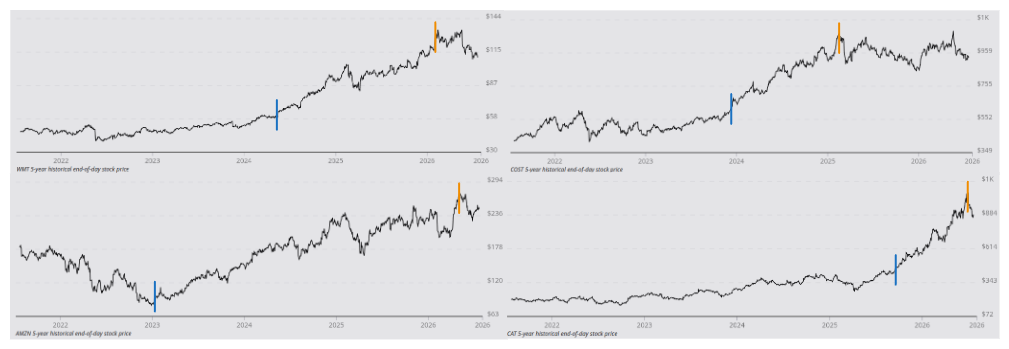
Walmart (WMT), starting May 2024, ending February 2026. These investors don’t sell.
Costco (COST), starting December 2023. These investors really don’t sell.
Amazon (AMZN), starting May 2023, ending January 2025. Has the potential to repeat as fundamentals (growth prospects) are getting strong for AMZN.
Celsius (CELH), starting June 2022, ending March 2024. More retail involvement, hence higher variation.
Caterpillar (CAT), starting May 2025, ending June 2026. One of the latest instances.
Note, that I didn’t include the current semis cycle, because I view it as organic momentum, and not a stimulated one.
With the exception of CELH, starting in 2022, I have analyzed every one of these stocks in-depth. All of them were already priced for a 2-3 year premium, and the momentum exacerbated their valuations to a 5+ year premium, at which point any sane forecaster stops and turns it over to strategy. Walmart had some fundamental justification for the jump initially (due to the large value-add effect of incremental operating margin expansion), but even that stopped making sense after November 2024.
In my view, starting in 2021 up to 2024, funds had more of an available cash problem, than a liquidity shortage, which may have allowed some variation of my hypothesized momentum acceleration strategy. Pumping a large cap stock may be still out of the question, but we may have witnessed cascading momentum acceleration when trading the right pressure points over a few-month period.
Recently the mantra to describe investing in some names has been “fundamentals don’t matter”, but I think a more appropriate description is “hijacked momentum stocks”.
Please note that all of this is my hypothesis/opinion on questions I consider to be highly relevant in explaining some of the market dynamics at play.
No posts
Comments
Nothing yet. Say the first thing.
Sign in to join the conversation.