
Originally published on ThinkValue.co
Andy Jassy, the CEO of Amazon (AMZN) published his 2025 shareholder letter where he outlines his vision for the company’s future.
There are a few areas where Amazon has the most potential to thrive:
Improved AWS economics due to custom chips
Robotics
Logistics drones
Satellite internet
Same-day groceries
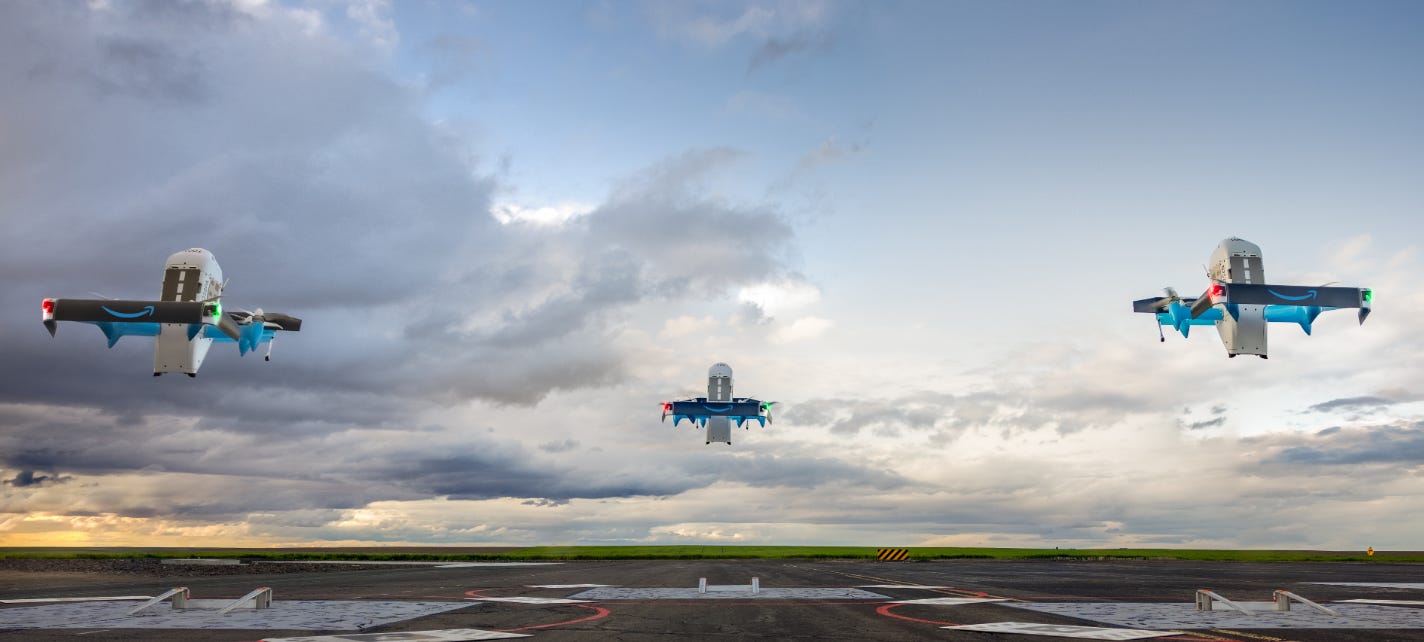
In my view, Amazon is well positioned to deliver high-stakes innovation in robotics and data-centers. Their infrastructure and know-how in these fields separate them from competitors that are just entering the race.
Most of the industry still relies on NVIDIA GPUs for data-center AI workloads (training and inference). These present a high cost for companies that are competing in AI, and is a key reason why some competitors including Amazon have started designing their own specialized chips for AI. While NVIDIA remains the performance leader, the in-house designed Trainium chips chips have turned out to be an affordable alternative with Trainium2 delivering “about 30% better price-performance than comparable GPU”, and Trainium3 delivering a 30% to 40% better price to performance on top of that. Both series are close to fully subscribed and the company maintains overwhelming demand, while Trainium4 is some 18 months from general availability.
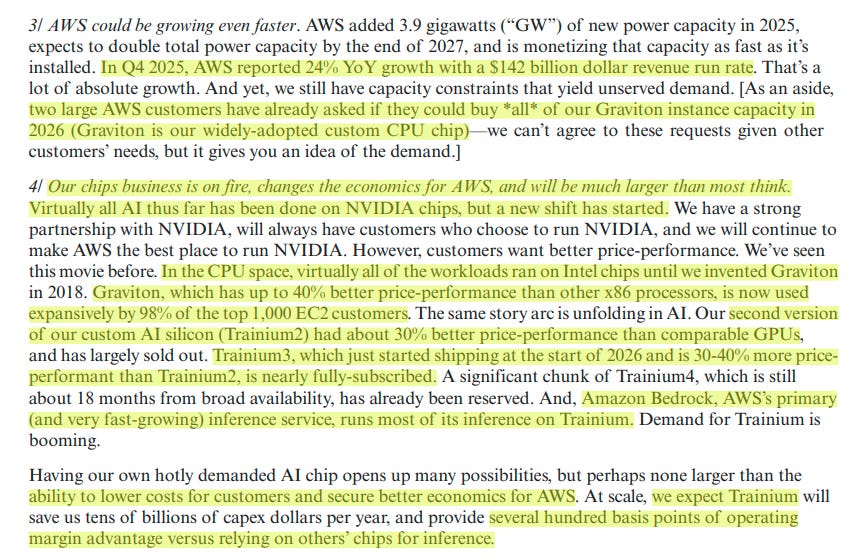
Custom silicon design is an innovation avenue and one that more companies are moving towards. Having this process in-house also allows them to iron out performance for their use cases, something where general manufacturers like NVIDIA lack the error-correction mechanisms.
As an infrastructure (IaaS) play, data-center services are purchased by customers who already have a real use-case. In contrast to someone like META, they have to get both the AI architecture and end-customer product right, which doubles their execution risk. AWS on the other hand has to work wit customers and provide compute capacity that is more economic than GCP or Azure. Every point of excess efficiency accrues towards AWS, while customers pay market rates for the services. The infrastructure model, also mitigates the risk of providing AI and general data-center services to low-ROI ventures such as serving casual customers for informative and education queries as tends to be the case for ChatGPT. In contrast to this, Anthropic, which also uses AWS services is moving to B2B with and targeting enterprise-level customers.
AWS also heavily relies on CPUs for general purpose compute services. This is where Graviton comes in. A custom designed, ARM-based CPU delivering superior price/performance for customers. The chip is primarily used in EC2 instances (VMs), but also available in Lambda and other AWS services. Most of the benefits come from the ARM-based architecture which was primarily used in mobile devices but is now becoming popular for server infrastructure.
Initially, AWS was monetizing the CPU chips via its cloud compute (EC2) services, however the Graviton chips are becoming popular for on-premise deployment and the company is opening the possibility to sell the physical racks with the chips to customers.
Mr. Jassy also pulled the “Ellison” in his remarks noting that “two large AWS customers have already asked if they could buy all of our Graviton instance capacity in 2026”, clarifying that this is not a request they can service. When things are set-up as such, asking for all of someone’s compute capacity is a no strings attached signal. In my opinion, this was unnecessary.
To put things in context, here is how Amazon performed in 2025:
Revenue: Grew 12% YoY to $717B.
Operating Income: Increased 17% to $80B.
Free Cash Flow (FCF): Decreased from $38B to $11B, caused by the $50.7B increase in Capex for AI infrastructure. Jassy frames this as a long-term trade-off for future FCF surplus. This FCF measure is lenient and organizations tend to use it in press releases, if you increase the scope of what constitutes CapEx and count SBC, the (levered) FCF for AMZN comes up slightly negative at -1.2B.
2026 Infrastructure Investment: Amazon plans to spend approximately $200B in CapEx in 2026, largely to build the power and data center capacity needed for AI.
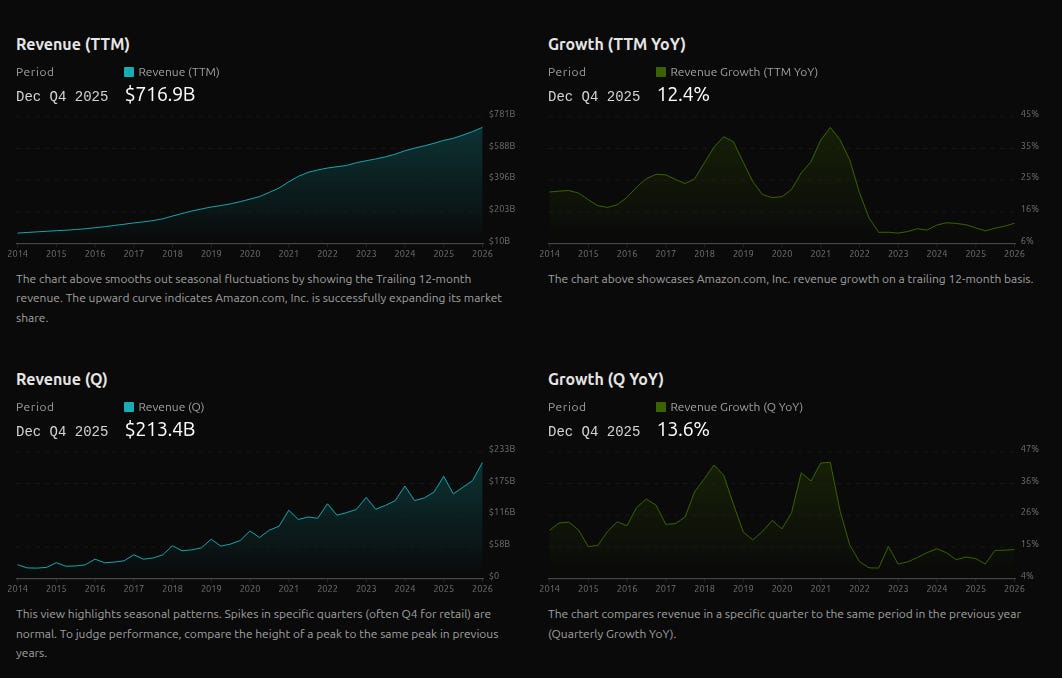
AWS also had a growth run, producing $128B TTM net sales, and $45.6B in operating income, picking up in Q4’25. AWS 2025 operating margin was 35.4%, which is significant even for a hyperscaler, and something that likely can’t be maintained without continued innovation.
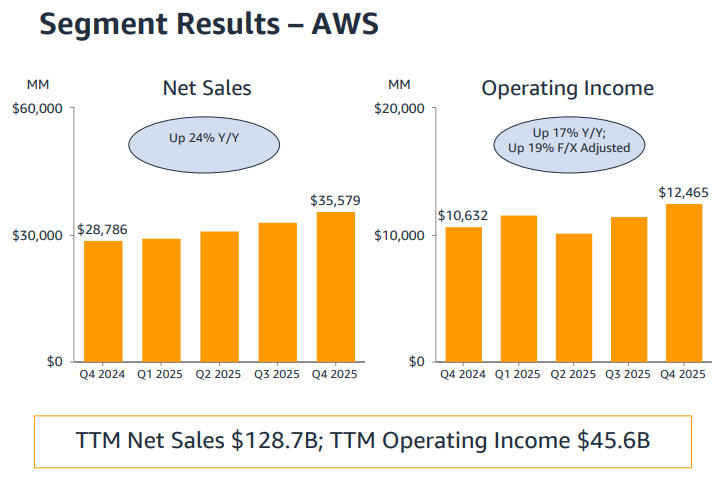
We can see that in the last Q4’25 quarter, AWS revenue growth accelerated to 24% YoY. All of these markers indicate that AWS is moving in the right direction.
Amazon is increasing the amount of robotics innovation it started within its fulfillment centers (warehouses) and is now expanding into delivery via drones. While individual robotics ventures will fail, Amazon and Tesla (TSLA) are the two companies that are now innovating on robotics that can open a wide field of application. When there is just one company pushing forward as was the case with Tesla and consumer robotics, most investors tend to be skeptical. However, now that Amazon is moving from warehouse robotics to delivery and industrial robotics, the field widens and even more competitors will have to enter the race.
While delivery drones started off as an edge case, they turned out to be the most innovative warfare vector. To that end, I expect that drone technology will continue being on the cutting edge of innovation, with interchangeable use cases in logistics and warfare. Amazon is well positioned to lead this avenue and improve the efficacy of their last mile delivery via drones. The drone avenue is not something to be implemented at a mass use case, but it does present an optionality that can yield future products and services.
Just as Tesla enabled internet connectivity from space via its low orbit satellite network (LOSN) service - Starlink, now Amazon is also going mainstream with its own LOSN called Amazon Leo (previously Kuiper).
The service is already making strides as Apple has chosen it to power satellite services for iPhones and other devices. Amazon announced an est. $11B acquisition of Globalstar in order to facilitate this expansion and enable Direct-to-Device services for customers.
While Tesla was the first to innovate enough to push the field to the mainstream, Amazon has a much larger distribution network and can use it to take market share from Starlink. If it was any other competitor but Tesla, the owner may have already packed-up due to Amazon’s notorious reputation to completely dominating a field it chooses to move into, but with Tesla the outcomes are always unpredictable so we are in for an interesting showdown.
Amazon started delivering non-perishables 20 years ago, but as their logistics systems improved and the company moved from 2-day delivery to same-day delivery, perishable goods like groceries suddenly became a viable business. The company now has grocery same-day delivery for 2,300 towns in the U.S. with $150B in gross sales in 2025, making Amazon the second-largest grocer.
The competitive landscape between Walmart, Kroger, Amazon and other retailers is going to heat up as companies move to eliminate the logistics friction for millions of customers in U.S. and beyond.
Two of the largest hurdles for innovation are bureaucracy KPIs, and making your manager look bad.
Amazon is notorious for having a short-term management incentive structure, hence why it is difficult to move and take risks. Arguably, if you as an employee have an innovation pitch, you should be shielded from your manager, and have the ability to pitch it somewhere else (to a dedicated office) where you can stake your reputation but be given a fair chance to try. It is speculated that many high-talent engineers are grinding in Amazon in service of the short-term bonus incentive for their managers, discouraging bottom-up innovation. This structure leaves the burden on innovation to be directed from the top and hope that the execution works out.
Jassy notes the example of Amazon Bedrock being completely refactored into Mantle by a spun off team of 6 engineers - A truly amazing story, but my suspicion is that this happens only because AI innovation is in FOMO mode, and thare are 100 Mantle-type ideas that have been suppressed by the corporate structure because the teams are not working in exciting fields and any innovation pitch is viewed as a risk to the manager instead of potential for the company. There should be 100 cases like the one with Mantle.
A quick mention on Prime Video: in my opinion, one of the worse streaming services. Customers are essentially paying for the privilege to browse, as everything good is a paid addon.
Amazon is now fiercely competing across multiple fronts including AWS, retail, robotics, internet, etc. Investors that believe that it can execute on these and future growth avenues will likely find Amazon to be an attractive, investors that are looking for cash flow returns now are going to have difficulty pulling the line from the financials to the current market valuation. In the past few years, it seems that sentiment reflected the investors of the latter kind, but now we are slowly learning to trust the new leadership of Amazon not because Jassy is legendary, but because Amazon is large enough and has the foundation in place to deliver on big dreams.
Below is my 10-year DCF model for AMZN:
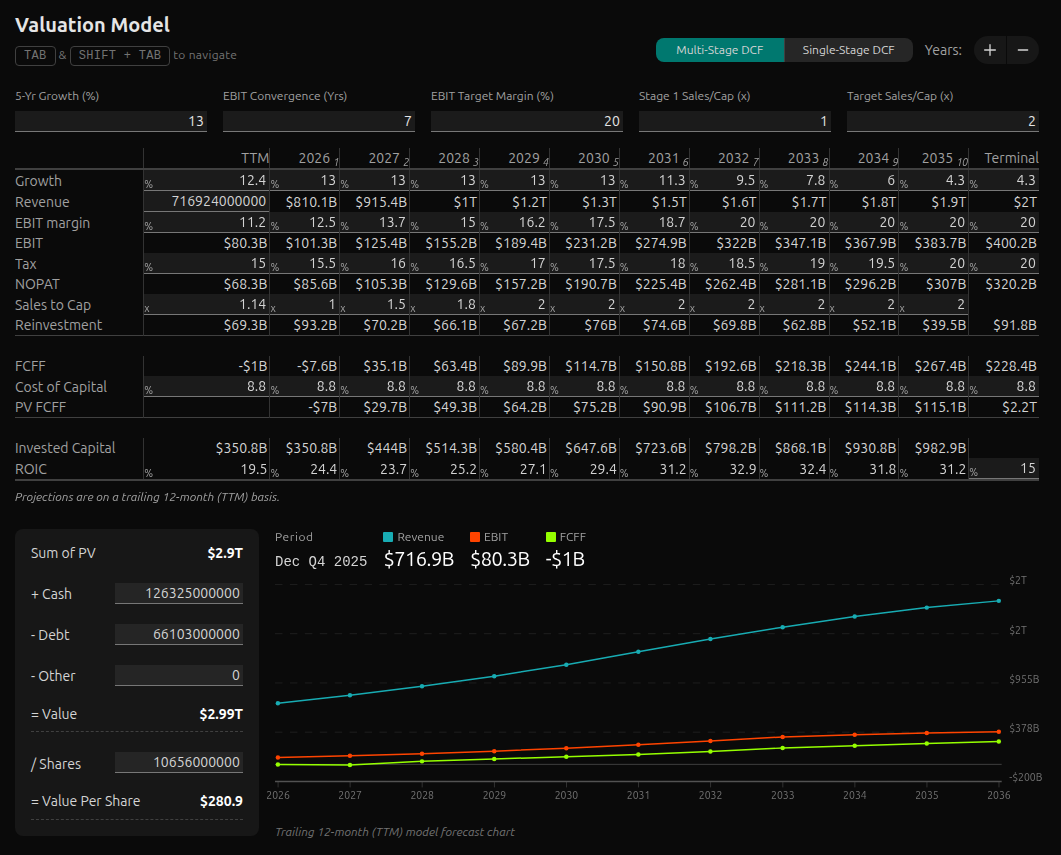
Even with the re-pricing of Amazon in the last few days, I am still optimistic that the company can deliver and is growing in the right direction.
No posts
Comments
Nothing yet. Say the first thing.
Sign in to join the conversation.