
I don’t know Josh Widdicombe’s wife. But I assume life as a successful interior designer married to a successful tele comic is pretty good, as glossy magazine editorials of the couple’s two well decorated mansions on the south coast attest. There is trouble in paradise though: she cannot get a driving license for love nor money.
“Someone needs to sort out this test situation. I know it’s not national priority but it’s literally almost five years since Covid and there’s still this insane backlog. I was talking to someone the other day and they have to go on every Monday at 6am - it’s like Glastonbury tickets - to try and get a cancellation.”
–Josh Widdicombe on Parenting Hell, 28th July
The situation has become a running gag on Widdicombe’s podcast, which charts in the top ten in Britain. Rose, his partner, has been learning to drive for three years and counting, waiting for a test. She is far from alone.
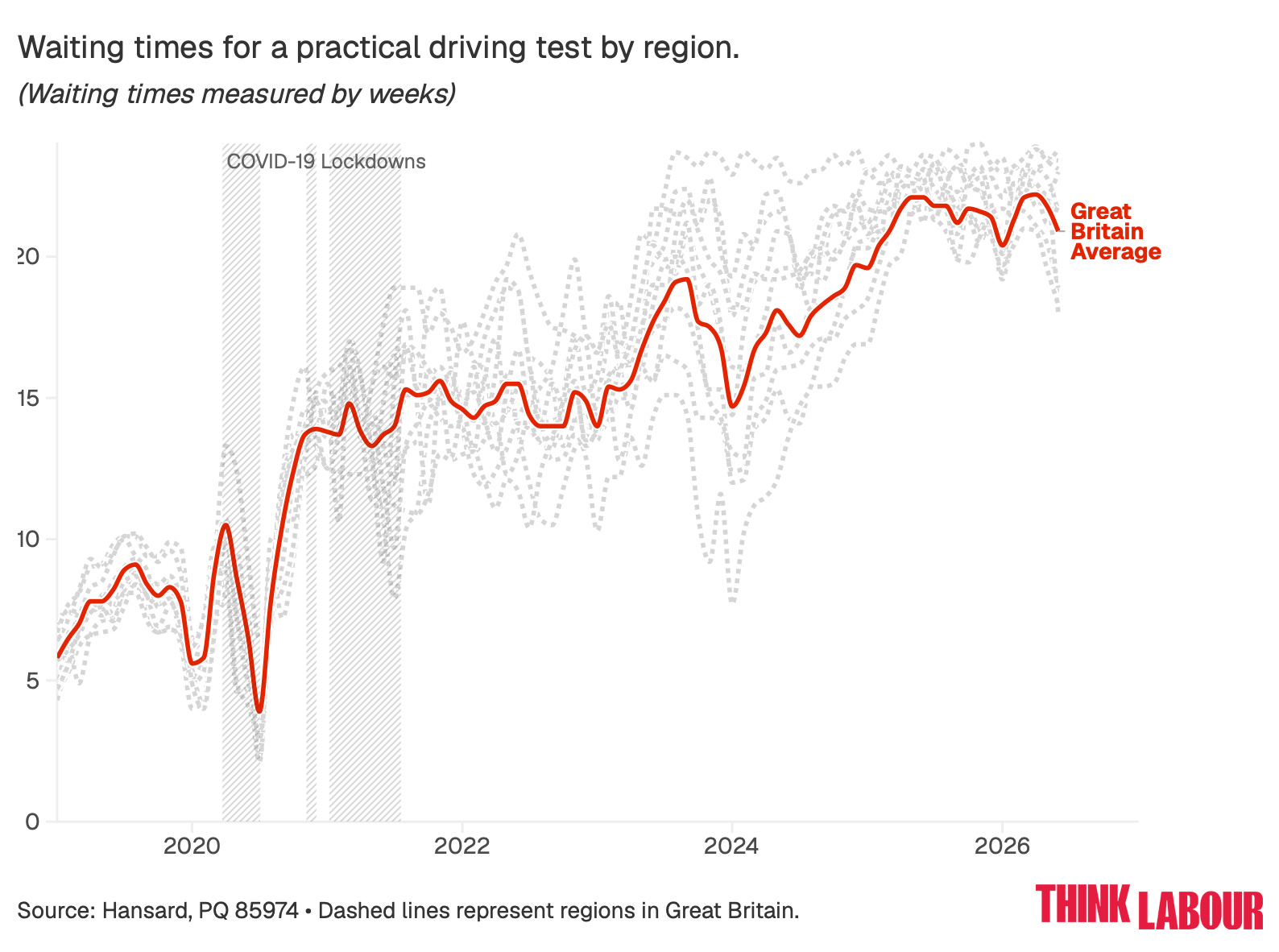
Every Monday morning thousands join a digital queue for the chance of securing a test slot in six months’ time, in a test system that has been broken since the pandemic. Much like for Glastonbury tickets, a resale market sprung up, offering tests for up to £500. The backlog affects roughly a million people a year.
That it is so hard to get a driving license, is, unsurprisingly, bad not just for the families of successful comics. It’s especially hard on young people, for whom lack of a license hampers access to work and education (ever heard of the NEETs crisis?). Fully a third of learners say they are learning to drive for a current or future job, reports the DVSA, the arms length body responsible for driving tests.
Both how the backlog happened and how to fix it are questions of basic arithmetic. The Covid lockdowns led to a backlog of wannabe test-takers. To fix this build-up in demand for tests, you need to supply more tests, presumably by hiring more driving test examiners. About 400 or so are required, the DVSA reckons.
Hiring 400 people to sit in the passenger seat as a trembling 17-year old attempts to parallel park shouldn’t, on the scale of the challenges the government faces, be so hard. Yet, six years on from the pandemic, it has so far eluded us. Over 19 recruitment campaigns since the pandemic, the DVSA managed to hire just 83 more driving examiners by December 2025, once you account for those who left the profession, according to the National Audit Office.
Why?
It comes down, bizarrely, to the politics of the cost of living.
You see, the price of a driving test hasn’t risen since 2009. Set in law at £62 by statutory instrument, it is a political choice to raise it. The Conservatives never did. Keeping the price fixed, presumably, was a tactic to make the DVSA more efficient and to avoid unpopular headlines (because no one likes higher prices).
That didn’t matter so much before the pandemic. Inflation was quite low during the 2010s so the DVSA could just about manage. But when the pandemic brought about both a backlog and an inflation spike, the DVSA didn’t have the resources to cope. From its driving test operations earning taxpayers millions annually, the DVSA now loses £44m on them: £24 per test. It couldn’t (and cannot) afford to pay examiners an attractive enough wage to hire more.
The most obvious way to fix the system would be to whack the price of a driving test up by 30 quid and hire some more examiners. But in a cost of living crisis, the political calculation of four successive post-pandemic governments is that such a price rise is impossible. The decree comes down from No10: We are a cost of living government now, you must not raise any prices your department is responsible for.
But keeping prices artificially low at the expense of a working test system costs learners far more – it keeps them out of work, it forces them to pay a scalper or for another six months of driving lessons. Nor is it based on evidence it’s what voters actually want.
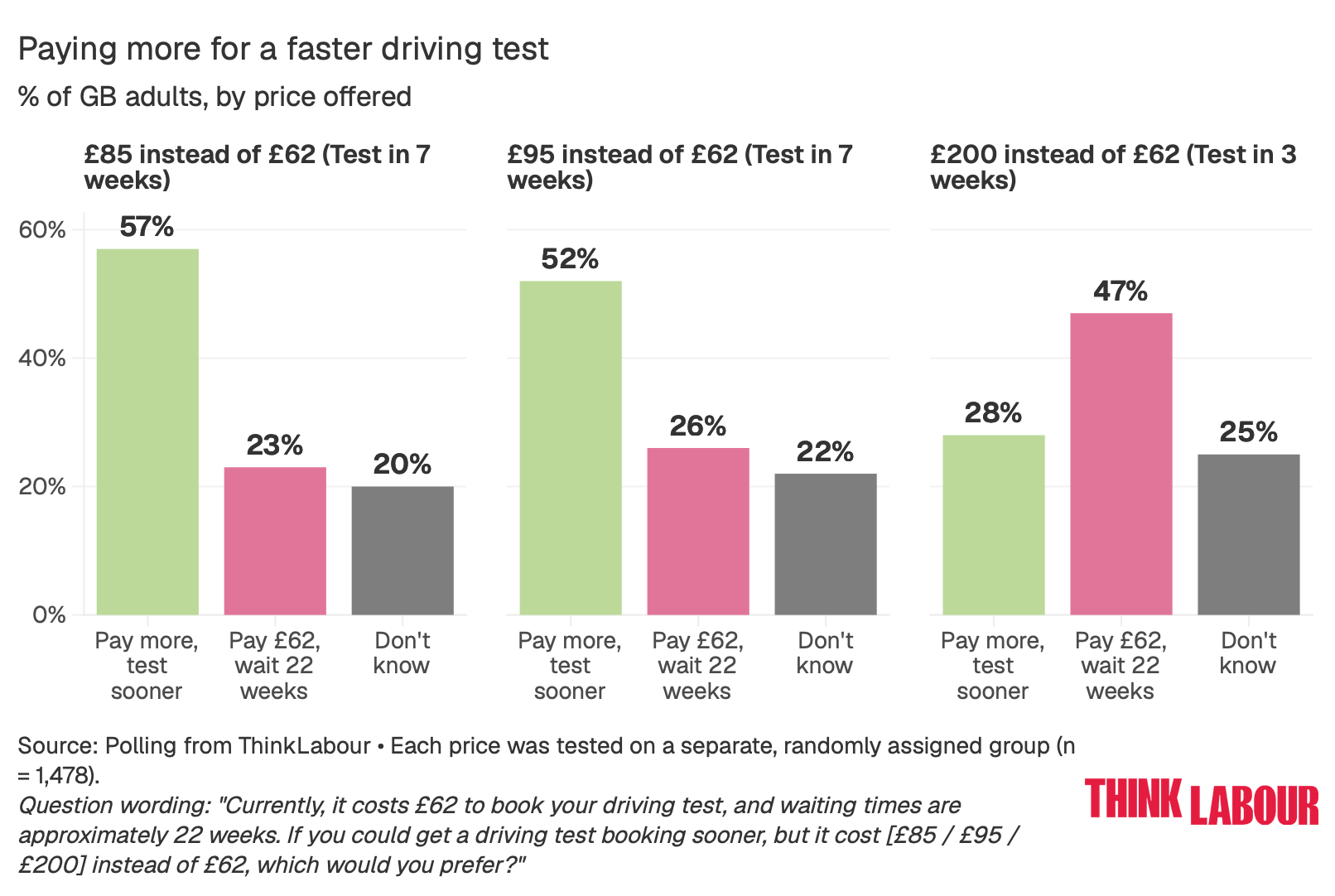
Here at ThinkLabour, we trust the public, so we decided to put it to a poll. We asked people whether they would be willing to pay more money (£85 or £95) to wait 7 weeks to take a driving test or to pay the current test cost to wait 22 weeks. The results were clear: most people said they would rather pay more than wait.
We may still worry that it’s politically difficult to raise prices while the system is still broken: even if you upped prices tomorrow, bringing waiting times down wouldn’t happen overnight (though it could happen quite quickly).
But our polling also suggests there are also ways to get creative.
28% of people said they would be prepared to pay £200 if it meant they only had to wait three weeks for a driving test. That’s not a majority by any means, so you’d struggle to raise the general price of a test that much, but it does suggest there’s a market for an express test option, by which people have the option of paying more than the standard price for a faster service.
Such a system already thrives elsewhere in government. The Passport Office runs one, whereby people can choose to pay more to get their passport sooner. If the DVSA did, the additional revenues could fund the additional examiners needed to get the system back on its feet–for more detail I’ve written a report separately for the campaign group End The Backlog setting out how here.
And it matches learners’ revealed preferences. Test resellers emerged precisely because a big portion of learners were prepared to pay £200, £300 or even £500 to get a test faster. The National Audit Office reported in December that a third of test-takers paid a test reseller rather than go through the official booking system (a result which nicely matches our polling!).
There’s nothing wrong with the government being concerned about the cost of living. But it should ask itself what it is really concerned with–headlines or results? Saving people money sometimes means raising prices, if only on the Rose Hansons of the world.
No posts
Comments
Nothing yet. Say the first thing.
Sign in to join the conversation.