
Party members sometimes get a bad press. Less than 2% of the UK population belongs to a political party. They are the sort of people whose idea of a fun Saturday morning is earnestly asking bleary-eyed students in their pyjamas what they think about the council’s new wheelie bin scheme. They are far more politically engaged than the average voter and are widely seen as being more ideological than even their party’s voters, let alone the public as a whole.
This summer, Labour members did not get the opportunity to express their views in a leadership contest as Andy Burnham was the only candidate nominated. Some would argue that was no bad thing, given that party members have often been accused of pulling leadership candidates towards positions that later prove electorally difficult.
Yet our latest ThinkLabour polling shows that the current Labour membership is strikingly pragmatic on many of the most politically contentious issues the new government will face.
That should not perhaps come as a complete surprise. The membership itself has changed substantially over the past six years. In the 2020 leadership election, Keir Starmer secured 56% of members’ first preferences. Today, supporters of Starmer make up 70% of those members who voted in the 2020 election, while those who backed Rebecca Long-Bailey have fallen from 28% of members to just 12%. Many of the party’s most left-wing members have clearly left in the intervening years.
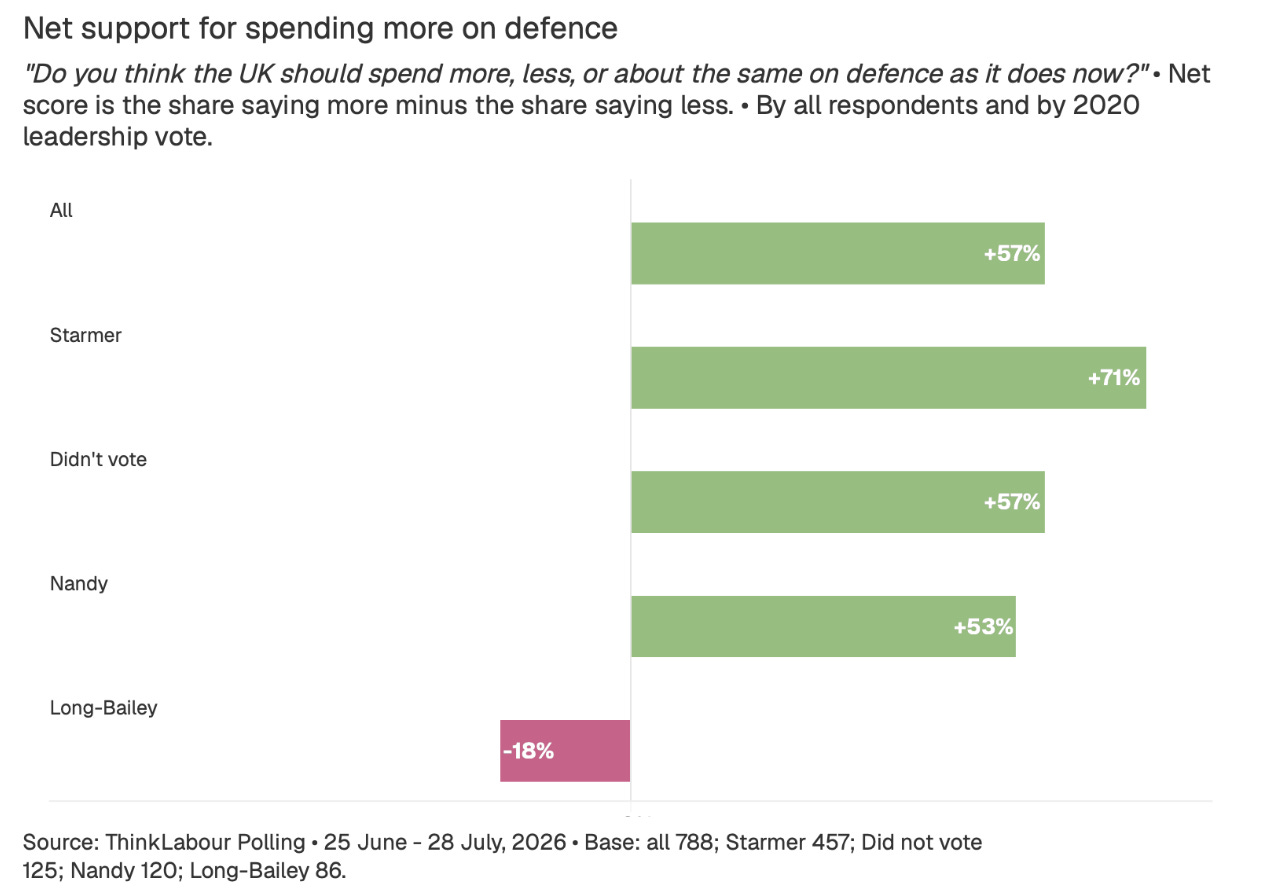
So when we asked party members about their attitude towards defence spending we found that a large majority supported increasing defence spending. At a time of heightened international instability, and against the immediate background of the crisis in Iran, more than two-thirds (68%) think Britain should spend more on defence, while only 11% think spending should be reduced. Among those who support higher defence spending, 54% think the money should come from higher taxes rather than additional borrowing or cutting spending on other things. And when we probed into what “other things” those members who said they preferred cuts were actually prepared to spend less on, 56% selected welfare and benefits, while 32% favoured further reductions to overseas aid. Just 8% wanted cuts to public services outside the NHS.
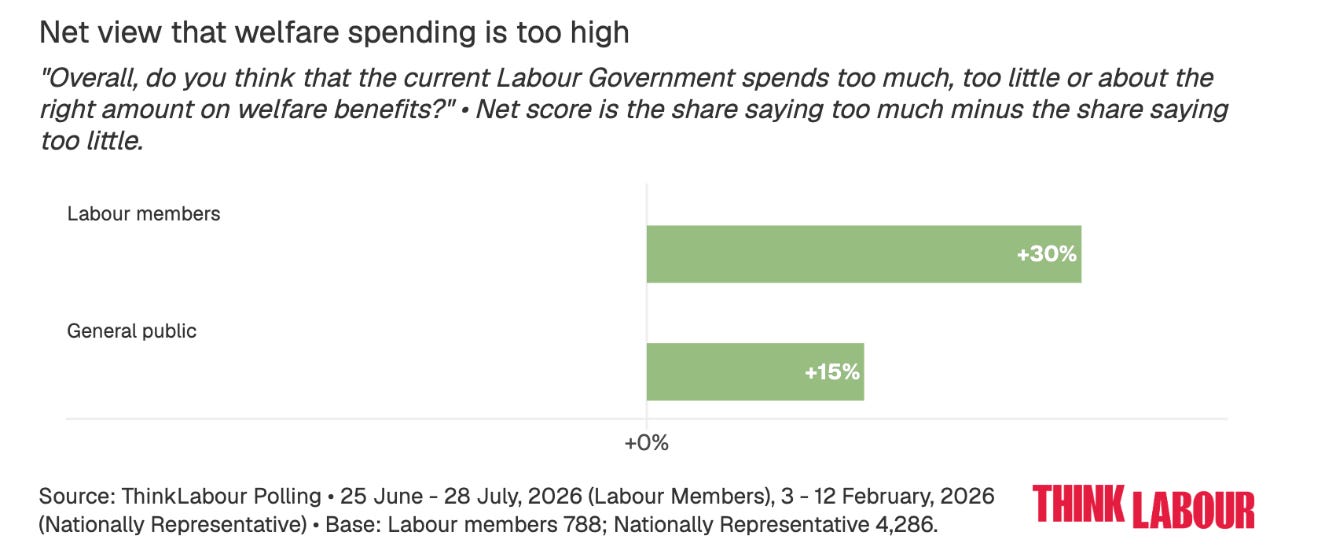
Perhaps the most surprising finding concerns welfare. Contrary to the public image, Labour members are actually more likely than the public as a whole to think welfare spending is too high. In our polling, 51% of members with an opinion, thought the government spends too much on welfare, while only 21% thought it spends too little. By comparison, polling of the wider public earlier this year found that 42% thought the government spends too much on welfare benefits (excluding “don’t knows”). Perhaps this unusually pragmatic membership recognises the political danger that unreformed welfare spending poses to the Labour government, and is therefore more willing to contemplate difficult choices.
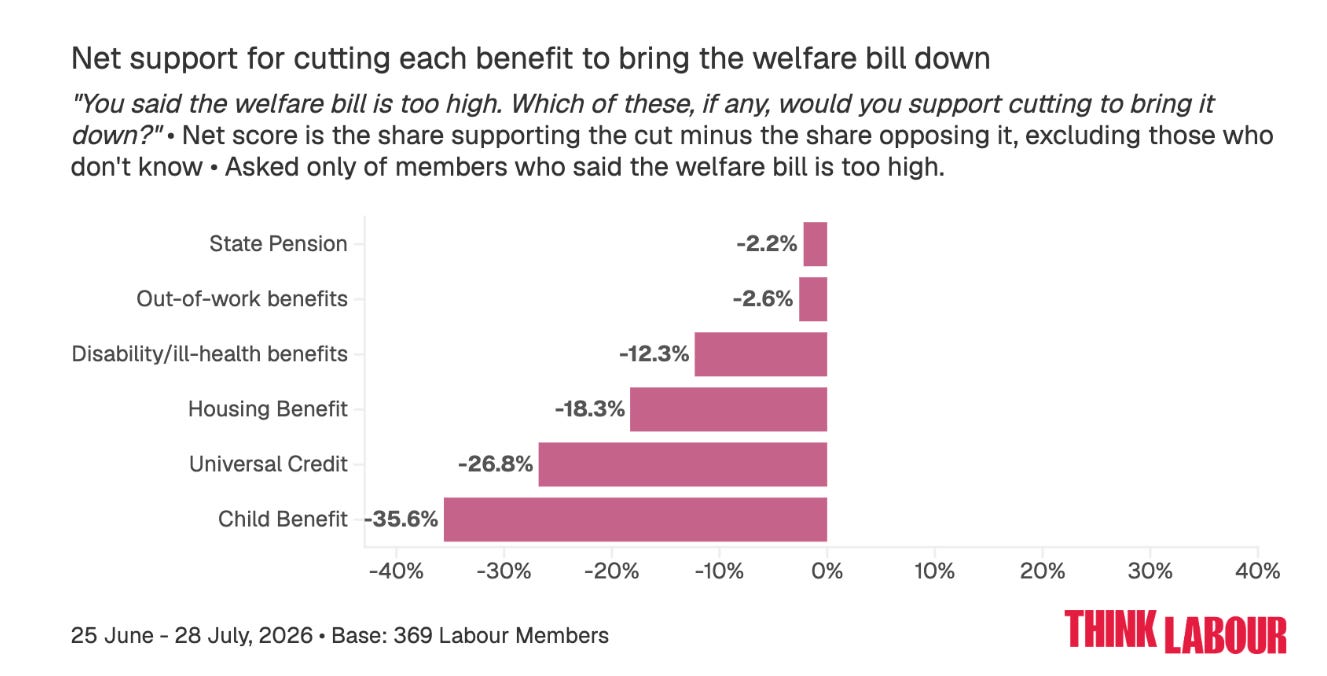
However, when we asked those who supported cuts about which individual benefits they would spend less on, more members opposed than supported every proposal we tested. They were especially opposed to cuts to Child Benefit, with 60% opposed and only 25% in favour. But the narrowest gap between opposition and support was on the State Pension. While 43% opposed pension cuts, an unusually high 41% said they would support them.
This preference was confirmed when we asked which area of the welfare system should be protected most from cuts. Labour members tended to prioritise disability and ill-health benefits, with 26% choosing these benefits, compared with only 18% who selected the State Pension. It is striking that protecting the pension was a relatively low priority, given that polling consistently finds large majorities of the general public want the State Pension triple lock protected. It is also surprising given the age profile of the membership itself. In our sample, almost two-thirds (63%) were aged over 55. Our findings do, however, mean that to win the approval of members, any cuts to disability and ill-health benefits will have to be seen as fair.
Finally we asked the membership about social care, which Andy Burnham has made clear that he personally is committed to reforming. Two thirds (67%) believe the current funding system is unfair, while 73% think government should spend more on social care even if doing so costs more.
Asked how that additional spending should be funded, among those who said we should spend more on social care, opinion was divided. A plurality (43%) favoured higher taxes on higher earners alone, but almost as many (39%) were prepared to support increases in general taxation. Very few wanted social care funded through cuts elsewhere in government, higher council tax or increased taxes on business.
Andy Burnham will face a series of extraordinarily difficult and painful choices as Prime Minister. Defence, welfare and social care all involve significant fiscal trade-offs. The encouraging message from our polling is that Labour’s current membership appears much more pragmatic than it is often given credit for. With Reform UK likely to be Labour’s principal opponent at the next general election, members appear determined to prioritise the party’s electoral survival above all else.
This polling and some other information on what’s happening at ThinkLabour was covered in the Guardian last week, I would recommend giving it a read!
No posts
Comments
Nothing yet. Say the first thing.
Sign in to join the conversation.