
Leadership does not suffer from a shortage of models. Transformational leadership, servant leadership, authentic leadership, adaptive leadership, emotional intelligence, psychological safety, and a long list of X-leadership theories have all made real contributions. I identified nearly thirty of them in my own leadership research in the 1990s.
So any claim that AI needs another leadership framework has to earn its keep. The burden of proof is not novelty; it is changed conditions.
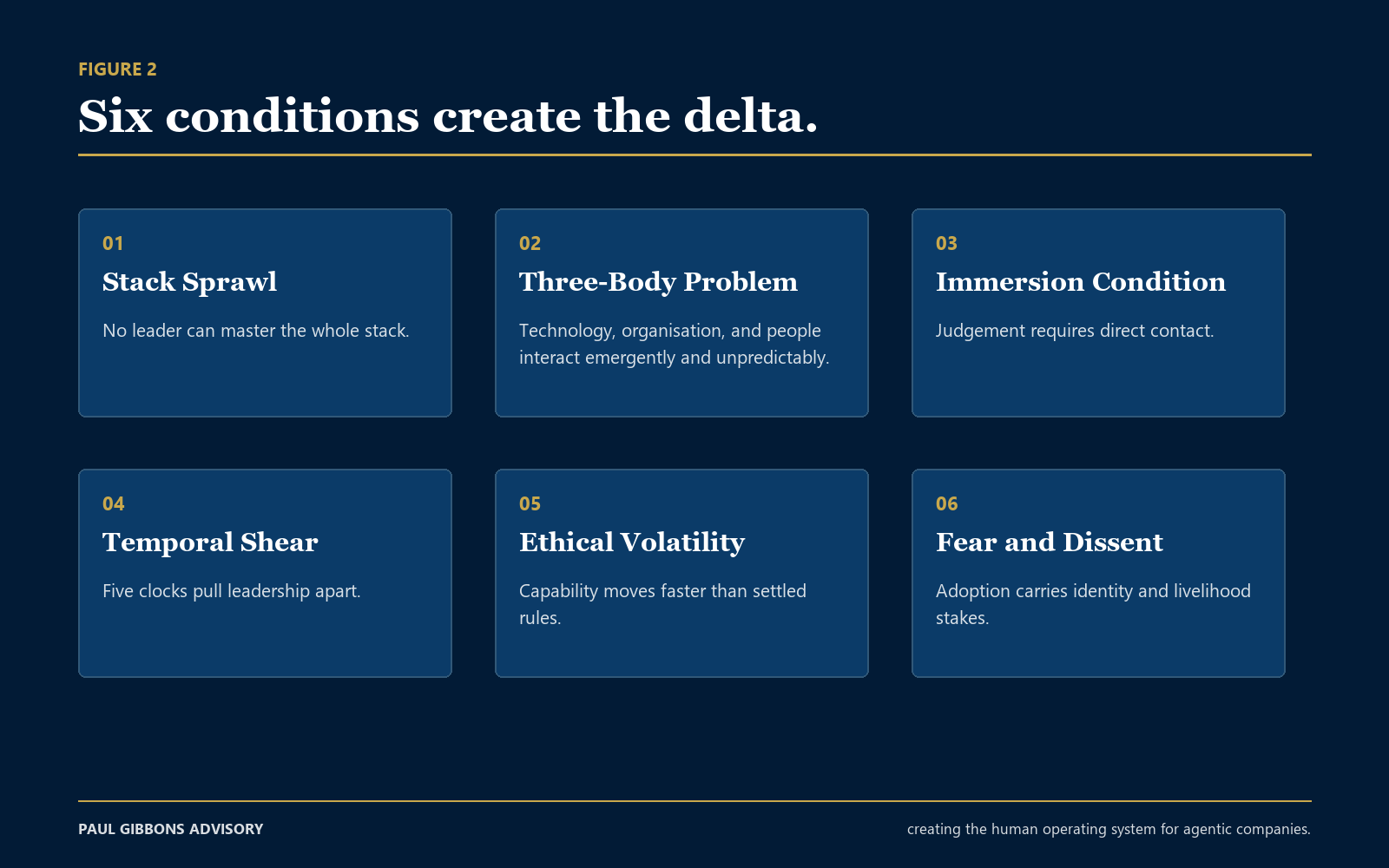
My argument in The AI Leadership Delta is that the conditions have changed. AI is not simply another enterprise technology to be rolled out: it can generate, recommend, decide, and act with partial autonomy. It spans technical layers no executive can master alone, creates ethical questions faster than many governance systems can answer them, and unsettles expertise, identity, trust, power, and the meaning of work.
Established leadership models remain valuable. Their relational axis is more important than ever: trust, psychological safety, meaning, and innovation climate are load-bearing. But relational capability alone is no longer enough.
TWO AXES, NOT ONE
AI demands strategic judgement that many leadership models address only partly:
🧭 Make build-or-rent decisions under uncertainty
⚙️ Sequence augmentation and automation
⚖️ Govern while regulation is still moving
🛠️ Develop direct contact with the technology
🧪 Practise build-test-kill discipline
🧱 Orchestrate people, process, evidence, and tools as one system
That is the gap between the leader you were trained to be and the leader this moment demands. The point is not to replace older models, but to locate what they still do well, identify what the AI moment adds, and turn that addition into observable practice.
The framework uses seven dimensions across three domains: Lead Self, Lead Others, and Lead System. It asks what leaders practise themselves, what they make possible in relationships, and what they build into the organisation.
The work is not to admire another framework. It is to change what leaders do.
The whitepaper is free for subscribers. Head over to paulgibbonsadvisory.com/publications for a free download.
Comments
Nothing yet. Say the first thing.
Sign in to join the conversation.