
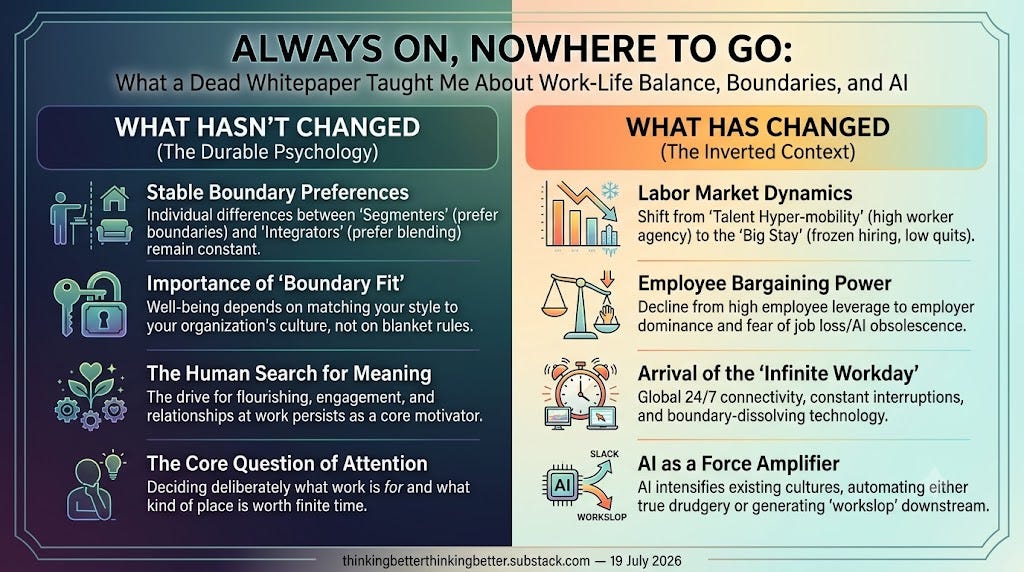
I recently exhumed a whitepaper I drafted in 2022, back when I was at IBM. It was about “talent hyper-mobility” — the idea that knowledge workers, untethered from geography, would enjoy the greatest surge in career agency in a generation. Workers could take a dream job 5,000 kilometres away without moving house. Employers in Chattanooga could poach from Silicon Valley. The war for talent would be won on purpose and culture, not compensation.
Four years later, nearly every prediction in that document has inverted. The quits rate, 3.0 per cent at its 2021 peak, has been frozen at [1.9 per cent for the better part of a year. Hiring, as measured by the JOLTS report, has slowed to levels last seen in 2010, when unemployment was near 10 per cent. Economists call it the Big Stay: low hire, low fire, nobody moves. The worker who could once field three offers from three time zones now clings to the job she has, wondering which of her tasks an AI agent will absorb next.
I could quietly bury the document and hope nobody ever finds it. Instead I want to do something more useful: ask which ideas in it survived the inversion. Because a few did — and they matter more now, not less. The half-life of labour-market predictions is about eighteen months. The half-life of the psychology underneath them is measured in decades.
Misgivings about “work-life balance” have circulated for years. Every article promising the working world’s nirvana is matched by one calling it a myth. So we got alternatives: work-life *integration*, work-life *blend*, work-life *harmony*. The US Chamber of Commerce defines integration as handling personal and professional responsibilities “at the times that work best for them” — interspersed through the day, no hard line between the two.
I am sceptical that channelling our frustration into semantics helps. A draining job does not become less draining because we update our metaphors. Rebranding balance as harmony is the linguistic equivalent of throwing a retention bonus at a toxic culture — it addresses the label, not the thing.
But beneath the branding exercise sits real research, and it points somewhere more interesting. Since 1996, organisational psychologists have distinguished two ways people manage the border between job and life.
Integrators prefer a seamless blend — the school run between meetings, the inbox on holiday, work and life as fibres in one weave.
Segmenters want walls — separate phone, separate desk, a hard stop at six. Most of us sit somewhere on the spectrum between the two, and where we sit is a fairly stable individual difference, not a failure of discipline.
My favourite study in this literature examined Episcopal priests — people whose “employer” is, in the most literal sense, always watching. Kreiner, Hollensbe, and Sheep found priests being approached for confession at the petrol station, in the supermarket, mid-errand. Even those with a sacred calling — the ultimate “purpose, not a paycheck” — had to build boundaries to preserve their sanity. If the clergy need to segment, perhaps your employees are allowed to as well.
The practical upshot is what Kreiner calls boundary fit: wellbeing depends less on which style you have than on whether your workplace lets you live it. A segmenter in an always-on culture suffers. So does an integrator under a rigid nine-to-five. This single finding demolishes most corporate wellbeing policy, which insists on solving an individual-difference problem with a blanket rule.
Here is what my 2022 draft got right for the wrong reasons. I argued that when labour markets are static and workers cannot move, they “suck it up” — they rationalise, settle, and stop asking dangerous questions like *what do I really want from work?* Ruminating over what you cannot change is corrosive; adaptation is the sane response. Mobility, I argued, was the solvent: when workers could leave, employers would finally have to compete on culture.
Then mobility went away. The logic, however, did not.
In a frozen market, the bargaining power that made work-life boundaries defensible evaporates. The worker who might once have declined the 8 p.m. meeting — because a recruiter called every week and her employer knew it — now weighs that refusal against a hiring rate at fifteen-year lows. Gallup’s most recent global data show engagement falling to 20 per cent, its second consecutive annual decline. Managers, the people meant to protect their teams’ saw their boundaries fall fastest. The Big Stay is not contentment. It is people gripping the rail.
And into precisely this moment — maximum employer leverage, minimum worker exit — arrives the most boundary-dissolving technology since email.
The infinite workday
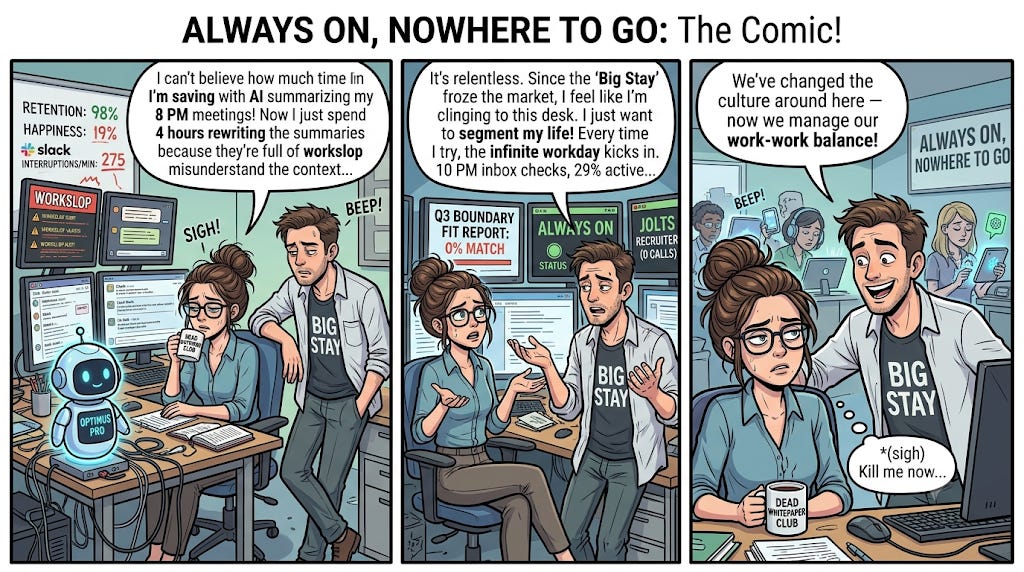
Microsoft’s telemetry across its 365 platform gives us something the balance debate rarely enjoys: measurement. Their 2025 Work Trend Index describes what they call the “infinite workday”: meetings after 8 p.m. up 16 per cent year on year, the average employee interrupted every two minutes — 275 times a day — and by 10 p.m., 29 per cent of active workers back in their inboxes. The average user now receives 58 chat messages outside core hours. Half of employees describe their work as chaotic and fragmented.
Read that alongside the boundary research and a diagnosis suggests itself. The infinite workday is an integrator’s world imposed on everyone, including the roughly half of humanity wired to segment. We have built a working rhythm that matches one boundary style, universalised it, and then wondered why burnout metrics look the way they do.
Legislatures have noticed. France legislated a right to disconnect in 2017; Portugal attached fines of up to €9,690 per violation. Australia’s law, was prompted in part by Australia Institute research finding employees averaging 5.4 hours of unpaid after-hours work per week. I favour these laws the way I favour speed limits — necessary, insufficient. You cannot legislate a culture into respecting time off; you can only make its disrespect slightly more expensive. The laws are best read as a symptom: when boundary-setting has to be outsourced to parliament, the labour market has stopped doing the job.
Does AI make this better or worse? Yes.
The lazy answer is that AI worsens always-on culture. That is an oversimplification: AI is an amplifier, not an author. It intensifies whatever relationship with work an organisation already has.
Start with the worsening case, because it is currently winning. Researchers at BetterUp Labs and Stanford coined the term “workslop” for AI-generated output that masquerades as good work while lacking the substance to advance the task. Their survey of US workers found 41 per cent had received workslop in the prior month, each instance costing nearly two hours of rework. — and, worse, recipients rated the senders as less capable and less trustworthy afterwards. AI here does not reduce work; it launders effort, shifting the cognitive burden downstream to a colleague. Always-on culture plus workslop is a particularly nasty compound: infinite availability to process infinite mediocrity.
Then there is the ratchet. When a task that took a day takes an hour, the rational firm does not bank the surplus as leisure; it raises the baseline. Content teams are expected to produce multiples of their pre-AI output; engineering sprint velocities get recalibrated upward. The technology removes the natural pauses that knowledge work once contained — the twenty minutes of formatting that doubled as cognitive recovery — and back-fills them with more cognitively demanding work.
Now the inconvenient evidence for the doom case. The largest careful study we have — Humlum and Vestergaard’s examination of 25,000 Danish workers across 7,000 workplaces — found AI chatbots had [no significant impact on hours or earnings in any of eleven occupations, with average time savings of about 3 per cent, a fraction of which was reabsorbed by new tasks. The lesson is not that AI does nothing. It is that AI does nothing *by itself*. The technology’s effect on your working life is almost entirely mediated by the organisation deploying it — which is another way of saying AI adoption is a human problem wearing a technology costume.
That is also where the hope lives. The same tools that generate workslop can also absorb real drudgery: the minute-taking, the status-chasing, the first drafts of documents nobody reads carefully enough. AI that summarises the 8 p.m. meeting so a segmenter need not attend it is a boundary technology. AI that makes the 8 p.m. meeting cheaper to convene is a boundary solvent. Identical capability; opposite cultures. The firms treating AI as a headcount-reduction device with a chat interface will get the infinite workday, intensified. The firms treating it as an instrument for redesigning work — deciding deliberately what the reclaimed hours are *for* — will get something rarer: slack, recovery, and the deep work that fragmentation killed.
From balance to flourishing
The most durable idea in my dead whitepaper came from positive psychology. In my work on human *flourishing* at work — the recognition that humans want more than an absence of overwork. They want engagement, relationships, meaning, and achievement, not merely a well-defended weekend. Researchers in the boundary literature have made the same turn: away from “how do we get to balance” and towards “how do we get to flourishing.”
I like this reframe for a reason that has nothing to do with positivity. “Balance” smuggles in a zero-sum assumption — two weights, one scale, every hour for work stolen from life. Flourishing permits the observation that good work is *part* of a good life, and lousy work poisons the other half no matter how firmly you disconnect at five. The priest who finds meaning in the petrol-station confession is not failing at segmentation; the accountant answering midnight emails about nothing is not succeeding at integration.
For organisations, the agenda follows from the evidence rather than the fashion. Stop solving culture problems with compensation — the research consistently finds culture vastly outpredicts pay in driving attrition, and toxic culture has roughly ten times the predictive power of compensation). Stop imposing one boundary style on a workforce that contains both types; boundary fit is cheap to offer and expensive to ignore. Treat after-hours contact as a design flaw, not a loyalty signal. And decide — explicitly, before the tools decide for you — whether AI in your organisation will compress the workday or colonise the evening.
For individuals, the frozen market counsels a colder realism. You may not be able to leave, for now. You can still know which end of the integrator-segmenter spectrum you occupy, negotiate for fit rather than for slogans, and refuse to mistake responsiveness for contribution. Markets thaw. The people who flourish on the other side of this one will be those who spent the freeze deciding what work is for — rather than letting an inbox, or an algorithm, decide for them.
The 2022 draft ended by declaring that Pandora’s box of talent mobility could never be closed. It closed. Boxes do. What stays open is the older question the mobility era briefly let workers ask aloud: *what kind of place is worth my finite attention?* No labour market, however frozen, and no technology, however clever, has yet managed to make that question go away.
---
Sources:
[BLS JOLTS May 2026](https://www.bls.gov/news.release/jolts.nr0.htm);
[Indeed Hiring Lab, May 2026 JOLTS analysis](https://www.hiringlab.org/2026/06/30/may-2026-jolts-report-more-of-the-same/);
[Microsoft Work Trend Index, “Breaking Down the Infinite Workday” (2025)](https://www.microsoft.com/en-us/worklab/work-trend-index/breaking-down-infinite-workday);
[Gallup, State of the Global Workplace 2025] https://www.gallup.com/workplace/708071/global-employee-engagement-continues-decline.aspx);
[Niederhoffer, Kellerman et al., “AI-Generated Workslop Is Destroying Productivity,” HBR (2025)](https://hbr.org/2025/09/ai-generated-workslop-is-destroying-productivity);
[Humlum & Vestergaard, “Large Language Models, Small Labor Market Effects,” NBER w33777](https://www.nber.org/system/files/working_papers/w33777/w33777.pdf);
[Kreiner, Hollensbe & Sheep, AMJ (2009)](https://journals.aom.org/doi/10.5465/amj.2009.43669916); Nippert-Eng, *Home and Work* (1996); [Sull, Sull & Zweig, “Toxic Culture Is Driving the Great Resignation,” MIT SMR (2022)](https://sloanreview.mit.edu/article/toxic-culture-is-driving-the-great-resignation/);
[DLA Piper on Australia’s right to disconnect](https://knowledge.dlapiper.com/dlapiperknowledge/globalemploymentlatestdevelopments/2024/the-right-to-disconnect-in-australia-what-we-know-so-far).*
Comments
Nothing yet. Say the first thing.
Sign in to join the conversation.