

Millennials are playing a lynchpin role - initiated on traditional fixed models, first frontline adopters of mobile flexible methods, often bridging generational gaps, now scaling with AI-enhanced tools, adapting to modern business dynamics. The dominant leadership group - as founders, executives, managers, investors - Millennials are gatekeepers to Gen Z’s futures. Gen Z are also vital contributors to business innovation. Hire and highlight young professionals to power growth.
“You can’t just pull the ladder up because it’s slightly cheaper in the short term.” — James McMahon, FDM Group, techUK panel on entry-level and graduate jobs in the era of AI, April 2026.
There’s a mindset shift on Wall Street about Gen Z’s potential contributions. This summer, incoming internships are not being viewed as multi-week reviews for hiring the next cohort of eager-but-mostly-ineffective employees.
Goldman Sachs will train interns on AI tools from day one. Citadel assessed AI fluency - and good judgement - during recruitment. While these interns have no/nominal work experience, they are AI-natives. Their capacity to embrace AI tools and adapt rapidly for AI-driven opportunities is a competitive advantage.
Leaders must bring on young talent to benefit from their: AI literacy and fluency, tech-facilitated curiosity, expansive innovation mindsets, and unencumbered approaches to management methods and distributed operations. The current environment is all they know. They now need context to optimise their potential.
Is your team enabling and benefiting from Gen Z’s extensive capabilities?
Students are trying to figure out what career they should target (first). In the UK, 21% of university students have already changed their career plans. More are considering it. With 22% asking an AI tool for career advice, is your company going to be able to find people with skills that match your needs?
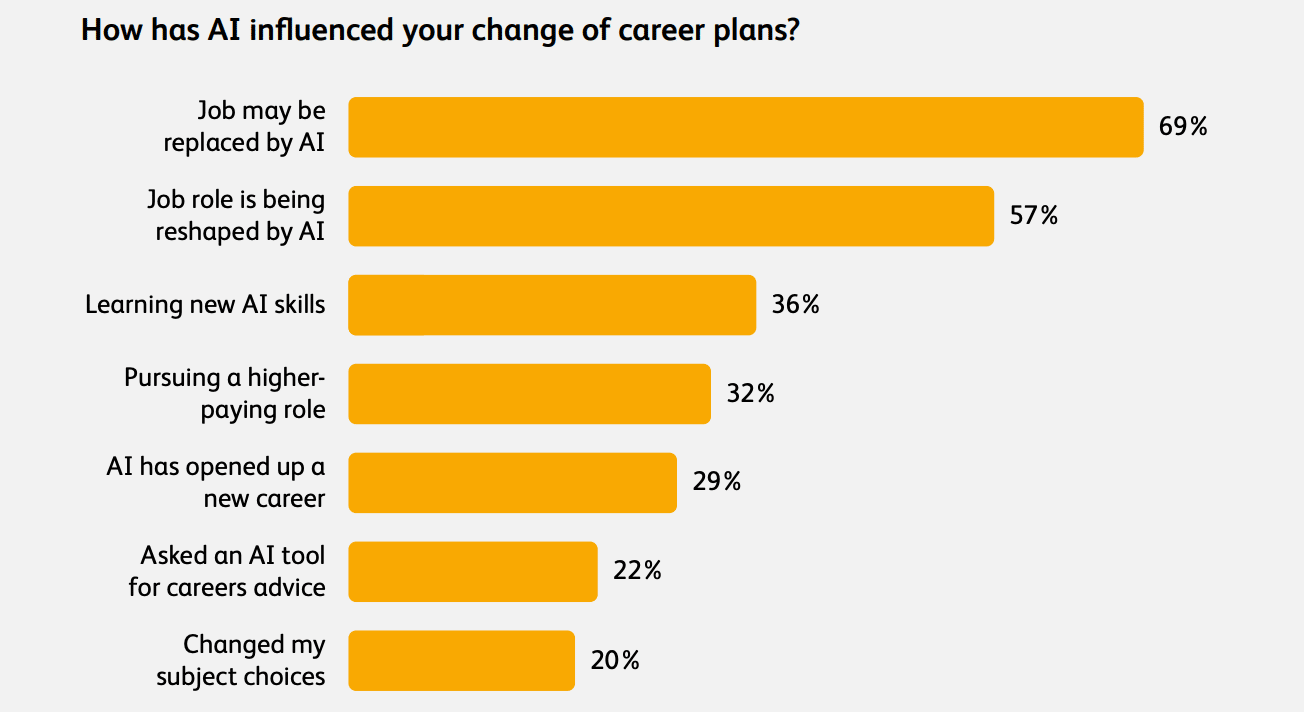
However, if young worker hiring deteriorates to mirror poor economy or recession-like conditions - especially without any foreseeable recovery - minimum long-term impact is projectable: underemployment, lower wages, increased job mis-matches (people taking whatever job is available), slower career advancement, especially if training and skills are also underinvested in.
42.5% US grad underemployment in Q4 2025. 2020+ record [NY Fed].
1 million UK 16–24 yo NEET (Not in Education, Employment or Training).
61.6% of them have never had a job [Gov UK May 2026].
Millennials leaders need young talent to develop into good managers, product thinkers, client leads, AI orchestrators, and business ecosystem-supporting future founders. The first rungs are where labour market entrants learn judgement, frontline context, customer relationships, institutional knowledge, governance boundaries, and quality standards. They spark ideas, test tools, make (smaller) mistakes, hone interpersonal skills, and grow self-awareness.
Shrinking early roles at your company would result in limited business-specific skills, constrained AI-first innovation, reduced institutional knowledge, a thin management bench, less confident leaders, weaker succession options, all combined with expensive recruitment of specific specialists.
Is your cohort of 2026 graduates large enough for sustained business growth?
The fear alone is destructive, evident by recent booing at commencement speeches and employees’ reported AI sabotage. Sentiment needs shifting:
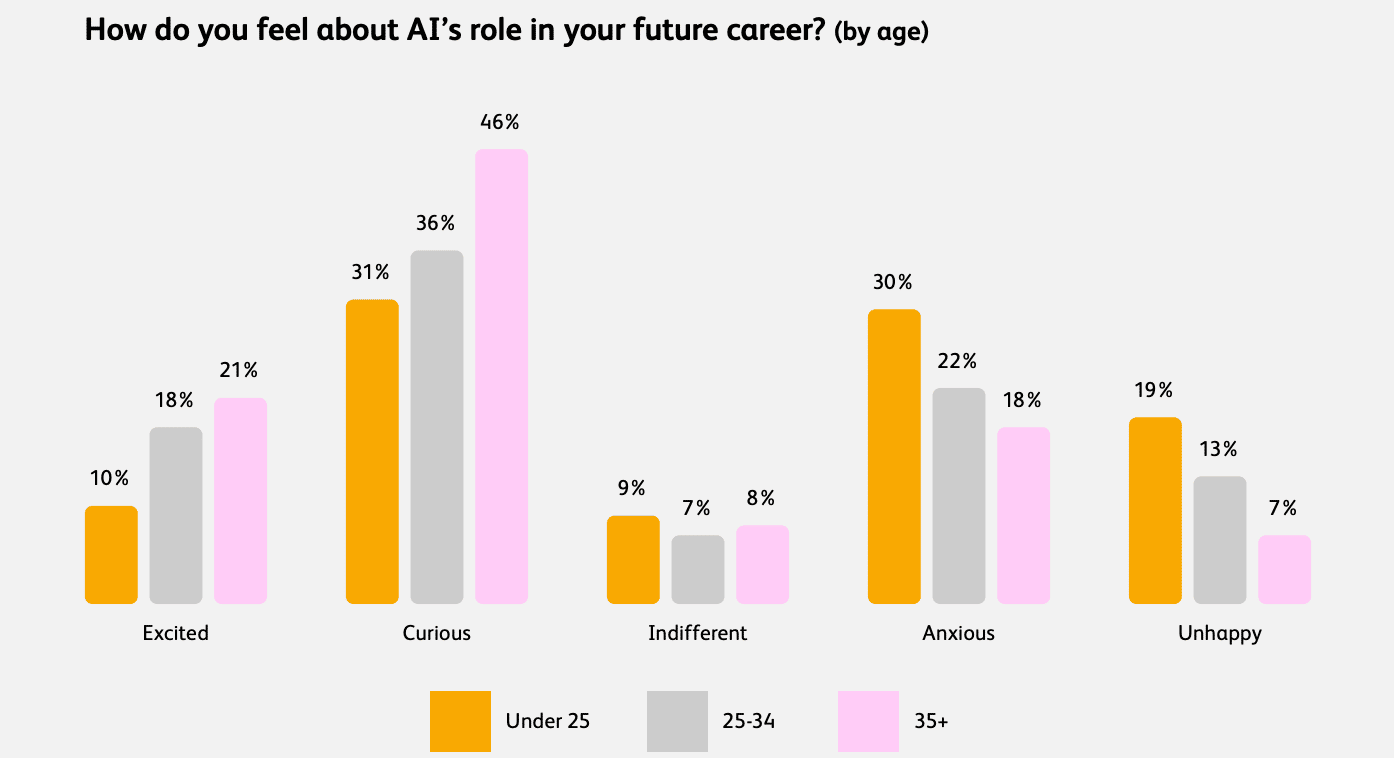
Emphasis can focus on positive career impact for the 36% who learned AI skills and 29% for whom AI opened up new careers. Meanwhile, hiring impact remains more stable than media articles are highlighting. For example:
53% of UK firms expect entry-level hiring to remain similar over 3 years.
27% of UK employers expect hiring increases, 17% expect reductions.
0% predictions that over 25% of roles will be replaced by AI [ISE, AI and Early Careers May 2026].
“IBM is globally tripling entry-level numbers because of AI, seeing graduates and apprentices as ‘people with fresh ideas who are not phased by the technology and can work with it immediately’” — Jenny Taylor, UK Graduate, Apprenticeship & Student Programme Leader, IBM.
However, students do not feel they are getting the education they need to start work - which is NOT their fault. 37% of UK undergrads and 52% taking A levels say their current education is preparing them either ‘not very well’ or ‘not at all’ - expect data for the US and W. European countries to be similar. New/recent grads need support to develop and fulfill their potential especially as:
92% of US Gen Z interns are confident about adapting to AI, yet want a direct mentoring relationship with their manager [KPMG, July 2025].
~50% UK graduating students want practical, hands-on AI support — to experiment, learn through practice, and structured guidance [ISE, 2026].
Gen Z benefits include their lack of decades of muscle memory from meeting- and hierarchy-heavy management. Instead, they are familiar with tech tools to clarify, streamline, and manage tasks. They are attuned to designing their work and possible to engage productively ensuring sufficient humans-in-the-loop.
These youngest workers are primed for an intentional learning environment and modern work management models that require clearer work design, better documentation, stronger task visibility, AI-assisted monitoring, faster feedback, and broader spans of control. They don’t have to unlearn legacy infrastructure. However, they do need culture and leadership to drive value with AI:
Culture, manager support, and talent practices have >2x the AI impact of individual factors, 67% vs 32% [Microsoft Work Trend Index, 2026].
~20% of an AI initiative’s value comes from the technology; 80% comes from redesigning work [PwC, 2026 AI Business Predictions].
“Reaping value from AI investments requires mastering the tensions between talent and tech or risking an AI productivity drop of 40%.“ EY Work Reimagined Survey, Nov 2025.
AI usage at work is widespread at 88%, yet only 28% of organisations are positioned to turn AI deployment into high-value outcomes [EY 2025]. Well-directed, curious and engaged - not fearful, isolated, and burned out - Gen Zs can help your company benefit from AI.
To close this gap, build a strong human-AI operating system. Gen Z’s comfort with tools can accelerate workflow fluency. Their career anxieties can become ambition when they see potential paths ahead. Their desire for autonomy can become responsible ownership if work is clear, measurable, and meaningful.
Many early career professionals do not trust their future to a single employer. Millennials are aware. They are/have been in the same boat and realise how a good first employee role for future founders can be mutually beneficial.
Millennial leaders can offer important initial founder experiences, sharing and learning customer exposure, commercial discipline, communication practice, a network, operational habits, what’s desired and what’s realistic. The founder pathway is becoming more real, more quickly:
71% of US Gen Z business founders used AI to launch in 2025.
56% of UK founders plan to start their next venture as a side hustle [Gusto, 2026; Enterprise Nation].
UK AI startups raised $2.4bn in H1 2025 [HSBC/Dealroom].
European VC fund have tripled since 2016 (median $32M → $105M)
European founder flywheel - Spotify, Klarna, Lovable, Legora - is compounding [GoodMachine, May 2026]
Those who leave to become founders having learned from you become your collaborators, clients, ambassadors, and advocates. Your business growth and vibrant ecosystem depends on developing new talent, skills, tools, and opportunities. The flywheel starts with you.
Hire and develop AI-capable young talent to become the rising leaders your business needs. Significant AI skills gaps exist in most countries:
97% of UK organisations identifying at least one AI skills gap in 2025
35% struggle to fill AI roles [UK DSIT, 2025]
82% of US companies Train on AI.
59% of US companies still a skills gap [Atlanta Tech, April 2026]
In Europe, the European Commission found:
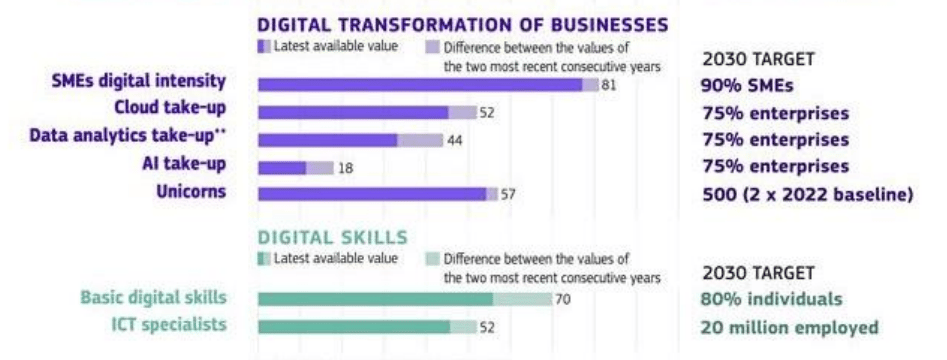
Your company’s sustainable growth depends on future managers who understand both AI and humans. The bench you build now is your leverage in 2030 — and investment in the generation looking up to you.
Build evidence of capability
Go to a Millennial-led venture where you use AI tools from day one. Build a portfolio of evidence rather than wait to be selected by a large scheme.
Document workflows where AI helped you research, draft, analyse, or improve quality. Explain where your judgement changed the outputs.
Make any career plan pivot deliberate. Research where AI skills can compound, combine with human investigation and discussion.
Redesign and develop.
Design an AI apprenticeship entry-level role: specify tasks, tools, senior review, judgement-building. Define the person will know in 90 days.
Discuss AI fears directly: Tell Gen Z hires how AI does/not change their role. Show how their AI learning compounds.
Founder potential: Engage with Gen Z employees wanting to start new ventures. Help them learn and position your company as the launchpad.
Strategise and invest.
Pipeline metric: Track how many juniors become experienced hires, managers, internal movers, founders, suppliers, or clients.
Pipeline audit: check what defined portion of junior hires have a 2-year path that incorporate AI-tool fluency and expanded spans of control.
Management model: plan fewer layers and broader spans of control where appropriate, improve documentation, human judgement, reviews.
📹 Entry level and graduate jobs in the era of AI, techUK, May 2026.
📘 The Startup of You, Reid Hoffman and Ben Casnocha.
🗞️ This summer’s interns are walking into a very different Wall Street.
🎶 Young Folks, Peter Bjorn and John.
How are you generating sustainable growth opportunities for your business? Gen Z are curiously cautious. They are AI-first and fearful. They have entrepreneurial instincts without legacy habits that hinder work design. They need mentorship, frameworks, exposure, trust, and jobs. You need them. They need you.
See you next week.
Sophie
Comments
Nothing yet. Say the first thing.
Sign in to join the conversation.