
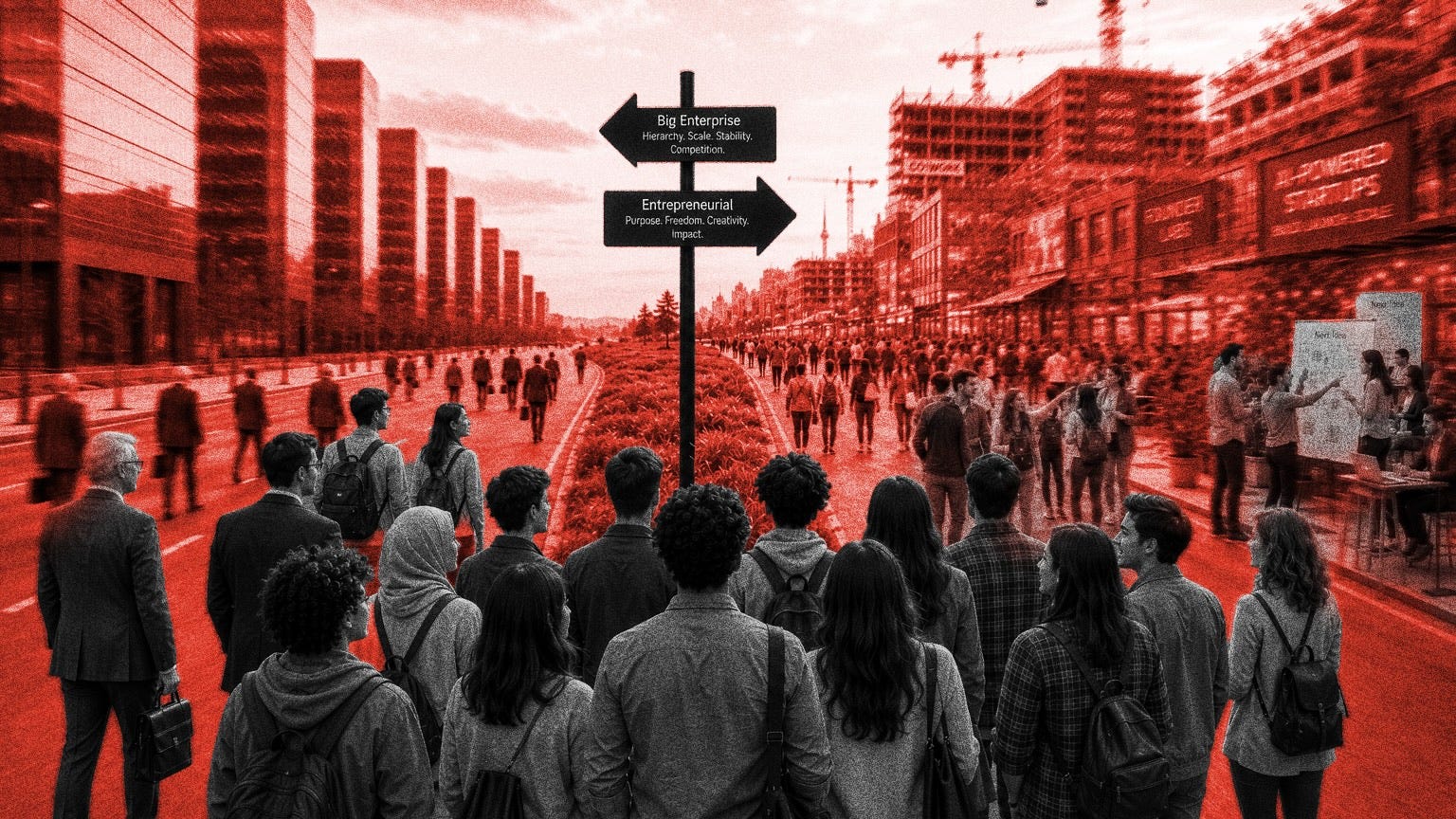
A viable vision of your AI future - plausible with somewhat familiar contours - is not easy to imagine. Not with so much in flux, when only hyped up or dystopian scenarios are highlighted. Few ‘middle ground’ scenes are discussed. Where are reasonable extensions of current situations being explored? Are they viewed as wishful platitudes? However, a viable AI-infused economy, with broad work participation is possible and in progress. How can you align and help activate it?
“Technical capability does not translate cleanly into job loss risk. Many highly exposed jobs are more likely to be redesigned or expanded than immediately automated.“ OpenAI, April 2026.
OpenAI’s “AI jobs transition framework“ April 30th told us that of over 900 (US) occupations they looked at exposure to AI to determine what the NEAR-TERM impact might be for people in that job. How can this data help you identify the emerging pressure and possible choices for you at your company?
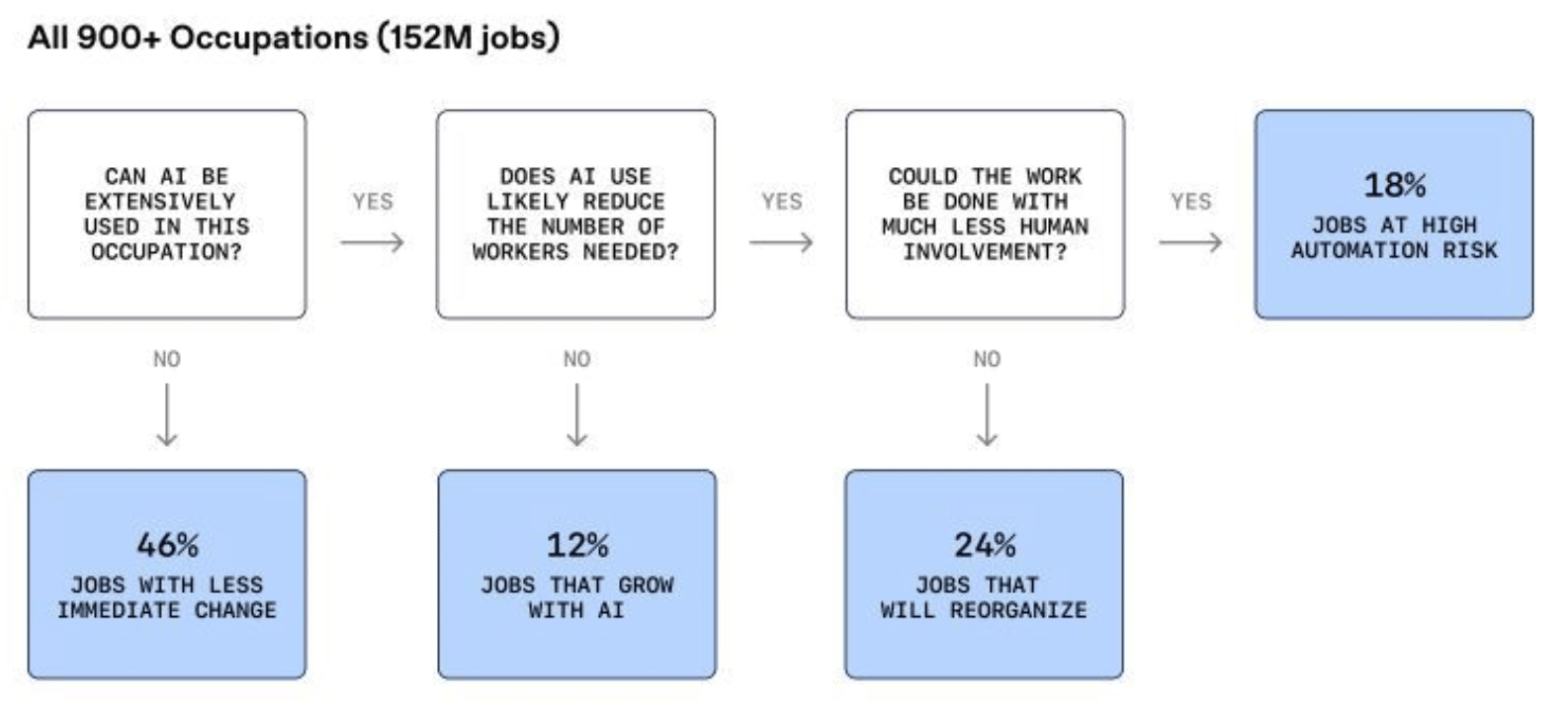
Is your job at risk? What about your team? What choices are you considering?
Big Tech and Big Enterprise dominate our news cycles with disproportionate impact on sentiment, especially AI-related stimulating fear among executives and employees. But even in the US, the tech sector shows uneven influence:
~1/3 of US stock market value created
~10% of US economic activity involvement
4-6% of US workers employed
Moreover, ‘large’ enterprises do NOT employ the majority of workers:
UK: Large businesses = 250+ employ ~33% (~11.2m) of UK workforce, ~24% (8.2m) work at companies with 1000+ workers.
US: Large businesses = 500+ employ ~41% (66.7m) of US workforce, ~34% (55.6m) at cos with 1000+ workers (’large’ is larger in US).
Spain: ~39% of employment by large enterprises = 250+ workers.
Sweden: 42.7% of employment at large enterprises = 250+ workers.
Denmark: ~36-38% of workers at large enterprises = 250+ workers.
Meantime, SMEs play a significant role in workforce activity:
99.9% of UK businesses are SMEs, employ 16.9m, ~49% of workforce
99.9% of US businesses are SMEs: employ 62.3m, ~38% of workforce.
99.8% of Spanish businesses are SMEs: employ 9.7m, ~44% of total.
99.8% of Swedish businesses are SMEs: employ 1.97m, ~57% of total.
These core blocks of economic value creation are shifting. AI is significantly increasing much smaller companies’ capacity - i.e. with many fewer than 250 employees - to build affordably and create sustainable businesses.
Is your company adding capacity to increase growth? Does that include you?
For a decade or more, projecting related trends, long-known and rarely-voiced Future-of-Work expectations included large companies reducing full-time employees to a small core supplemented by many freelancers and contractors.
Extended talent pool arrangements can provide balanced options IF they: give businesses greater nimbleness to respond to market opportunities, end demoralising hiring/firing cycles, accept more (worker-desired) non-employee arrangements, allow independent workers to achieve more diversified and dependable income, and permit non-employees to have more control over their working lives (NOTE: to be sustainable policies and other changes are vital).
Transformed organisation structures have been accelerated and boosted by:
GREAT RECESSION 2008-10: Mass firings with disregard for Boomer and Gen X employees’ tenure or dedication taught younger generations: employers have little/no loyalty, independent work spreads risk across clients, increases autonomy and improves work lifestyle.
PANDEMIC INSIGHTS 2020-23: Huge pivots, unpredictable conditions, core layoffs without support, over-hiring then layoffs, proven OOO productivity, distributed work tech and learnings, improved virtual collaboration tools, disparity in work attitudes and approach to work/life balance, lack of trust, RTO-based control issues, legacy methods.
AI-CAPABILITIES 2025+: Greater tech/economic/geopolitical uncertainties, business needs to flatter and nimbler respond faster, smaller human-AI teams, lack of transparency, increasing re/upskilling, rising AI investment costs, early career employee replacement options, fast-evolving AI capabilities and challenges, more work design, lack of executive clarity and direction, ambiguous competitive pressure.
“Talent wants to work differently, and Deloitte has been one of the real innovators in adopting new flexible talent models,“ John Winsor, CEO, Open Assembly, on Deloitte’s June 2025 launch of Extended Workforce Solutions.
AI is a catalyst, not the cause. AI is hastening us along an existing trajectory.
The time is now. Many Millennials aren’t sitting around waiting to get fired. They are building up their side hustles, resigning to see what new venture they can use AI to launch new professional opportunities, or continuing as independent workers to have greater income security. Without the same experience, expertise, or networks, Gen Zers are more focused on entrepreneurship:
62% of UK 18–30 yo, 51% aged 31-40 are thinking of starting a business [Enterprise Nation’s 2025 report].
16% (was 5%) of UK 18-29 adults in early stage venture activity.
36% of UK working age adults are entrepreneurs or planning to be in next 3 yrs {record high since 1999).
>50% of people starting new businesses are under 35 in 10 of 48 major economies [Global Entrepreneurship Monitor 2025/2026(GEM)].
9% of new business starts in 2025 by Gen Z, vs. 5% by Boomers — first time Gen Z surpassed Boomers [Yahoo Finance, Gusto data, May 2026].
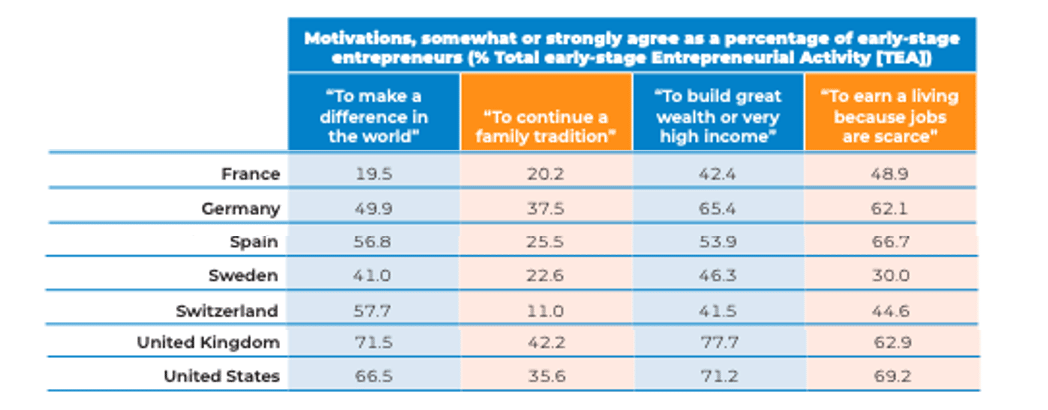
AI is enabling entrepreneurs and start-up teams to affordably launch and scale new businesses. Goals are aspirational as well as practical as GEM’s recent data shows, with continuing desire to make a difference in the world.
In parallel, to counter job insecurity, additional revenue sources are pursued and independent work is common:
36% of traditional US employees have an independent side gig.
40% are Gen Z, 44% are Millennials - 48% of them fear losing their job.
34% of these workers offer freelance or consulting services.
27.6 million US full-time independent workers in 2025.
US full-time independent workers: 28% Gen Z, 34% Millennials, 27%Gen X [MBO Partners 2025 State of Independent Worker].
56% of UK founders plan to start a new venture as a side hustle in 2026.
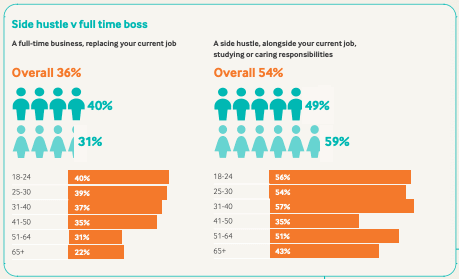
“A business or side hustle feels like a way to protect myself financially.” Sam Ikhuoria, from Newham, East London, is a visual artist and creative producer in Enterprise Nation, 2026 StartUp Ambition Report.
Turning job insecurity into new professional possibilities and changing AI’s replacement capacity into greater startup scalability, can be the seeds of a future growth path that is far from doom and dystopia.
We are already on this path. We have seen these trends. You can channel more intentional energies to make the ongoing changes work more to your long-term advantage. Most important: agency and a viable vision. Don’t wait for someone to step in, but take action to create choices and opportunities for yourself.
Imagine Big Tech and Big Finance as utility companies. Developing, financing, and providing useful technologies and supporting operational growth. As service industries, they must develop solid applications, finance infrastructure and provide expansion capital. Point #1: These firms don’t drive your life or business decisions, have exclusivity, or lay the foundations of your future.
What entrepreneurial growth are you witnessing around you? Perhaps a friend or family member recently launched something that intrigued you. Maybe you already have a side hustle that needs more determination or a change of direction. Point #2: Whether stimulated by an existing passion project, fear or practical needs, start to imagine a more entrepreneurial landscape for yourself.
Entrepreneurship is hard, rewarding work when you find people to build something with. Growing a side hustle can target a business opportunity and be a great way to learn and launch. As large enterprises shrink to a smaller core, they must outsource more. Point #3: Consider what you might provide to your current employer. Could a different employment arrangement be better for you?
AI is enabling and expanding skills and capacity. If you haven’t experimented and explored extensively yet, start right away. Whatever vision you imagine, your ability to augment how you develop, refine, produce, market, deliver, and service whatever it is, can be helped by AI. Point #4: Embrace AI thoughtfully to boost, test and help you explore, choose, and create the future you want.
Collectives, communities, and networks are all available for freelancers, independent workers and early stage entrepreneurs, whether locally or virtually, whatever your concept to provide resources, support, connections, and even customers as you work to develop your next idea and a new viable vision for your future. Point #5: You’re not alone. Reach out. Get help. Go for it.
What will you start on this week?
There’s no pretending that any country is well set up to support entrepreneurs. The US may be better than most - especially with forgiving bankruptcy laws. However, venture capital in the US was always looking for the 30x opportunity to make their portfolio returns. Now, that is likely 3000x at a minimum!
However aspirational you are, remember startups with 2x, 3x or 5x potential often need to apply for government funds (after friends and family). Research what grants or programs have startup capital and what terms it comes with.
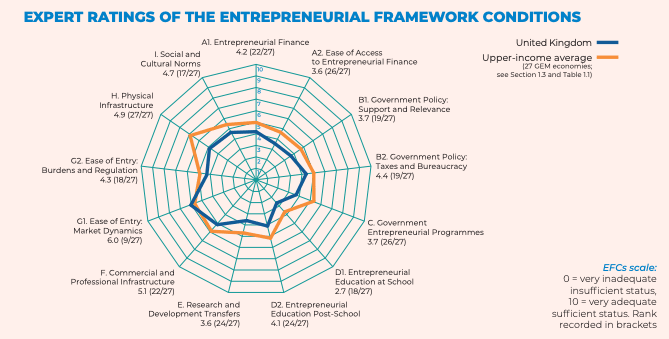
Meantime, there are significant constraints that don’t help entrepreneurs succeed. Explore the expert ratings for your country to see where the most substantial hurdles might be and what you might do ahead of time to mitigate them. These challenges will improve over time as fears about AI’s impact gets government and other bodies responding.
📹 6 Tips on Being a Successful Entrepreneur - John Mullins, TED talk.
📘 Side Hustle: Build a Side Business and Make Extra Money - Chris Guillebeau
🗞️ Global Entrepreneurship Monitor 2025/2026 - amazing date to explore.
🎶 Don’t Stop Me Now, Queen - this is the moment to get going!
To create your viable vision, bring your human genius and inspiration, purpose and passion, agency and intention, skills and tools, friends and family. It’s a process. If you aren’t on it yet, start this week.
Ride with the wave of innovative energy and collective contributions that have been growing for years. You don’t need a unicorn, you need to imagine and build towards an outcome you can believe in.
See you next week.
Sophie
Comments
Nothing yet. Say the first thing.
Sign in to join the conversation.