
📌In a Nutshell:
A role only fixes what it claims to fix when the underlying condition the evidence demands is actually met, otherwise it is the old failure wearing a more confident name
Every organisation redesigning itself around a new kind of role is making a quiet bet: that naming a structure correctly is the same as building it correctly. It is not. Each of these role types solves a genuine problem the old management ladder handled poorly, but each one only works under a single, specific condition that most organisations never actually check. Get that condition wrong, and the label survives long after the structure underneath it has already failed.
Why the “equal” dual career ladder is usually not equal — and what actually happens to pay as technical specialists rise through it
The hidden cost of formalising an IC track without checking whether it is quietly reinforcing pay and representation gaps
What actually makes a DRI model work, versus simply relabelling the same old coordination failure
Where corporate flattening trends and rising delegation of authority are really coming from
The exact tipping point where a player-coach stops being efficient and starts quietly damaging the team underneath them
What actually separates a manager who thrives under a heavy player-coach load from one who burns out, and why most organisations never check for it before assigning the role
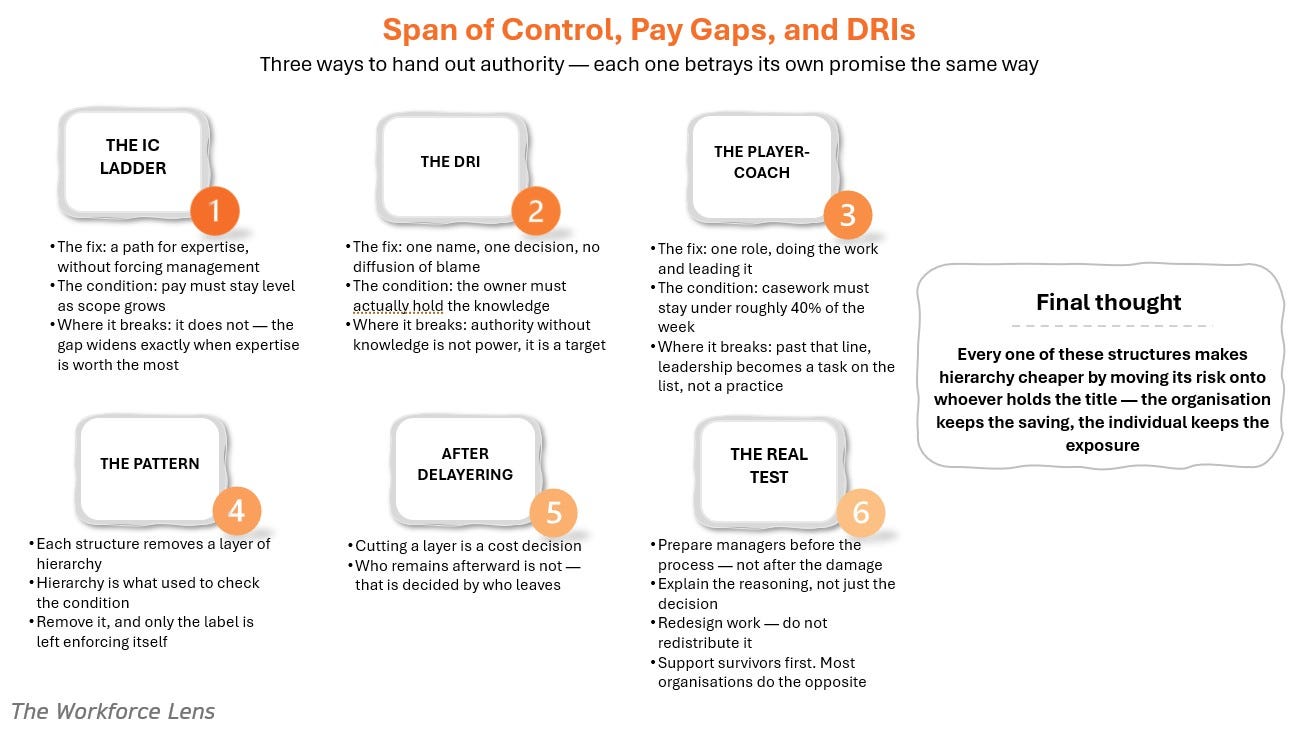
Three Org Models Under Pressure: IC Ladders, DRIs, and Player‑Coaches
The IC track: dual career ladders and the hidden pay gap
DRI roles: clear ownership, delegation, and decision rights
Player‑coach managers: span of control, IC workload, and burnout
Final thoughts: designing orgs that actually work
Key Takeaways
Next on The Workforce Lens
Further Reading
The org chart used to answer one question: who manages whom. More growth meant more boxes, more layers, more distance between the person doing the work and the person who owned the outcome. That model is being taken apart. In its place, three role types keep showing up, again and again, across very different industries: the individual contributor (IC) track, the directly responsible individual (DRI), and the player-coach. Each solves a different failure of the old ladder. What is new is that we finally have decent data on where each one actually breaks — and the picture is messier than the frameworks let on.
💡 Related read:
How to distribute power without losing accountability: research-backed framework
Discover why distributing decision-making power fails as a cultural slogan and succeeds only as a systems design problem, and what the research reveals about linking authority to accountability without losing control.
The dual career ladder exists to solve the Peter Principle without ever saying the phrase out loud. Your best engineer is not automatically your best manager, and forcing the conversion wastes a good engineer while producing a mediocre manager. So firms built a parallel track: Staff, Principal, Distinguished, running alongside Manager, Director, VP, supposedly carrying the same pay and the same status at each rung.
Supposedly is doing a lot of work in that sentence. A 2026 paper out of Kellogg (Bianchi, Cao, Friedrich and Nguyen) reconstructed full reporting chains from personnel records across 43 mid-size and large firms specifically to test whether the two ladders actually pay the same. They do not. ICs earn substantially less than managers at similar levels, and the gap widens the further up the hierarchy you go. That is not universal — some firms in the sample run something close to real parity, others let the gap balloon — but the direction is consistent enough that “dual ladder” should probably come with an asterisk in most job architecture decks.
Here is the part that should worry a compliance function more than the pay gap itself: women and minority employees are disproportionately stacked on the IC side, especially at senior levels. Put those two findings together and the IC track stops looking like a neutral career choice. It starts looking like a mechanism — one that quietly routes certain groups toward the lower-paying rail of a system marketed as equal, and does it without anyone signing off on that outcome deliberately. If your organisation is about to formalise an IC ladder, that is the finding to design against, not the footnote to skim past.
Apple popularised the term. The idea is older than the label: for any decision with no natural owner, name one person and make them own it — not a committee, not a working group, one name. Dilip Mookherjee laid out the trade-off this solves back in 2006 (Journal of Economic Literature): centralise a decision and you protect coordination but lose the speed and local knowledge of whoever is closest to the problem; delegate it and you get the speed back but risk drift from what the wider organisation actually needs.
Rajan and Wulf’s NBER work backs the direction of travel, if not the DRI name itself. Tracking payroll and reporting-line data from 300-plus large US firms through the late nineties, they found a steady rise in the number of people reporting straight to the CEO and a steady fall in the layers underneath — even after accounting for the obvious explanations (firm growth, new C-suite roles, mergers), a chunk of the pattern remained, and they read that remainder as real delegation, not noise. Guadalupe and Wulf then showed this flattening tracks competitive pressure: the more a firm’s industry got hit by trade liberalisation, the more it flattened. While neither paper explicitly mentions DRIs, they are describing the exact same structural shift under a different name.
For a licensing function, this maps onto something already familiar: one named person accountable for an obligation, regardless of where they sit on the chart. Mookherjee’s caution is worth keeping in your back pocket, though — delegated ownership only beats a centralised call when the person holding it actually has the knowledge the decision needs. Hand the DRI label to someone without the scope to back it, and you have rebuilt the committee problem with a single, very exposed name attached.
Coinbase runs on it. Meta’s applied engineering teams reportedly run on something like it. And Gallup’s data tells you almost exactly where it stops working. Across a panel of 16,442 US managers, the average number of direct reports climbed from 10.9 in 2024 to 12.1 in 2025 — nearly a 50% jump since Gallup started tracking this in 2013, when the mean sat at 8.2. But the median has barely moved: five or six people per manager, year after year. A handful of enormous teams — the 13% of managers now running 25 or more people — is dragging the average up while most managers’ day-to-day reality has not changed much at all.
The mechanism behind the breakdown is precise, and it is not headcount on its own. Ninety-seven per cent of managers in Gallup’s panel do some individual-contributor work themselves. The median is 40% of their time. Stay under that line and engagement holds roughly steady no matter how many people report to you. Cross it, and engagement drops — worse the more direct reports you add on top. Bryan Hancock, a partner at McKinsey, put a related observation into words in a 2023 interview tied to the book he co-authored, Power to the Middle. Player-coach setups work, he said, on “a relatively small team that doesn’t have a lot of people who actually need to be managed” and where the manager’s own expertise is directly relevant to what the team does — and they start to break down once “a player-coach’s player responsibility is well over half of your time,” at which point coaching a team of “seven, ten, 15 people” leaves no room in the day for actual one-on-ones. Two independent sources, one a survey panel and one a practitioner’s own account, landing on the same shape of problem.
Picture the version of this that actually happens inside most compliance functions: a permit management lead who used to run their own caseload full-time gets handed six reports and told to “keep doing the technical work too, obviously — you are the expert.” Eighteen months later they are behind on both fronts, their team is undercoached, and leadership is confused about why the player-coach model that worked so well for the small pilot team stopped scaling. It stopped scaling because nobody checked whether the person had the talent Gallup’s research says actually rescues this model at larger spans — motivation, workstyle, initiation, collaboration, and what Gallup calls “thought process.” High scorers on those traits hold engagement even under a heavy IC load and a large team. Everyone else degrades, and degrades faster the bigger the team gets. A player-coach structure rolled out uniformly is not a cost-neutral org design choice. It is a bet on manager quality that most organisations have not actually thought to place.
None of these three roles is a substitute for the other two, and none of them is a substitute for management altogether — a point MIT Sloan Management Review made bluntly in its 2023 piece “Rethinking Hierarchy”: the case for eliminating management has never really held up, because hierarchy still solves coordination problems that flat structures do not. Delayering does not just change the org chart, either. It changes who is still in the building afterward. Reitzig and Heiss’s 2025 research (also MIT Sloan) found that firms which strip out layers end up with a workforce skewed toward more conscientious, open, agreeable people — not because anyone selected for that, but because those are the people who stayed once the less-suited ones left. Nobody plans for that outcome. It happens anyway.
Treat these three as separate tools, not a package deal. The IC ladder earns its keep only where the pay parity is real, not just published in a job architecture deck. The DRI label is worth nothing if the person wearing it does not actually have the scope to back the decision. And the player-coach model, more than either of the others, comes down to a single unglamorous question nobody wants to ask before rolling it out: is this particular manager actually good enough to carry both jobs at once? Most organisations skip that question. Gallup’s data suggests they should not.
The dual career ladder is not a neutral career choice. It functions as a distribution mechanism, and the data shows it distributes pay and demographic representation unevenly, whether or not any firm intended that outcome
Delegation only works when it moves decision rights to where the information already sits. A DRI label attached to the wrong person does not solve the coordination problem the model was built for. It simply hides the same failure under a more confident name
The player-coach model breaks on a specific, measurable line, not on instinct or team size alone. Past that line, the constraint is calendar arithmetic, not effort, and no amount of individual competence changes the arithmetic
Manager talent, not structure, is the real variable separating a player-coach setup that scales from one that quietly degrades. Most organisations design around the role and skip the harder question of who should actually hold it
Flattening a hierarchy changes who works there, not just how the chart looks. The people who remain after de-layering are not a random sample of who was there before, and nobody plans for that shift deliberately
None of these three structures replaces management. Each one is a targeted fix for a specific failure of the old ladder, and applying any of them as a blanket policy, rather than a precise instrument, tends to reproduce the very problem it was meant to solve
Microsoft has already given it a name: the agent boss, an employee who builds, delegates to, and manages AI agents the way a manager once managed people. The vocabulary of accountability comes along for free, delegate, own, escalate, review, applied to something on the other side of the relationship that has never had to answer for anything in its existence.
The next piece asks a question the first one never had to: can this structure be fixed the way an underpaid IC ladder or an underpowered DRI can, by checking a missing condition and correcting course, or is agent boss the first structure in this series that fails no matter how well it is built. A randomised experiment already has an answer, and it is not the one most organisations are betting on.
For the structural roots of poor management, “Why Leadership Development Fails: The Real Reason We Keep Producing Bad Leaders“ argues that leadership failure begins at selection, not training, and that fixing the promotion pipeline matters more than fixing the person once they are already in the seat.
For a real-world case of flat hierarchy in practice, “Unleashing the Unconventional: DeepSeek’s Radical Talent Revolution“ shows what happens when a company removes management layers and decision rights entirely, trading structure for speed, curiosity, and cognitive diversity.
For the broader pattern behind these breakdowns, “Why Work Transformation Fails: Seven Hidden Patterns HR Must Understand“ traces how organisations keep retrofitting dynamic, fast-moving work onto infrastructure built for a slower, more stable era, and why that mismatch is the real source of the failure.
How AI is reshaping entry-level careers: risks, skills, and strategies
Generational diversity in the workplace: key HR strategies to improve engagement and retention

Thanks for reading The Workforce Lens’s Substack! This post is public so feel free to share it.
Dual Career Ladders: Individual Contributors in Modern Corporate Hierarchies. Kellogg School of Management
Decentralization, Hierarchies, and Incentives: A Mechanism Design Perspective. Journal of Economic Literature
The Flattening Firm: Evidence From Panel Data on the Changing Nature of Corporate Hierarchies
The Flattening Firm and Product Market Competition: The Effect of Trade Liberalization
People Follow Structure: How Less Hierarchy Changes the Workforce. MIT Sloan Management Review
Comments
Nothing yet. Say the first thing.
Sign in to join the conversation.