
Today, Wall Street is expected to start selling a privacy coin.
There is something wonderfully absurd about that sentence. Zcash has spent the better part of the past year becoming one of crypto’s dominant narratives, so I don’t want to pretend that an ETF suddenly rescued some forgotten coin from obscurity. Crypto rediscovered Zcash long before Wall Street did, and anyone who has watched ZEC’s extraordinary run already knows that. The price has exploded, the privacy conversation has returned in force, and Zcash has gone from something many investors had written off to one of the most discussed assets in the market.
What changes today is where you can buy it.
Most Bitcoin investors face the same tradeoff: they want BTC’s upside but don’t want their full principal riding on it. Peoples Reserve built their Bitcoin Bond for exactly that. The structure allocates roughly 80% to U.S. Treasuries held to maturity, designed to protect principal, with the remaining 20% in bitcoin to drive yield. Their framing: bond-like safety, Bitcoin-like ceiling, no forced choice between the two.
First issuance rolls out early Q4 and the waitlist is open now. Register before launch and they’ll lock in a 10% discount on performance fees for the first issuance. Head to
Grayscale’s Zcash ETF is expected to begin trading on NYSE Arca under the ticker ZCSH, potentially putting a privacy-focused cryptocurrency inside the same basic financial wrapper that helped transform Bitcoin from something banks wanted nothing to do with into an asset available through virtually every brokerage account in America.
And here’s the funny part: buying the Zcash ETF gives you absolutely no privacy. Your broker knows who you are. The fund knows what it owns. The underlying assets sit with a regulated custodian. There is nothing anonymous about buying ZCSH in your Fidelity account, nor is that really the point.
The interesting part is the asset sitting inside the wrapper and the idea behind it. Zcash exists partly because of an increasingly obvious problem with public blockchains: maybe putting everyone’s financial life permanently on a ledger that anyone can inspect isn’t actually a great idea.
For the record, I don’t own Zcash. This isn’t me talking my book, and I have no particular interest in convincing you to chase an asset after an enormous move. What interests me is how dramatically the conversation around privacy has changed, because for years privacy coins looked like the one corner of crypto that institutional adoption might actually kill.
The logic wasn’t difficult to understand. Crypto wanted regulatory clarity, ETFs, banks, governments, asset managers and institutional capital, while privacy coins were specifically designed to make certain transaction information harder to see. Governments have spent decades building a financial system in which banks and brokers know their customers, monitor suspicious activity and provide information to law enforcement when legally required. Crypto then showed up with technology capable of obscuring the sender, recipient or amount of a transaction. You didn’t exactly need a crystal ball to predict some friction.
And there was plenty of it. Japan pushed exchanges to remove privacy coins years ago, South Korean exchanges followed, European regulations created additional pressure, and major exchanges either delisted certain privacy assets or restricted them in various jurisdictions. Binance ultimately delisted Monero in 2024, while Kraken removed it for customers in the European Economic Area later that year. For a while, the direction of travel seemed obvious: Bitcoin and Ethereum would become increasingly integrated into traditional finance, while privacy coins would be pushed further toward the edges.
The market eventually decided otherwise.
Privacy came roaring back as a major crypto narrative over the past year, and Zcash became the clearest beneficiary. That happened before this ETF, which is why I think it’s important not to confuse cause and effect. Wall Street didn’t revive Zcash. If anything, Wall Street is arriving after crypto already decided that privacy mattered again.
The more interesting question is why.
Zcash launched in 2016 around a fairly straightforward problem with transparent blockchains. Bitcoin is often described as anonymous, but it really isn’t; it’s pseudonymous. Addresses don’t automatically have names attached to them, but the transaction history itself is public. Once an address can be reliably connected to a person, company or institution, an enormous amount of financial activity can potentially be followed.
Zcash approached the problem using zero-knowledge proofs, cryptography that allows information to be verified without necessarily revealing the underlying information itself. Zcash users can transact transparently or use shielded transactions that conceal information such as the sender, recipient and amount while still allowing the network to verify that the transaction is valid.
Technologically, that’s incredibly interesting. But the concept becomes much more important when you stop thinking about privacy exclusively through the lens of someone trying to hide a crypto transaction and start thinking about the financial system the industry says it wants to build.
We keep hearing that everything is going onchain. Stablecoins are already moving hundreds of billions of dollars around the world. Stocks are being tokenized. Treasury products live on public blockchains. Banks are experimenting with blockchain settlement. Asset managers are tokenizing funds. If the more aggressive predictions are even directionally correct, trillions of dollars of financial activity will eventually migrate onto blockchain infrastructure.
That sounds great until you ask whether everyone involved actually wants the entire world watching.
A company doesn’t necessarily want competitors tracking payments to suppliers in real time. A hedge fund certainly doesn’t want everyone watching it build or unwind a position. Businesses have payroll, invoices, counterparties, acquisitions and countless other financial relationships they have completely legitimate reasons to keep private. Individuals probably don’t want their salaries, savings, purchases and net worth permanently available to anyone who manages to connect their identity to an address.
None of that has anything to do with money laundering.
Privacy and criminality are not synonyms, although the debate around privacy coins has often treated them that way. In fact, traditional finance already recognizes this distinction because the financial system we use today is extraordinarily private from the public. You can’t inspect my checking account because you know my name. I can’t see your brokerage portfolio. Your employer doesn’t publish your salary every time it sends you a paycheck, and paying your mortgage doesn’t expose your entire financial history to your neighbors.
The existing financial system is private to everyone who doesn’t need access, while remaining visible to the intermediaries operating it and, under appropriate circumstances, governments and law enforcement.
Public blockchains largely flip that architecture around. They can make transactions radically transparent to everyone by default, which is fantastic for auditability and verification but considerably less appealing if we expect ordinary people, companies and financial institutions to conduct a meaningful portion of their financial lives on them.
That creates a problem crypto eventually has to solve. We want blockchains to be transparent enough that nobody has to blindly trust whoever maintains the ledger, while still providing enough privacy that using one doesn’t require publishing your financial life to the internet. Those goals sound contradictory, but increasingly they don’t have to be.
That’s where zero-knowledge technology becomes much more interesting than the simple label “privacy coin.” The basic idea of proving something without revealing everything has expanded far beyond Zcash. Zero-knowledge proofs are now being used and developed across blockchain scaling, identity, compliance and other applications where one party needs to verify information without necessarily seeing all of the underlying data.
Imagine proving that you satisfy KYC requirements without broadcasting your personal information to every participant in a network, or proving that you have enough assets to complete a transaction without revealing your entire balance sheet. A financial institution could potentially verify that a transaction complies with certain rules without making the transaction itself visible to the entire world. The goal doesn’t have to be absolute anonymity; it can be selective disclosure.
That is a much more nuanced version of financial privacy than the debate we had five or ten years ago, when the conversation often amounted to regulators arguing that privacy enabled criminals and crypto advocates responding that governments had no right to see anything.
Reality is probably somewhere in between.
There are legitimate reasons for governments to combat money laundering, sanctions evasion and criminal finance. There are equally legitimate reasons why ordinary people and companies shouldn’t have their entire financial lives exposed publicly simply because they choose to use blockchain infrastructure. If crypto actually succeeds in moving a meaningful portion of global finance onchain, both of those things have to be true at the same time.
Which brings us back to the ETF.
A Zcash ETF obviously doesn’t solve this problem, nor does its existence mean American regulators have suddenly embraced anonymous financial transactions. Buying shares of ZCSH is fundamentally different from using Zcash’s shielded functionality. Investors are getting price exposure to the asset through a regulated financial product while the underlying ZEC is held by a custodian. Nobody buying the ETF should confuse owning exposure to Zcash with actually using the privacy technology Zcash provides.
But the symbolism is difficult to ignore. An asset built around financial privacy, after years in which privacy coins were removed from major trading venues because of compliance concerns, is now crossing into one of the most mainstream and heavily regulated investment structures in American finance. That doesn’t settle the privacy debate, but it certainly suggests the old assumption that regulated crypto and privacy technology could never coexist was too simplistic.
We’ve watched this happen repeatedly in crypto. Bitcoin was once dismissed as internet money for criminals before becoming an asset held by governments, corporations and the largest financial institutions in the world. Stablecoins spent years being treated like unregulated casino chips before Washington began discussing them as critical infrastructure for extending dollar dominance. Prediction markets existed in a regulatory gray zone before becoming large enough that established derivatives exchanges started fighting them for market share.
The technology often survives long enough for the narrative around it to change.
Privacy may be going through the same process, except I think there’s an additional twist this time. The very institutional adoption that once looked like an existential threat to privacy technology may ultimately create more demand for it. The more assets we put onchain, the more businesses transact onchain and the more of our financial lives become connected to public networks, the more obvious the limitations of radical transparency become.
That doesn’t mean Zcash wins. ZEC still faces competition, regulatory uncertainty and the much harder question of whether growing demand for privacy and zero-knowledge technology necessarily translates into growing value for this particular token. An ETF also doesn’t change the fact that ZEC has already experienced an enormous run, which is precisely why I’m not interested in turning this into an argument for buying it today.
I think the bigger idea is far more important than the trade. For years, much of the industry assumed that crypto would have to sacrifice privacy as the price of entering mainstream finance. Instead, we may be discovering that mainstream finance cannot realistically move onto public blockchains without eventually importing some form of privacy with it.
That would be a remarkable reversal. Privacy coins spent years looking like a relic of crypto’s cypherpunk past, fundamentally incompatible with the regulated future the industry was building toward. Now Zcash is entering that regulated future through the front door, wrapped in an ETF and listed on the New York Stock Exchange.
Maybe the lesson isn’t that Wall Street suddenly learned to love privacy. It’s that the more finance moves onchain, the harder it becomes to pretend we won’t need it.

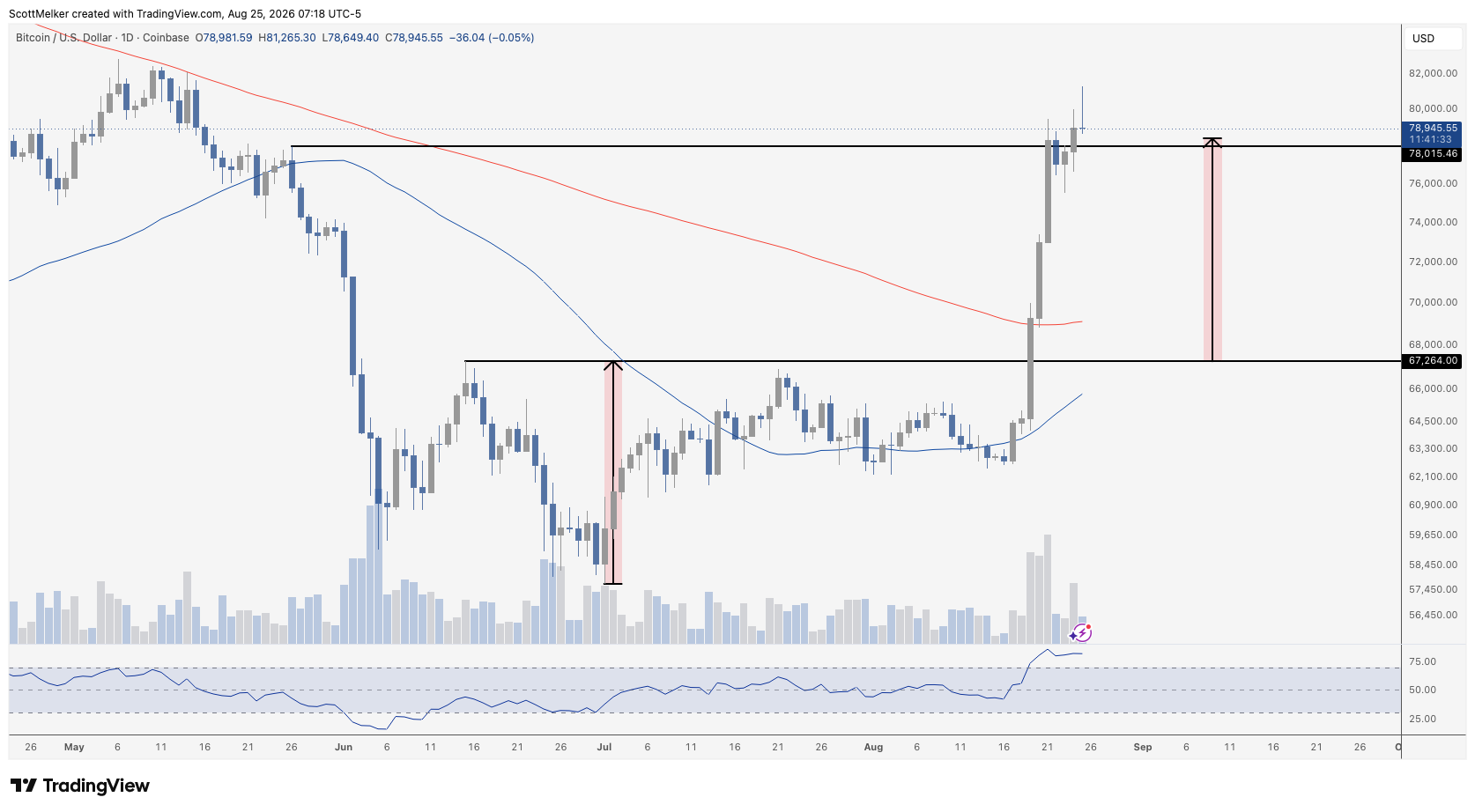
Bitcoin has now effectively reached the measured target from the complex inverse head-and-shoulders/bottoming pattern that we have been watching, after an extraordinary move from roughly $63,000 to above $80,000 in little more than a week. That move also carried price decisively through the daily 200 MA and the prior resistance around $67,300, two developments that materially improved the broader structure.
The problem in the short term is that Bitcoin has simply gone too far, too fast. Daily RSI is massively overbought, lower timeframes are already showing confirmed bearish divergences and the daily chart is threatening to develop one as well. None of that means the top is in. In fact, after a move of this magnitude, I would argue that a healthy correction would be constructive. Markets need to reset momentum, shake out late leverage and establish new support before they can sustainably move higher.
This is therefore becoming less interesting to me as a place to chase and more interesting as a market where I want to identify the next good dip to buy. A shallow consolidation is certainly possible, but the area from the low $70,000s into the high $60,000s would be particularly compelling. The rising daily 200 MA is moving through that region, while roughly $67,300 represents the major breakout level that capped price for months. A pullback into that confluence, particularly if momentum resets toward neutral or oversold conditions, would offer a significantly cleaner risk/reward than buying after an almost vertical advance.
The important distinction is that a correction from here would not automatically undermine the emerging bullish thesis. Bitcoin has broken above the 200-day MA, escaped a lengthy bottoming structure and produced an impulsive move on strong volume. I don’t think the evidence currently suggests that this move is finished; I think it suggests that Bitcoin could use a reset before attempting the next leg.
After spending months looking for evidence that the bear market was ending, this is a welcome change. The question is no longer where the bottom might be. It’s whether the next meaningful pullback gives us an opportunity to buy it.
Above $82,800 is the real line. That’s where the market makes a higher high for the first time and bearish market structure dies.

Coinbase launches tokenized U.S. stocks on Base, including Apple, Nvidia, Tesla and Strategy
Coinbase has launched tokenized versions of 13 U.S. stocks on Base, including Nvidia, Apple, Meta, Google, Microsoft, Tesla, Coinbase and Strategy. These tokens represent claims on underlying shares rather than synthetic bets, effectively bringing traditional equities onto blockchain rails while the U.S. regulatory framework for tokenized stocks is still being worked out.
This is the tokenization story becoming real in front of us. We’ve spent years hearing that stocks will eventually trade onchain and around the clock; now one of America’s largest crypto companies is actually building the infrastructure. The particularly interesting part is that the technology is moving faster than Washington. Again.
BlackRock leads $338 million day for Bitcoin ETFs as Ethereum funds extend their inflow streak
U.S. spot Bitcoin ETFs took in roughly $338 million Monday, with BlackRock’s IBIT accounting for $209 million, while Ethereum ETFs added another $116 million for their sixth consecutive day of inflows. BlackRock also dominated the ETH side, with ETHA pulling in roughly $91 million.
The important thing here is that the forced buying from last week’s historic short squeeze is long gone, yet ETF demand continues as Bitcoin pushes above $80,000. We’ve been waiting to see whether actual buyers would replace the liquidated shorts after the initial explosion. So far, institutions appear happy to keep paying higher prices.
BitMine closes in on owning 5% of Ethereum after building its massive position in just 14 months
BitMine now owns roughly 5.85 million ETH, or about 4.8% of the entire Ethereum supply, putting Tom Lee within striking distance of his stated 5% target. Even more remarkably, roughly 5.07 million ETH is already staked, which the company estimates will generate around $330 million annually.
We’ve talked about BitMine before, but the scale is getting absurd. Strategy took six years to accumulate roughly 4% of Bitcoin; BitMine is approaching 5% of Ethereum in about 14 months. It’s also becoming more than a treasury trade - the staking income alone is now large enough to help finance BitMine’s preferred dividend. Saylor’s financial engineering is clearly contagious.

Arch Public - It’s a hedge fund in your pocket. Built for retail traders, designed to outperform Wall Street. Try emotionless algorithmic trading at Arch Public today.
Promote your brand with The Wolf of All Streets. For sponsorship and partnership opportunities, contact info@thewolfofallstreets.io.
The Wolf Pack - My Telegram group where I share daily market updates, real-time observations, and ongoing discussions with the community. There’s a dedicated channel and group chat, and it’s completely free to join.
X - I spend most of my time on X, contributing to CryptoTownHall every weekday morning, sharing random charts, and responding to as many of you as I can.
YouTube - Home of the Wolf Of All Streets Podcast and daily livestreams. Market updates, charts, and analysis!
The views and opinions expressed here are solely my own and should in no way be interpreted as financial advice. Every investment and trading move involves risk. You should conduct your own research when making a decision. I am not a financial advisor. Nothing contained in this e-mail constitutes or shall be construed as an offering of financial instruments or as investment advice or recommendations of an investment strategy or whether or not to "Buy," "Sell," or "Hold" an investment.
Thanks for reading The Wolf Den! Subscribe for free to receive new posts and support my work.
Comments
Nothing yet. Say the first thing.
Sign in to join the conversation.