
Quick programming note before we get into it: apparently I’ve had a lot to say lately.
A number of you have politely pointed out that reading The Wolf Den has started requiring roughly the same time commitment as a Russian novel. Point taken. The goal here has always been to make complicated things easier to understand, not to make you cancel your morning meetings to finish the newsletter. We’re going to tighten things back up and make an effort to get to the point faster.
Starting today.
Last week, I wrote about Treasury doubling the maximum size of its long-duration bond buybacks and the extraordinary reaction that followed across markets, particularly Bitcoin. I also spent a fair amount of time explaining what Treasury was not doing. This wasn’t QE, the Fed wasn’t printing money, and despite half of Twitter immediately screaming “YIELD CURVE CONTROL,” it wasn’t really that either.
Stanley Druckenmiller agrees that this isn’t QE or traditional yield curve control. He just thinks I may have been too generous about what it actually is.
Druckenmiller, one of the greatest macro investors of all time and, interestingly, a former mentor of Treasury Secretary Scott Bessent during their years working for George Soros, published a blistering critique of the expanded buyback program this week. His argument is much stronger than simply warning that Treasury could eventually begin trying to suppress long-term rates. He believes that’s effectively what it is doing already, calling the move “price management” rather than liquidity management and arguing that Treasury is interfering with the most important price signal in global finance.
And he has a point worth taking seriously.
The bond market isn’t simply a place where investors trade government debt. Long-term Treasury yields contain an enormous amount of information about what investors expect from inflation, growth, deficits, government borrowing and the future value of money. When investors become less comfortable lending to the United States for 20 or 30 years, they demand a higher return. Yields rise, borrowing becomes more expensive, and eventually that higher cost creates pressure on Washington to address whatever is making lenders nervous.
In other words, the bond market is supposed to be annoying.
For decades, people have referred to “bond vigilantes” as the market’s version of fiscal discipline. Congress can vote for whatever spending it wants and politicians can make whatever promises they want, but eventually somebody has to finance it. If those buyers start demanding 5%, 6% or more to lend the government money for decades, Washington receives a message that becomes increasingly expensive to ignore.
Druckenmiller’s argument is that the market has finally started sending that message, and Treasury’s response has been to try to quiet it. He points out that there was little evidence the Treasury market was actually malfunctioning when the new buybacks were announced. Trading remained orderly, there weren’t failed auctions or widespread forced liquidations, and the long end was doing exactly what markets are supposed to do: repricing risk as federal debt surpassed $40 trillion, deficits remained enormous and inflation continued running above target.
That distinction is important because Treasury has a perfectly reasonable explanation for its buyback program. These operations weren’t invented last week, and Treasury has long argued that buying older, less-liquid securities can improve market functioning and liquidity. The amounts involved are also tiny relative to the roughly $30 trillion Treasury market, while the government continues issuing vastly more debt than it is buying back. Calling this money printing or QE remains simply wrong.
But Druckenmiller’s point is that context matters. Treasury doubled the maximum size of buybacks in the 10-to-20 and 20-to-30-year portions of the curve from $2 billion to at least $4 billion shortly after the 30-year yield reached its highest level in nearly two decades. Markets immediately interpreted the announcement as an effort to push long rates lower, bonds rallied violently, and then much of that move reversed within roughly a day.
His argument, essentially, is that the market saw exactly what Treasury was trying to do and wasn’t particularly impressed.
The larger concern is what comes next. The United States now carries more than $40 trillion of federal debt and continues running massive deficits while refinancing trillions of dollars at substantially higher interest rates than it enjoyed for most of the previous decade. Higher rates don’t merely hurt homeowners, businesses and financial markets; they dramatically increase the government’s own interest expense. The longer rates remain elevated, the more debt service consumes the budget, requiring still more borrowing and creating still more interest expense.
This is where the slippery slope toward something resembling yield management becomes relevant. Actual yield curve control would be considerably more aggressive than anything happening today, generally involving a central bank establishing a target for certain yields and buying whatever quantity of bonds is necessary to defend it. Treasury isn’t doing that. But Druckenmiller’s warning is that once the government decides the market price of its own debt is unacceptable, each intervention makes the next one easier to justify.
Maybe $4 billion doesn’t work, so the operations become larger. Maybe that still doesn’t work, so Treasury finds another mechanism. Maybe eventually pressure builds for the Fed to become involved. None of that is happening today, but Druckenmiller’s argument is that governments have a terrible historical record when they decide markets are producing the wrong price and attempt to fight the underlying fundamentals rather than fix them.
His preferred solution is considerably less exciting: fix the fiscal problem. Reduce deficits, reform the structural drivers of spending and give investors a reason to demand lower yields rather than trying to manufacture them through bond purchases.
Unfortunately, that is also considerably harder politically.
This brings us back to Bitcoin, because I think last week’s reaction makes more sense through this lens. It would be a mistake to say Treasury bought bonds and therefore Bitcoin pumped. The initial move was amplified enormously by leverage, with a historic short squeeze turning a macro catalyst into an explosion. But Bitcoin’s reaction reflected something larger: markets immediately recognized that Washington is becoming increasingly sensitive to what is happening at the long end of the curve.
Bitcoin doesn’t require the United States to default, experience hyperinflation or destroy the dollar for its monetary thesis to work. The simpler argument is that governments carrying enormous debt loads eventually face increasingly uncomfortable choices between accepting higher borrowing costs, reducing spending, raising revenue or finding ways to make that debt easier to carry.
The politically easiest choices are rarely the ones that impose immediate pain.
That’s why I think Druckenmiller’s criticism deserves more attention than the debate over whether Treasury’s announcement technically qualifies as yield curve control. It doesn’t. But obsessing over the label risks missing the larger point. The most important bond market in the world is sending Washington a price signal at exactly the moment Washington has never been more indebted, and one of the greatest macro investors of the past half-century thinks Treasury is trying to interfere with it.
There is one hilarious footnote to all of this. Druckenmiller acknowledged yesterday that he used AI to help write his Wall Street Journal op-ed, comparing it to using a calculator to solve math problems. Considering I just promised to make this newsletter shorter after using AI to help me write increasingly long newsletters, apparently Stanley and I are both working through our issues.
His argument is still his argument, and it’s a good one.
Maybe Bessent is right and these buybacks remain exactly what Treasury says they are: relatively small operations designed to improve liquidity and market functioning. But if long-term yields keep rising because investors demand more compensation for financing American debt, we’re eventually going to learn how much pain Washington is actually willing to tolerate before it decides the market price is wrong.
Druckenmiller thinks they should let the bond market speak. Considering what it appears to be saying about America’s fiscal trajectory, I can understand why Washington might prefer not to listen.

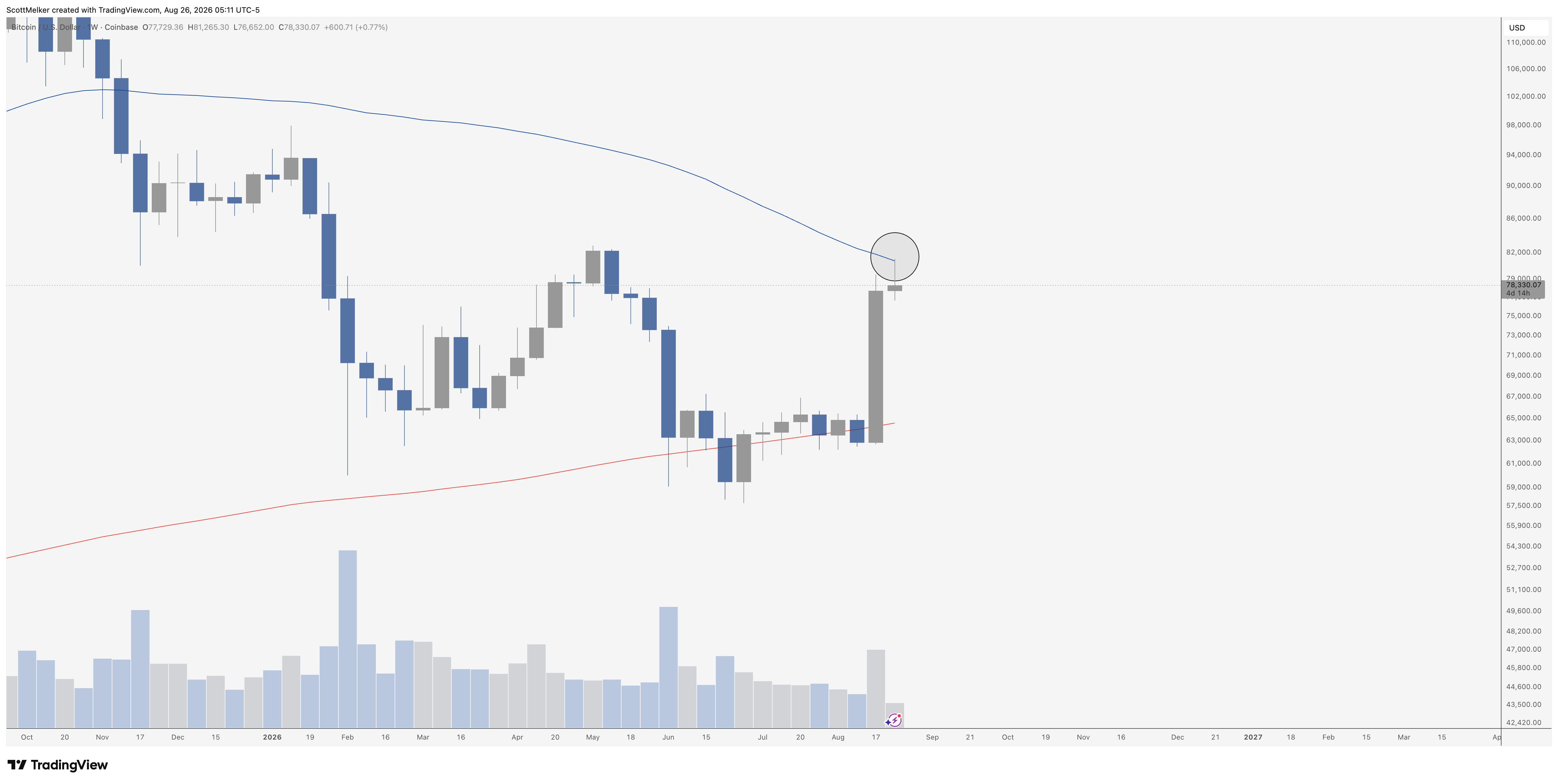
There are moving averages, and then there are moving averages that actually matter.
Bitcoin has now run directly into one of the latter: the weekly 50 MA.
You can see on the chart just how important this level has been during the current bear market. Bitcoin lost the weekly 50 as the decline accelerated and has spent essentially the entire bear market beneath it. After finding support around the much longer-term moving averages below, Bitcoin has now rallied almost $20,000 in a matter of days and tapped the weekly 50 from underneath. So far, it has been rejected almost perfectly.
History is what makes this test particularly interesting. The weekly 50 MA has repeatedly acted as something of a regime filter for Bitcoin. Following the major bear markets of 2014-15 and 2018, reclaiming the weekly 50 was part of the transition from a bottoming market into a new bullish phase. The same thing happened following the FTX collapse: Bitcoin eventually reclaimed the weekly 50 in early 2023, held above it and went on to begin the advance that ultimately carried price to new all-time highs.
These were not perfect signals. The 2019 recovery, for example, was eventually interrupted by the COVID crash. More importantly, simply poking above the line was never the point. The signal came from reclaiming it, holding above it and eventually turning the moving average from resistance back into support.
That’s what makes the current test so important.
Bitcoin has already held major long-term support near the lows, developed bullish momentum divergences, reclaimed the daily 200 MA and broken out of a months-long bottoming structure. The weekly 50 is another major hurdle in that progression. A weekly close above it, followed by acceptance above the line, would add another piece of historical evidence that what we’re witnessing is more than a violent bear-market rally.
For now, though, resistance is resistance. The first test has produced a rejection, and after the move we have just experienced, some consolidation or a deeper reset would be completely normal. In fact, I would welcome it.
The bull case does not require Bitcoin to blast straight through every major resistance level. It requires former ceilings to eventually become floors.
Historically, turning the weekly 50 MA from a ceiling into a floor has been one of the more important steps in that process.

39 U.S. banking groups are building their own nationwide blockchain network
Thirty-nine state banking associations representing thousands of U.S. banks have formed the BankChain Alliance, with plans to launch an industry-owned blockchain network in 2027 supporting stablecoins, tokenized deposits, smart payments and automated settlement. The group is currently selecting a technology provider and says the network will be interoperable with other blockchains.
There’s some beautiful irony here. Banks spent years arguing that crypto threatened the financial system, and now they’re collectively building their own blockchain. The debate is increasingly not whether finance moves onchain, but who owns the rails when it does.
BlackRock cuts Bitcoin ETF swap minimum to $1 million
BlackRock has reportedly lowered the minimum for large Bitcoin holders to exchange BTC directly for shares of its IBIT ETF from $5 million to $1 million, significantly expanding the group that can move from self-custodied Bitcoin into the ETF without first selling for cash.
That’s a fascinating development in the self-custody debate. ETFs originally gave traditional investors an easier way into Bitcoin exposure; increasingly, the infrastructure is also making it easier for existing Bitcoin holders to move out of self-custody and into Wall Street’s wrapper. Apparently “not your keys, not your coins” now has a $1 million conversion desk.
POSCO International completes trade-receivables tokenization pilot
South Korea’s POSCO International has completed a pilot that tokenized trade receivables from its U.S. subsidiary, working with Olea and Intain to put the transaction on blockchain infrastructure built using Avalanche technology. The companies are exploring whether the structure can eventually be used more broadly across trade finance.
This is the version of tokenization I find considerably more interesting than putting meme stocks onchain. Trade finance is enormous, slow and filled with paperwork, reconciliation and intermediaries. If blockchain actually improves those processes, nobody needs to know they’re “using crypto” at all. That’s probably what real adoption eventually looks like.

Arch Public - It’s a hedge fund in your pocket. Built for retail traders, designed to outperform Wall Street. Try emotionless algorithmic trading at Arch Public today.
Promote your brand with The Wolf of All Streets. For sponsorship and partnership opportunities, contact info@thewolfofallstreets.io.
The Wolf Pack - My Telegram group where I share daily market updates, real-time observations, and ongoing discussions with the community. There’s a dedicated channel and group chat, and it’s completely free to join.
X - I spend most of my time on X, contributing to CryptoTownHall every weekday morning, sharing random charts, and responding to as many of you as I can.
YouTube - Home of the Wolf Of All Streets Podcast and daily livestreams. Market updates, charts, and analysis!
The views and opinions expressed here are solely my own and should in no way be interpreted as financial advice. Every investment and trading move involves risk. You should conduct your own research when making a decision. I am not a financial advisor. Nothing contained in this e-mail constitutes or shall be construed as an offering of financial instruments or as investment advice or recommendations of an investment strategy or whether or not to "Buy," "Sell," or "Hold" an investment.
Thanks for reading The Wolf Den! Subscribe for free to receive new posts and support my work.
Comments
Nothing yet. Say the first thing.
Sign in to join the conversation.