
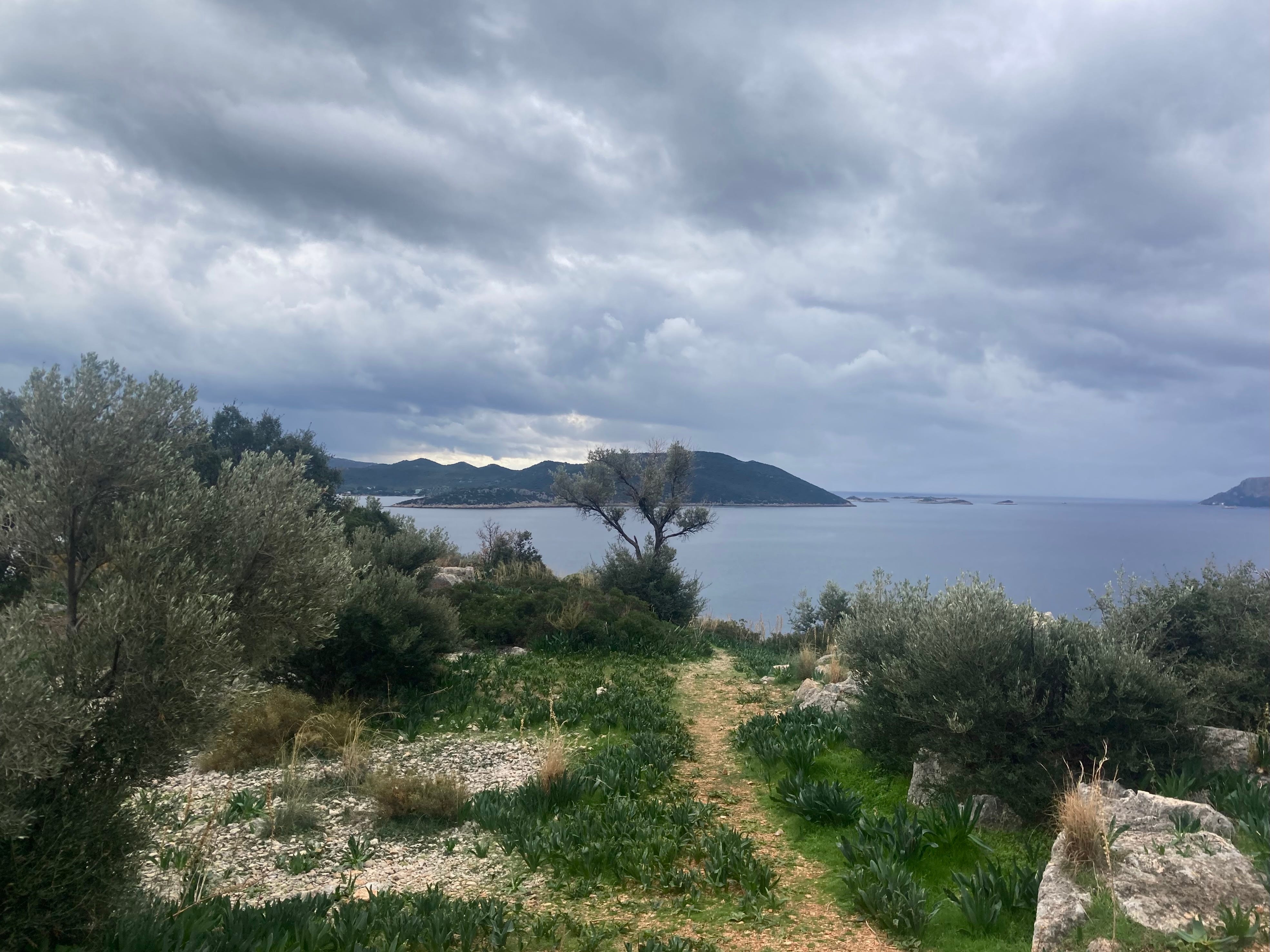
Since our births, we are filled with some unique garden of beauty and tragedy. This is not a pessimistic outlook; it is simply that our nature as humans stands perpetually misaligned from the ideal (an ideal which we as humans also created). We can envision perfection in our minds, and so we live as if it exists somewhere. But the issue is that perfection is only the alignment between our visions (which can stretch infinitely in all directions with boundless malleability, drawing from insights we’ve absorbed, half-remembered or invented) and the physical manifestation of those visions in daily life. It is here where we see our actions meeting the constraints of reality.
That garden inside us grows.
Our first moment of being disciplined as children gets mixed with a moment from last week, eating potato chips and watching an Instagram reel of someone dripping food dye into cold water for five minutes. It grows when we hurt, when we laugh, when we make love, when we are rejected, when we dream, when we connect. It changes every moment.
And you know, no one knows this garden better than we do, because no one else can feel it from the inside like we do. They can observe it, but they don’t know how it feels when our roots expand in our soil, when our peonies die, when dandelions take over, when the rose bush is prolific and fragrant.
And yet many people want to wander in our gardens, to plant their seeds there, to trim our hedges, to give their opinion on how we prune our maples, to toss something in and walk away. Some want to just see and remark, “oh how I adore your lilacs, your weeping willows and aspens.” We cannot prevent this. By merely being alive, we are engaged in energetic exchange constantly. When we sit down with one another, we are taking a walk together hand-in-hand in our combined gardens.
So it led me to reflect more frequently on the idea: what are we giving to the gardens of others, what are we exchanging with them, what are we receiving from them into our gardens?
If we wall ourselves off from pain and our mistakes, what we can discover are others who are doing the same. We can laugh and have fun until someone reveals they have lost a family member, or struggle with addiction, or anything, and then we are naked without any knowledge of how to meet them. Do we run? Ignore? Shut down? Who do we turn into in the hardest moments that test our inner foundations? If we swim in darkness, assume it is a part of us, we discover the other swimmers, some of whom are willing to drown us to desperately get a break from their own exhaustion.
The garden becomes a chaotic, tangled thicket. Who we are becomes lost in the enmeshment with gardens that have no gates. Who we are becomes blocked in a garden with cages on every plant, gates at every turn. Where is the balance?
But what protects our inner spaces is not only a fine blend of boundaries and vulnerability, but it is also this: knowing that each relationship, each energetic exchange, is 100% unique. There are patterns in us, yes. There are deep longings, old rhythms. I recognize mine constantly in my relationships, friendships, imagination, in my art. I know my core struggles. I must wrestle with them daily. And there are many that are still hidden from me. But I know they are always changing, because I do not exist in isolation. Even if I retreated to a cabin in the woods forever, I would still be swimming inside thirty-one years of exchange. I would simply cut off the inflow and be left with what remains. How can I serve those I love, those I care for and believe in, if I do not have the experience of what it takes to navigate with compassion the daily storms of life?
Some people long for the ideal of perfection, of preventing exchange, or the fear that their own garden will weigh negatively on others, and so, we close ourselves off from showing who we are, or try to work on ourselves until we are in our deathbeds and somehow never “finished the work.” What was the work? What are the results of it? Do we have a lifetime of relationships based on love, honesty, generosity and connection? Are we alone with only our family surrounding us, none of whom can fathom much good to say other than, “at least they can finally give their anxiety a rest”? Is it a mix? Do we regret not doing the thing we said we would, or take the lesson, apologize and go forth into the horizon?
And if we strive for an ideal, when do we reach it? When do we arrive to the summit?
Our moment to live is right now. Not yesterday or tomorrow. If this building I am sitting in as I write this suddenly collapsed, would I feel ready? If your last breath was in five seconds, would you? Why or why not?
If we are constantly changing, then our garden is always changing, our patterns, dreams, desires are all changing. So each connection then becomes a teacher, each dark moment becomes a teacher, each reaction becomes a teacher — not to be some symbol of perfection, not to release ourselves from a cycle of suffering (that I believe is inescapable, but can be manageable), but to give us insight and perspective to grow into whoever we wish to be.
Who do you want to be?
A deep ideal inside me is this: I want to share my authentic self with the world. I don’t want to hide behind a persona of sweetness or gentleness or style/inaccessibility or whatever. I want the version of me people meet in daily life to be the same one they’d encounter in the depths of my inner realms. Maybe I’m close to that, maybe I’m still pretty far. But I don’t need or expect people to understand me. Of course, it feels good when they do — when we align in our deepest thoughts — but it also reminds me of a question a friend once asked me:
If there were multiple versions of you, what would you do?
Unfortunately, I don’t fully remember my answer. But what I do remember saying is something like, “oh God, no…” and then trying to soften it into something that came off as a bit kinder toward myself. But when I asked myself recently, my answer was simpler: I don’t want or need them. Perfect mirrors of me would only reinforce what I already believe, and that prevents me from seeing the beauty of all the ways we hurt, we love, we try, we question and solve, we fail, we perceive and misunderstand; the ways we care and cry alike.
When I was younger (and even now, in some chambers of me; those that arise in my most difficult moments), I believed resonance was the highest dream: to experience people and moments that vibrate at the same frequency, or as close as possible. But so much of it was because I struggled to really see myself for who I am. I wanted to felt seen by another so desperately, because I struggled to find that mirror within my spirit.
But what is it that actually comes with resonance? And what is it that gets neglected in resonance?
Imagine a relationship built entirely out of mirroring. Two people understand each other spiritually, intellectually, emotionally at a deep level. They read each other when something is off, they can create the most magnificent fantasy together that resolves the nature of the universe. But when it comes to washing dishes, planning, maintenance, picking up dog shit, accepting that their oracle can be depressed, lazy, overwhelmed, impatient, angry, then they can think, “ohh no, it’s too much for me!” They have crafted idols out of each other, mystic beings who somehow don’t ever have diarrhea, grieve, fall into debt, or get irritated at small things.
The spiritual space is magnificent for exploring depth, but it can be siren-like in its invitation to live there permanently.
Is it expectations that take us there? And what happens when we start to love, not from a place of what someone can or cannot do for us, or who they will or will not be in the future, but for who they are right now? What happens when we decide to love them for the quality of their heart, the depth in which they love, their compassion, gentleness, understanding, and encouragement for them to be the most beautiful version of whoever they can naturally be? And you know, what if I told you that this beautiful version of that person — even with all the flaws we see within ourselves — is who we are right now. Who can love you like that? Can you love yourself like that?
So it leads me to that question from earlier. Instead of who do you want to be, I ask you:
Who are you right now?
Are we spreading goodness to those closest to us? (Not just those we have distance from, but those who know us best; who are the longest, hardest-to-maintain relationships in our lives)
With these people, do we support them in following their dreams, or do we use them as containers for our waste, our projections, our anger, our visions of who we think they should be? Do we support them, love them each day, irrespective of what materially happens or not? Do we feel that love from them each day just the same? Not the fire — but the kindling coals that keep it breathing.
Do we approach others with flexibility, rigidity, or with the expectation that they must conform to our inner rules, our expectations, or inner architecture?
Do we listen and accept someone’s truth, or do we reject this and force our own? Do we try to offload our pain, darkness, longing, anxiety onto others, or do we take responsibility for what grows within us?
What is our communication like within ourselves? Are we gentle? Harsh and cutting? Forgiving? What is our voice?
How does it feel to be vulnerable with another? Do we assume another’s intentions, or can we trust them enough to stay in open dialogue?
How do we forgive? Can you forgive others for their mistakes? Can you forgive yourself for yours?
These are some samples and ideas, but ultimately these answers must come from each of us uniquely.
We can look at our past for them, but like any garden, our past is part of our present. If we take a stroll, perhaps we will be surprised to see that everything we need is right there in front of us.
And when the clouds roll in, the thunder folds us, and the rain creates sheets of gray mist, where are we? Are we running for shelter? Are we blaming the storm on our spouse, on god, the government, the gardener? Or are we laughing as we join hands with the ones we love, tuning our hearts to the music of the universe and dancing in it?
We all carry storms inside us. They water our gardens, turn the soil, bring in nutrients, wash away old sediment, and bring new shapes to our landscape; sometimes their lightning strikes our beloved trees.
But it is how we interact with those storms in ourselves and others — and how we tend our gardens after they pass — that shape who we are in each moment.
See you in the rain, friends. May you discover that magical gardener that is you.
No posts
Comments
Nothing yet. Say the first thing.
Sign in to join the conversation.