
On August 19, the Montana Fish and Wildlife Commission will meet to decide the fate of wolves in Montana. The proposal is to kill 250 wolves across the state through hunting and trapping. Additionally, up to 15 “removals” on any individual private property for threats to livestock, persons, or pets is allowed. Apparently, there is no limit as to how many of these “properties” can be included, thus no limit on wolves killed on private property.
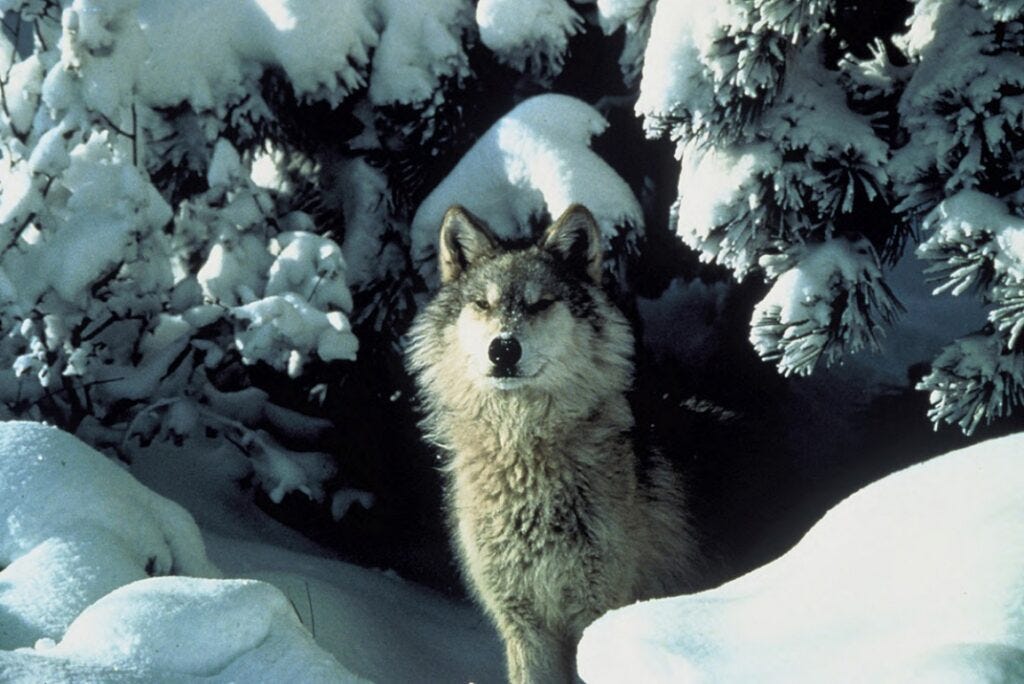
Then there is to be no limit on removals by MFWP, USDA Wildlife Services, or others “in defense of property or human safety” across all ownerships. Thus, there is seemingly no real limit to the killing of wolves under the current proposal. While the public comment period closed on August 12, there is an opportunity to register to make additional comments at the August 19 public meeting via Zoom. This is available until August 18.
We submitted detailed comments and provided a report that analyzed Montana management of wolves in comparison to other states and European countries. Montana does not rank very high as it lacks a proven method to document wolf populations and statistics and its models are highly questionable in accuracy of prediction. While MFWP is working to improve, wolves are needlessly being killed.
Montana’s wolf debate is often framed as a conflict between wolves and livestock, but the state’s management system frequently applies a landscape-wide remedy to a highly localized problem. Montana Fish, Wildlife & Parks (FWP) authorizes general hunting and trapping seasons across wolf range while also conducting targeted removals after verified livestock depredations. Those two tools are not equivalent. Hunting or trapping kills wolves largely according to where hunters and trappers have access and success; targeted control removes identified wolves or packs where a conflict occurred.
Montana’s own research provides a clear answer. A 2018 FWP-led study by DeCesare and colleagues analyzed wolf-livestock conflicts from 2005 through 2015. Targeted management reduced recurrent depredations, but public harvest did not reliably eliminate conflict from one year to the next. Even where higher harvest was associated with fewer depredations, the authors estimated the effect at 5.7 fewer depredation events statewide per year, an 8% reduction from the average annual statewide total. The spatial mismatch was equally important: the study reported that 83% of documented depredations occurred on private land, while only 41% of public wolf harvest occurred there. The authors concluded that removing relatively small numbers of wolves through either partial pack control or public harvest may do little to prevent future depredations in recurrent-conflict areas. We suggest that preventive measures are the solution for livestock producers and feel it is past time for them to do their part, focus on private lands and stop killing wolves on public lands.
The economic scale of the interests surrounding this policy is also revealing. According to the Bureau of Economic Analysis (BEA) for 2024, Montana’s hunting/shooting/trapping activity generated approximately $118.4 million in 2024, while guiding and outfitting contributed $162.5 million. Dividing these figures by Montana’s $78.4 billion 2024 GDP gives 0.15% for hunting/shooting/trapping and for 0.21% for guiding and outfitting. A separate 2026 University of Montana Institute for Tourism & Recreation Research study found that fishing generated the most outfitting revenue, followed by wildlife viewing and then hunting. Guided hunting is consequently only one component of the broader outfitting economy. These sectors are not bulwarks of Montana’s economy. The hunting and trapping of wolves is even smaller as a subset of the overall recreation or hunting/trapping/shooting sector and its absence would hardly be missed in Montana’s economy.
In a 2023 survey of Montana residents by the University of Montana in cooperation with FWP, 74% of the general population said they were tolerant or very tolerant of wolves on the landscape. The survey also found that 58% of the general population was tolerant or very tolerant of wolf hunting, down from 71% in 2012. Support for trapping was lower and declining. Wolves were delisted in Montana in 2011. The recent 16th-annual Conservation in the West poll shows high concern among voters about such rollback of environmental protection laws. On a partisan breakdown, 94% of Democrats, 87% of Independents, and 74% of Republicans in Montana have serious problems with the rollback of environmental protections.
Hunting and outfitting have a disproportionate role in decisions about wildlife management under the North American model where selling licenses to hunt and fish provides revenue to Game and Fish departments, thus a conflict exists where the general public’s preferences for wildlife and habitat protection are subordinate to the desires of the department and those who fund the department.
A simple google inquiry reveals some interesting economic information. Yellowstone National Park is a magnet for wildlife watchers, those who come to see wolves and bears. Montana gateway communities such as Gallatin County average a bit less than $1 billion in nonresident spending. Another gateway, Flathead County at Glacier National Park is at about the same level. In the 2025 – 2026 license year, revenue from licenses for wolf hunting and trapping was a bit over $300,000. This for killing 247 wolves. Amazing the incompetence and lack of vision of the state. A state with over 28 million acres of National Forest, BLM lands, National Parks and Wildlife Refuges can’t tolerate having wolves in sufficient numbers to play their role in natural ecosystems.
The other factor in killing wolves is the livestock industry whose political influence in western states is clear, while their economic value is minimal compared to overall agriculture. Public lands ranching is insignificant, while costing taxpayers to subsidize it.
BEA reports that Montana’s real GDP from farms—crop and animal production combined—was $1.43 billion in 2024. Comparing this to the GDP for the same year gives approximately 1.8%. (think of the revenue in Gallatin and Flathead Counties for their proximity to National Parks) Because the farm series includes both crop and animal production, livestock alone necessarily accounts for less than the full farm-sector percentage. Any claim that wolf policy protects a large fraction of Montana’s entire economy therefore overstates the direct economic exposure, even though wolf losses can be important to individual livestock producers.
The disparity is greater for federal public-land grazing. Economist Thomas Michael Power, whose analysis was summarized in a published article in Arkansas National Agricultural Law Center 1998) concluded that western ranching’s political visibility exceeded its measurable role in modern state economies. At the time, for Montana, the published summary reported 1,085 jobs associated with federal grazing, equal to 0.25% of statewide employment, and 0.14% of statewide income. While these are historical data, the implication remains valid. It’s minuscule.
A more recent American Farm Bureau Federation analysis estimates the value of livestock sales attributable to forage consumed on public lands. It reports that Montana is among the western states with more than $100 million annually in livestock sales attributable to public-land forage. Using $100 million only as an order-of-magnitude comparison against Montana’s $78.4 billion 2024 GDP produces approximately 0.13%. This doesn’t account for the huge subsidies ranchers receive from the public’s taxes.
These numbers do not make hunting, outfitting, or ranching unimportant; they show that political influence is not necessarily proportional to GDP. These are organized constituencies that repeatedly participate in legislative, commission, and agency processes. By contrast, the 74% of surveyed general-population respondents who expressed tolerance or high tolerance for wolves represent a much more diffuse but much larger public interest.
A defensible wolf policy should therefore separate livestock protection from generalized predator reduction. Where wolves repeatedly depredate livestock, FWP should verify the conflict, require reasonable preventive measures, and then use targeted removal when necessary. Where no conflict exists, killing wolves should not be justified as livestock protection without evidence that the action is likely to significantly reduce depredation. Montana’s own research shows why: conflict is geographically concentrated, while public harvest is not. Broad killing may reduce wolf numbers, but reduction in numbers is not the same thing as reduction in conflict.
The management standard should be simple: use the least generalized lethal tool capable of accomplishing a defined biological or conflict-management objective. That would preserve authority for decisive action against demonstrably problem wolves while reducing unnecessary killing of stable packs elsewhere. It would also align policy more closely with what Montana’s science, economy, and public opinion actually show—a state in which wolves are broadly accepted, livestock conflicts are real but localized, and the industries most vocal in wolf policy represent far smaller shares of the overall economy than their political visibility implies.
Wolves selectively prey on vulnerable animals and may, under certain conditions, reduce or delay modeled chronic wasting disease outbreaks. Wolves and other carnivores nevertheless influence elk abundance, distribution, aggregation, carrion availability, and scavenger communities, all of which can affect disease transmission. Montana research also indicates that diverse scavenger communities can shorten the persistence of potentially infectious reproductive material. These ecological functions should be considered alongside livestock conflicts and harvest objectives rather than treated as separate issues.
We at Yellowstone to Uintas Connection value predators and scavengers for their role in the ecosystem and their own being. We oppose killing of predators in general and particularly on public lands where ecosystems should function naturally, and livestock producers should live with the consequences of placing their livestock on our public lands and national forests.
No posts
Comments
Nothing yet. Say the first thing.
Sign in to join the conversation.